Posts written by Thomas Lumley (2645)

avatar

Thomas Lumley (@tslumley) is Professor of Biostatistics at the University of Auckland. His research interests include semiparametric models, survey sampling, statistical computing, foundations of statistics, and whatever methodological problems his medical collaborators come up with. He also blogs at Biased and Inefficient

October 3, 2014

Antibiotics, kids, and obesity

Earlier this week, the Herald had a story about antibiotics and childhood obesity. No-one involved really covers themselves in glory here, but probably the reporter comes out best.

The headline (Antibiotics ‘link to child obesity’) with appropriate claim quotes, and the lead

Children who are given antibiotics in the first two years of their lives are at greater risk of becoming obese in early childhood, a study suggests.

are fine, though there’s a sub-headline “Study finds some treatments kill bacteria that affect rate at which toddlers gain fat” that manages to be wrong in every respect.

The story goes on

The United States research is based on the medical records of 65,000 children between 2001-2013.

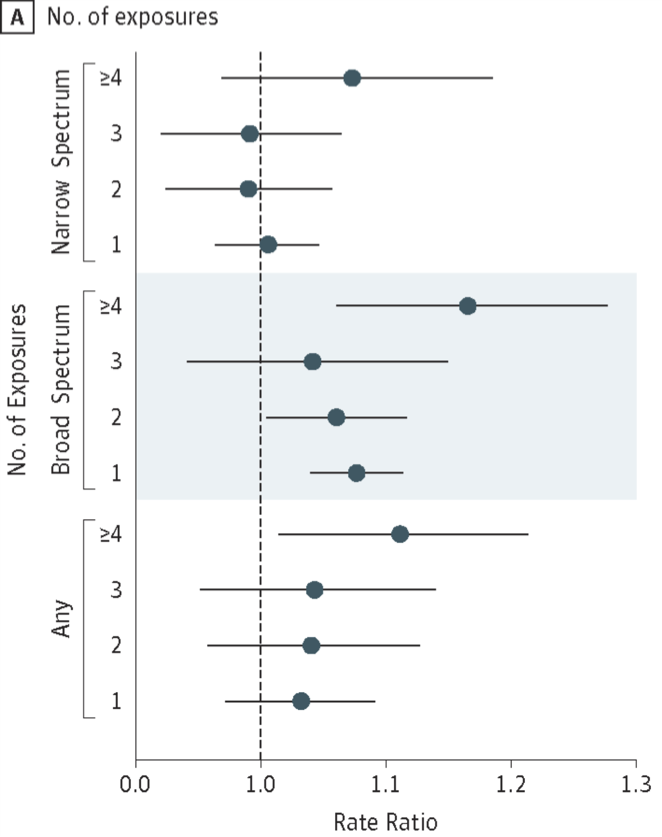
Researchers found infants who were given broad-spectrum antibiotics at least four times in their first two years were 16 per cent more likely to be obese by the age of 5.

That is in the research paper, but it’s much less impressive in context
antibiotic

The circles are the observed ratios of rates of obesity, the lines give the margin of error. You can see that, compared to no exposure, one exposure seems bad, two or three not so bad, and four or more worse.  They’ve looked at a lot of comparisons that don’t show a clear pattern, and picked out the biggest number.

There are other quibbles, for example, ‘broad spectrum’ doesn’t mean what it usually means, it means ‘everything except penicillin and amoxicillin’, but the biggest problem is confounding.  There are lots of things related to obesity and to antibiotic prescription, and it wouldn’t be at all surprising for one of them to explain this relationship.

More importantly, there’s no way this explains any meaningful fraction of the increase in childhood obesity.  Only about 3% of children were in the ‘4+ broad spectrum exposures’, so even if the ratio of 1.16 was true, the antibiotics would only be responsible for about half a percentage point of the obesity rate.  Even less of the the obesity increase would be explained, since antibiotics aren’t actually completely new.  Differences between countries also don’t seem to fit this as an explanation. For example, South Korea used to have a serious antibiotic overuse problem, which was reduced by new regulations in 2000. They don’t have much of a childhood obesity problem.

Still, there’s no reason the result couldn’t be true to some extent.  Antibiotics do affect gut bacteria, and gut bacteria are important in metabolising food. It might be true, but it’s definitely being oversold, and there are more urgent reasons not to over-use broad spectrum antibiotics.

The other part of the story that’s disappointing for the light it casts on science communication is some of the response

Some New Zealand experts are sceptical. Fight the Obesity Epidemic founder Dr Robyn Toomath noted that the latest study was funded by the American Beverage Foundation for a Healthy America, founded by the soft-drink industry.

“This is the industry buying crap science,” she said. “People who are poor get sick and get more antibiotics. They are more likely to be fat and a lot of other things as well.”

I’m in favour of scientists commenting on public issues, and I don’t see anything wrong with advocacy, but I think public allegations of intellectual dishonesty need a bit more detailed backup than this. You’d almost get the impression that the research hadn’t looked at number of doctors visits or any indicators of poverty.
October 1, 2014

Climate change and flooding

flooding

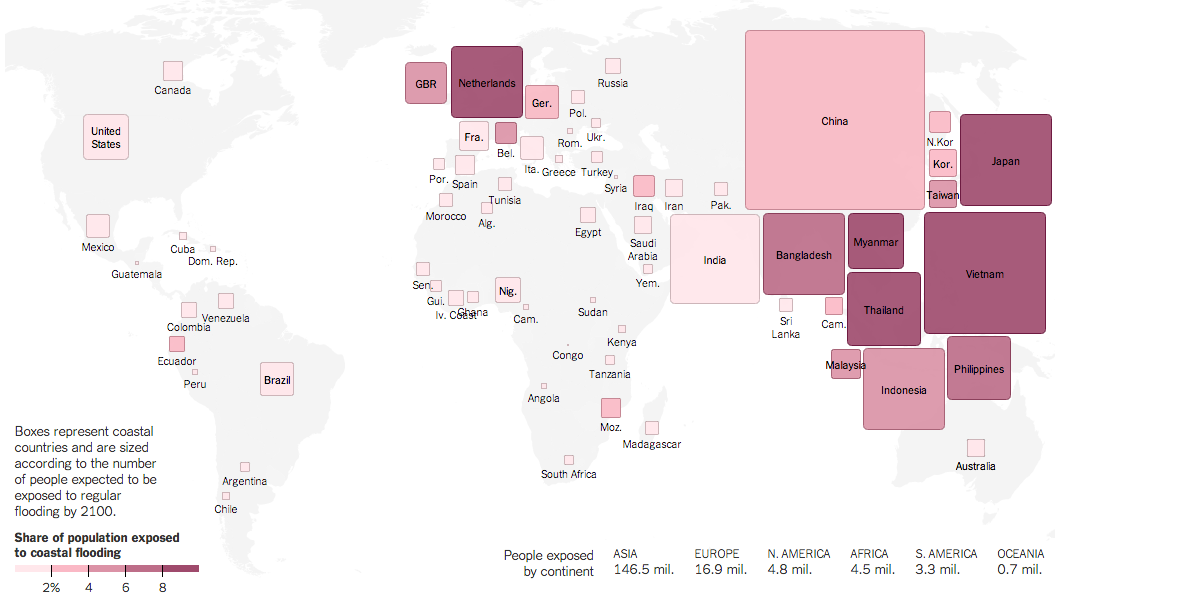
The Upshot blog at the New York Times had this interactive map of the flooding risk from climate change. It lets you see the number affected in each country, and also lets you vary the estimates for how much CO2 will be emitted and how sensitive ocean levels are to CO2.

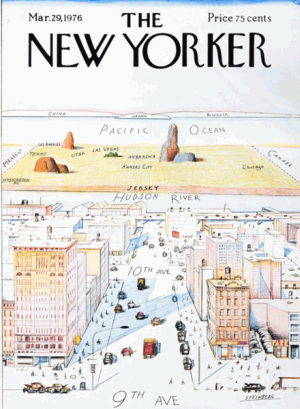
It’s missing something, though: not just New Zealand, but all the Pacific Island countries. We often get maps cut off at about 167 E longitude, and we can just whinge quietly about the New York view of the world

Steinberg_New_Yorker_Cover

but in  this context, where some of these islands will cease to exist if sea levels rise as predicted, leaving them out seems more inappropriate than usual.

September 29, 2014

Stealth advertising survey

Stuff has a story that at first glance seems to be about baldness:

There are more men suffering hair loss in Auckland than anywhere in the country, with 42 per cent of those who live in the Super City thinning or completely bald.

In contrast, the hairiest region is Canterbury, where men are more rugged and sport glowing locks. Just 27 per cent of Canterbury men admit to suffering any hair loss.

We aren’t told the sample size or margin of error — if the survey was of 1000 people, you’d expect to get that sort of variation between the highest and lowest regions by chance.

I haven’t been able to find any more detailed results anywhere, but the important part of the story is actually in the next sentence

The headlining Colmar Brunton poll, commissioned by SRS Hair Clinic and released this week, surveyed men aged between 25 and 50.

That is, the point of this survey is to advertise a hair clinic (which sells a hair tonic that claims 100% Natural Ingredients and Zero Side Effects)


September 26, 2014

Small multiples and graphical details

A really great long-form post on graphics and design by Lena Groeger at the ProPublica Nerd Blog

Waldo, and the eternal search for him, can actually tell us quite a lot about design. In many ways, Waldo is a great example of what NOT to do when using wee things in your own work. So with Waldo as our anti-hero, let’s take a look at how people read and interpret small visual forms, why tiny details can be hugely useful, and what principles we can apply to make all these little images and moments work for us as designers.


Screening is harder than that

From the Herald

Calcium in the blood could provide an early warning of certain cancers, especially in men, research has shown.

Even slightly raised blood levels of calcium in men was associated with an increased risk of cancer diagnosis within one year.

The discovery, reported in the British Journal of Cancer, raises the prospect of a simple blood test to aid the early detection of cancer in high risk patients.

In fact, from the abstract of the research paper, 3% of people had high blood levels of calcium, and among those,  11.5% of the men developed cancer within a year. That’s really not strong enough prediction to be useful for early detection of cancer. For every thousand men tested you would find three cancer cases, and 27 false positives. What the research paper actually says under “Implications for clinical practice” is

“This study should help GPs investigate hypercalcaemia appropriately.”

That is, if a GP happens to measure blood calcium for some reason and notices that it’s abnormally high, cancer is one explanation worth checking out.

The overstatement is from a Bristol University press release, with the lead

High levels of calcium in blood, a condition known as hypercalcaemia, can be used by GPs as an early indication of certain types of cancer, according to a study by researchers from the universities of Bristol and Exeter.

and later on an explanation of why they are pushing this angle

The research is part of the Discovery Programme which aims to transform the diagnosis of cancer and prevent hundreds of unnecessary deaths each year. In partnership with NHS trusts and six Universities, a group of the UK’s leading researchers into primary care cancer diagnostics are working together in a five year programme.

While the story isn’t the Herald’s fault, using a photo of a man drinking a glass of milk is. The story isn’t about dietary calcium being bad, it’s about changes in the internal regulation of calcium levels in the blood, a completely different issue. Milk has nothing to do with it.

Paracetamol and ADHD reporting

Everyone has a story about the new Auckland findings of correlation between paracetamol use in pregnancy and ADHD in kids.

Almost uniformly they don’t make it easy to the find actual (open-access) research paper, not even naming the journal: NZ Doctor’s reprint of the press release does best, with

“The study was published [date] in Plos One online at this link;” [sic]

without a link or a date. The paper is here.

The other thing the stories don’t really make clear is that this finding is important only because it confirms the surprising finding from a big Danish study published earlier this year. The evidence from the New Zealand research wouldn’t be at all convincing on its own, but the replication of an association with paracetamol but not other commonly-used medications is potentially important.   Even the Science Media Centre didn’t really make this clear in their post, though the University of Auckland website does better.

It’s still quite possible that chance or confounding explains this association, and we don’t know if other groups tried to replicate the association and failed, but the replication is a significant step.

PhD gender gap

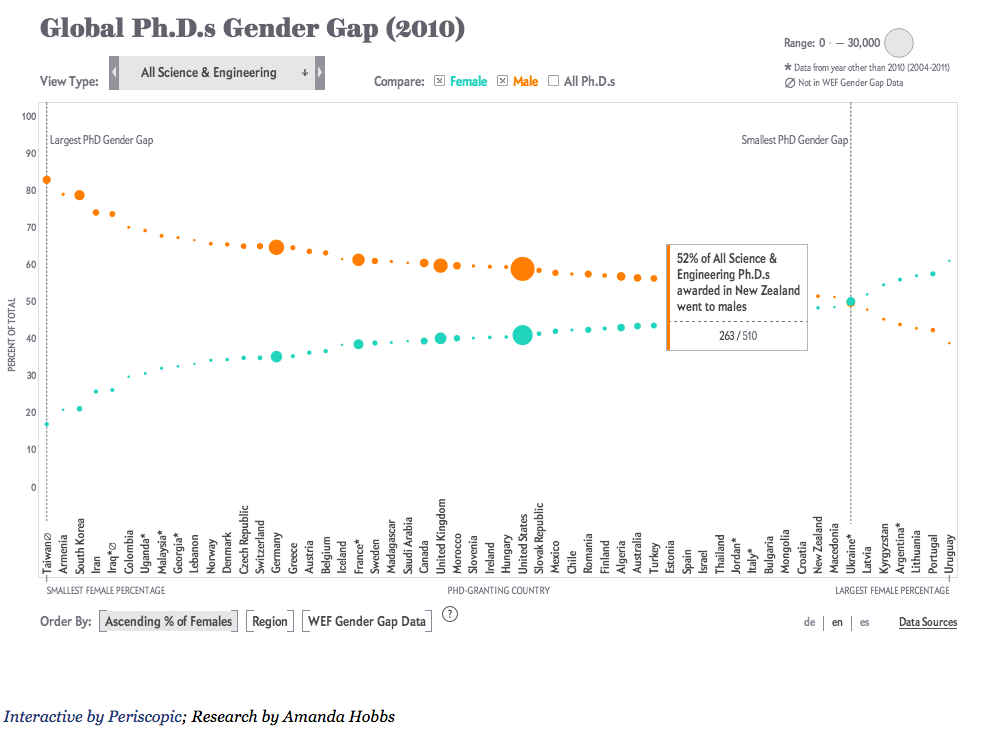
From Scientific American and Periscopic, an interactive display of international gender differences in PhDs awarded in various fields.

phd-gap

September 25, 2014

Asthma and job security

The Herald’s story is basically fine

People concerned that they may lose their jobs are more likely to develop asthma than those in secure employment, a new study suggests.

Those who had “high job insecurity” had a 60 per cent increased risk of developing asthma when compared to those who reported no or low fears about their employment, they found.

though it would be nice to have the absolute risks (1.3% vs 2.1% over two years) , and the story is really short on identifying information about the researchers, only giving the countries they work in (the paper is here).

The main reason to mention it is to link to the NHS “Behind the Headlines” site, which writes about stories like this one in the British Media (the Independent, in this case).

Also, the journal should be complimented for having the press release linked from the same web page as the abstract and research paper. It would be even better, as Ben Goldacre has suggested, to have authors listed for the press release, but this is at least a step in the direction of accountability.

September 24, 2014

That’s just a guess

oranges

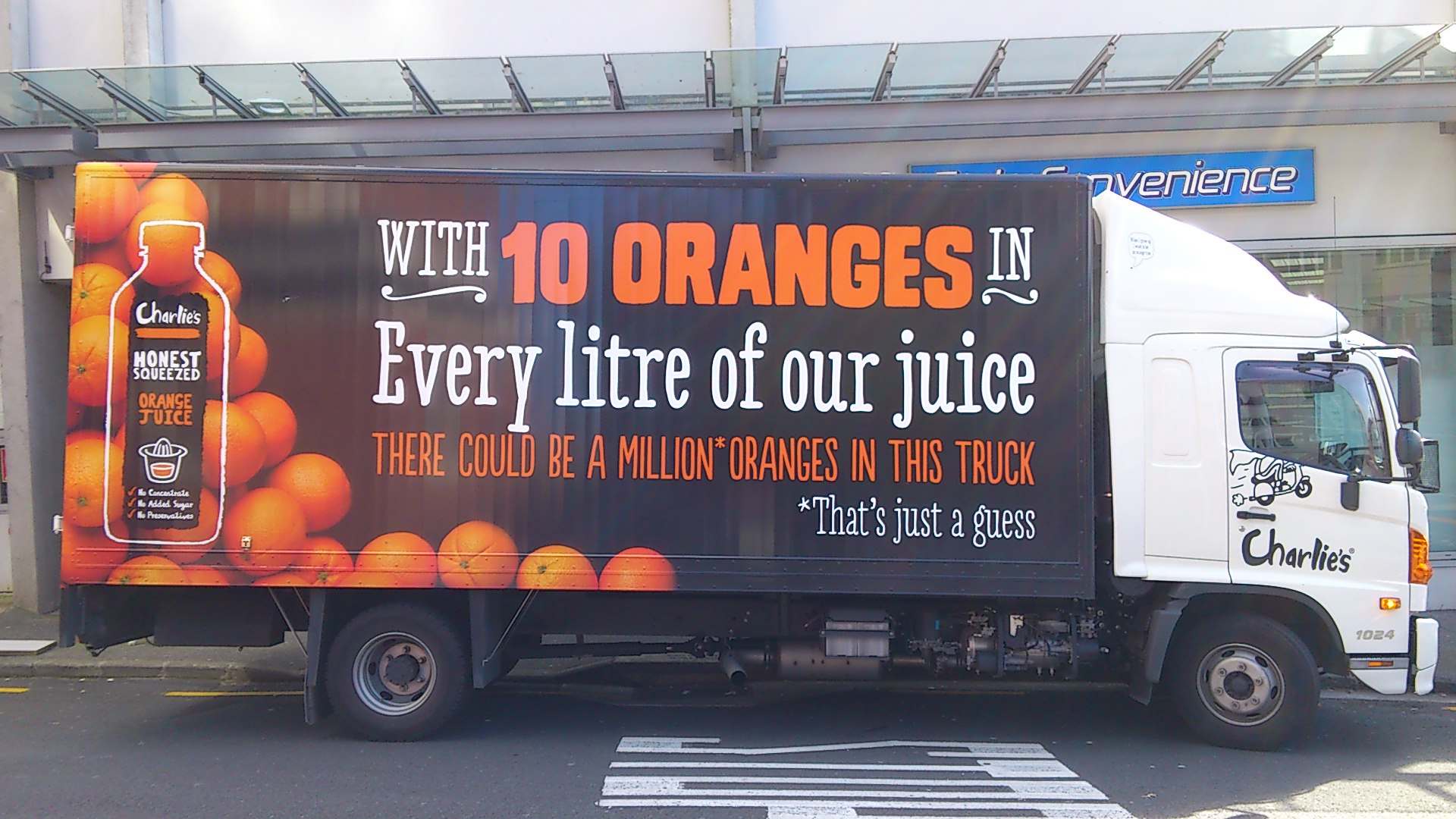
While it’s nowhere near as annoying as Phoenix Organics “Don’t drink science“, Charlie’s could do better than ‘just a guess’ as to whether there are a million oranges in this truck

If there are ten oranges in a litre of juice, there are ten thousand in a cubic metre of juice, so a million oranges would make 100 cubic metres of juice. The little juice bottles probably don’t pack that efficiently, so you’d need more than 100 cubic metres of truck.

So, how big is a truck?  A standard twenty-foot container is 6.1m long, 2.44m wide, and 2.59m high, with a volume of 38.5 cubic metres.  That truck doesn’t look three times as big as a twenty-foot container to me.

There could be a hundred thousand oranges in that truck. I don’t think a million is feasible.

September 22, 2014

Blame it all on mum

Says the Herald (reprinting the Daily Mail)

If you have always found doing sums a struggle, you might just be able to blame your mother.

Because research has linked a woman’s hormone levels in pregnancy with her child’s maths skills at age five.

Boys and girls whose mothers were very low in the hormone thyroxine were almost twice as likely to do badly in arithmetic tests, it found.

The hormone in question is thyroxine, produced by the thyroid, and the basic issue is that iodine deficiency is getting more common again. In Australia and New Zealand, iodine has been added to bread since September 2009 to address this problem. In Australia, the fortification of bread has been fairly successful; there doesn’t seem to be data for New Zealand, but there’s no reason to expect it to be different. So the story  may not be applicable to New Zealanders.

Also, as with the cannabis paper a couple of weeks ago, the “twice as likely” is simply wrong.  Doing badly in arithmetic was defined as being in the bottom 50%, and it’s not plausible that low-thyroxine kids are twice as likely to be in the bottom half.  In fact, it’s the odds ratio for being in the lower 50% of students in maths that was 1.79.  Since the overall odds of being in the bottom half is 1:1, if you multiply by 1.79 you get 1.79:1, which is a probability of 64% of being in the bottom half.

A difference between 50% and 64% is not “almost twice as likely”, and “blame” is a completely inappropriate term — this is new research, so even if it’s true (it could be) and relevant to New Zealand (it probably isn’t) it would not be something for which ‘blame’ would be appropriate. There’s entirely too much blaming mothers already.