Posts written by Thomas Lumley (2645)

avatar

Thomas Lumley (@tslumley) is Professor of Biostatistics at the University of Auckland. His research interests include semiparametric models, survey sampling, statistical computing, foundations of statistics, and whatever methodological problems his medical collaborators come up with. He also blogs at Biased and Inefficient

November 9, 2015

NZ Herald promotes data

Today (assuming nothing went wrong overnight) the Herald is giving data journalism a much higher profile: Insights

Harkanwal Singh and Caleb Tutty have been working frantically to assemble and format the past data visualisations and do new stuff for the launch. You should check it out: the way to convince the Herald management that good local data journalism is more valuable than bogus UK health stories is for it to get pageviews.

November 6, 2015

Failure to read small print

smallprint

This story/ad/column hybrid thing on the Herald site is making a good point, that people don’t read the detailed terms and conditions of things. Of course, reading the terms and conditions of things before you agree is often infeasible — I have read the Auckland Transport HOP card T&Cs, but I don’t reread them to make sure they haven’t changed every time I agree to them by getting on a bus, and it’s not as if I have much choice, anyway.  When the small print is about large sums of money, reading it is probably more important.

The StatsChat-relevant aspect, though is the figure of $1000 per year for failing to read financial small print, which seemed strange. The quote:

Money Advice Service, a government-backed financial help centre in the UK, claims failure to read the small print is costing consumers an average of £428 (NZ$978) a year. It surveyed 2,000 consumers and found that only 84 per cent bothered to read the terms and conditions and, of those that did, only 17 per cent understood what they had read.

Here’s the press release (PDF) from Money Advice Service.  It surveyed 3000 people, and found that 84 per cent claimed they didn’t read the terms and conditions.

The survey asked people how much they believed misunderstanding financial terms in the last year had cost them. The average cost was £427.90.

So the figure is a bit fuzzier: it’s the average of what people reported believing they lost, which actually makes it more surprising. If you actually believed you, personally, were losing nearly a thousand dollars a year from not reading terms and conditions, wouldn’t you do something about it?

More importantly, it’s not failure to read the small print, it’s failure to understand it. The story claims only 17% of those who claimed to read the T&Cs thought they understood them — though I couldn’t find this number in the press release or on the Money Advice site, it is in the Mirror and, unsourced, in the Guardian.  The survey claims about a third misunderstood what ‘interest’  meant and of the 15% who had taken out a payday loan, more than half couldn’t explain what a ‘loan’ was, and one in five didn’t realise loans needed to be paid back.

As further evidence that either the survey is unreliable or that it isn’t a simple failure to read that’s the problem, there was very little variation between regions of the UK in how many people said they read the small print, but huge variation (£128-£1014in how much they said it cost them.

I’m not convinced we can trust this survey, but it’s not news that some people make unfortunate financial choices.  What would be useful is some idea of how often it’s really careless failure to read, how often it’s lack of basic education, how often it’s gotchas in the small print, and how often it’s taking out a loan you know is bad because the alternatives are worse.

November 5, 2015

New source for medical/science news

STAT (statnews.com) is not, sadly, a statistics news site. On the upside, it’s a very promising site covering medicine and medical science.  It’s owned by the same person as the Boston Globe, but is a separate venture.

Their front page has a lot of news items already; for a look at the sort of more detailed story they can handle, there’s one on whether antioxidants have positive or negative effects on cancer. That’s by Sharon Begley, a highly-regarded and award-winning science writer.

STAT has recruited, either as staff or columnists, a lot of impressive people. It’s definitely worth looking at.


November 3, 2015

Briefly

  • Cancer cure hype: In a five-day period in June, 36 cancer drugs were described in the news as “breakthrough”, “game-changer”, “miracle” or similar words. Five of them had not yet been tested in humans.
  • Similarly , from Vox, on a 2003 study: “They looked at 101 studies published in top scientific journals between 1979 and 1983 that claimed a new therapy or medical technology was very promising. Only five, they found out, made it to market within a decade.” Most promising treatments don’t work: that’s not cynicism, it’s empirical fact. Of course, it’s only with new pharmaceuticals that we find out they don’t work.
  • An XKCD comic on Bill Gates’ blog, talking about the importance of being boring and non-innovative to finally finish off polio
  • London has a smaller proportion of residents born overseas (37%) than Auckland (39%). So does New York (37%). No real conclusion, just that it’s interesting. (via Hayden Glass)
  • “Cartography — what maps reveal about ourselves” from the BBC
  • Typically beautiful use of interactive graphics and maps in a New York Times story about ice melting in Greenland.

Dogs and asthma

One News saysThe family dog or growing up on a farm could be the keys to reducing the chances of a young person suffering from asthma.

This is pretty good research. It’s obviously not a randomised experiment, but it uses the population administrative and medical data of Sweden to get a reasonable estimate of associations, and it is consistent with other population studies and has a reasonable explanation in immunology. One News gave all the relevant numbers, and got Dr Collin Brooks from Massey in as an expert. So that’s all good.

But (you knew there was a ‘but’), the population impact is smaller than the news story suggests.  That has to be the case: New Zealand, with very high asthma rates by international standards, already has fairly high dog ownership rates.  In fact, as often happens, this new study has found less benefit than earlier, smaller studies.

At current NZ asthma rates, for every extra 100 little kids who live with dogs, the research would predict that you’d prevent one or two cases of asthma. And that’s without worrying about, say, reduced housing options for households with pets.


November 2, 2015

Have you ever tasted tofu?

Q: Did you see that an Asian diet helps ward off the effect of menopause?

A: An “Asian diet?” Do they mean Afghan, Punjabi, Bengali, Goan, Kirghiz, Uighur, Malaysian, Thai, Vietnamese, Lao, Korean, Beijing, Sichuan, Shanghai, …

Q: Ok, yes, I get the point.  Did you see that a diet with lots of soy, similar to Japanese and some Chinese diets, helps prevent fractures and heart attacks?

A: The story about phytoestrogens? Yes.

Q: And do they?

A: Hard to tell.

Q: Was it mice again?

A: No, this was a proper randomised trial in women. It’s just they didn’t measure fractures or even bone density.

Q: What did they measure?

A: The concentration of two proteins that are involved in bone formation

Q: How reliable is that?

A: By the standards of purely biochemical laboratory markers, not bad. An article in the newsletter of the American Association for Clinical Chemistry said “Commercially available immunoassays for all the markers are reasonably bone-specific and reflect bone turnover in postmenopausal osteoporosis and following anti-resorptive therapy.

Q: I can sense a ‘but’ coming on here

A: The story doesn’t say how big the changes were, and since this is only a forthcoming conference presentation, it’s hard to find out much detail. The abstract is here.

Q: How does it work?

A: Soy beans contain chemicals that weakly stimulate oestrogen receptors and so have some of the effects of oestrogen.

Q: Oh, like the dangerous endocrine disrupting pollutants I keep hearing about?

A: No, those are synthetic chemicals, not natural dietary components.

Q: That’s a remarkably good poker face you have

A: Can we move on?

Q: Ok, so what about the cardiovascular risk factors? The story says “They were also less at risk of heart disease, which oestrogen is also thought to protect against.” Did they measure heart disease?

A: No, they measured “cardiovascular risk markers”

Q: Does oestrogen improve these “risk markers”?

A: Yes, it does.

Q: Wait, wasn’t there a big trial of oestrogen and heart disease risk?

A: You mean the Women’s Health Initiative? Yes, there was.

Q: Did they see these improved risk markers?

A: Yes

Q: And a reduction in fractures?

A: Yes.

Q: But they didn’t see a reduction in heart disease, did they?

A: No, an increase. Over all, serious chronic disease was very slightly worse with oestrogen supplements.

Q: So why do we expect soy to be different?

A: An excellent question

November 1, 2015

Twitter polls and news feeds

aje

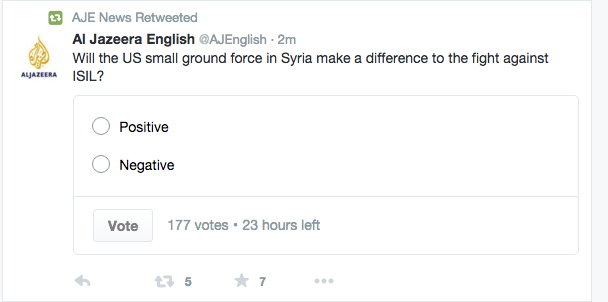
I don’t know why this feels worse that the bogus clicky polls on newspaper websites. Maybe it’s the thought of someone actually believing the sampling scheme says something useful. Maybe it’s being in Twitter, where following a news headline feed usually gets you news headlines. Maybe it’s that the polls are so bad: restricting a discussion of Middle East politics to two options with really short labels makes even the usual slogan-based dialogue look good in comparison.

In any case, I really hope this turns out to be a failed experiment, and that we can keep Twitter polls basically as jokes.


Communicating swimming pool risks

There’s a story in the Herald tending to imply that the government is planning to repeal the laws that require fences around swimming pools, and that this will cost about 70 lives over the next ten years, for a saving of $17 million in `compliance costs.’  The story doesn’t quite say this, but it’s certainly possible for intelligent people to read it that way. Some did.

On the other hand, the Treasury Regulatory Impact Statement estimates the changes will save about six lives over the next ten years. It’s possible that the Treasury is that badly wrong but if they are it would have been helpful to see details of how and why.

Everyone agrees that fencing swimming pools saves lives. I mean, not just the Government, the Treasury, and Water Safety New Zealand, but everyone, even the Freakonomics guys whose whole shtick is not agreeing with things.  The question is what the law changes  do to pool fencing.

To start with, these changes do repeal the Fencing of Swimming Pools Act 1987, but not in the sense of making the requirements go away. They’ve been relocated as amendments to the Buildings Act 2004, with details in the Building Code.

The plans are

  • inspections reduced from three years to five years, but councils will be required to perform them (some now don’t inspect at all)
  • spa pools allowed to have child-proof covers instead of fences
  • putting fencing requirements in the building code, so compliance is more likely to happen automatically
  • an infringement notice as first penalty for violating the code, rather than the theoretical ability to prosecute immediately.

Water Safety New Zealand has said in the past that they think spa-pool covers are effective; at that time they were concerned that the covers wouldn’t be inspected (as quoted by Treasury from public comments to the 2013 version of the proposal).

It looks like the main real concern is the reduction in inspections both for councils who current inspect every three years, and from the omission of spa pools.

Requiring councils to inspect spa pools would be expensive (they estimate $67 million more over ten years). Three-yearly instead of five-yearly required inspections of swimming pools is estimated to cost an extra $19 million over ten years.  Those, not $17 million for the whole package, are the relevant cost-benefit numbers, relative to how many lives you think would be saved.

I could see three-yearly inspections being worthwhile if the rate of, say, broken swimming-pool gates in otherwise compliant fencing was high enough. I’d be a bit more surprised for spa pools, but it’s not inconceivable.  The story doesn’t say anything that could help me make up my mind.

There are also areas where the government could have tightened up rules but didn’t. For example, the Regulatory Impact Statement considered the option of forcing existing pools to comply with some building code changes, but estimated the cost would be about $10 million per life saved.

You can find the various government documents here, and Water Safety NZ’s submission here.

The story is encouraging people to make public submissions on the Bill. As a general principle, this is a good idea. In New Zealand, public submissions on legislation are, at least sometimes,  taken seriously. The chances will presumably be higher if you’re relatively precise about what you think should be changed in the bill and why — it’s not an opinion poll, it’s crowd-sourced review and editing.

October 30, 2015

Pie charts “a menace”, study shows

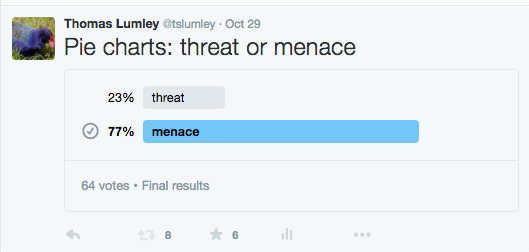
StatsChat can reveal exclusive study results showing that pie charts are a menace to over 75% of us.

Although these round, delicious, data metaphors have been maligned in the past, this is the first research of its kind, based on newly-available survey technology.

Researchers used an online, multi-wave, respondent-driven sampling scheme to reach thousands of potential respondents. 77% of responses agreed that pie charts are a menace.

threatormenace

Aren’t these new Twitter polls wonderful?

October 27, 2015

The computer is watching

When I was doing an MSc in statistics, back last century, the state of the art in image analysis was recognising handwritten numbers. There was a lot of money in number recognition, for automated sorting of letters by postal code. Australia Post made it easier by having little squares printed on the envelope, showing you where to write the numbers.

In 1997, Terry Pratchett referred to the then state of the art in one of his Discworld novels. A pocket organiser powered by a small demon could do handwriting recognition: you show it a sample, and it says “Yes, that’s handwriting”.

At the time, neural networks weren’t regarded as terribly interesting in statistics. They weren’t good models for the brain, and they were a bit disappointing as black-box classifiers, even discounting how much more black-box they were than the alternatives. The people who taught me were of the opinion that neural networks probably wouldn’t amount to all that much.

It turns out that all they needed was twenty more years development and tens of thousands of times more computing power and training data. Now, neural-network image recognition actually works. I have two posts by Andrej Karpathy to illustrate.

In the first, “What I learned from competing against a ConvNet on ImageNet,” Karpathy tries to do better than a neural network on classifying objects present in photos. He manages. Just.  The neural network was particularly good at fine-grained classifications such as breeds of dogs.

The second, “What a Deep Neural Network thinks about your #selfie” indicates some of the problems. The neural network was trained to recognise “good” selfies. Actually, it was trained to recognise selfies that got lots of likes.  If you think about what might make a photo get more or fewer likes, you could easily come up with some ideas that aren’t just about photo quality.