Posts written by Thomas Lumley (2645)

avatar

Thomas Lumley (@tslumley) is Professor of Biostatistics at the University of Auckland. His research interests include semiparametric models, survey sampling, statistical computing, foundations of statistics, and whatever methodological problems his medical collaborators come up with. He also blogs at Biased and Inefficient

July 1, 2014

Does it make sense?

From the Herald (via @BKDrinkwater on Twitter)

Wages have only gone up $34.53 annually against house prices, which are up by $38,000.

These are the findings of the Home Affordability Report quarterly survey released by Massey University this morning.

At face value, that first sentence doesn’t make any sense, and also looks untrue. Wages have gone up quite a lot more than $34.53 annually. It is, however, almost a quote from the report, which the Herald embeds in their online story

 There was no real surprise in this result because the average annual wage increase of $34.53 was not enough to offset a $38,000 increase in the national median house price and an increase in the average mortgage interest rate from 5.57% to 5.64%. 

If you look for income information online, the first thing you find is the NZ Income Survey, which reported a $38 increase in median weekly salary and wage income for those receiving any. That’s a year old and not the right measure, but it suggests the $34.53 is probably an increase in some measure of average weekly income. Directly comparing that to the increase in the cost of house would be silly.

Fortunately, the Massey report doesn’t do that. If you look at the report, on the last page it says

Housing affordability for housing in New Zealand can be assessed by comparing the average weekly earnings with the median dwelling price and the mortgage interest rate

That is, they do some calculation with weekly earnings and expected mortgage payments. It’s remarkably hard to find exactly what calculation, but if you go to their website, and go back to 2006 when the report was sponsored by AMP, there is a more specific description.

If I’ve understood it correctly, the index is annual interest payment for an 80% mortgage  on the median house price at the average interest rate, divided by the average weekly wage.  That is, it’s the number of person-weeks of average wage income it would take to pay the mortgage interest for a year.  An index of 30 in Auckland means that the mortgage interest for the first year on 80% mortgage on the median house would take 30 weeks of average wage income to pay. A household with two people earning the average Auckland wage would spend 15/52 or nearly 30% of their income on mortgage interest to buy the median Auckland house.

Two final notes: first the “There was no real surprise” claim in the report is pretty meaningless. Once you know the inputs there should never be any real surprise in a simple ratio. Second, the Herald’s second paragraph

These are the findings of the Home Affordability Report quarterly survey released by Massey University this morning.

is just not true. Those are the inputs to the report, from, respectively, Stats New Zealand and REINZ. The findings are the changes in the affordability indices.
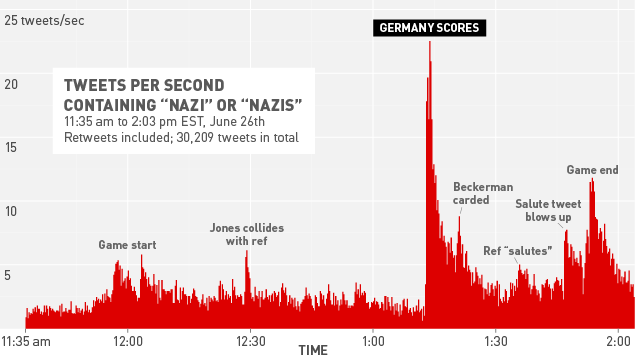
Graph of the week

From Deadspin. No further comment needed.

785528210252283206

Facebook recap

The discussion over the Facebook experiment seems to involve a lot of people being honestly surprised that other people feel differently.

One interesting correlation based on my Twitter feed is that scientists involved in human subjects research were disturbed by the research and those not involved in human subjects research were not. This suggests our indoctrination in research ethics has some impact, but doesn’t answer the question of who is right.

Some links that cover most of the issues

June 30, 2014

Briefly

June 29, 2014

Not yet news

When you read “The university did not reveal how the study was carried out” in a news story about a research article, you’d expect the story to be covering some sort of scandal. Not this time.

The Herald story  is about broccoli and asthma

They say eating up to two cups of lightly steamed broccoli a day can help clear the airways, prevent deterioration in the condition and even reduce or reverse lung damage.

Other vegetables with the same effect include kale, cabbage, brussels sprouts, cauliflower and bok choy.

Using broccoli to treat asthma may also help for people who don’t respond to traditional treatment.

‘How the study was carried out’ isn’t just a matter of detail: if they just gave people broccoli, they wouldn’t know what other vegetables had the same effect, so maybe it wasn’t broccoli but some sort of extract? Was it even experimental or just observational? And did they actually test people who don’t respond to traditional treatment? And what exactly does that mean — failing to respond is pretty rare, though failing to get good control of asthma attacks isn’t.

The Daily Mail story was actually more informative (and that’s not a sentence I like to find myself writing). They reported a claim that wasn’t in the press release

The finding due to sulforaphane naturally occurring in broccoli and other cruciferous vegetables, which may help protect against respiratory inflammation that can cause asthma.

Even then, it isn’t clear whether the research really found that sulforaphane was responsible, or whether that’s just their theory about why broccoli is effective. 

My guess is that the point of the press release is the last sentence

Ms Mazarakis will be presenting the research findings at the 2014 Undergraduate Research Conference about Food Safety in Shanghai, China.

That’s a reasonable basis for a press release, and potentially for a story if you’re in Melbourne. The rest isn’t. It’s not science until they tell you what they did.

Ask first

Via The Atlantic, there’s a new paper in PNAS (open access) that I’m sure is going to be a widely cited example by people teaching research ethics, and not in a good way:

 In an experiment with people who use Facebook, we test whether emotional contagion occurs outside of in-person interaction between individuals by reducing the amount of emotional content in the News Feed. When positive expressions were reduced, people produced fewer positive posts and more negative posts; when negative expressions were reduced, the opposite pattern occurred. These results indicate that emotions expressed by others on Facebook influence our own emotions, constituting experimental evidence for massive-scale contagion via social networks.

More than 650,000 people had their Facebook feeds meddled with in this way, and as that paragraph from the abstract makes clear, it made a difference.

The problem is consent.  There is a clear ethical principle that experiments on humans require consent, except in a few specific situations, and that the consent has to be specific and informed. It’s not that uncommon in psychological experiments for some details of the experiment to be kept hidden to avoid bias, but participants still should be given a clear idea of possible risks and benefits and a general idea of what’s going on. Even in medical research, where clinical trials are comparing two real treatments for which the best choice isn’t known, there are very few exceptions to consent (I’ve written about some of them elsewhere).

The need for consent is especially clear in cases where the research is expected to cause harm. In this example, the Facebook researchers expected in advance that their intervention would have real effects on people’s emotions; that it would do actual harm, even if the harm was (hopefully) minor and transient.

Facebook had its research reviewed by an Institutional Review Board (the US equivalent of our Ethics Committees), and the terms of service say they can use your data for research purposes, so they are probably within the law.  The psychologist who edited the study for PNAS said

“I was concerned,” Fiske told The Atlantic, “until I queried the authors and they said their local institutional review board had approved it—and apparently on the grounds that Facebook apparently manipulates people’s News Feeds all the time.”

Fiske added that she didn’t want the “the originality of the research” to be lost, but called the experiment “an open ethical question.”

To me, the only open ethical question is whether people believed their agreement to the Facebook Terms of Service allowed this sort of thing. This could be settled empirically, by a suitably-designed survey. I’m betting the answer is “No.” Or, quite likely, “Hell, no!”.

[Update: Story in the Herald]

June 26, 2014

Slightly too Open Data

  1. The Atlantic published some visualisations of taxi rides in New York
  2. Chris Whong asked for the data under Freedom-of-Information laws, and got it. Of course, the taxi and driver ids were anonymized
  3. Vijay Pandurangan noticed that the driver id and taxi id were really, really weakly anonymised.
  4. You can find out a lot once you know the taxi id.


The NY Taxi & Limousine Commission had run the ids through a cryptographic hash function, MD5. Hash functions are designed so that if you don’t know anything about the input you can’t reconstruct it from the output, but if you know the input exactly, you can verify easily that it gives the same output.  The problem comes when you know a lot about the input, but not everything.  In this case, there are only about two million possible id numbers, and you can just try them all. Once you have the ids, you can look up.

Even if the taxi authorities had done the anonymisation correctly — replacing each id with a random number — it would inevitably have been possible to extract some of the ids with a bit of work.  That’s not the same as being able to extract all of them with a few hours’ computer time.

Roundup return

The Séralini et al paper on Roundup and Roundup-resistant GM corn is back. The NZ Science Media Centre has comments.  As does Retraction Watch

June 25, 2014

Something to listen to

Two people we have linked to a lot, Felix Salmon and Cathy O’Neill, now have a podcast on money and finance, at Slate

Not even wrong

The Readers’ Digest “Most Trusted” lists are out again. Sigh.

Before we get to the actual complaint in Stat-of-the-Week recommendation, we should acknowledge that there’s no way the “most trusted” list could make sense.

Firstly, ‘trusted’ requires more detail. What is it that we’re trusting these people with? Of course, it wouldn’t help making the question more specific, since people will still answer on some vague ‘niceness’ scale anyway: we saw this problem with a Herald poll at the beginning of the year, which asked opinions about five notable people and found the only one notable for his commitment to animal safety had the lowest rating for “who would you trust to feed your cat?”. Secondly, there’s no useful way to get an accurate rating of dozens of people (or other items) in an opinion poll. People’s brains overload. Thirdly, even if you could get a rating from each respondent, the overall ranking will be sensitive to how you combine the individual ratings.

So how does Readers’ Digest do it? They say (shouting in the original)

READER’S DIGEST COMMISSIONED CATALYST CONSULTANCY & RESEARCH TO POLL A REPRESENTATIVE SAMPLE OF NEW ZEALANDERS ABOUT TRUSTED PEOPLE AND PROFESSIONS. A TOTAL OF 603 ADULTS RANKED 100 WELL-KNOWN PEOPLE AND 50 JOB TYPES ON A SCALE OF ONE TO TEN IN MARCH 2014.

That is, the list is determined in advance, and the polling just addresses the ordering on the list. There is some vague sense in which Willie Apiata is the most trusted person,  or at least the most highly-regarded person, or at least the most highly-regarded famous person, in New Zealand but there really isn’t any useful sense in which Hone Harawira is the least trusted person in New Zealand. There are many people in NZ who you’d expect to be less trusted than Mr Harawira; they didn’t get put on the list, and the survey respondents weren’t asked about them.

It’s not surprising that stories keep coming out about this list, and I suppose it’s not surprising that people try to interpret being on the bottom of the list. Perhaps more surprising, no-one has yet complained that there are actually 101 well-known people, not 100, on the list.