Posts written by Thomas Lumley (2645)

avatar

Thomas Lumley (@tslumley) is Professor of Biostatistics at the University of Auckland. His research interests include semiparametric models, survey sampling, statistical computing, foundations of statistics, and whatever methodological problems his medical collaborators come up with. He also blogs at Biased and Inefficient

September 30, 2017

Simple and ineffective

Q: Did you see there’s a new test to predict dementia?

A: Another one?

Q: Yes, the Herald says it  “would allow drugs and lifestyle changes, such as a healthy diet and more exercise, to be more effective before the devastating condition takes hold.

A: That would make more sense if there were drugs and lifestyle changes that actually worked to stop the disease process.

Q: At least it’s a simple one and accurate test. It’s just based on your sense of smell.

A: <dubious noises>

Q: But  “almost all the participants, aged 57 to 85, who were unable to name a single scent had been diagnosed with dementia. And nearly 80 per cent of those who provided just one or two correct answers also had it,

A: That’ s not what the research says

Q: It’s what the story says.

A: Yes. Yes, it is.

Q: Ok, what does the research say? It’s behind a paywall

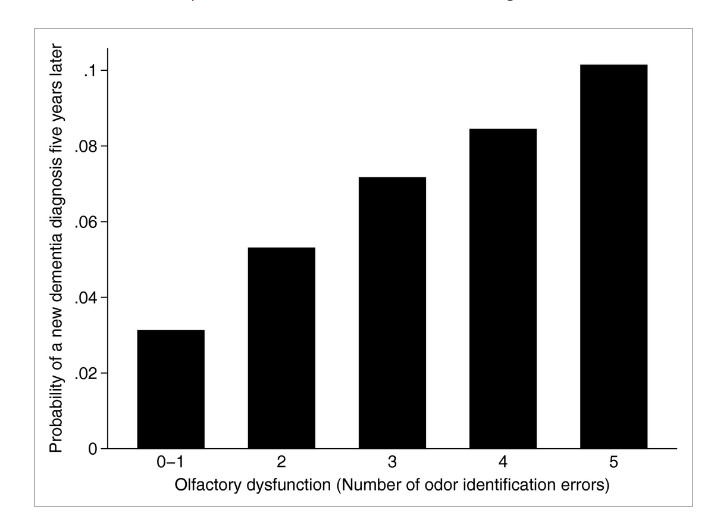
A: Here’s a graph
scents

Q: That matches the story, doesn’t it?

A: Check the axis labels.

Q: Oh. 8% and 10%? But couldn’t the labels just be wrong?

A: Rather than the Daily Mail? It’s possible, but the research paper also says “9% positive predictive value”, meaning that only 9% of those who are predicted to get dementia actually do, and that matches the graph.

Q: Um

A: And there’s a commentary in the same issue of the journal, headlined  Screening Is Not Benign and saying “No test with such a low [positive predictive value] would be taken seriously as a way to identify any disease in a population”

Q: But it’s still a big difference, isn’t it.

A: Yes, and it’s scientifically interesting that the nerves or brain cells related to smell seem to be damaged relatively early in the disease, but it’s not a predictive test.


[Update: the source for the error seems to be the University of Chicago press release.]

[Update: It’s on Stuff, too]
September 27, 2017

Stat Soc of Australia on Marriage Survey

The Statistical Society of Australia has put out a press release on the Australian Marriage Law Postal Survey.  Their concern, in summary, is that if this is supposed to be a survey rather than a vote, the Government has required a pretty crap survey and this isn’t good.

The SSA is concerned that, as a result, the correct interpretation of the Survey results will be missed or ignored by some community groups, who may interpret the resulting proportion for or against same-sex marriage as representative of the opinion of all Australians. This may subsequently, and erroneously, damage the reputation of the ABS and the statistical community as a whole, when it is realised that the Survey results can not be understood in these terms.

and

The SSA is not aware of any official statistics based purely on unadjusted respondent data alone. The ABS routinely adjusts population numbers derived from the census to allow for under and over enumeration issues via its post-enumeration survey. However, under the Government direction, there is there no scope to adjust for demographic biases or collect any information that might enable the ABS to even indicate what these biases might be.

If the aim was to understand the views of all Australians, an opinion survey would be more appropriate. High quality professionally-designed opinion surveys are routinely carried out by market research companies, the ABS, and other institutions. Surveys can be an efficient and powerful tool for canvassing a population, making use of statistical techniques to ensure that the results are proportioned according to the demographics of the population. With a proper survey design and analysis, public opinion can be reliably estimated to a specified accuracy. They can also be implemented at a fraction of the cost of the present Postal Survey. The ABS has a world-class reputation and expertise in this area.

(They’re not actually saying this is the most important deficiency of the process, just that it’s the most statistical one)

Briefly

  • “This 30-point shift could be because attitudes changed rapidly. Villasenor’s study was immediately after Charlottesville, for example, and students might be more primed to think about Nazi’s marching on their campus…It could also be because of differences in survey methods. Surveying college students is really hard.
  • From the Ottawa CitizenIn six high-profile cases documented by the Citizen, searching the name of a young offender or victim online pointed to media coverage of their court cases, even though their names do not appear anywhere in the news articles themselves.
September 24, 2017

The polls

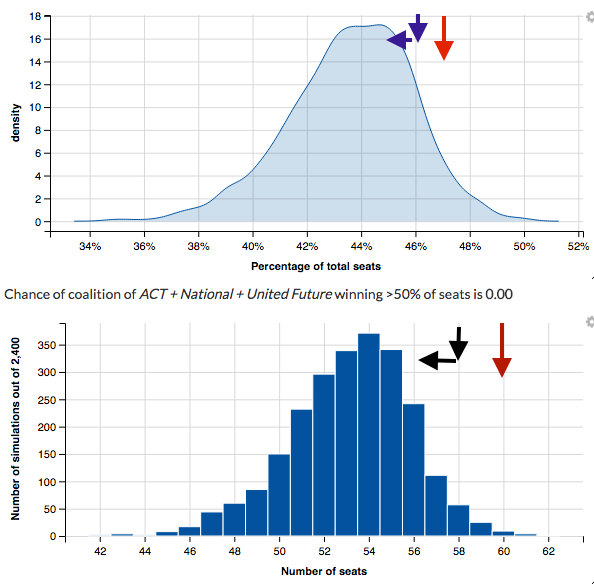
So, how did the polls do this time? First, the main result was predicted correctly: either side needs a coalition with NZ First.

In more detail, here are the results from Peter Ellis’s forecasts from the page that lets you pick coalitions.

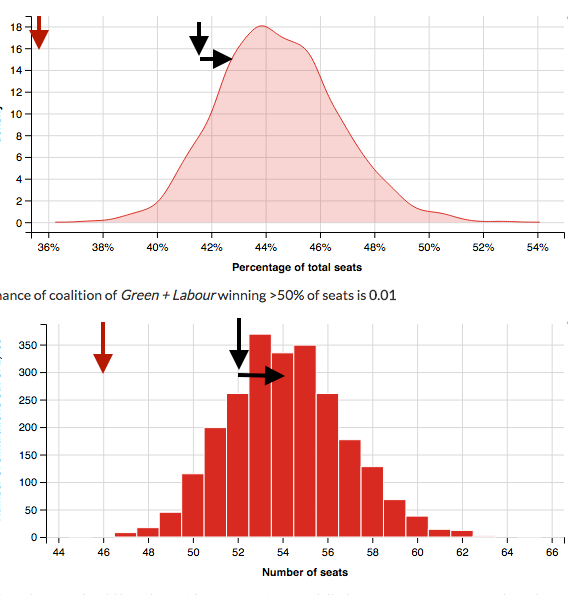
Each graph has three arrows. The red arrow shows the 2014 results. The blue/black arrow pointing down shows the current provisional count and the implied number of seats, and the horizontal arrow points to Graeme Edgeler’s estimate of what the special votes will do (not because he claims any higher knowledge, but because his estimates are on a web page and explain how he did it).

First, for National+ACT+UnitedFuture

national

Second, for Labour+Greens

labgrn

The result is well within  the uncertainty range of the predictions for Labour+Greens, and not bad for  National. This isn’t just because NZ politics is easy to predict: the previous election’s results are much further away. In particular, Labour really did gain a lot more votes than could reasonably have been expected a few months ago.


Update: Yes, there’s a lot of uncertainty. And, yes, that does  mean quoting opinion poll results to the nearest 0.1% is silly.

September 20, 2017

Democracy is coming

Unless someone says something really annoyingly wrong about polling in the next few days, I’m going to stop commenting until Saturday night.

Some final thoughts:

  • The election looks closer than NZ opinion polling is able to discriminate. Anyone who thinks they know what the result will be is wrong.
  • The most reliable prediction based on polling data is that the next government will at least need confidence and supply from NZ First. Even that isn’t certain.
  • It’s only because of opinion polling that we know the election is close. It would be really surprising if Labour didn’t do a lot better than the 25% they managed in the 2014 election — but we wouldn’t know that without the opinion polls.


Takes two to tango

Right from the start of StatsChat we’ve looked at stories about how men or women have more sexual partners. There’s another one in the Herald as a Stat of the Week nomination.

To start off, there’s the basic adding-up constraint: among exclusively heterosexual people, or restricted to opposite-sex partners, the two averages are necessarily identical over the whole population.

This survey (the original version of the story is here) doesn’t say that it just asked about opposite-sex partners, so the difference could be true.  On average, gay men have more sexual partners and lesbians have fewer sexual partners, so you’d expect a slightly higher average for all men than for all women.  Using binary classifications for trans and non-binary people will also stop the numbers matching exactly.

But there are bigger problems. First, 30% of women and 40% of men admit this is something they lie about. And while the rest claim they’ve never lied about it, well, they would, wouldn’t they?

And the survey doesn’t look all that representative.  The “Methodology” heading is almost entirely unhelpful — it’s supposed to say how you found the people, not just

We surveyed 2,180 respondents on questions relating to sexual history. 1,263 respondents identified as male with 917 respondents identifying as female. Of these respondents, 1,058 were from the United States and another 1,122 were located within Europe. Countries represented by fewer than 10 respondents and states represented by fewer than five respondents were omitted from results.

However, the sample is clearly not representative by gender or location, and the fact that they dropped some states and countries afterwards suggests they weren’t doing anything to get a representative sample.

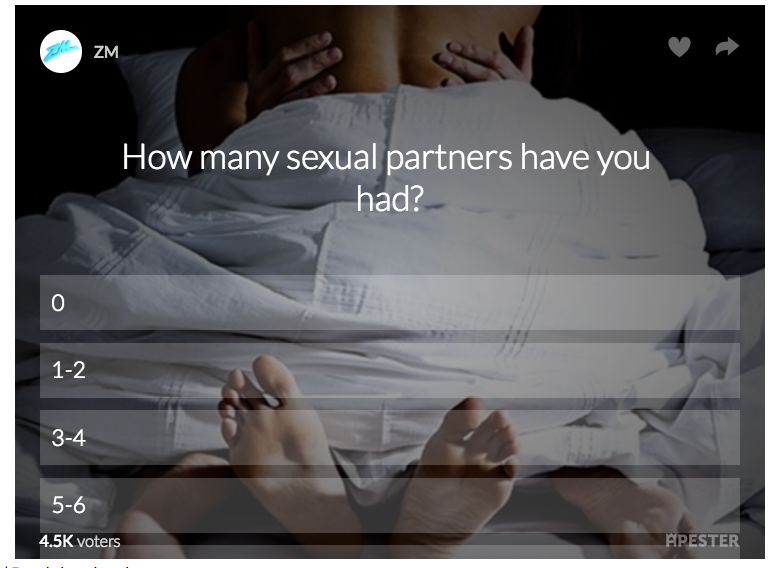
The Herald has a bogus clicky poll on the subject. Here’s what it looks like on my desktop

sex

On my phone it gets a couple more options visible, but not all of them. It’s probably less reliable than the survey in the story, but not by a whole lot.

This sort of story can be useful in making people more willing to talk about their sexual histories, but the actual numbers don’t mean a lot.

September 19, 2017

Briefly

  • During the Cold War, there were a few occasions where a nuclear war could easily have started if one person hadn’t got in the way. One of those people was Stanislav Petrov. He died this week.
  • I saw a pharmacy in Ponsonby advertising “Ultrasound bone density screening for all ages”. There’s no way screening for osteoporosis makes sense ‘for all ages’, even if it was free (which it isn’t).
  • As I’ve mentioned a few times, the UK has an independent Statistics Authority whose chair is supposed to monitor and rebuke misuses of official statistics. The chair, Sir David Norgrove, criticised Boris Johnson over the £350m “savings” from Brexit he has kept repeating. We don’t have anything similar, sadly.
  • If you’re interested in the history of data journalism, you could do worse than reading Alberto Cairo’s PhD thesis. Dr Cairo is a former data journalist, current professor of visual journalism at the University of Miami, and one of next year’s Ihaka Lecture speakers here in Auckland.
  • Janelle Shane has a blog with examples of neural networks generalising from a wide range of inputs (recipes, hamster names, craft beers). Her current post is on D&D spell names, and shows the importance of a large input set for these networks: would you prefer your character to cast “Plonting Cloud” or “Wall of Storm”?
  • Kieran Healy, of Duke University, has an online book Data Visualization for Social Science. Yes, if you think you recognise the name, it’s him.
  • The American Statistical Association and the New York Times are partnering in a new monthly feature, “What’s Going On in This Graph?”

Denominators and BIGNUMs

billennial

It’s pretty obvious that Bon Appétit has just confused averages and totals here.

So, what is the average? There were about 75 million millennials in the US in 2016 (we can probably assume  Bon Appétit doesn’t care about other countries), so we’re looking at $1280/year, or about $25/week. Which actually seems pretty low as an average.  The US as a whole spent $1.46 trillion on food and beverages in 2014, which is about $4500/person/year or about $87/week.

As with so much generation-mongering, asking about the facts is missing the intended purpose of the story, which is to recycle some stereotypes about lazy/wasteful youth.

The story links to another, about a new book “Generation Yum”

Turow characterized the quintessential Millennial experience this way: “You got into a top tier high school, you hustled through college—you’ve done everything society told you—and you’re not rewarded. 

When “get into a top-tier high school” is a quintessential generational experience it’s clear we’re not even trying to go beyond unrepresentative stereotypes.  In which case, hold the numbers.

September 18, 2017

Another Alzheimer’s test

There’s a new Herald story with the lead

Artificial intelligence (AI) can identify Alzheimer’s disease 10 years before doctors can discover the symptoms, according to new research.

The story doesn’t link (even to the Daily Mail). Before we get to that, regular StatsChat readers will have some idea of what to expect.

Early diagnosis for Alzheimer’s is potentially useful when designing clinical trials for new treatments, and eventually will be useful for early treatment (when we get treatments that work).  But not yet.  It’s also not as much of a novelty as the story suggests. Candidate tests for early diagnosis are appearing all over the place (here’s seven of them).

Second, you’d expect that the accuracy of the test and its degree of foresight to have been exaggerated — and the story confirms this.

Following the training, the AI was then asked to process brains from 148 subjects – 52 were healthy, 48 had Alzheimer’s disease and 48 had mild cognitive impairment (MCI) but were known to have developed Alzheimer’s disease two and a half to nine years later.

That is, the early diagnosis wasn’t of people without symptoms, it was of people whose symptoms had led to a diagnosis but didn’t amount to dementia

The Herald doesn’t link, but Google finds a story at New Scientist, and they do link. The link is to the arXiv preprint server. That’s unusual: normally this sort of story is either complete vapour or is based on an article in a research journal.  This one is neither: it’s a real scientific report, but one that hasn’t yet been published — it’s probably undergoing peer review at the moment.

Anyway, the preprint is enough to look up the accuracy of the test. The sensitivity was high: nearly all Alzheimer’s cases and cases of Mild Cognitive Impairement were picked up. The specificity was terrible: more than 1/4 of people tested would receive a false positive diagnosis.

It’s possible that this test can be re-tuned into a genuinely useful clinical tool. As published, though, it isn’t even close.

But probably not

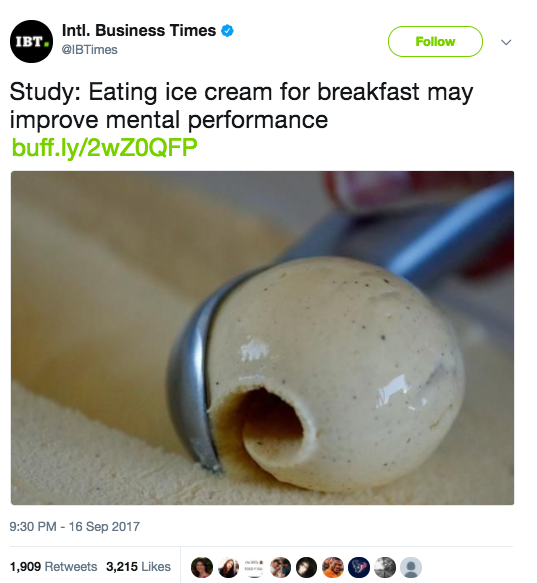
Q: Did you see icecream for breakfast may improve mental performance?

icecream

A: Pigs may fly

Q: But it’s a STUDY

A: That’s actually one of the questions left unresolved.

Q: Just follow the link. The International Business Times links to their source.

A: That link is to a Japanese news site. And it’s 404.

Q: Already? The tweet was just from this weekend.

A: The story is from November last year.

Q: But there’s a professor! Isn’t he real? Can’t you look at his publications.

A: Yes, he’s real. And he has publications. And they aren’t about icecream for breakfast.

Q: Back to the icecream. It could still be true, even if the data aren’t published, right?

A: Sure. In fact there’s a fair chance that, compared to no breakfast, icecream could improve mental performance.

Q: The comparison was to not eating anything?

A: It was compared to a glass of cold water.

Q: So, what does this tell us?

A: 2017 must be a slow news year.