Posts written by Thomas Lumley (2644)

avatar

Thomas Lumley (@tslumley) is Professor of Biostatistics at the University of Auckland. His research interests include semiparametric models, survey sampling, statistical computing, foundations of statistics, and whatever methodological problems his medical collaborators come up with. He also blogs at Biased and Inefficient

June 7, 2026

Small, modular?

I randomly came across a story about a “small modular reactor” startup that was having its first pre-operational test, not ready to generate electricity or anything, just heating up.  This made me think about the recent suggestion that NZ should buy a couple of small modular reactors, as if they were standard off-the-shelf equipment like windmills or ferries. In fact, China has one SMR, Russia has one pair, and lots of people are doing R&D trying to develop them for sale in the future.

RNZ had a story this week, where most of the content was attributed to a spokesperson from “the international organization that promotes nuclear power and supports the companies that comprise the global nuclear industry” (per Wikipedia).  I’m not going to check the whole thing, but I was struck by one statistic

Finland reportedly saw its electricity prices fall 75 percent when its latest nuclear power came online.

This obviously wasn’t a small modular reactor, but also there is no way that could possibly be an honest summary (I suppose the ‘reportedly’ might also have signalled that)

If you follow the link (as RNZ perhaps should have) the headline is Electricity prices in Finland flipped negative — a huge oversupply of clean, hydroelectric power meant suppliers were almost giving it away.  As with similar stories, this is a transient phenomenon. There is no mention at that link of nuclear power.

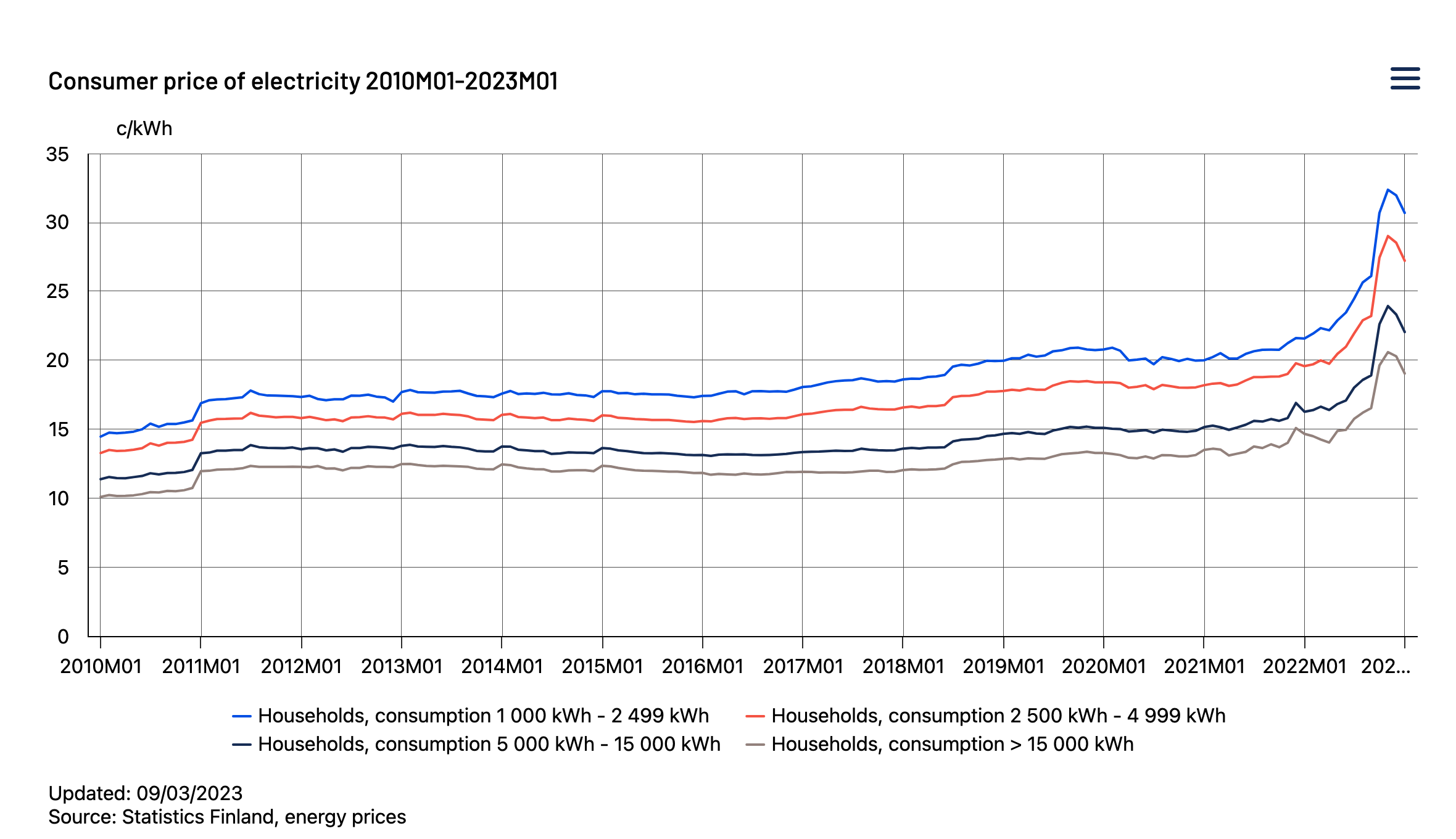
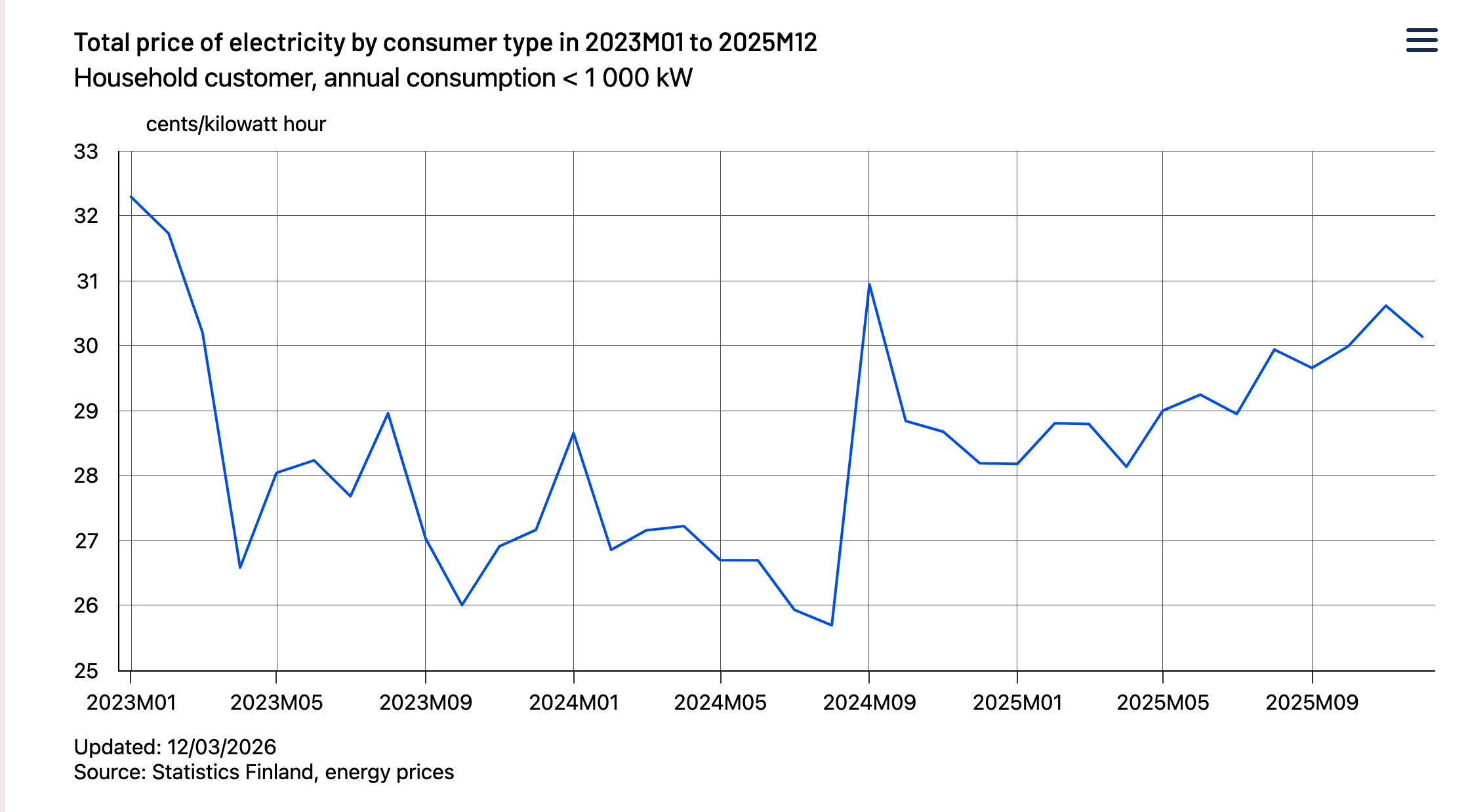
We can also check with Stats Finland. Here’s the price of electricity from the start of 2023

That does show an apparently important drop in early 2023, which is when the most recent nuclear station went online, but a relatively short-term one. Looking back before 2023 we see

with a big run-up in prices suggesting there might have been other forces affecting Finnish power costs in 2022 that would complicate the pro-nuclear interpretation.

I don’t have a firm opposition to small modular nuclear reactors (I’m not a proper Kiwi), but if they were a good idea you’d think the links would be to documents that actually support the case.

May 28, 2026

Dirty comparisons

RNZ: NZ among world’s worst for landfill waste per person 

RNZ: New Zealand generates double the global average of rubbish, report says (also repeated here and here)

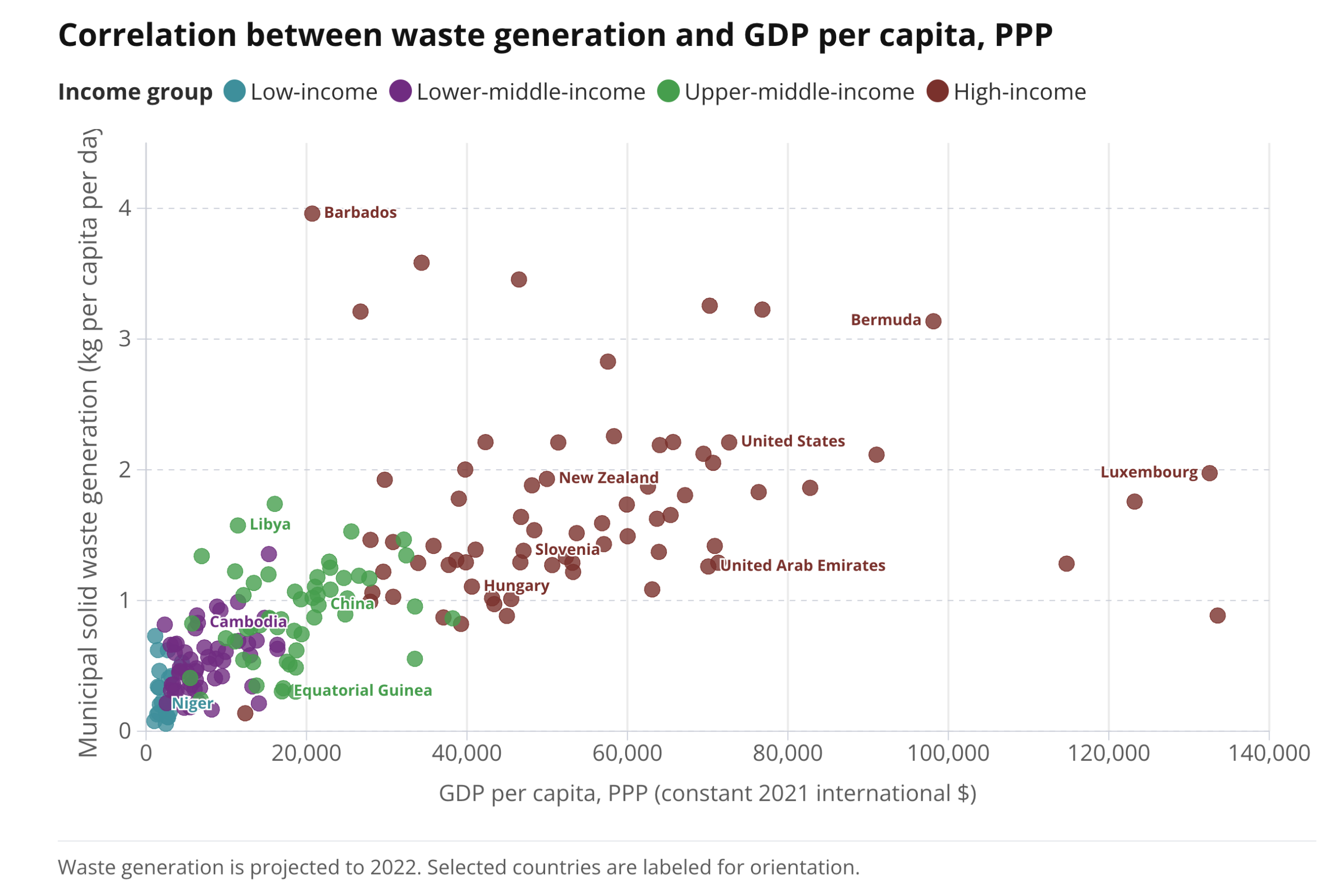
This attributes the claim to a World Bank report, but doesn’t link to it or describe in any more detail where to find it.  Searching does give a World Bank report on waste. This does agree with the 2kg/person/day figure in the RNZ story, so it might be the right one. Here is a graph from it (click to embiggen)

There are clearly some outlying points here. They aren’t New Zealand, which is in the middle of the pack.   We have similar waste generation to other moderately rich countries.

The point here isn’t that New Zealand’s level of waste generation is ok. The point is that if you want to do something about it, you need to have a realistic understanding of what the problem actually is.  If you look at an older World Bank report, described in Stuff in 2018 and visualised here, you see that New Zealand actually was called out as notably high-waste back then, and was ranked 10th in the world.  We were generating 3.68 kg/person/day, so there’s been a big decrease — perhaps because of the ban on so-called single-use plastic bags.  The situation then is different from the situation now, but you wouldn’t be able to tell from the media coverage.

May 3, 2026

As man’s ingratitude

RNZ has a report on the purported costs of weather warnings for (ex-)Cyclone Vaianu a few weeks ago.

Northland spending was down 48 percent. Auckland’s was down 46.5 percent, Waikato was down 52.58 percent, Bay of Plenty down 68.32 percent, Gisborne down 51.6 percent and Hawke’s Bay was down 56.34 percent.

That’s at least two more decimal places than I would want to use, but let’s assume the numbers are correct.  There are still a few issues with the attribution to weather warnings.

First, we can’t easily distinguish the effects of the warnings, the effects of the forecast, and the effects of the storm.  Presumably no-one is suggesting that weather forecasts should be edited to make approaching storms look less scary, but some of the reduction in spending would have been a response to the heavy rain and strong winds in the forecast, regardless of a specific warning.  Even if the forecasts were sanitised, people who remember, say, the Auckland Anniversary Weekend storm or Cyclone Gabrielle might want to be cautious about the risks of an approaching storm.  The report says the reductions in spending were highest in the areas where the forecast storm was most intense, but that’s what you’d expect if people were reacting to the forecast rather than to the North-Island-wide warning.

Second, there’s an economic issue that should be clear already to people in or near local government, because it’s part of how convention centres, stadiums, and major cultural events are oversold.  It’s much easier to get people to change where and when they spend money than to change how much money they spend.  Suppose you were planning a barbeque for your kid’s birthday on April 12th. You might well have cancelled it because of the storm warning, but that wouldn’t mean your kid didn’t get a birthday this year. You’d have the event some other time.  Similarly, if you wanted to see a movie (Project Hail Mary seems popular) or you needed to buy a new vacuum cleaner or you wanted to see the fireworks and racing at Waikaraka Park you might well not go out that day, but you might well go some other day when you could easily get to the cinema or Briscoes or when the racing and fireworks were rescheduled1.  The reduction in spending on the day of the storm is a substantial overestimate of the impact of the storm on spending. (In the same way, stadiums collect money, but a lot of it is money that people would otherwise still have spent in the city).

And finally, there’s an important issue about uncertain predictions.  The storm didn’t in fact cause major damage across the North Island, but that doesn’t mean the warning was wrong.  If you play Russian roulette and survive, that doesn’t mean it was a good bet and you should do it again, it just means you got lucky.  The report gives no reason whatsoever to assume that less caution was warranted for this storm than for the two big storms in 2023 (one of which was seriously underpredicted).  It’s not inconceivable that our weather warnings are poorly calibrated, but any decision of this sort should be based on some actual evidence that they are.

  1. Last night. Ask me how I know.
May 1, 2026

Briefly

  • Canada is starting its census on Monday
  • Another ultraprocessed food headline: CNN says Even a single daily serving of ultraprocessed food may raise dementia risk.  As before, the research didn’t even try to compare people with no ultraprocessed food intake to those with only a single daily serving.  They used a model that approximates the relationship by a curve with no safe level, and so couldn’t address this question — nor did they claim to.  The “even a single daily serving” is CNN.  What the research claimed is that each extra daily serving translated to 10% more dementia risk.  I’m a bit dubious, for the simple reason that ultraprocessed food consumption has gone up but dementia risk (at a given age) hasn’t. But I don’t think anyone’s claiming ultraprocessed food is good.
  • Strava makes an app that tracks cycling and running and confidential military locations. Over the last year, Seattle was the top US city for logging bicycle commutes, with Chicago and Minneapolis in the next positions.  The Seattle Times says Seattle front of the pack for bike commuting in U.S. cities, but given Seattle’s status as a West Coast tech and nerd haven, it seems quite possible that we’re seeing selection bias.  It could easily be that Chicago or the Twin Cities are ahead in commuting but people there are just less likely to report it to Strava.
  • Nice blog post by Kieran Healy on maps of data and using hexagons to make all the regions visible
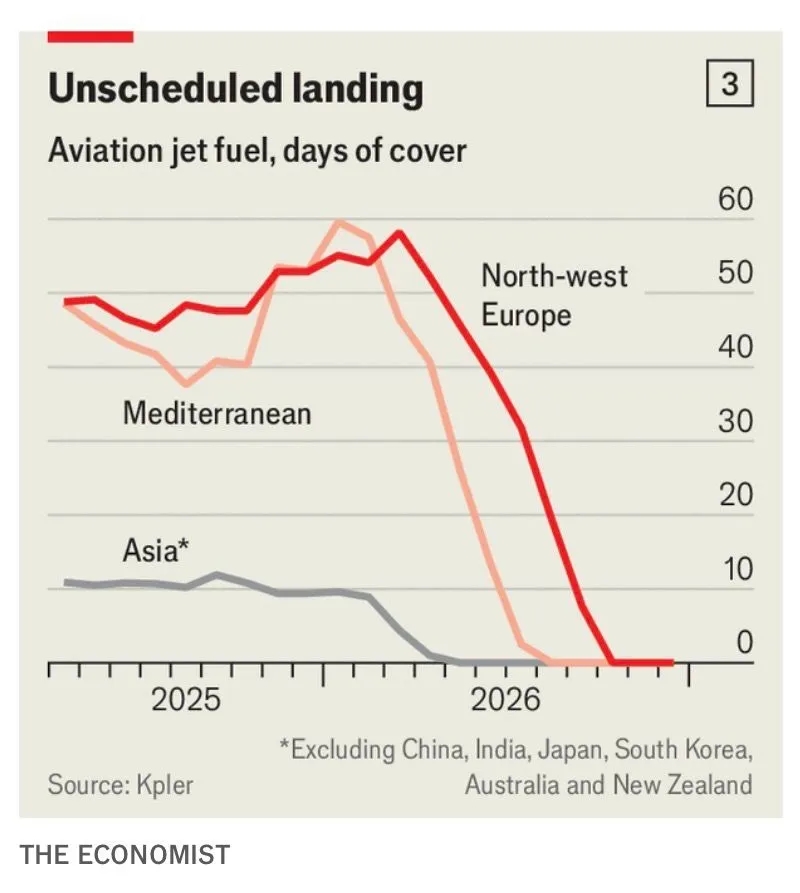
  • A graph from The Economist. 

    I first noticed the unusual definition of Asia in the footnote, especially the exclusion of countries no-one would think to include. The time axis could also be clearer. I presume the slightly longer tick mark is either Dec 2025 or Jan 2026, but a stronger visual cue to past vs future would perhaps be more helpful.  The other aspect, which is very common in graphs of the fuel crisis, is the smoothness of the projected decline in the face of uncertainty as to both supply and attempts to manage demand.
April 21, 2026

Green and full of terrors

If you want to get a health story into the papers it helps if it sounds controversial and it especially helps if it tells people they can eat food they want to eat: thus the frequency of stories about chocolate, wine, and beer.

This week’s version is a not-very-detailed abstract from a conference in the US that purportedly says healthy food gives you lung cancer. And when I say that’s what the study purportedly shows, I mean:

  • MSN: Eating fruits, vegetables and whole grains may increase chance of early onset lung cancer
  • The Independent: Eating more fruits and vegetables could put you at risk for this cancer
  • Newsweek: Fruits and Vegetables May Increase Your Cancer Risk, New Research Shows
  • and even the researchers’ own press release: Eating fruits, vegetables and whole grains may increase chance of early onset lung cancer

One exception is Ars Technica, headlining the story as Absurd study suggests eating fruits and vegetables leads to cancer.

The press release says

“Our research shows that younger non-smokers who eat a higher quantity of healthy foods than the general population are more likely to develop lung cancer,” said Jorge Nieva, MD,

and, no, it really doesn’t show that.  For a start, we shouldn’t really be advertising  health advice to the general public based on just a conference abstract, with so little detail. In this case even the limited detail we have is enough to say that this shouldn’t be a big health story.

The research is part of a project to study lung cancer in younger people who don’t smoke. It used to be that nearly all lung cancer cases were in older people who had been smokers, but one of the victories of global public health is to reduce the number of cases like this.    Clearly, if someone has lung cancer at age 30 it isn’t because they’ve been smoking for fifty years — and in fact, many of them haven’t smoked at all. So, there’s interest in studying what causes their lung cancer.  The Epidemiology of Young Lung Cancer study wants to look at genetic attributes and environmental risk factors for lung cancer before age 40.

Finding a control group is hard. You can’t just recruit a whole bunch of young people and see who gets lung cancer, because it’s an very rare disease: you won’t find anyone.  You need to look for diagnosed cases, but then you need to decide who to compare them to. In this research the people with lung cancer were compared to people in a big national survey series, NHANES, which asks about diet.

The primary reported finding is that young people diagnosed with lung cancer had healthier diets (according to one measure) than the average of the US population.  The researchers don’t say they expected to see this, and my guess is they didn’t.  Their theory is that pesticides — in some generic holistic sense — are responsible.  It’s obviously not impossible that pesticides could be carcinogenic, but this doesn’t seem like a very good way to find out. In particular, while the people in the study all have lung cancer, they don’t all have similar mutations in their tumours  — they don’t have the same sort of lung cancer — and there’s literally zero actual data on pesticides, just an assumption that they’re present in healthier food, so this isn’t picking out some sort of ultra-selective cancer effect.

Everything here is correlations, but better correlational studies with controls consistently find that people with lung cancer eat less of the fruit and vegetables and high-fibre foods than people without lung cancer (eg here). There’s a theoretical argument that a diet high in anti-oxidants might reduce the body’s ability destroy cancer, but you wouldn’t look at a small, unusual subset of lung cancers to study this question.  There are perfectly good alternative reasons why the young lung cancer patients might have healthier diets than the US average. They’re young, for a start.  They have had their cancers diagnosed early enough to end up in a study like this one, which will correlate with income and interest in medical science. They’re non-smokers.

If unreliable evidence of a healthier diet in a subset of people with lung cancer is taken as evidence of harm from pesticides, should we take evidence of a less healthy diet in other groups of people with serious illness as evidence that pesticides are beneficial?

April 16, 2026

Top five wealthiest?

From the NZ$ Herald New Zealand ranks among world’s top five wealthiest countries per capita in rich list report. I don’t think it really makes sense to call this a “rich list” report, but New Zealand does indeed rank “among” the world’s top five wealthiest countries (obviously we’re in fifth place, otherwise we’d be “among” the top four).

As Damien Venuto at Stuff notes, this doesn’t sound right. Is NZ really wealthier than Norway or Denmark or Japan or the UK?

The report being quoted is here; nobody links. There are at least three things going on.

First, the numbers are means when we usually prefer medians for this sort of comparison. The means are much more strongly influenced by the richest people, and also are just larger.  The use of means isn’t some evil capitalist plot by Allianz — it’s just easier to find out the mean, since you get it by taking the total and dividing by the population.  Working out the median per capita financial assets would take some serious survey-based research.  I will note that they aren’t completely clear about how they define the population, but it won’t make much difference to comparisons.

The second issue, which is important in the Stuff piece, is that a big chunk of the ‘wealth’ in New Zealand and Australia is over-valued real estate.  Real estate is problematic for wealth because it’s hard to extract the wealth that is nominally generated and use it to pay for stuff.  It’s even harder for large chunks of society to extract their real-estate wealth, since doing so would tend to bring prices back in line with reality.

A third issue, especially when comparing with the USA on one hand and the Scandinavian countries on the other hand, is what expenses need to be covered by that wealth.  In the USA, private assets pay for a larger fraction of healthcare and education than they do in New Zealand, and in turn we pay privately for more of these than they do in Norway.  When the public sector provides less, it will tend to use less  money, leaving private households more money to spend on the services they now have to buy.   The per-capita mean is not the best statistic for tracking this sort of thing: distribution of wealth and income matters.

As a final note, there is a whole chapter on distribution in the report that neither NZ paper mentioned.  The chapter isn’t very positive — inequality between between countries seems to have stopped decreasing, and it hasn’t improved within countries either.

April 9, 2026

Kōkako goneburger?

The North Island kōkako is one of Aotearoa’s most elegantly beautiful birds, and while rare, they still exist in the wild as well as in sanctuaries. I’ve seen them on Tiritiri, near Auckland.  The South Island kōkako is a bit more controversial. It has been regarded as extinct and but is officially classified at the moment as “Don’t Know”.

This week, the Press published a story about the South Island kōkako, based on a publication in a regional ornithology journal, claiming there was a 48% chance that the species is still around.  The story raises two questions: what even does that mean, and is it reasonable?

We know that many of the reported sightings of South Island kōkako must be wrong: if they were not, the bird would be everywhere and there would be no uncertainty about its survival.  The question is whether any of the reported sightings are correct. Now, if there are no South Island kōkako then clearly all the sightings are mistaken, no matter how skilled and careful the reporters are– just like all the sightings of Bigfoot.  If South Island kōkako are rare, then most of the sightings are mistaken, but some of them are probably correct. Most of the sightings aren’t all that convincing anyway, but some of them do look pretty convincing.

There are various ways to approach this problem statistically. One is to try to pick out some sightings that you are sure are correct and see whether these stop at some point, or become less frequent. Another is to look at sightings during the period we know the bird existed and see what the ratio of convincing to dodgy sightings was like then, and see if it changed.  These (described more elegantly and formalised with maths) are the methods of three papers by Andrew Solow and co-workers (a,b,c — the copyright industry probably won’t let you read them).

One of the key bits of data in this calculation is a 2007 observation of the South Island kōkako that the Ornithological Society of NZ thought was convincing. According to the research paper, the last reliable sightings from the period when  the bird was uncontroversially still around were five over the period 1954-1967.  The 48% kōkako probability in the new report relies very heavily on the bird not being extinct in 2007. Without that one report, the estimated survival probability would be basically zero.  The isolated 2007 sighting, if true, would also provide evidence that real sightings are rare even when the species is still present.

There’s a problem with the formulation of the extinction models.  The original paper describing the first method, the one that gives the 48% probability, says “The methods described in this note assume that, prior to extinction, sightings follow a stationary Poisson process”.  In English: we assume that (true) sightings occur independently at a constant underlying rate.  They probably don’t.  There are a lot more people out there now than in 1967, so the rate is probably not constant. Also, there will be clustering: if someone convincingly reports seeing a South Island kōkako, the birding community will descend on the area with cameras at the ready and the chance of true sightings should go up[1]  And if the population is diminishing slowly (as it would have to be), the true sightings will also diminish slowly. This method also requires that you can tell which sightings are true.

The third method I linked above allows for uncertain sightings, so you don’t have to be able to tell in advance which sightings are true. However, to make the maths tractable, it still models both true and false sightings as being stationary Poisson processes: there’s a constant random rate of true sightings before extinction and a constant random rate of false sightings before and after extinction. Under this model, if the kōkako is extinct then at least 99.75% of the sightings since 1967 are false.

That’s less impressive than it sounds. To start with, obviously if there aren’t any kōkako now and there were no reliable sightings between 1967 and 2007, then nearly all sightings are false.  Also, this doesn’t mean that people’s accuracy in distinguishing kōkako from other things is less than 1 in 100. The iNaturalist site records 350,000 observations with photo or sound recording of securely-identified birds that aren’t South Island kōkako over just the time since 2012, and people may have seen birds and not posted about it to iNaturalist. The proportion of times someone sees something and wrongly think it’s a South Island kōkako could still be tiny — it’s just large compared to the (possibly zero) number of true sightings.

So, overall the paper says that if there were South Island kōkako in 2007 it’s not unreasonable that there still are a few. Which is fair. If they exist, they’re probably in one remote area rather than all over the South Island.   The 48% probability was correctly presented in the research paper as the output of the statistical method they used, but you shouldn’t put a lot of weight on the precise number. When you don’t have good data to put into the model you aren’t going to get much certainty out of it, and the statistical modelling had to make some pretty big approximations.  In particular, the model is leaning quite hard on the approximation that the search effort (and number of false sightings) has not increased over time.


[1] there’s a type of statistical model called a “self-exciting point process”, whose name is very appropriate here.

April 4, 2026

NZTA much better?

This is an expansion from the “Briefly” post about an NZTA summary of public comment on their SH1 Wellington proposals.

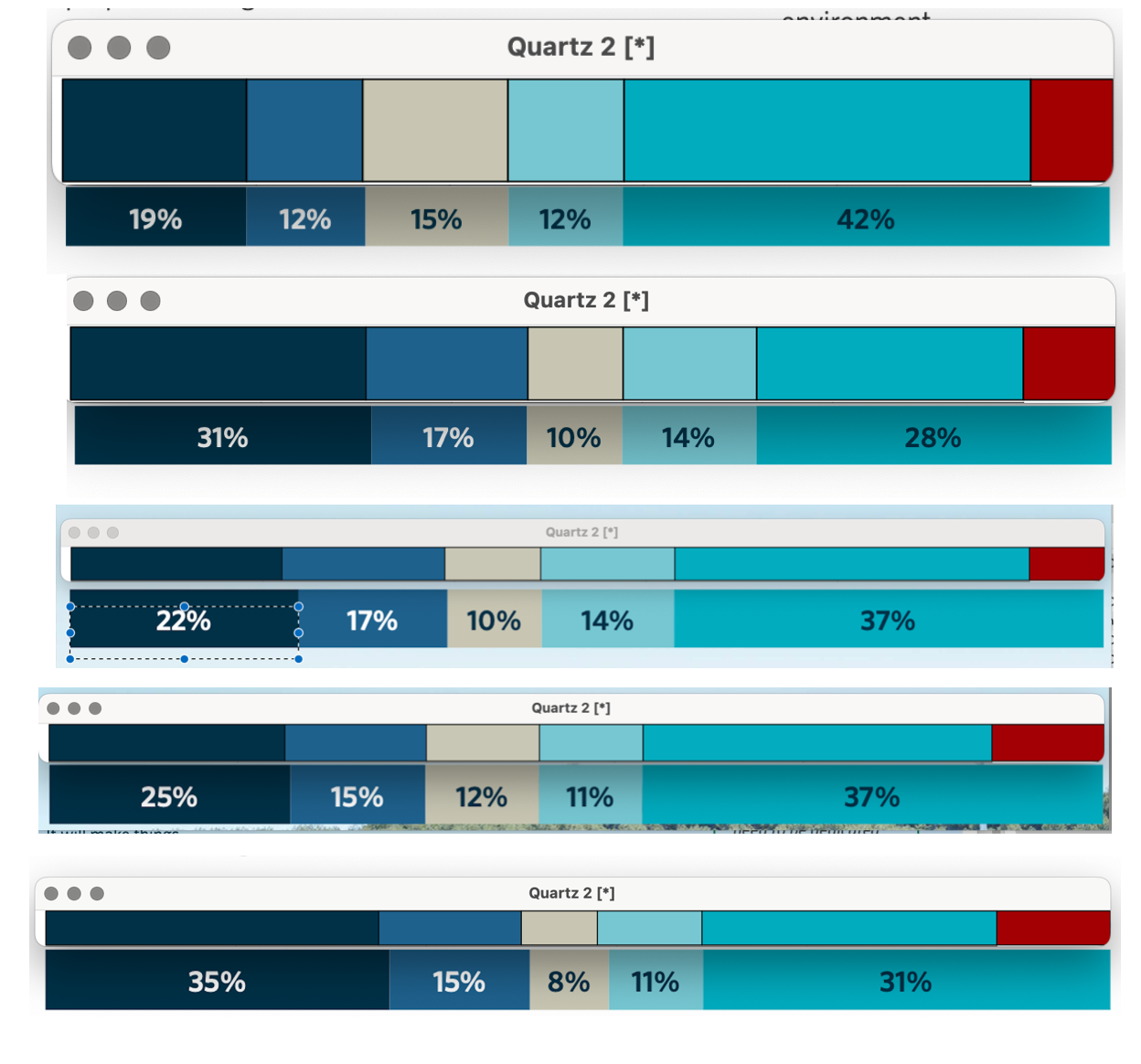
On Bluesky, @gwynebs had pointed out that some of the bars indicating levels of support didn’t appear to match the numbers attached to them — the “much better” category seemed inflated

A couple of days ago I noted there was a pattern to the distortion: it really was only the “much better” bar that was inflated and the other four were compressed in the same proportion. That is, some varying percentage was effectively being added to the “much better” level.  This is true for all five of the specific sections of the proposal,  but is not true for the two overall ratings in the middle of page 2, which appear correct. The bars are also correct in the much more detailed community engagement report; it’s just the summary that is wrong — which should indicate something about where things went wrong.

This is not rounding error. It’s much larger than that.

I went and measured the widths of all the bars in the five charts. These are in the same order as in the report: from top to bottom we have “2nd Terrace tunnel”, “Te Aro”, “Basin Reserve”, “2nd Mt Victoria tunnel”, and “Hataitai and Kilburnie”. The lower bar for each is cut from the NZTA summary. The upper bar has the correct percentages plus the necessary additional amount to make the bars line up — so the red is the amount that has been added to the “much better” category in the graph compared to the numbers. My bars and their bars don’t line up perfectly; that is probably rounding error. One possible explanation is that the red is some sort of “Don’t know” value that has inadvertently been put into the last bar — I could see that happening if the bars were drawn as pictures rather than as charts.

How much should we care about this? On the one hand, this sort of thing is probably corrosive to public trust in government data. On the other hand, this purports to be quantitative analysis of a self-selecting survey of the sort that attracts highly motivated and unrepresentative minorities*, so there’s a real limit to how seriously you should be taking the numbers.

Arguably, the point of this sort of survey is to see if there are surprising results — either something NZTA didn’t know about, or stronger opposition than they expected.  Even so, most people who aren’t the Advertising Standards Authority would think there’s something wrong with graphs that don’t match the data they purport to present.


*eg, people such as me

April 2, 2026

Briefly

  • For the day between March 31 and April 2nd, Andrew Gelman takes on an app that claims to find patterns in lotto numbers and make you money.
  • RNZ reports the plans for tolls on the Road of Northland Significance, a charge of $4.50 each way from Warkworth to Te Hana (you will see some quotes of $14.20, which includes current tolls on the already-existing road to Puhoi). They don’t report what fraction of the cost the tolls will cover. Greater Auckland looked at the NZTA consultation papers about the tolling and say 35 years of tolling will raise $391m. That would be nearly 10% of the (phase 1) cost if you didn’t include interest; it’s a much smaller fraction when you do. And this is phase 1 — there are two more phases in the planned road to Whangārei.  Whether the road is worth the cost isn’t my specialty, but it’s a lot of cost.
  • Len Cook (former Government Statistician) is in the Otago Daily Times disapproving of the planned removal of the census enumerations. We’ve covered this topic before.  The changes to the Data and Statistics Act are up for public comment, as are the necessary changes to the Electoral Act.   The electoral changes are not intrinsically controversial but are needed because electoral redistricting is currently triggered by the census. The electoral changes are important because they need a 75% supermajority in Parliament.
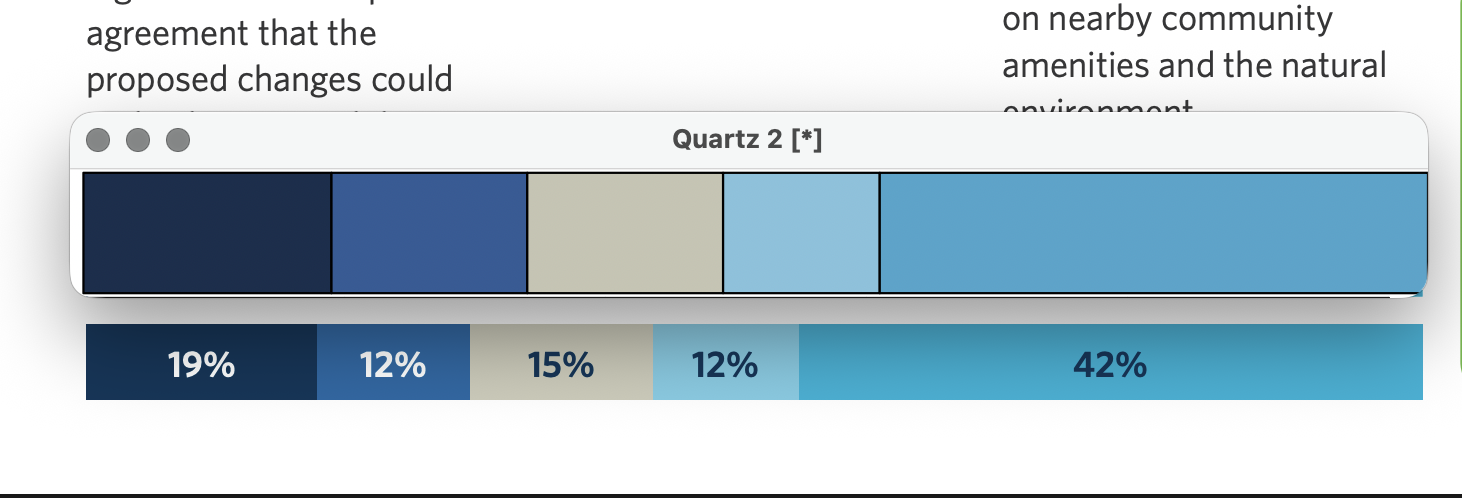
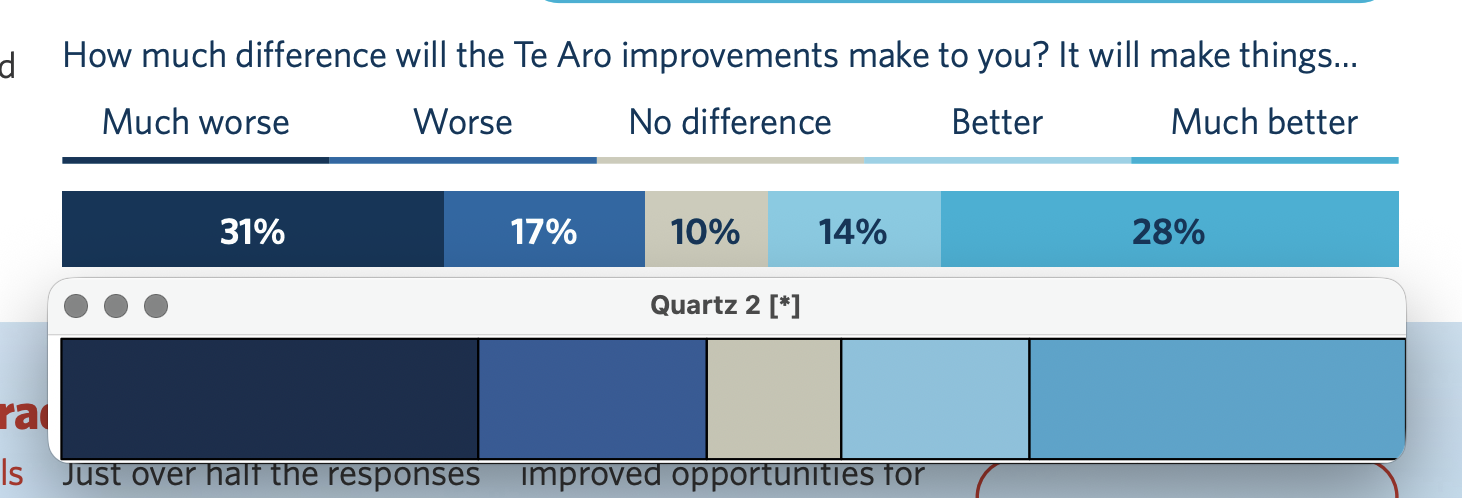
  • RNZ reports on an NZTA report on public consultation about road changes in Wellington. First, the usual whinge: please link to this sort of report, so we can read it if your summary gets us interested!  Second, and the StatsChat motivation, the NZTA report displays pretty graphics of the public feedback, which are systematically wrong! For example, on the question “will a second Terrace Tunnel make things worse or better for you?” the lower bar is from the report and the upper bar is correct based on the percentages.  The right end of the bar is “better”, and is exaggerated

    Or the next question, about Te Aro improvements (original above, correct version below). Again, the “better” end is exaggerated

    I don’t think this is likely to be deliberate, but it’s a bad look

Oily rag

The Ministry of Transport have put up a fuel monitoring dashboard. It shows estimates of demand, supply, and price.

At the moment, the reduction in demand is less than 10%, a level of demand that’s probably not sustainable in the medium when global supply is down at least 25%. On the other hand, we are still at level 1 of the alert system, and even level 2 doesn’t ask for any real reductions in demand.

What this display doesn’t show is any sort of “time to running out”.  That’s probably sensible, because it’s not even well-defined, let alone predictable. If you define “running out” as some petrol stations being out of supplies then it’s already happened. If you define it as “no fuel in the country”, it probably won’t happen. And if you define it as level 3 or level 4 restrictions on supply then it’s a choice by the government based on unknown criteria, and so is hard to forecast statistically.