Posts written by Thomas Lumley (2645)

avatar

Thomas Lumley (@tslumley) is Professor of Biostatistics at the University of Auckland. His research interests include semiparametric models, survey sampling, statistical computing, foundations of statistics, and whatever methodological problems his medical collaborators come up with. He also blogs at Biased and Inefficient

May 23, 2014

Is Roy Morgan weird?

There seems to be a view that the Roy Morgan political opinion poll is more variable than the others, even to the extent that newspapers are willing to say so, eg, Stuff on May 7

The National Party has taken a big hit in the latest Roy Morgan poll, shedding 6 points to 42.5 per cent in the volatile survey.

I was asked about this on Twitter this morning, so I went to get Peter Green’s data and aggregation model to see what it showed. In fact, there’s not much difference between the major polling companies in the variability of their estimates. Here, for example, are poll-to-poll changes in the support for National in successive polls for four companies
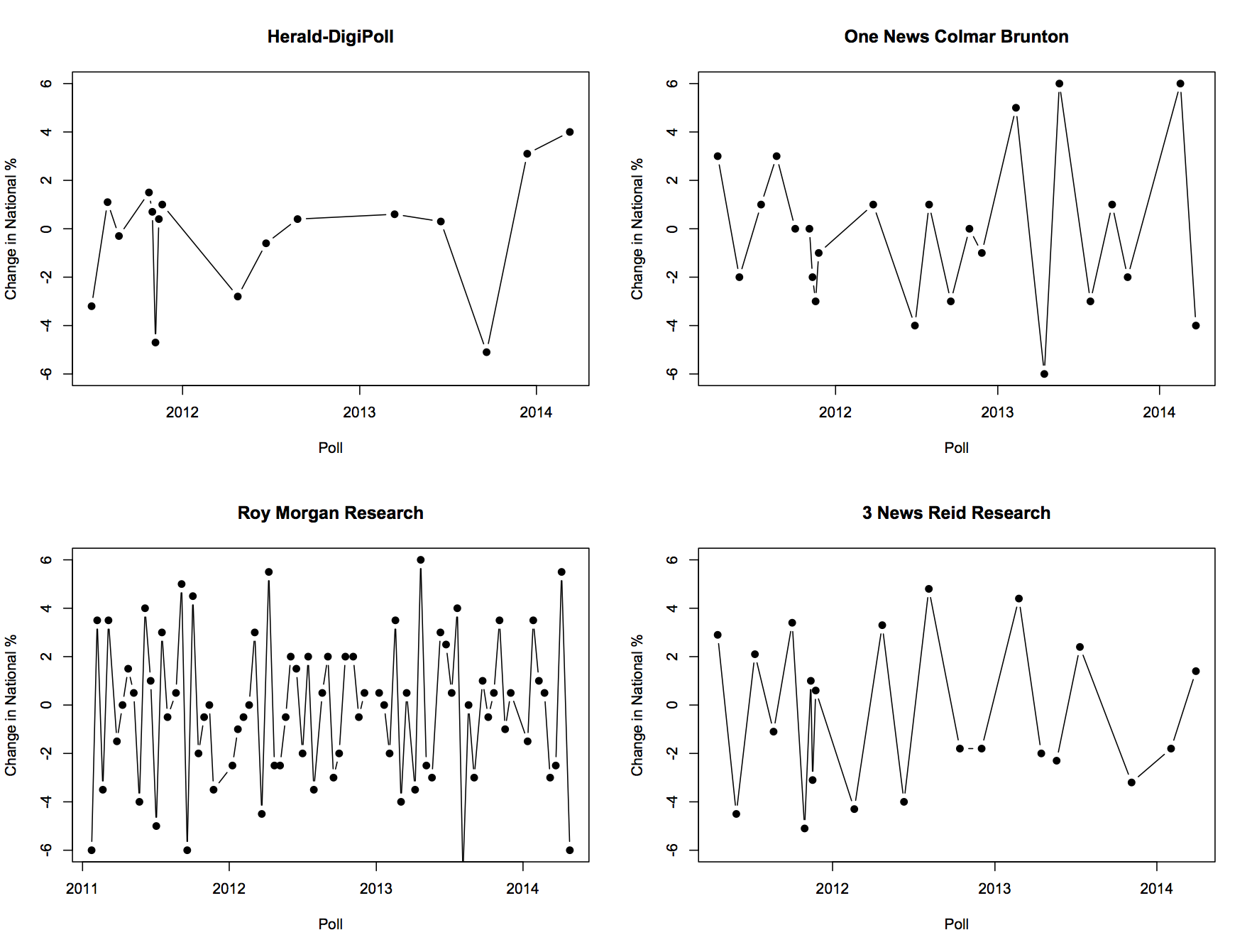
fourpollers


And here are their departures from the aggregated smooth trend
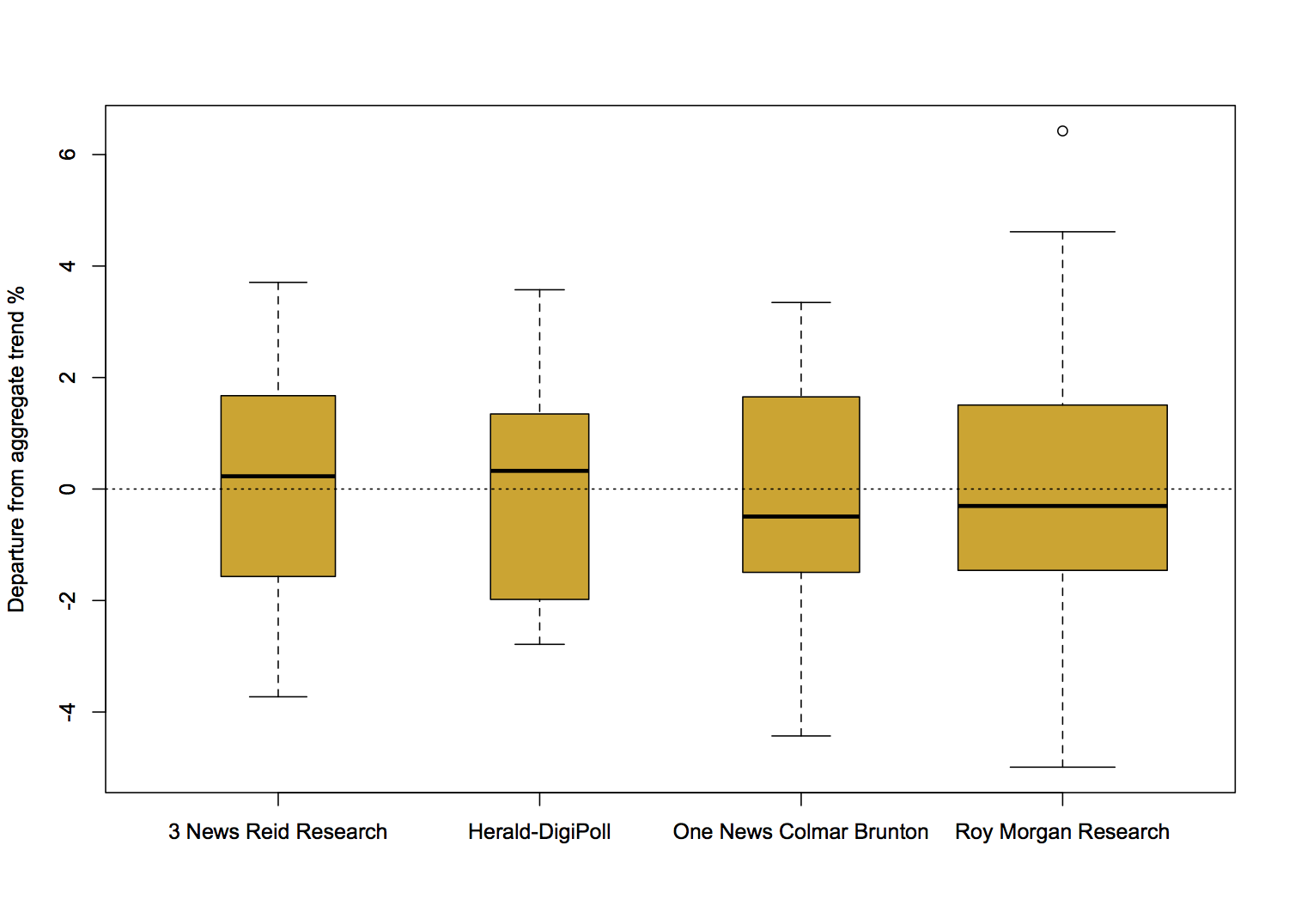
boxpollers


There really is not much to see here. So why do people feel that Roy Morgan comes out with strange results more often? Probably because Roy Morgan comes out with results more often.

For example, the proportion of poll-to-poll changes over 3 percentage points is 0.22 for One News/Colmar Brunton, 0.18 for Roy Morgan, and 0.23 for 3 News/Reid Research, all about the same, but the number of changes over 3 percentage points in this time frame is 5 for One News/Colmar Brunton, 14 for Roy Morgan, and 5 for 3 News/Reid Research.

There are more strange results from Roy Morgan than for the others, but it’s mostly for the same reason that there are more burglaries in Auckland than in the other New Zealand cities.
Distrust the center

Automated location information can be very useful, but if the ‘location’ is an area and the automated result is a single point, it’s easy to get misled.

May 22, 2014

Big Data social context

From Cathy O’Neil: Ignore data, focus on power (and, well, most of the stuff on her blog)

From danah boyd and Kate Crawford: Critical Questions for Big Data

Will large-scale search data help us create better tools, services, and public goods? Or will it usher in a new wave of privacy incursions and invasive marketing? Will data ana- lytics help us understand online communities and political movements? Or will it be used to track protesters and suppress speech? Will it transform how we study human communication and culture, or narrow the palette of research options and alter what ‘research’ means?  


A simple colour example

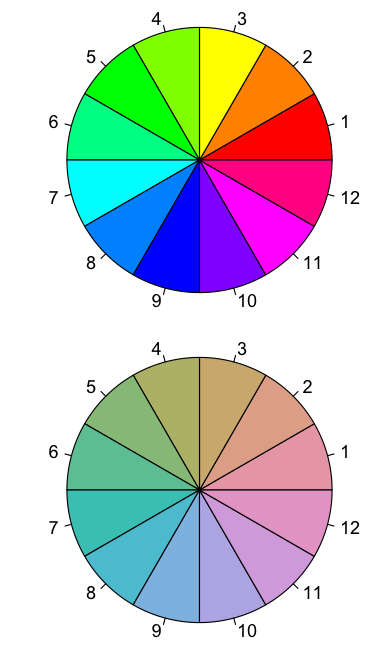
Two colour wheels, one using red-green-blue colour coordinates based on how monitors work, the other using a rescaled coordinate system based approximately on what the eye sees

angle


The second set of colours isn’t as dramatic, but they are much better at being evenly spaced around the circle and equally bright.

Briefly

Health and evidence edition

  • Evidently Cochrane, a blog with non-technical explanations of Cochrane Collaboration review results
  • Design process for a graphic illustrating the impact of motorbike helmet laws.  In contrast to bicycle helmet laws, laws for motorbikes do have a visible effect on death statistics
  • Stuff has quite a good story on alcohol in New Zealand.
  • The British Association of Dermatologists responds to ‘drinkable sunscreen’.
  • 3News piece on Auckland research into extracts of the lingzhi mushroom. Nice to see local science, and the story was reasonably balanced, with Shaun Holt pointing out that this is not even approaching being anywhere near evidence that drinking the stuff would do more good than harm.
May 21, 2014

Explaining income tax shares

Following up on the “net tax” tangle, Keith Ng has a step by step explanation of how income tax and income distribution has changed over recent years in NZ.

You can also play with the visualisation yourself. Or, if you want to see the arguments about it, they’ll be on his Public Address post.

When not to map

Maps are good because they take advantage of all the previous maps we’ve seen to provide background familiarity.  On the other hand, they use up both the available spatial dimensions before you’ve actually got any data, so you need to encode the information some other way. Colour is the obvious choice, but colour is much more limited than people appreciate.

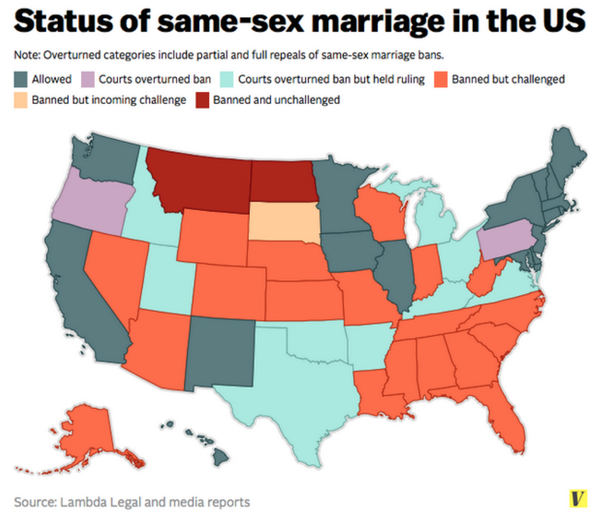
Kieran Healy tweetedIt’s not like there’s a simple, tradeoff-free solution, but this is not a good map.”

BoH2_TfIMAACQIl


And he’s right; it isn’t. There are too many categories, and some of them are ordered but not all of them, so colour isn’t enough. Even if you’re going to try, these aren’t the right colours: for example, orange should be between yellow and red.  About the most you could do clearly with a single map is the three-way split: Yes, same-sex couples can just roll up to the registry;  No, not this week; or It’s Complicated.

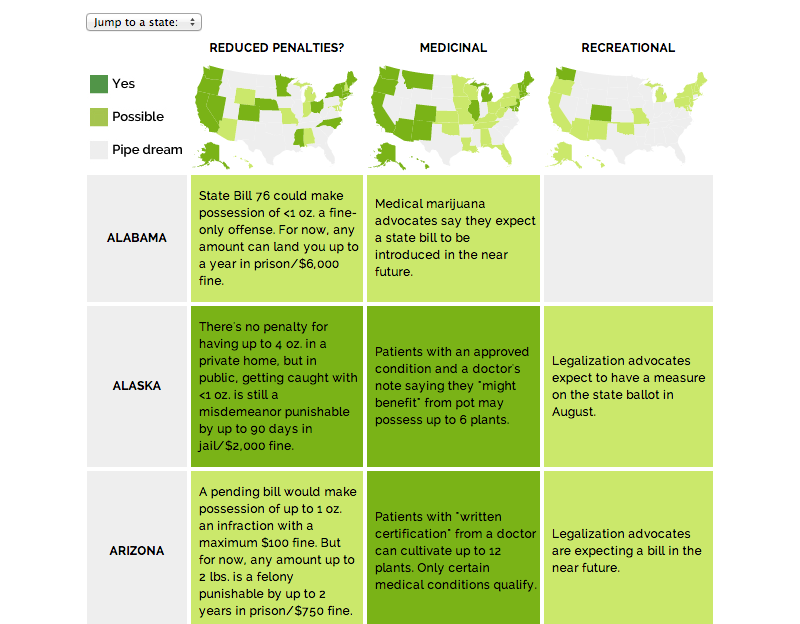
Jacob Harris pointed to an article at Source, describing the design of graphics for a story about marijuana legalisation. It does much better


raja_final_product_1


They link to the classic piece “When maps shouldn’t be maps” by Matthew Ericson, which I’ve linked before. They also have a whole collection of articles on better maps, though it’s fairly programming-oriented.

Sea rise visualisation

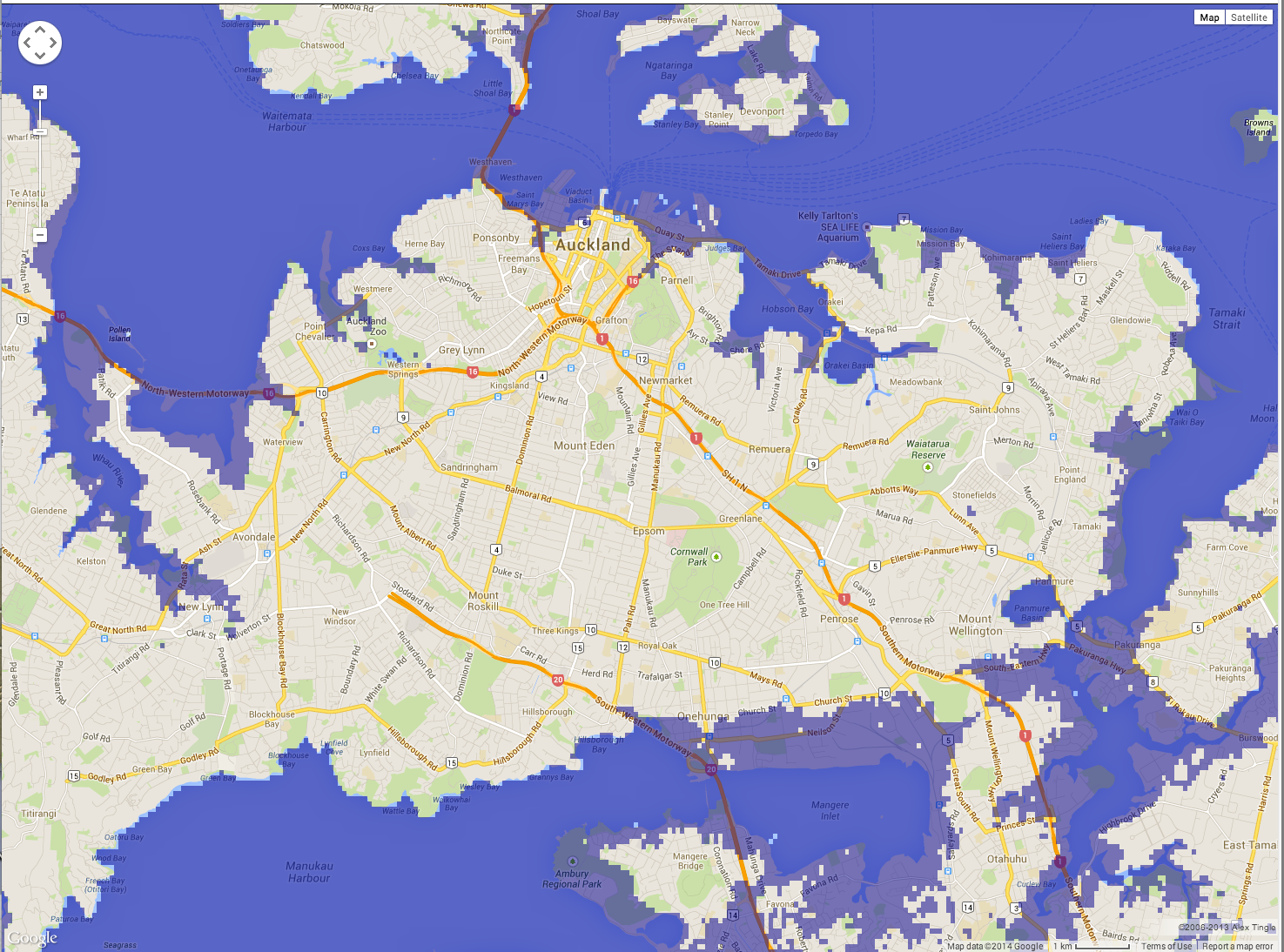
A new map to let you see the impact of rises in sea levels on your area: this is Auckland with 13m sea rise

flood


This doesn’t show the impact of storm surges, which are the big problem for a lot of eastern coastal Auckland (though not so much for Manukau Harbour).

(via everyone on twitter)

Revolutionary new advertising success

The Daily Mail (and the Telegraph) recently ran puff pieces advertising a new ‘drinkable sunscreen’

Those who make the product, which is available to buy, claim that once the elixir is ingested, molecules of the product vibrate on the skin to cancel out 97 per cent of UVA and UVB rays.

Actually, the Telegraph headline was “Could this be the first drinkable sunscreen?”, and, following Betteridge’s Law, the answer is “Fsck, no!” A blog at the Guardian has a good demolition of the stories, and the illuminating byline

Dean Burnett is acutely aware of how many ways he could be sued if he wrote his initial reactions to the articles about this sunscreen. He is on Twitter, @garwboy

British libel law has been modified after the notorious attack on Simon Singh, but it’s not surprising that no-one wants to be a test case for the new law.

After seeing the reaction, the Mail has at least modified their article to add a concluding warning

Hermoine Lawson, spokesman at the British Skin Foundation, said: ‘We would advise extreme caution of any product claiming UV protection using methods not supported by clinical research. 

‘When it comes to an issue as serious as preventing skin cancer, customer testimonials cannot take the place of scientific evidence, for which this particular product cannot provide.

The Telegraph has a story about the implausibility of the claim and the lack of supporting evidence, though it carefully doesn’t mention how you might have come to hear about the claim, and there certainly isn’t an apology or a retraction.

That’s all on the other side of the world.  Here, where we have one of the highest rates of melanoma, you’d expect a bit more of a clue about sunscreen. But, no, One News has the story. They don’t have the testimonial from someone who used it on a toddler, but they do have the inventor claiming it is effective for more than 99% of people.

Although One News just describes them as a US skincare company, they have a New Zealand distributor with a New Zealand company registration and .co.nz website, and a whole bunch of ‘harmonized water’ products with superficially implausible claims, and they do include the ‘sunscreen’ and the claims:

•Neutralizes UV radiation 
•Allows for increased sun exposure (30x more than normal) 
•Enhances tanning effect from the sun 

Perhaps someone might like to ask the Advertising Standards Authority to verify that the claims are indeed valid and substantiated?

May 20, 2014

International Clinical Trials Day: Alltrials

Video from the Alltrials campaign. It’s fair to point out that this is well-designed propaganda, even though it’s absolutely right about the problem


You can also read what a drug-discovery chemist says about the results of the campaign to get all the Tamiflu trials analysed.