Posts written by Thomas Lumley (2645)

avatar

Thomas Lumley (@tslumley) is Professor of Biostatistics at the University of Auckland. His research interests include semiparametric models, survey sampling, statistical computing, foundations of statistics, and whatever methodological problems his medical collaborators come up with. He also blogs at Biased and Inefficient

August 9, 2013

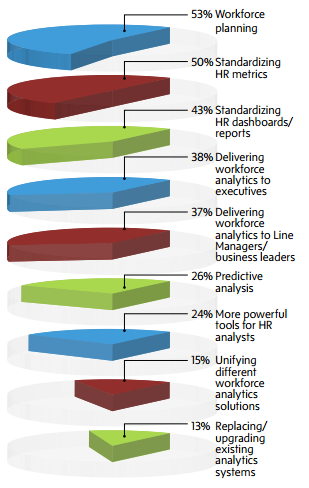
Graphical innovation in delivering workforce analytics

Via Nathan Yau (from a source that evades Google’s reverse image search), another innovation in data visualisation

If you’re the first person to use a data visualisation idea, it’s just possible that it’s because it isn’t a very good idea.

Covering chocolate

Chocolate tastes nice but (sadly) is high in fat, so there’s a lot of potential appeal in news stories that say it’s really terribly healthy. Ideally these stories would come out just before Valentine’s Day, or Christmas, or perhaps Mothers’ Day, but any time of the year will do.

The Herald has a chocolate story, with the lead

Hot chocolate can help older people keep their brains healthy, research has shown.

The research compared blood flow in the brain, and performance on some cognitive function tests. The participants were assigned to drink cocoa with high or low levels of flavonols (aka flavonoids), the chemicals in chocolate that are thought to possibly have beneficial effects.  Based on the headline, you might expect that the researchers saw a difference between the two groups. Sadly, no:

Half the participants were given hot chocolate rich in antioxidant flavanol plant compounds while the other half received low-flavanol cocoa.

Flavanol content made no difference to the results, the researchers found.

That is, participants in both groups improved over the course of the study, regardless of what they drank.  Normally, this would be considered evidence against an effect of chocolate.

For comparison, there’s a more careful story at NPR news, and a less careful one at Forbes. We repeat the  StatsChat position on chocolate “Don’t eat it just for health reasons. If you don’t like it, save it for people who do.”

 

August 7, 2013

Bogus poll on bogus shark documentary

Every year, the Discovery Channel has “Shark Week”, which is apparently their top-rated week of the year.  This year they led off with a programme about the extinct shark C. megalodon, which made the great white shark look like a guppy.

Unfortunately, they did a “Does Megalodon still exist?” programme.  The answer is, definitively, “No”, and to get any other answer you’d have to make up some evidence. That didn’t put them off.  Read Christie Wilcox (scientist) and Wil Wheaton (celebrity nerd) for more.

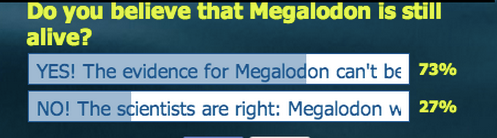
The excuse for putting this on StatsChat is below

bogusshark


I suppose it’s appropriate that they use a bogus poll to try to prove they fooled most of the people who trust them for science communication.

August 2, 2013

A tax on hope?

An excellent long piece about lotteries, from the online magazine Nautilus.  There are many viewpoints presented, including one from the president of the Tennessee lottery corporation

Hargrove has an intuitive understanding of what drives her customers to play the game. She has a preternatural sense of where their psychological buttons are located and how to push them. She responded in a flash to my comment about the logical futility of playing the lottery. “If you made a logical investment choice, you’d play a different game,” she said, leaning forward for emphasis. “It’s not an investment. It’s entertainment. For a very small amount of money you might change your life. For $2 you can spend the day dreaming about what you would do with half a billion dollars—half a billion dollars!”

When  both payoffs and odds that are beyond any conceptual understanding you could do a simple expected-value calculation and label government lotteries as a tax on stupidity, but that framing assumes lottery players are calculating the expected payoff and just getting it wrong. Empirically, it seems to be more complicated than that.

Briefly

  • A good story in the Herald about a survey of health risk behaviour in NZ high-school students. Things are improving, as the story says. There’s even a link to the real research.  Pity about the headline.
  • Short free-access piece in the Listener on estimating and understanding risks of death.  There’s a longer cover story in the paid-access or squashed-tree versions, also by Mark Broatch.
  • The NZ Science Media Centre has a new edition of its Desktop Guide for Science Reporters. It’s also valuable for people reading science stories — especially those by journalists who haven’t read the guide.

The methods behind the statistics do matter

From the US 6th Circuit Court of Appeals (PDF), in a lawsuit alleging false advertising by a US law school, based on a low-quality survey of graduates

For example, the Employment Report for 2010 states that the “average starting salary for all graduates” was $54,796. On its face, the phrase “all graduates” means just that: all Cooley graduates—not just the ones who responded to the survey—made, on average, $54,796. One could assume that, because there were 934 graduates, the average starting salary for all 934 graduates was $54,796. The title of the document containing this statement is “Employment Report and Salary Survey.”  Therefore, it cannot be that the average starting salary of all 2010 graduates was $54,796, because the document, entitled “Employment Report and Salary Survey” (emphasis added) was not based on the responses of all of the Cooley graduates in 2010; rather, the document states that the number of 2010 graduates was 934, but the number of graduates with employment status known was 780. So, the “[a]verage starting salary for all graduates” would instead mean the average starting salary of graduates who responded to the survey and chose to include their salary information—not the average salary of all Cooley graduates in any given year.

We agree with the district court that this statistic is “objectively untrue,” but that the graduates’ reliance upon it was “also unreasonable,”  which dooms their fraudulent misrepresentation claim.

It’s not just statisticians who think you need to pay attention to where the numbers come from.

(via)

Facts are scared

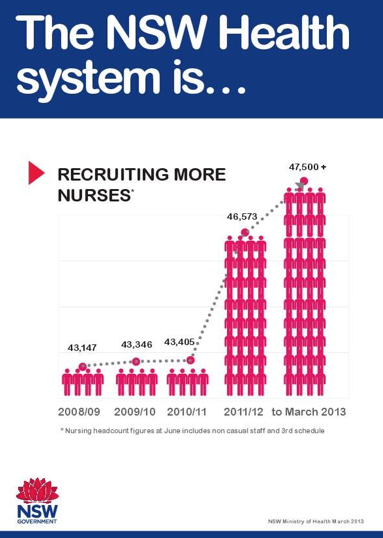
The Guardian blog section has the motto “Comment is free, but facts are sacred”.  Their Datablog is showing 16 examples of infographics that don’t exactly cast light on the facts, including

nurses

August 1, 2013

The machine that goes ‘ping’

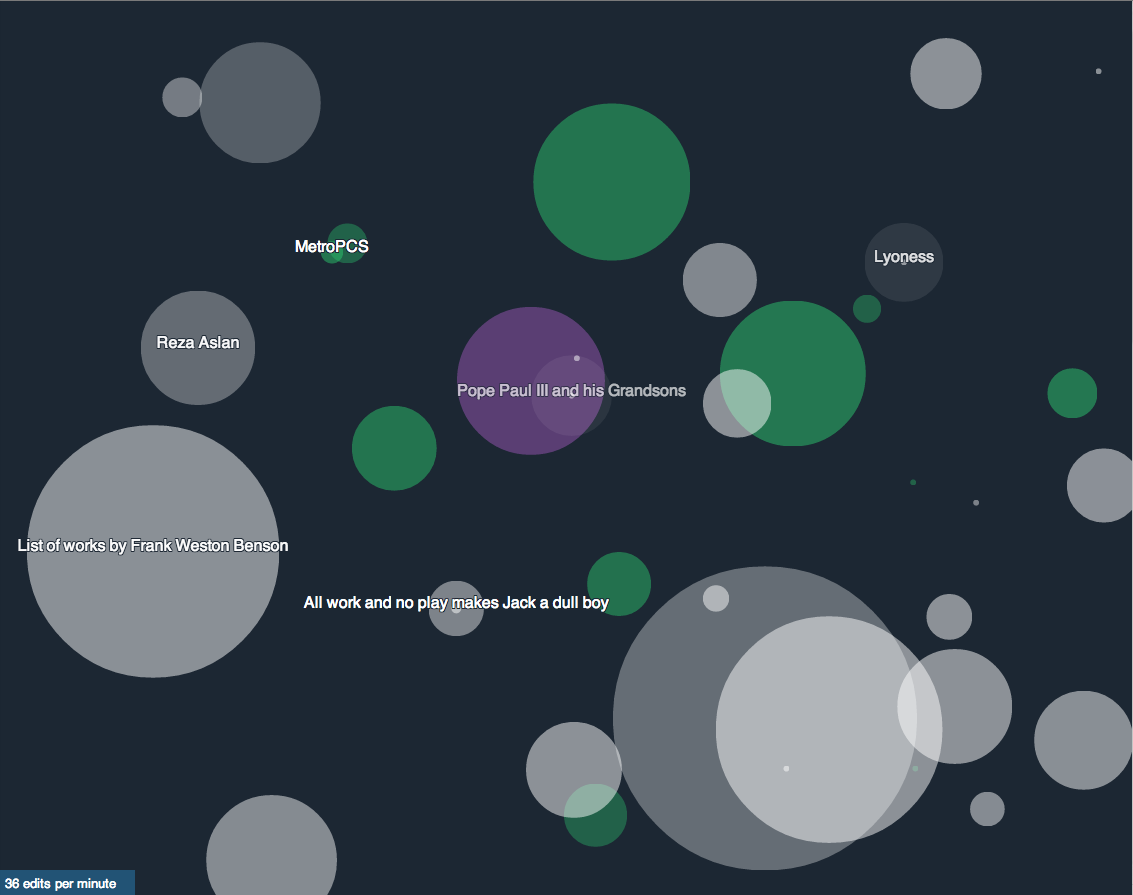
Listen to Wikipedia is an entrancingly pointless real-time display of edits to Wikipedia, with visual and audio, indicating additions and deletions, by registered or unregistered people or bots

ltw


(via @hildabast)

When in doubt, randomise

What are randomised trials and why are they important: one of a set of videos made for the 100th anniversary of the UK Medical Research Council

Also, a post about public randomisation ceremonies as a way of making the process transparent and obviously fair in trials where whole communities rather than individuals are randomised. In this case it was in Cameroon, but the PRISM trial of improved support for new mothers in Victoria, Australia used the same approach.

July 31, 2013

It depends on how you look at it

Collapsing lots of variables into a single ‘goodness’ score always involves choices about how to weight different information; there isn’t a well-defined and objective answer to questions like “what’s the best rugby team in the world?” or “what’s the best university in the world?”.  And if you put together a ranking of rugby teams and ended up with Samoa at the top and the All Blacks well down the list, you might want to reconsider your scoring system.

On the other hand, it’s not a good look if you make a big deal of holding failing schools accountable and then reorder your scoring system to move a school from “C” to “A”. Especially when it’s a charter school founded by a major donor to the governing political party.

Emails obtained by The Associated Press show Bennett and his staff scrambled last fall to ensure influential donor Christel DeHaan’s school received an “A,” despite poor test scores in algebra that initially earned it a “C.”

“They need to understand that anything less than an A for Christel House compromises all of our accountability work,” Bennett wrote in a Sept. 12 email to then-chief of staff Heather Neal, who is now Gov. Mike Pence’s chief lobbyist.