Posts written by Thomas Lumley (2645)

avatar

Thomas Lumley (@tslumley) is Professor of Biostatistics at the University of Auckland. His research interests include semiparametric models, survey sampling, statistical computing, foundations of statistics, and whatever methodological problems his medical collaborators come up with. He also blogs at Biased and Inefficient

May 2, 2013

Why does no-one listen to us?

Dan Kahan, a researcher in the Cultural Cognition project at Yale Law School, has an interesting post on “the science communication problem”

The motivation behind this research has been to understand the science communication problem. The “science communication problem” (as I use this phrase) refers to the failure of valid, compelling, widely available science to quiet public controversy over risk and other policy relevant facts to which it directly speaks. The climate change debate is a conspicuous example, but there are many others

May 1, 2013

Hostis humani generis

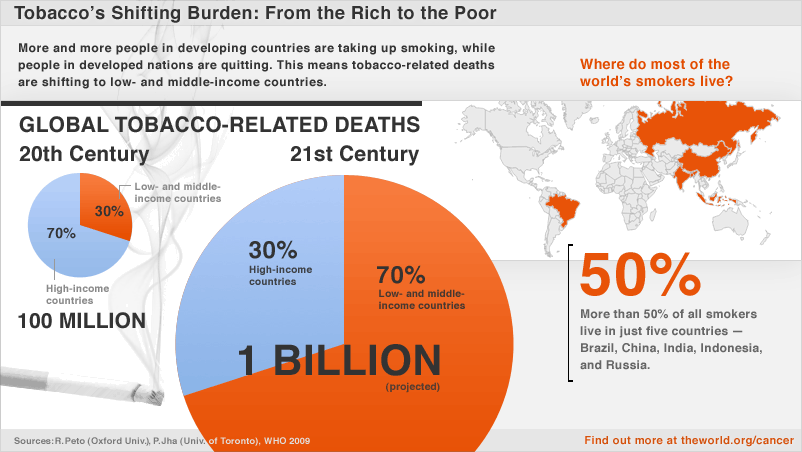
This graph, from Public Radio International, may help illustrate why public-health people have such a different attitude to business and economics people on cigarette plain packaging

cancer-tobacco-lg


Economists worry about whether plain packaging is effective in reducing smoking, and whether the costs it imposes in New Zealand are out of proportion to the benefits. Other businesses may worry that the idea will spread.

Public health advocates are genuinely mystified by this. They regard tobacco as unique, and tobacco companies as among the common enemies of humankind, to be wiped out as expeditiously as is possible without too much collateral damage.

Two new books

April 30, 2013

Return of the Pomegranate: the sequel

While distracted by a conference in late January, I missed the next exciting installment of the Edinburgh pomegranate saga.

As you will recall, a research group in Edinburgh have put out press releases in recent years about the impact of pomegranate juice on blood pressure, cortisol (a stress hormone), and testosterone.  They haven’t published any scientific papers about these findings, though they have produced a presentation at a scientific conference.

The most recent installment claims that pomegranate extract reduces hunger and food consumption. This study seems to be better designed than the previous ones: participants were randomised to pomegranate extract tablets or placebo for three weeks.  They were then given a glass of pomegranate juice and a meal.  Those who had been taking the pomegranate extract reported feeling less hungry and ate less — 22% less. It’s a pity the study didn’t measure weight, because if the 22% reduction in food consumption generalised beyond the one experimental meal it would have led to measurable weight loss over three weeks.

Again, this was a premature and unsubstantiated press release, and the experiment has not been published in a peer-reviewed journal, although the researchers do at least say they will be presenting it at a conference later in the year.

Briefly

Two small gems from the Twitter feed

April 29, 2013

Boring, low-tech medical innovation

A long piece in the Washington Post: by Ezra Klein, recommended by Atul Gawande

Brenner puts it more vividly. “There is a bias in medicine against talking to people and for cutting, scanning and chopping into them. If this was a pill or or a machine with these results it would be front-page news in the Wall Street Journal. If we could get these results for your grandmother, you’d say, ‘Of course I want that.’ But then you’d say, what are the risks? Does she need to have chemotherapy? Does she need to be put in a scanner? Is it a surgery? And you’d say, no, you just have to have a nurse come visit her every week.”

April 28, 2013

Context

We heard today that the Christchurch rebuild will be more expensive, by sagans of dollars, than previously computed.

3News attempted to provide some context for the cost of the rebuild, saying it was about the “same as the GDP of Kuwait or Vietnam.(1:20)  The problem is that most of us have less understanding of the GDP of Kuwait or Vietnam than of $40 billion, so this isn’t terribly helpful.

In fact, the lack of understanding appears to extend  to 3News, since in fact the GDP of Kuwait and Vietnam are about US$175 billion and US$125 billion, not NZ$40 billion.  The government budget (not GDP) in Vietnam is roughly NZ$40 billon, but I don’t know where the Kuwait figure comes from.

Briefly

  • BBC news report on the Amanda Knox case and misuse of statistics: judge did not believe that repeating a test could increase its accuracy (via Mark Wilson)
  • A tool for finding stories based on light makeover of press releases. Unfortunately, it often doesn’t detect recycling of stories from sites such as Medical Daily and Science Daily, which do enough rewriting to mask the sources.
  • New York Times opinion piece on evidence and science reporting — yes, distinguish experimental and observational studies, but also distinguish small exploratory studies from larger confirmatory ones. (via @brettkeller)
  • Using anecdotes rather than data to convince patients. On one hand, speaking to people in language they understand is good; on the other hand, you can use anecdotes to support anything.
April 27, 2013

Facebook data analysis and visualisation

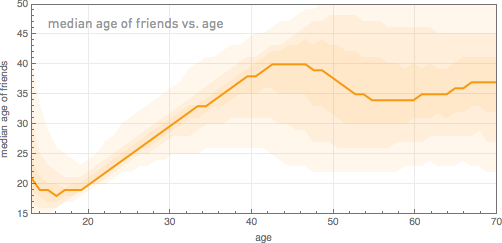
From the Stephen Wolfram blog, lots of analysis of Facebook friend data with well-designed graphs.  For example, this graph shows how the mean age of your `friends’ is related to your age.

median-age-friends-vs-age2


Those under 40 have Facebook friends of about the same age, but after than the age distribution levels off and becomes much more variable.

New science journalists

Three journalists who have just finished internships in science journalism with NPR news in Washington, DC. Might be useful to follow in the future: