Posts written by Thomas Lumley (2645)

avatar

Thomas Lumley (@tslumley) is Professor of Biostatistics at the University of Auckland. His research interests include semiparametric models, survey sampling, statistical computing, foundations of statistics, and whatever methodological problems his medical collaborators come up with. He also blogs at Biased and Inefficient

March 5, 2013

Statistics used for decoration

The story on Stuff starts

Wellingtonians are an inventive bunch, with many in the capital applying to patent ideas they could create income from.

You might expect this would be backed up by data on high or increasing patent submissions from Wellington, but no:

In the year to July 2012, the Intellectual Property Office of New Zealand received 6253 patent applications, compared with 6163 a year earlier.

Last year, 124 were filed from the Wellington region and only 27 were accepted.

That is, the number of patent applications is roughly constant, and Wellington is under-represented in terms of population (and I would have though in terms of number of head offices as well).

The numbers don’t actually add anything to the story, they’re like the little paper umbrellas in a cocktail, intended for decoration rather than consumption.

They think they are representing you

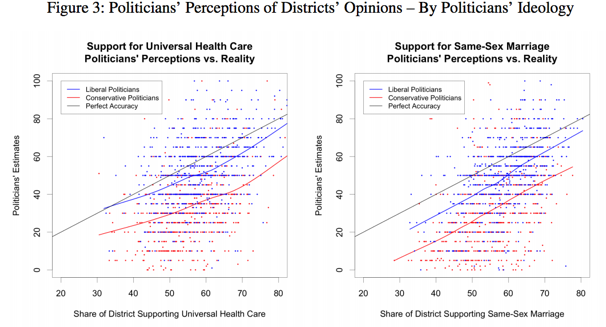
An interesting finding from the US (via):  politicians think their electorates are more conservative than they actually are — slightly more conservative for left-wing politicians, much more conservative for right-wing ones.

broockman_graph


The errors are large: right-wing politicians overestimate the support among their electorate for conservative positions by an average of nearly 20%.  The size of the error, and the big differences by ideology of the politician mean that it can’t just be explained by actual voters being more conservative than the population at large.

March 4, 2013

Briefly

Successful randomized trial of diet

As I have previously observed, there are far too many clever ideas and far too few actual evaluations of effectiveness in diet research, so it’s great to see something that has actually worked.

Researchers in Spain randomized 7500 people at high risk of cardiovascular disease to be told to follow a Mediterranean diet with extra olive oil, a Mediterranean diet with extra nuts, or just to get standard background dietary advice.  The trial was stopped early, after about five years’ followup, because the two Mediterranean diet groups had a substantially lower rate of major cardiovascular events.  The relative risk reduction was about 30%, and the absolute risk reduction about 1 percentage point.

Getting people to adopt a Mediterranean diet may be easier in Spain, so it would be good to have similar results for other recommended diets, eg, based on south-east Asian food.

(via Simply Statistics)

March 3, 2013

Keep calm and ignore tail risk

Consider a problem in statistical decision theory.

Suppose you can create a t-shirt slogan at zero cost, and submit it for market testing.  If it’s popular, you make money; if it isn’t popular, you pay nothing.  It’s easy to see that you should submit as many t-shirt designs as you can generate: there’s no downside, and the upside might be good.

The problem is that you might create slogans that are sufficiently offensive to get the whole world mad at you.  And if you create more than half a million t-shirt slogans, it’s not all that unlikely that some of them will be really, really, really bad. And it’s not a convincing defense to say that the computer did it, and you didn’t bother checking the results.

Shooting yourself in the foot

The US has just imposed a set of spending cuts that was deliberately designed to be so stupid and destructive that even getting the wrong side of a compromise would be more attractive to both parties.

Among the major victims are scientists and their technical staff. Here’s some of what they have written about it

[update: the #sciquestertips tag on Twitter has black humour about the situation]

Statistics and journalists

The (US) National Institute for Computer-Assisted Reporting is having its annual conference.  This is a project of Investigative Reporters & Editors, whose statistics interventions for journalists range from a set of statistical tipsheets to having Hadley Wickham teach R to the nerdier ones. Unfortunately, it’s harder to fund this sort of thing in a small country.

Liz Lucas, one of the participants in a recent ‘statistics boot camp’ wrote about why journalists should learn statistics

When confronted with this statistical reality, what did the state officials say? In effect, “leave the statistical analysis to the government, OK?”

Now, if that doesn’t make you want to run for the nearest copy of “Statistics for Dummies”, I don’t know what will.


Homeopathy: there’s nothing to it

From yesterday’s Herald:

Government agencies are assessing the legality of a diet that promises people they will lose up to half a kilogram a day by using a homeopathic fertility hormone banned in the United States.

The diet, which is gaining popularity in New Zealand, involves taking a substance known as hCG and restricting food to 500 calories a day for up to 40 days.

If it’s homeopathic, it doesn’t involve taking hCG. That’s kind of the point of homeopathy.  Either way, if the diet involves losing half a kilogram a day, that’s water, not fat.  Losing half a kilogram of fat means cutting cumulative energy intake by 4500 Calories, and you’re not doing that in a day.

If it’s homeopathic, then the product itself is presumably safe, but the diet probably isn’t, and the quoted statements by the distributor seem to pretty clearly violate NZ Advertising Standards, as does the web site.

Update: if the drops are homeopathic, they won’t be doing anything, but would real hCG help with weight loss?  The place to look for evidence is the Cochrane Library (which is free-access in NZ). There is a systematic review of 14 randomised trials of hCG.  In summary

Twelve of the RCTs reported that weight‐loss with the use of hCG was no greater than with the use of a placebo or with the use of diet alone.

All of the 8 trials reporting fat distribution as an outcome had negative results.

Ten trials reported on hunger and 8 on a feeling of well‐being, only one trial in each case having a positive result.

So, this is a homeopathic version of a treatment that has been demonstrated ineffective, coupled with a dangerous diet.

The data speak for themselves

Today, from the Herald “More people on benefits as Govt fiddles with job requirements”

Labour spokeswoman for social development Jacinda Ardern said the highest unemployment numbers were at around 10 per cent in the early 1990s but support for solo parents and invalids have hit record highs during Bennett’s reign as Social Development Minister.

Between January 2009 and January 2012, the number of people on the DPB rose by 13.2 per cent. During the same period, the number of people on the unemployment benefit rose by 82 per cent.

Late January, in the Fairfax papers, “Beneficiary numbers in overall down trend”

Staff at Work and Income work hard to identify job opportunities with local employers and connect them with people who’re ready to work,” Mrs Bennett said.

On average Winz put 1000 people into new jobs each week around the country.

In the year to October 2012, 82,000 New Zealanders went off benefits and into work.

Ministry of Social Development website figures show the number of people on the unemployment benefit last month was the lowest December figure since 2008.

Since the actual numbers are a matter of public record, presumably both Adern and Bennett are telling the literal truth, but both of them are being misleading. To start with, you’d have to be suspicious about a trend that’s being quoted up to Jan 2012, which was more than a year ago.

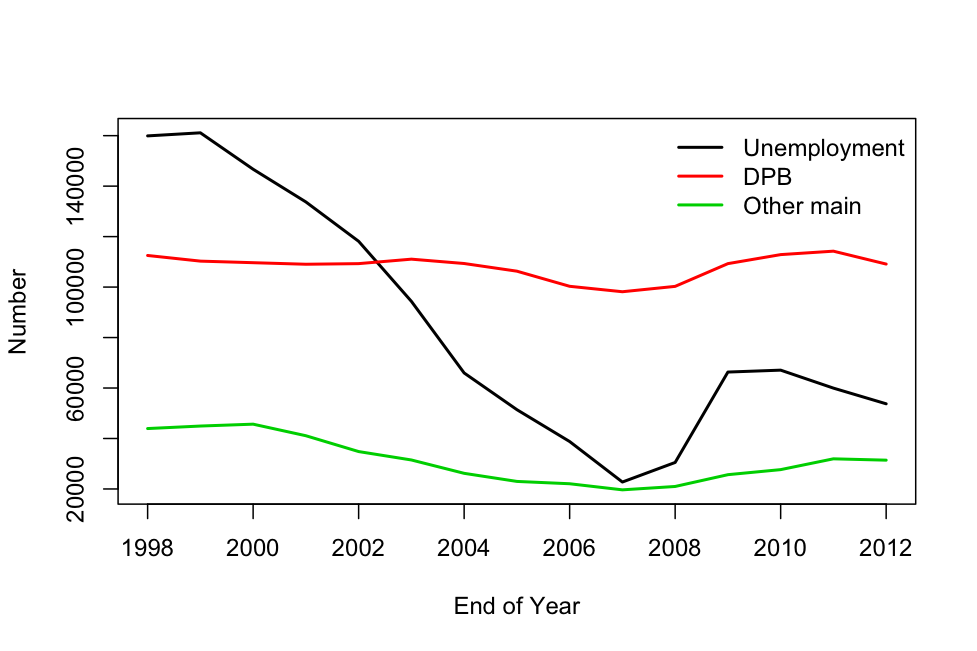
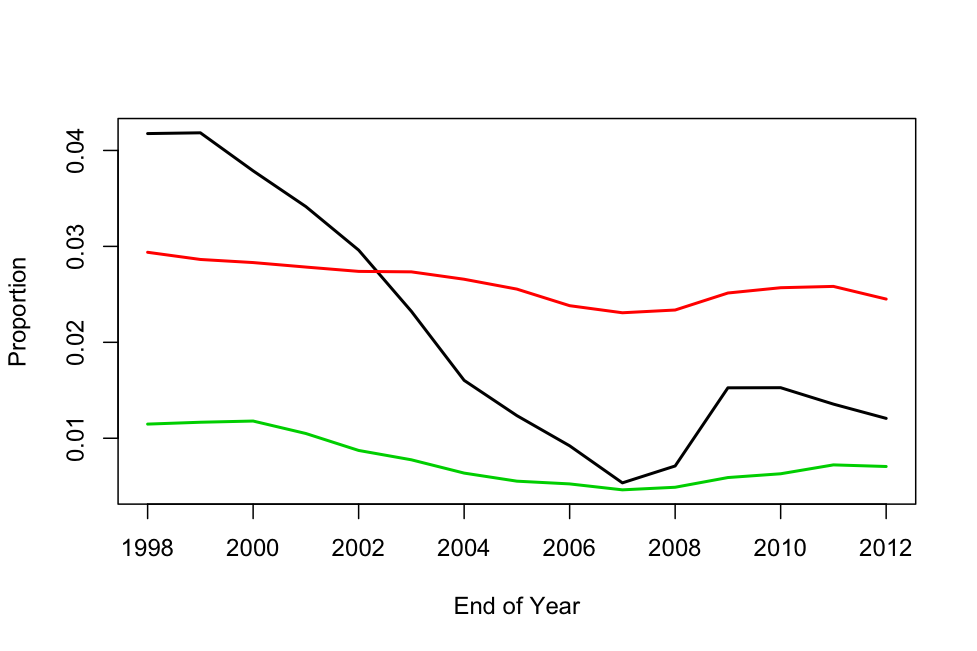
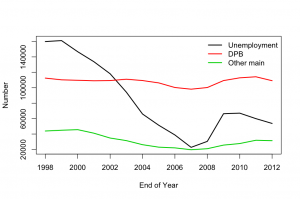
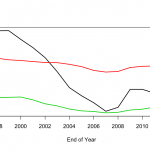
If you at the actual numbers, from the Ministry of Social Development (and work around the fact that they are in a Word document, not some sensible data format), it becomes clear that there are two patterns.  For unemployment, Dependent Persons Domestic Purposes, and “Other main” benefits, the main variation is with the state of the economy (strongly, for unemployment, more weakly for the other two).  It’s not really possible to tell if the recent changes have had any effect, but it is clear that anyone quoting a difference between two points as if it was evidence is not to be trusted.
benefits1


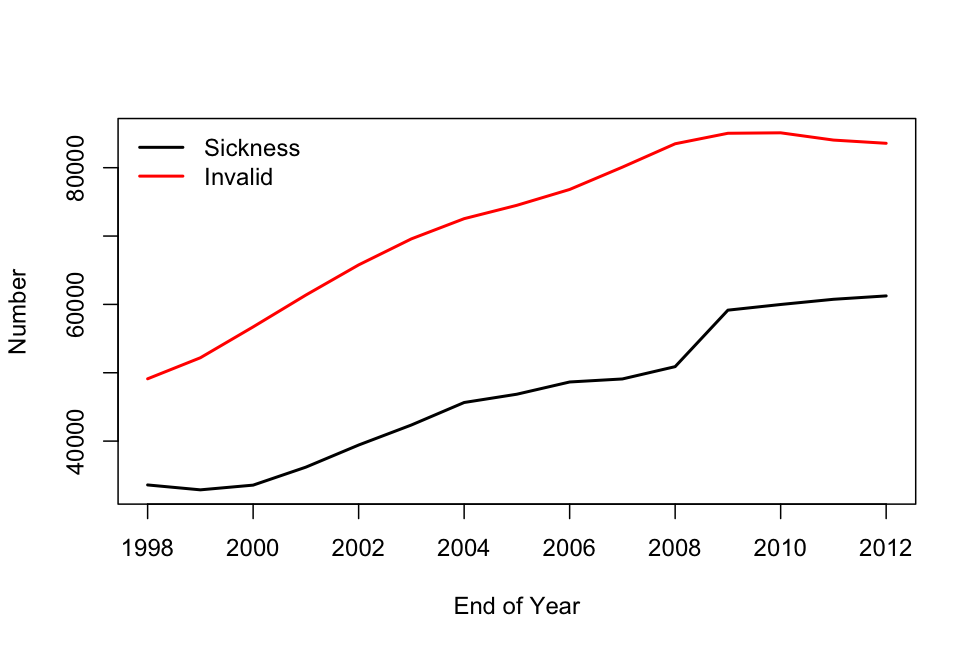
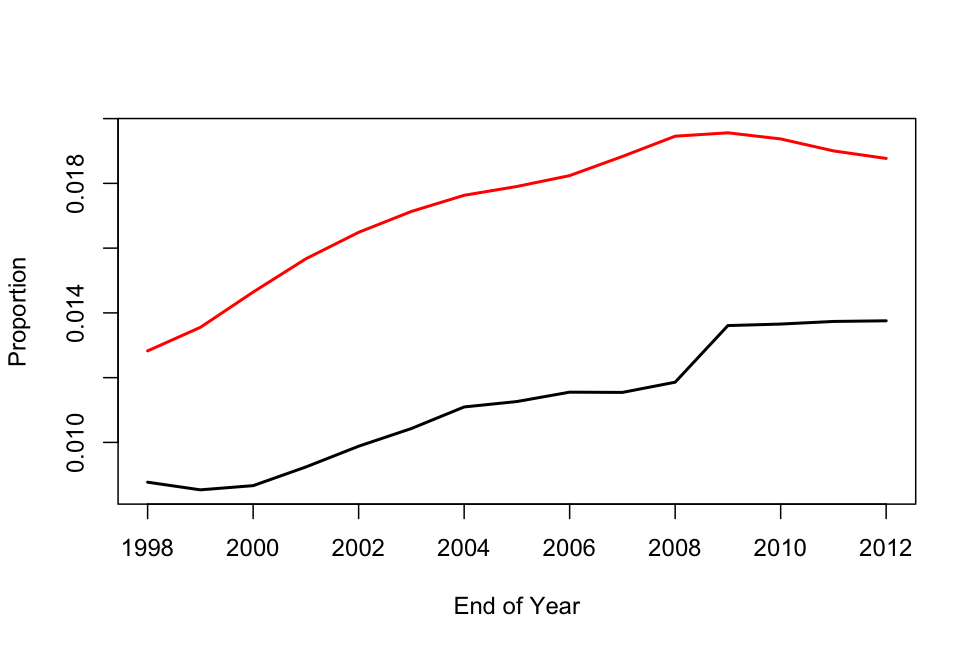
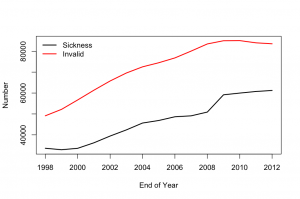
Sickness benefit and Invalid’s benefit have been rising, for as long as I can find the numbers, though the rise has flattened off in recent years.  This could possibly be evidence for the effectiveness of Bennett’s changes; it really can’t be evidence against them.
benefits2


Ideally these should have been standardised by population, which increased about 25% over this period, but it doesn’t make much difference, as you can see.  Age adjustment would also be useful, but is a lot more work.
benefits3  benefits4

March 1, 2013

It’s all happening…

Next Tuesday, March 5, is Nerdnite Auckland again, at Nectar, above the Kingslander pub on New North Rd

  • Tim McNamara, who coordinates digital volunteer response in emergencies talking about privacy. “Privacy: It’s worse than you think”.
  • Biomedical engineer Michelle Dickinson, on nanotechnology
  • Richard Easther, a cosmologist from the physics department at Auckland University will be giving us a biographical talk about Beatrice Tinsley

and when you get home, you can fill out your Census form.