Posts written by Thomas Lumley (2645)

avatar

Thomas Lumley (@tslumley) is Professor of Biostatistics at the University of Auckland. His research interests include semiparametric models, survey sampling, statistical computing, foundations of statistics, and whatever methodological problems his medical collaborators come up with. He also blogs at Biased and Inefficient

January 27, 2013

N jobs destroyed?

So. 3News reports that the changes to the warrant of fitness rules are going to lead to 2000 jobs being destroyed.  Since this number comes from opponents of the change, it’s almost certainly exaggerated, but how does it compare to the  general rate of job creation and destruction?

According to Stats NZ, in 2009 there were 252 360 jobs lost. Fortunately, there were 223 860 jobs created, even in the depths of the recession.  In 2008, there were 259 920 jobs created and 205 170 jobs destroyed.  So, the WoF change amounts to about 3 days worth of normal background job destruction.  As this shows, jobs always turn over quite rapidly. If we (or, rather, those of you who have cars) stop spending money on WoFs, the money saved will mostly get spent on something else, and will create broadly the same number of jobs there.

Specific job creation or destruction matters a lot in towns that depend on a single employer or industry, but otherwise the headline numbers are rarely as bad as they sound, unless you have one of the jobs.

Clinical trials in India

Stuff has a story from the Sydney Morning Herald on clinical trials in India.  The basic claims are damning if true:

…clinical drug trials are at the centre of a growing controversy in India, as evidence emerges before courts and, in government inquiries, of patients being put onto drug trials without their knowledge or consent…

With a very few exceptions (eg some trials of emergency resuscitation techniques and some minimal-risk cluster-randomised trials of treatment delivery)  it is absolutely fundamental that trial participants give informed consent. Trial protocols are supposed to be reviewed in advance to make sure that participants aren’t asked to consent to unreasonably things, but consent is still primary.  This isn’t just a technical detail, since researchers who were unclear on the importance of consent have often been bad at other aspects of research or patient care.

The Fairfax story mixes in the claimed lack of consent with other claims that are either less serious or not explained clearly. For example

Figures from the drugs controller- general show that in 2011 there were deaths during clinical trials conducted by, or on behalf of, Novartis, Quintiles, Pfizer, Bayer, Bristol Mayer Squibb, and MSD Pharmaceutical.

Of course there were deaths in clinical trials. If you are comparing two treatments for a serious illness, the trial participants will be seriously ill.  When you need to know if a new treatment reduces the risk of death, the only way to tell is to do a study large enough that some people are expected to die.  Even if improved survival isn’t directly what you’re measuring, a large trial will include people who die. In the main Women’s Health Initiative hormone replacement trial, for example, 449 women had died by the time the trial was stopped.  The question isn’t whether there were deaths, it’s whether there were deaths that wouldn’t have occurred if the trials had been done right.

There’s also a claim that families of participants who died were not given adequate compensation as part of the trial.  If there had been consent, this wouldn’t necessarily matter. Lots of trials in developed countries don’t specifically compensate participants or relatives, and there’s actually some suspicion of those that do, because it provides another incentive to participate even if you don’t really want to.

Other sources: Times of India, Chemistry World, a couple of review articles, the Nuremberg Code


January 26, 2013

Selma and Stonewall

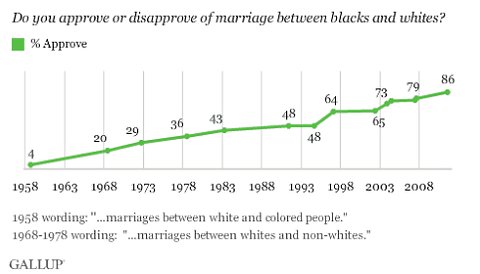
Today’s fascinating survey time series: for fifty-five years Gallup has been asking people in the US if they approve of interracial marriage. (via Paul Krugman, in the NY Times)

Gallup, via New York Times

On the one hand: Yay, progress! On the other hand, one in seven people still not only don’t approve but are prepared to admit this to a random caller on the phone.


Think of a number and multiply by 3120

The Herald has a story about a new app called TalkTo. Rather than you calling a business and waiting around for a possibly unhelpful response, you can text TalkTo and wait for them to call the business, ask your question and pass on the unhelpful response. Or, at least, you can if the business is in the USA or Canada — they currently wouldn’t handle Novapay or Qantas, the two examples in the story. The app obviously wouldn’t help for issues that require a dialogue, which includes essentially all the time I spend on hold.

Anyway, the statistics angle is that we apparently spend 43 days on hold during our lives.  As a basic numeracy challenge: is this more than you expect or less?

The number comes from 20 minutes per week for 60 years, so it doesn’t apply to any actually existing people — 60 years ago, we didn’t have the same level of on-hold, and 60 years in the future there’s at least some hope that a larger fraction of businesses will figure out how to make a useful web page (or whatever the next communication technology but seven turns out to be).

Bogus poll headlines return

It’s been a long time since we last had a headline based on a bogus poll, but this week the Herald gives us a link on the Life & Style page

Poll: Cafe made right call
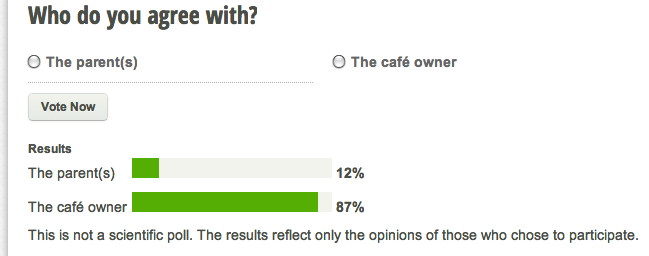
A poll shows almost 90 per cent of people think the café did the right thing, asking the mother to remove her crying baby…

and the headline for the story Crying baby debate: Cafe made right call.”

The first question for “almost 90 per cent of people” is “which people?”, and second “how were they sampled?”

The poll (which comes with a bogosity disclaimer) is in the Bay of Plenty Times

Bay of Plenty Times clicky poll


NZ Herald bogus poll

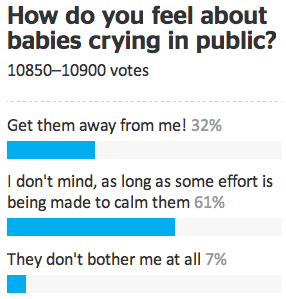
In the Herald, the story is accompanied by another bogus poll, one that gives a quite different impression (and which doesn’t come with a disclaimer)

The difference will partly be the different audiences, partly the different phrasing of the question, and partly a reflection of the fact that bogus polls are completely useless as data-gathering methods.

The lack of agreement is still pretty dramatic.


January 24, 2013

Pie charts rot the brain

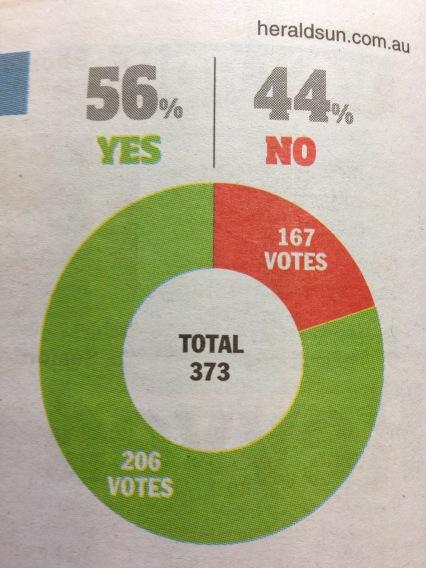
Evidence from a well-known West Island newspaper

hun


The chart says about 20%, the numbers say 44% (actually 45% if you can round correctly, but let’s not quibble).  (via and)

Enough with the Nobel correlations, already

Remember the correlation between current chocolate consumption and all-time Nobel Prizes?

Two British researchers now have done the same exercise for current milk consumption. Their letter, in the journal Practical Neurology suggests (I hope not seriously) that vitamin D might be responsible. They used Messerli’s data on Nobel Prizes, and don’t seem to have noticed any of the problems with it.

As you will remember, we showed length of country name (per capita) was rather more strongly correlated with Nobel Prizes (per capita) than chocolate consumption, and it also beats milk consumption. It’s also much more convincing as a causal relationship: the country names are much more constant over the time the Nobel Prize data were accumulated than milk or chocolate consumption, and since there’s no plausible mechanism for wealthy countries to have longer names than poor countries we avoid economic confounding.


Rare disease dilemma

The Herald has a story about a new treatment for a very rare blood disorder, and the fact that Pharmac isn’t funding it.

The drug, eculizumab (brand name Soliris), is currently the world’s most expensive, at about NZ$500 000 per year. It’s also very effective.  There’s starting to be a lot of this: we now have the technology to develop specific treatments for a wider range of rare diseases, and most of the rest of that ‘most expensive’ list are replacement enzymes for rare deficiency disorders.   Another recent example is ivacaftor (brand name Kalydeco), which, in about 5% of cases of cystic fibrosis allows the defective chloride transporter protein to work normally.  The result appears to be complete control of the disease, but at a cost of US$300 000 per year. Similar drugs for other variants of cystic fibrosis are being tested.

Funding any one of these drugs would be a minor total cost for Pharmac, because each rare disease is rare. There are only about eight people in New Zealand who would take eculizumab, which would cost only 0.5% of Pharmac’s budget; there would be about 25 who could take ivacaftor, adding up to a percent or two of the budget. The difficulty is that rare diseases collectively are not rare — the European Organization for Rare Diseases estimates that 6-8% of the European Union population have a rare disease and applying that figure to the NZ population still gives 270 000 people.  At $500 000 per person, Pharmac’s total budget would pay for 1500 people to get this sort of very expensive treatment.  At the moment there probably aren’t 1500 people in NZ whose rare diseases are expensively treatable, but there are a lot more than eight.

The patient support group for people with this rare blood disorder obviously think the treatment should be funded

The group’s founder, Auckland artist Daniel Webby, 32 – who almost died from PNH complications – said the funding process did not recognise the rights of rare-disease sufferers.

“They need to recognise that for rare diseases, [drug] development costs are higher per patient. They need to put that into their budget and make sure people get … life-saving treatments when they are available.”

I’m sure Pharmac does recognise this, but changing the national approach to subsidy of health care to give priority to ‘miracle’ treatments for rare diseases is not the sort of decision Pharmac should be making on its own, and the money shouldn’t be taken out of the current Pharmac budget (which is already on the low side).   Kiwis need to decide whether a miracle drug fund is something we want to support and are willing to pay for.


[Update: The Herald has an editorial weighing in strongly against expensive drugs even if effective.  I basically agree, but it’s a pity they don’t have the same attitude to miracle treatments that don’t work]

January 23, 2013

Bad graphs

A few resources for connoisseurs of bad graphics

But remember, as Martyn Plummer demonstrates, the graph may not be the author’s fault.

PS: we get a surprising number of readers searching for “cool excel graphics”, which is an excellent resource for bad graphs

Statistical evidence and cheating at chess

At the Zadar Open chess competition last month, a player who had previously been at the low end of the chess master range did extraordinarily well, playing the level of the world’s very best. Or at the level of a good computer program. There was absolutely no physical evidence to suggest that he had been cheating, but his level of improvement, and the agreement between his moves and those produced by top computer programs are striking.  On the other hand, if you are going to allow accusations in the absence of any corroborating physical evidence, it’s also essentially impossible for an innocent person to mount a defense.

KW Regan, who is a computer scientist and chess master has analysed historical chess competition data, looking at agreement between actual moves and those the computer would recommend, and he claims the Zadar Open results should happen less often than once in a million matches. In his letter to the Association of Chess Professionals, he raises the questions

1.What procedures should be instituted for carrying out statistical tests for cheating with computers at chess and for disseminating their results? Under whose jurisdiction should they be maintained?
2. How should the results of such tests be valued? Under what conditions can they be regarded as primary evidence? What standards should there be for informing di fferent stages of both investigative and judicial processes?

There’s a New York Times story, and Prof Regan also has a blog post. (via)