Posts written by Thomas Lumley (2645)

avatar

Thomas Lumley (@tslumley) is Professor of Biostatistics at the University of Auckland. His research interests include semiparametric models, survey sampling, statistical computing, foundations of statistics, and whatever methodological problems his medical collaborators come up with. He also blogs at Biased and Inefficient

February 5, 2016

Briefly

Returning-from-travel edition

  • Wordbank is an open database of information about children’s vocabulary growth. With pointy-clicky apps.
  • The Ethical Data Scientist. Cathy O’Neil, writing at Slate. “As long as our world is not perfect, and as long as data is being collected on that world, we will not be building models that are improvements on our past unless we specifically set out to do so.”
  • Billboards that use DNA on discarded cigarette butts or gum to recreate images of the litterer. “Obviously we have no photos of the original litterers to compare the sketches to, but according to Oglivy, the results are accurate.” [trust us, we’re an advertising agency]
  • HeadlineRevealed: The drug that keeps you young. Story: “Experts say they had extended the lifespan of mice by 35 per cent” and “The one used on mice is not suitable for people”
February 3, 2016

Units matter

I think this is just a typo in the Herald story about testing for methamphetamine in state houses:

Forensic scientist Dr Nick Powell said any meth contamination above 0.5mcg per 100sq m of surface risked headaches, coughs and sleeplessness, and poorer appetite and infant brain growth.

The NZ standard for cleanups is 0.5μg per 100cm2, which is designed to be safe, rather than just on the borderline of danger, so even with square centimetres this is a strong claim. Changing the denominator to square metres makes the claim ten thousand times stronger.

February 2, 2016

Not everything is a breakthrough. But.

Jack Scanlan, at Lateral

Steps could be taken to reduce the hype associated with every tiny step towards curing a disease or developing a new technology, but the trade-off would be a reduction in the amount of science making its way to the public.

Helpful prediction vs recycled prejudice

From What World Are We Building?  by danah boyd

One of the perennial problems with the statistical and machine learning techniques that underpin “big data” analytics is that they rely on data entered as input. When the data you input is biased, what you get out is just as biased. These systems learn the biases in our society, and they spit them back out at us.


January 25, 2016

Briefly

  • “Claims that forensic experts can match a bullet or shell casing found at a crime scene to a specific weapon lack a scientific basis and should be barred from criminal trials as misleading, a D.C. Court of Appeals judge wrote this week.”  The judge objected to claims that the evidence proved a ‘unique’ match. And quite right, too.
  • You can prove that a treatment works without knowing how it works, but it’s much harder to find treatments that way. Lithium for bipolar and other mood disorders is an excellent example
  • You might have heard of CRISPR in the news and wondered what exactly it was.  It’s a technique for cutting DNA at very easily customised locations, for example, to allow for new sequences to be inserted. Good references

Hangover cure?

“The ‘kudzu’ could cure your hangover”, says the Herald (from the Daily Mail)

We’ve had stories based on unpublished research before. This one is a bit special, because the ‘unpublished research’ is a BBC television programme that won’t be shown for a few days (or, at all, in NZ). And because it didn’t study hangovers or people with hangovers.

The BBC programme is apparently going to report a placebo-controlled crossover trial of how much free booze people drank when they had taken kudzu root extract or a dummy pill — they say they saw a 20% difference. The design is a good one, and given the general theme of the show there probably isn’t much risk of publication bias. Having a reasonably good design fits with seeing a benefit that’s only about half of what was seen in earlier US research.

The big problems with the BBC study are that it’s probably small (the stories don’t say) and doesn’t (so far)give any idea of the uncertainty in the 20% reduction, and that open-bar drinking in a television science experiment may be importantly different from the sort of drinking they’d like to decrease.

As science, the BBC study might actually be ok. But reducing alcohol consumption by 20%, if it does, is unlikely to have a big impact in preventing hangovers. And there is not the slightest suggestion in the research that kudzu root would work as a hangover cure.


January 24, 2016

Tracing a data factoid

I saw on Twitter this morning the claim “90% of the worlds data was created in the last 12 months”, raising the twin questions “Says who?” and “What does that even mean?”.

The tweet linked to a story at the Huffington Post, which attributed the claim to Constellation Research, but with no further information on how they found it out or when, or what they meant by it. Further Google searches find that most occurrences of the claim are either completely unsourced, attributed to the guy who wrote the HuffPo story, or also just say “Constellation Research”.

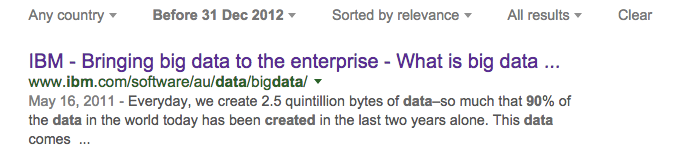
IBM has claimed “Everyday, we create 2.5 quintillion bytes of data–so much that 90% of the data in the world today has been created in the last two years alone.” But that’s two years, not 12 months. And they’ve been saying it for some time:
ibm

In 2012, the skeptics site at stackexchange.com discussed the IBM claim and found it plausible then — assuming that ‘data has been created’ meant that ‘data has been stored in some permanent medium of the sort IBM sells’. It’s not just business data, as some of the citations imply — it will include cat videos on mobile phones, data from the Large Hadron Collider, the NSA’s archive of your email, and lots and lots of porn.

It still could be that Constellation Research has a new estimate, not the recycled one from the days before Siri. However, a 2015 Oracle presentation (PDF, slide 7) says “90% of the world’s data has been created in the last two years“, and cites “ Constellation Research: “Businesses Must Answer the Call for Cloud Based Integration”“. So I’m guessing maybe not.

January 22, 2016

There’s nothing like a good joke

Q: Did you see that laughing can burn as many calories as a brisk walk?

A: In the Herald? Yes.

Q: Can it?

A: A very short brisk walk, yes.

Q: What do you mean?

A: They say “flat out, uncontrollable, roll on the floor howling – was found to burn 120 calories an hour, similar to the amount burnt by walking at a moderate pace.”

Q: So you just need to do that for an hour, nonstop?

A: That’s right.

Q: This was a British scientist, right?

A: ….yes?

Q: The BBC has pretty good comedies

A: Not that good

Q: Do they have any real estimates of how much exercise you could get?

A: Not in the Herald, but another newspaper says their estimated maximum for the funniest show they looked at was 32 ­calories of laughter over 45 minutes.

Q: So like a quarter of an hour of brisk walking?

A: Pretty much

Q: Which show?

A: Taskmaster

Q: ?

A: I think you had to be there.

Q: And how about humour producing wry smiles and the occasional snigger?

A: That burns about as much energy as reading blogs.

Q: It doesn’t sound like a serious suggestion. Is it possible that the papers which printed this story just didn’t get the joke?

A: Could easily be.

January 21, 2016

Mining uncertainty

The FDA collects data on adverse events in people taking any prescription drugs. This information is, as it should be, available for other uses. I’ve been involved in research using it.

The data are also available for less helpful purposes. As Scott Alexander found,  if you ask Google whether basically anything could cause basically anything, there are companies that make sure Google will return some pages reporting that precise association.  And, as he explains, this is serious.

For example, I tried “Adderall” and “plantar fasciitis” as an implausible combination and got 4 hits based on FDA data. And “Accutane” and “plantar fasciitis”, and “Advair” and “plantar fasciitis”, and “acyclovir” and “plantar fasciitis”. Then I got bored.

It’s presumably true that there are people who have been taking Adderall and at the same time have had plantar fasciitis. But given enough patients to work with, that will be true for any combination of drug and side effect. And, in fact, the websites will happily put up a page saying there are no reported cases, but still saying “you are not alone” and suggesting you join their support group.

These websites are bullshit in the sense of philosopher Harry Frankfurt: it is irrelevant to their purpose whether Adderall really causes plantar fasciitis or not. They make their money from the question, not from the answer.


(via Keith Ng)

January 19, 2016

Rebooting your immune system?

OneNews had a strange-looking story about multiple sclerosis tonight, with lots of footage of one British guy who’d got much better after treatment, and some mentions of an ongoing trial. With the trial still going on, it wasn’t clear why there was publicity now, or why it mostly involved just one patient.

I Google these things so you don’t have to.

So. It turns out there was a new research paper behind the publicity. There is an international trial of immune stem cell transplant for multiple sclerosis, which plans to follow patients for five years after treatment. The research paper describes what happened for the first three years.

As the OneNews story says, there has been a theory for a long time that if you wipe out someone’s immune system and start over again, the new version wouldn’t attack the nervous system and the disease would be cured. The problem was two-fold. First, wiping out someone’s immune system is an extraordinarily drastic treatment — you give a lethal dose of chemotherapy, and then rescue the patient with a transplanted immune system. Second, it didn’t work reliably.

The researcher behind the current trial believes that the treatment would work reliably if it was done earlier — during one of the characteristic remissions in disease progress, rather than after all else fails. This trial involves 25 patients, and so far the results are reasonably positive, but three years is really to soon to tell whether the benefits are worth the treatment. Even with full follow-up of this uncontrolled study it probably won’t be clear exactly who the treatment is worthwhile for.

Why the one British guy? Well,

The BBC’s Panorama programme was given exclusive access to several patients who have undergone the stem cell transplant.

The news story is clipped from a more in-depth current-affairs programme. That BBC link also shows a slightly worrying paranoid attitude from the lead researcher

He said: “There has been resistance to this in the pharma and academic world. This is not a technology you can patent and we have achieved this without industry backing.”

That might explain pharma, but there’s no real reason for the lack of patents to be a problem for academics. It’s more likely that doctors are reluctant to recommend ultra-high-dose chemotherapy without more concrete evidence. After all, it was supposed to work for breast cancer and didn’t, and it was theorised to work for HIV and doesn’t seem to. And at least in the past it didn’t work reliably for multiple sclerosis.

All in all, I think the OneNews story was too one-sided given the interim nature of the data and lack of availability of the treatment.  It could also have said a bit more about how nasty the treatment is.  I can see it being fine as part of a story in a current affairs programme such as Panorama, but as TV news I think it went too far.