Posts written by Thomas Lumley (2645)

avatar

Thomas Lumley (@tslumley) is Professor of Biostatistics at the University of Auckland. His research interests include semiparametric models, survey sampling, statistical computing, foundations of statistics, and whatever methodological problems his medical collaborators come up with. He also blogs at Biased and Inefficient

January 18, 2016

Supplement pushing

The Herald has a Daily Mail story about vitamin D for making you generally feel better. It’s not so long ago that the NZ media had a lot of less supportive coverage on vitamin D — Ian Reid, Mark Bolland, and Andrew Grey won the Prime Minister’s Science Prize last year for their work showing that calcium and vitamin D aren’t all they’re cracked up to be.

The story does have some new evidence.

In the study, by a medical team in Edinburgh, volunteers were asked to cycle for 20 minutes. They were then given either a placebo or vitamin D and, two weeks later, were asked to cycle for 20 minutes again.

The buck needs to stop somewhere

From Vox:

Academic press offices are known to overhype their own research. But the University of Maryland recently took this to appalling new heights — trumpeting an incredibly shoddy study on chocolate milk and concussions that happened to benefit a corporate partner.

Press offices get targeted when this sort of thing happens because they are a necessary link in the chain of hype.  On the other hand, unlike journalists and researchers, their job description doesn’t involve being skeptical about research.

For those who haven’t kept up with the story: the research is looking at chocolate milk produced by a sponsor of the study, compared to other sports drinks. The press release is based on preliminary unpublished data. The drink is fat-free, but contains as much sugar as Coca-Cola. And the press release also says

“There is nothing more important than protecting our student-athletes,” said Clayton Wilcox, superintendent of Washington County Public Schools. “Now that we understand the findings of this study, we are determined to provide Fifth Quarter Fresh to all of our athletes.”

which seems to have got ahead of the evidence rather.

This is exactly the sort of story that’s very unlikely to be the press office’s fault. Either the researchers or someone in management at the university must have decided to put out a press release on preliminary data and to push the product to the local school district. Presumably it was the same people who decided to do a press release on preliminary data from an earlier study in May — data that are still unpublished.

In this example the journalists have done fairly well: Google News shows that coverage of the chocolate milk brand is almost entirely negative.  More generally, though, there’s the problem that academics aren’t always responsible for how their research is spun, and as a result they always have an excuse.

A step in the right direction would be to have all research press releases explicitly endorsed by someone. If that person is a responsible member of the research team, you know who to blame. If it’s just a publicist, well, that tells you something too.

January 17, 2016

Not science yet

I’ve written before about the problem of unpublished science in the news: the news story won’t (can’t) give much detail, and there’s no way to find it out.  Stuff has gone one step further:

Recent animal studies show sleep’s cleansing process in action. But now scientists at Oregon Health & Science University are preparing to conduct a study on humans that would further explain deep sleep’s effect on human brains.

The ‘animal studies’ claim comes without any source. Fortunately the Google comes to the rescue and suggests it’s the research in this story from 2013. Interestingly, a couple of subsequent mouse studies have also found brain problems from interrupted sleep — but since each of the three studies found a different problem, with no overlap, this isn’t as supportive as it sounds.

It would matter less if it weren’t for the first sentence of the story

Forget about needing beauty sleep. It’s your brain that may suffer the most from a lack of deep shut eye.

There’s a definite suggestion that this is a risk factor you can do something about, especially as this is in the “Well & Good” section of the Stuff site.

Even if the Oregon research had been carried out and published, it might well not justify that sort of implication. Research that they’re still preparing to do certainly doesn’t.


[Update: It’s getting to be a trend: the Herald also has a story about research that hasn’t happened yet, on addiction.]

January 15, 2016

When you don’t find any

The Icelandic Ethical Humanist Association commissioned a survey on religion. For people who don’t want to read the survey report (in PDF, in Icelandic), there’s a story at Iceland Magazine. The main point is in the headline: 0.0% of Icelanders 25 years or younger believe God created the world, new poll reveals.

That’s a pretty strong claim, so what did the survey actually do? Well, here you do need to read the survey report (or at least feed snippets of it to Google Translate). Of the people they sampled, 109 were in the lowest age category, which is ‘younger than 25’.  None of the 109  reported believing “God created the world” vs “The world was created in the Big Bang”.

Now, that’s not a completely clean pair of alternatives, since a fair number of people — the Pope, for example — say they believe both, but it’s still informative to some extent. So what can we say about sampling uncertainty?

A handy trick for situations like this one is the ‘rule of 3’.  If you ask N people and none of them is a creationist, a 95% confidence upper bound for the population proportion is 3/N. So, “fewer than 3% of Icelanders under 25 believe God created the world”

Who got the numbers, how, and why?

The Dominion Post has what I’m told is a front page story about school costs, with some numbers:

For children starting state school this year, the total cost, including fees, extracurricular activities, other necessities, transport and computers, by the time they finish year 13 in 2028 is estimated at $35,064 by education-focused savings trust Australian Scholarship Group.

That increases to $95,918 for a child at a state-integrated school, and $279,807 for private school.

Given that the figures involve extrapolation of both real cost increases and inflation thirteen years into the future, I’m not convinced that a whole-education total is all that useful. I would have thought estimates for a single year would be more easily interpreted.  However, that’s not the main issue.

ASG do this routinely. They don’t have the 2016 numbers on their website yet, but they do have last year’s version. Important things to note about the numbers, from that link:

ASG conducted an online education costs survey among its members during October 2013. The surveys covered primary and secondary school. In all, ASG received more than 1000 survey responses.

So, it’s a non-random, unweighted survey, probably with a low response rate, among people signed up for an education-savings programme. You’d expect it to overestimate, but it’s not clear how much. Also

Figures have been rounded and represent the upper ranges that parents can reasonably expect to pay

‘Rounded’ is good, even though they don’t actually show much sign of having been rounded. ‘Represent the upper ranges’ is a bit more worrying when there’s no indication of how this was done — and when the Dom Post didn’t include this caveat in their story.


January 13, 2016

New UK alcohol recommendations

From David Spiegelhalter, at the Understanding Uncertainty blog

Last week, the Chief Medical Officer announced new guidelines for alcohol consumption. The summary says:

‘The proposed guidelines and the expert group report that underpins them, have been developed on the basis of the following principles: People have a right to accurate information and clear advice about alcohol and its health risks.

‘There is a responsibility on government to ensure this information is provided for citizens in an open way, so they can make informed choices.’

This admirable aim of treating the public as adults capable of making up their own minds seems in stark contrast with the authoritarian tone of publicity from the Department of Health, which baldly says: ‘Men should not drink more than 14 units of alcohol each week, the same as women’.

Read the rest

January 12, 2016

When it’s still not worth playing the lottery

Following up on the recording-breaking Powerball jackpoint in the US, there’s a story on Time.com headlined “The One Time It’s Mathematically Advantageous to Play Powerball.”  They’re still wrong, but they have taken many more of the relevant factors into account than usual, and it’s definitely worth reading.

On top of the microscopic chance of getting the winning numbers, they also look at the likelihood that you will have to share the jackpoint, the benefit of the minor prizes,  the US federal tax payable on the winnings, and the fact that the advertised payout is actually inflated by about 60% — it’s the total future payment for a 30-year annuity you can buy with the prize, not the value of the prize itself.

They come to the conclusion that a jackpot worth more than about $2.2 billion is worth buying tickets for, in the sense that it has positive expected cash return.  The one thing they don’t take into account is the non-linear utility of money. Two billion dollars isn’t actually worth two billion times as much as one dollar, unless you’re the US government or something.  If this sounds strange, all that it’s saying is that each extra dollar is worth more to you than it is to a billionaire.

The diminishing value of extra money means that playing the lottery basically can’t be worthwhile if you evaluate it in terms of winning. The only way playing the lottery can make sense is if you get enough enjoyment from thinking about winning to be worth the upfront cost.

January 6, 2016

Pay shock vs data

From the Herald, using data from Seek.co.nz: Pay shock: Wellington, not Auckland, is the New Zealand city with the highest advertised salaries.

According to the New Zealand Income Survey, the Wellington region has had the highest median weekly earnings for people in paid employment every year since at least 2007., so the shock should have had time to sink in by now. Looking at NZ.Stat, that’s also true for average weekly earnings.

However, when looking at actual earnings rather than advertisements at one site, Wellington’s percentage lead was only about half as big. And, of course, the actual dollar amounts are lower.

January 5, 2016

Some things don’t need exaggerating

Stuff:

The Dow Jones industrial average was set for its worst start to a year since 1932 as stock markets tanked after weak Chinese economic data reignited fears of a global slowdown.

Herald

The U.S. blue-chip index tumbled toward its worst start to a year since 1932, while banks and technology shares led the Standard & Poor’s 500 Index lower.

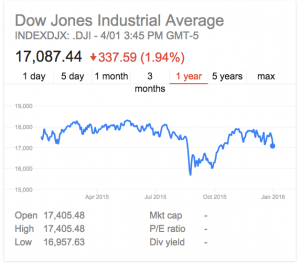
That’s presumably true, and bad news, but “start to a year” is doing a lot of work. Here’s the past year’s Dow:

dow

Unless there’s something especially predictive about the first trading day of the year, this is no worse than some quite recent days. And, the Herald says further down in the story

S&P Dow Jones Indices data indicate the first day of trading has no predictive power for the rest of the year. The index ends the year in the same direction it takes on the opening day 50.6 percent of the time, the data show. The first month of the year has proved more telling — the gauge’s return in January determines its direction for the year 72.4 percent of the time.


New things to read

Lateral is a relatively new science magazine produced by a bunch of mostly Australian, mostly young over-achievers. Their sixth issue is about Data.

And I think I’ve mentioned STAT, the new health and medicine (and not statistics) news site, but it’s worth mentioning again.