Posts written by Thomas Lumley (2645)

avatar

Thomas Lumley (@tslumley) is Professor of Biostatistics at the University of Auckland. His research interests include semiparametric models, survey sampling, statistical computing, foundations of statistics, and whatever methodological problems his medical collaborators come up with. He also blogs at Biased and Inefficient

January 4, 2016

Seek and ye shall be disappointed

There’s another Herald story about incomes based on job ads at Seek.co.nz.

Data released by job search company Seek shows outside of consultancy work roles linked to the building industry were paid the most last year and were some of the few sectors to see decent pay rises.

The average salary for the construction industry is now $94,580, a boost of 5 per cent on 2013 while engineers earned an average of $92,595

Stats NZ data isn’t quite as up to date, but the NZ Income Survey, in June, found average weekly earnings in the construction industry to be $1096 (go here, and select ‘Construction’ from ‘Industry’), up about 1% from 2013 (though 5% from 2014). If you assume a full-time job with holidays, that’s $57,000 per year.

I don’t know how much of this is due to different definitions and how much is due to the Seek jobs being non-representative, but it’s possible for anyone who really cares to find out exactly what the Stats NZ number means, and that’s not true for the Seek number.


January 3, 2016

Briefly

  • True-colour photos of Earth from space — why it’s not as simple as that, by Emily Lakadawalla
  • “The ranks of the wealthy grew in 2013, with 1.38 million households making it into the Top 1%, up from 1.36 million a year earlier.”  From CNN Money (who should understand percentages) via Felix Salmon
  • Translation of international new reprints matters. The Herald had a headline “North Pole now 50 degrees above normal“, which was 50 Fahrenheit degrees. In NZ terms, just under 30 Celsius degrees.
  • From the Christmas edition of BMJ, famous for its joke (but accurate) articles, a functional MRI imaging study comparing people who do and don’t celebrate Christmas, found differences in brain activation. These differences could be argued as a biological “Christmas Spirit” locus, plausible in terms of previous research.  The point, obviously, is how easy it is to overinterpret such things.
  • A group in the US did a randomised, blinded trial to see what effect faster internet speeds would have: they raised the bandwidth for 1500 people from 105Mbps to 250Mbps without telling them. People used the internet more, and it wasn’t primarily the heaviest users whose use increaseed.
January 1, 2016

As dangerous as bacon?

From the Herald (from the Telegraph)

Using e-cigarettes is no safer than smoking tobacco with nicotine, scientists warned after finding the vapour damages DNA and could cause cancer.

Smoking tobacco is right up near the top of cancer risks that are easy to acquire, both in terms of how big the risk is and in terms of how strong the evidence is.

[There was some stuff here that was right as to the story in the Herald but wrong about the actual research paper, so I got rid of it. Some of the tests in the research paper used real cigarette smoke, and it was worse but not dramatically worse than the e-cig smoke]


The press release is a bit more responsibly written than the story. It describes some of the limitations of the lab tests, and makes it clear that the “no safer than smoking” is an opinion, not a finding. It also gets the journal name right (Oral Oncology) and links to the research paper.

It’s worth quoting the conclusion section from the paper. Here the researchers are writing for other people who understand the issues and whose opinion matters. I’ve deleted one sentence that’s technical stuff basically saying “we saw DNA damage and cell death”

In conclusion, our study strongly suggests that electronic cigarettes are not as safe as their marketing makes them appear to the public. [technical stuff]. Further research is needed to definitively determine the long-term effects of e-cig usage, as well as whether the DNA damage shown in our study as a result of e-cig exposure will lead to mutations that ultimately result in cancer.

That’s very different from the story.

December 31, 2015

One of those end of year post thingies

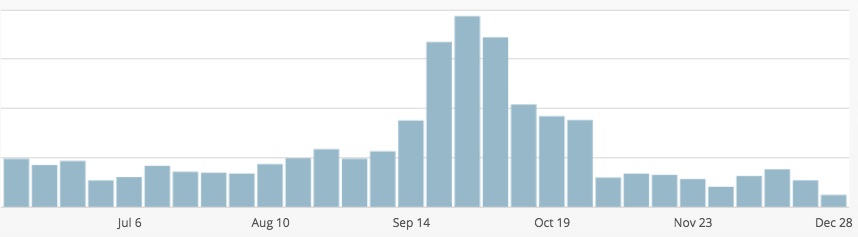
The most obvious thing in the StatsChat logs: the Rugby World Cup:

rugby

Also, back last January, there was a study on the relationship between cell divisions and cancer risk across human tissues. The popular misinterpretations of the research — “cancer is mostly bad luck” — led to our most popular post ever.

The question of what it means for something to be a Group I carcinogen gets us a lot of low-level traffic, but interest peaked after the IARC report on red meat and processed meat.

Posts on the risk posed by foreign drivers were popular early in the year. In July, though, they were displaced by foreign-sounding home buyers.

I wrote about the largest human randomised controlled trial of mānuka honey to prevent illness, when it was reported in June. It was done by kids at a London primary school. They didn’t find a benefit.

Finally, there’s a steady trickle of people interested in the mathematics of the lottery, presumably in the mistaken hope that we’ll tell them how to beat the martingale optional sampling theorem.

Superbooze?

Q: Did you see there’s a designer Kiwi cider that makers claim could combat ageing?

A: <sigh> Yes.

Q: And do the makers claim that?

A: Pretty much: “I never feel guilty about the drinks I consume, but I know that’s not the case for everyone. Knowing I’ve played a part in unlocking the secret to eternal youth is a career highlight.”

Q: Wow.

A: I know, right?

Q: What is his secret to eternal youth?

A: Cascara

Q: I think I’ve heard of ….  wait,  isn’t that a laxative?

A: They’re probably hoping their customers are too young to think of that. This is a completely different plant, just the same Spanish word.

Q: Ah. I see. Coffee berry husks. They used to just throw it away?

A: Well, in Yemen it’s a traditional beverage, and they drink it in Bolivia, too. And everywhere it at least gets recycled as compost. But from the viewpoint of the superfood industry they threw it away.

Q: Are they more specific about the whole eternal youth thing?

A: The Herald didn’t quote them, but yes, the company blog says “brewers added the berry’s purported health benefits that include preventing premature aging, heart disease, high cholesterol, asthma and Alzheimer’s to the cider profile.

Q: What research do they cite supporting this?

A: Very droll.

Q: No, seriously, don’t they say anything?

A: No.

Q: Is there research?

A: Well, it’s got antioxidants.

Q: Doesn’t everything?

A: And it seems to stimulate the release of brain-derived neurotrophic factor.

Q: In mice?

A: No, in people. Five of them.

Q: And is this brain-derived neuro-factor thing good?

A: With a name like that, how can it not be? Having some of it is important for lots of things.

Q: Some of it?

A: Doesn’t seem to be any real evidence that releasing more is good.

Q: But releasing it is unusual?

A: Caffeine does.

Q: Oh. Doesn’t sound like much support for the claims.

A: That’s what Dr Paul Jarrett, said — the expert the Herald asked.

Q: How about Yemen? Does this coffee berry stuff make them healthier there?

A: You couldn’t really tell, given what a mess the social and healthcare systems are in, not to mention the occasional drone bombings.

Q: Well, that was depressing

A: Ok. Back to the cider, then.

Q: Right. So, you’re not going drink it?

A: Well, not for the eternal youth. The flavour combination sounds attractive if I can hold my nose over the marketing.

Q: And maybe find a charity that does useful things in places like Yemen and Bolivia

A: Yeah.

December 29, 2015

Briefly

  • The Herald (and to a lesser extent Stuff) has started reporting number of crashes as well as number of fatalities on the roads. Probably a good thing.
  • Health News Review writes about spin in medical news reporting.
  • “But now scientists may finally have the answer. They have found that if a food is labelled as a healthy option we tend to eat more of it” From the Mail via the Herald. In fact, the research did not compare the consumption of food with healthy labels to food without.
  • The frequency of `positive’ words such as “favorable”, “encouraging”, “supportive” has been increasing in medical research abstracts. In less favourable reporting, Language Log points out that abstracts have gotten longer, and is not entirely supportive about deducing attitude from single words.
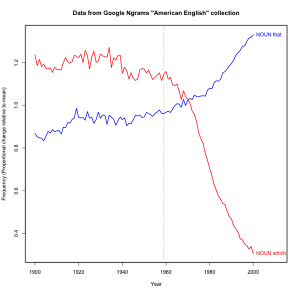
  • Also from Language Log: the `traditional’ `grammar rule’ that “which” doesn’t occur in restrictive relative clauses first became popular roughly when The Beatles did.
    CXIqYQnUsAAht_0

Recycling

For when stories we’ve commented on get recycled as ‘best of’

December 26, 2015

For the day after Christmas

  • Violin plots are a useful way to show the whole distribution of a large set of data, or dot plots for a small set
  • There’s a new movie out about at the effect of repeated minor brain injuries in US football; the same problem occurs in other sports.
  • “The shipping container is one of those rare devices, like the light bulb or the telephone, that can be traced to a single inventor”  — from a review, now ten years old, of an fascinating book about container shipping. Yes, I do know how that sentence sounds.
  • Will the new Stars Wars movie beat the original one in (real) ticket income? Will it go further and beat Gone With The Wind?
December 25, 2015

Temperature anomalies

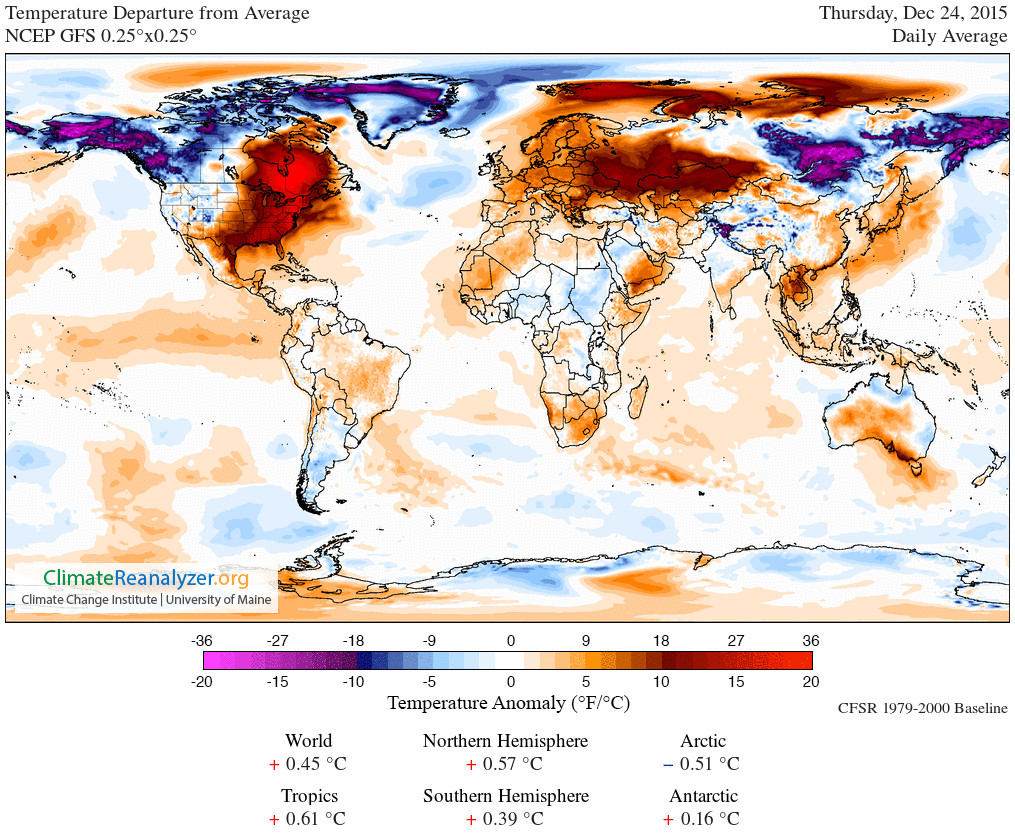
The northern hemisphere is warmer than usual this Christmas, as you may have heard. To be precise, it’s about 1 Fahrenheit degree above the 1979-2000 average after seasonal adjustment. (via)

Parts of the northern hemisphere are a lot warmer than that, including many parts that have a concentration of news media with a seasonal shortage of stuff to report. It’s hot in the eastern US, and this quite reasonably gets more reporting that it being cold in Siberia.

GFS-025deg_WORLD-CED_T2_anom

When the US northeast has unusually cold or snowy periods in winter, you see lots of people carefully explaining how this is weather or short-term variation and doesn’t tell you much about long-term climate patterns.

I’m one of those people, so this year I’m making the same point about warm weather.  The northern hemisphere as a whole is warm by about what the well-known trend suggests. The strong El Niño causing weird local weather in the eastern US could definitely be due in part to the global trend, but conclusions about regional variation are much less reliable than conclusions about this CO2 stuff being a bit of a worry.

Like the snow last year, the hot Christmas this year is consistent with climate change predictions but doesn’t add importantly to the evidence. It’s dramatic that Baltimore is as warm as Auckland this Christmas, but compared to the mass of accumulated evidence on the subject, a few days freak weather in a small part of the world just doesn’t mean much.

O Christmas Tree

tree

(from Wikipedia)