Posts written by Thomas Lumley (2645)

avatar

Thomas Lumley (@tslumley) is Professor of Biostatistics at the University of Auckland. His research interests include semiparametric models, survey sampling, statistical computing, foundations of statistics, and whatever methodological problems his medical collaborators come up with. He also blogs at Biased and Inefficient

November 19, 2012

Keep taking the tablets

Stuff’s headline “Heart drug warning from Kiwi doctor” should perhaps have been “Heart drug reassurance from Kiwi doctor”.  It’s not a bad story, but some additional background might be helpful. Or interesting. Or something.

Beta-blockers block part of the body’s response to adrenaline, and are used for several quite different reasons.  They were one of the early treatments for high blood pressure, they are given after heart attacks, they are used to treat congestive heart failure (where the heart doesn’t pump effectively), and they are also used occasionally for their ability to block some of the physical symptoms of anxiety (and so are banned as performance-enhancing in some sports).  The ‘Kiwi doctor’, cardiologist Chris Nunn, is concerned that a study looking at beta-blocker use mostly for preventing serious heart disease might be misinterpreted by patients taking beta-blockers to treat serious heart disease.

The research study, published in the leading medical journal JAMA, was motivated by concern over the use of beta-blockers after heart attack being generalised to people who had not had a heart attack.  The abstract begins

β-Blockers remain the standard of care after a myocardial infarction (MI). However, the benefit of β-blocker use in patients with coronary artery disease (CAD) but no history of MI, those with a remote history of MI, and those with only risk factors for CAD is unclear.

The study is observational. That is, in contrast to the randomised experiments done with people who have had heart attacks or heart failure, this study didn’t assign people to beta-blockers.  The researchers just looked at who was and wasn’t taking the drugs, trying to get a fair comparison by matching users and non-users using a technique called propensity scores.   The idea behing propensity scores is that you will only get a bias from some other variable if it affects the chance of taking beta-blockers, so you can summarise all the available variables by a single score measuring their influence on the probability of taking beta-blockers.   This technique only works if you measure all the relevant variables (which you don’t) and you get exactly the right model for producing the propensity score (which, again, you don’t), so it’s less reliable than random assignments of treatment.  Even so, the study results in people who have had a heart attack were pretty consistent with the benefits seen after heart attack in randomised studies.

The results in people who had not had a heart attack are also consistent with randomised trials.  Since everyone in the study was seeing a doctor at least at enrollment, most of them were taking high blood pressure medication, and often of more than one kind.  One explanation of the lack of benefit from beta-blockers is just that they are less effective on average than some other high blood pressure medications in preventing heart disease and stroke. That is what was found in a combined analysis of randomised trials by a group including me, about ten years ago, and in some other similar analyses.

So.  Beta-blockers after heart attack or in heart failure are good. Beta-blockers in people with high blood pressure but not heart disease might be less effective than alternatives, but New Zealand guidelines (eg) already take all this into account, so the new study shouldn’t cause any changes in practice here.
 

Laboratories of democracy

The US states are often referred to as ‘laboratories of democracy’, suggesting that a typical American view of labs may be like this or this.

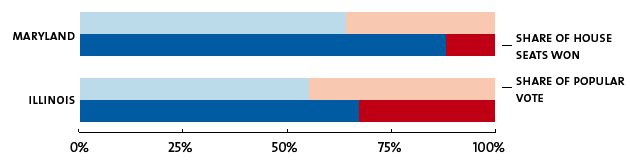
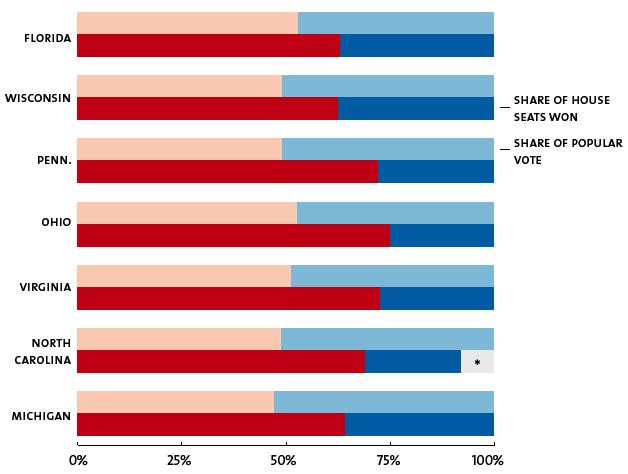
Back before the US election I posted a picture of the creatively-drawn electoral districts in Pennsylvania.  Redistricting is very effective: the Republicans got less than 50% of the total vote for Pennsylvania’s Representatives, but 70% of the seats.  The Democrats do the same things — they got 80% of Maryland’s seats with about 60% of the vote — but the Republicans controlled more states in the critical census year, and so managed to get a majority in the House of Representatives with a minority of the vote.

Here are graphs, from Mother Jones magazine. Remember that the moderate right-wing party in the US uses the same colour, blue, as here in NZ, and the red is for Republicans.


The importance of friends

A Herald story today tells us, four times,  “22 per cent of women feel they have stronger relationship with girlfriends than their partners.”  According to a 2009 survey (PDF), 18% of adult Kiwis were not married, living together, or even dating.  That could potentially explain a lot of the 22%.

At least that one was for a charitable cause. The other survey story was for an online dating service that relies on recommendations from (Facebook) friends. Unsurprisingly, the survey they commissioned could be read as supporting this strategy:

43 per cent of people trusted their friends and families when it comes to dating advice, tips and recommendations.

and

The survey found singles were less inclined to go to a professional matchmaker for help, with only 1 per cent saying they would trust them


November 18, 2012

Why was this survey done?

Some surveys are done to find out information.  Others, perhaps not so much.

Today’s example is from the Herald, where the most informative sentence in the story is at the end:

The survey of 500 men and women in New Zealand and 1000 in Australia was commissioned by Bendon in conjunction with the release of a range of cleavage-enhancing bras.

November 17, 2012

Single molecule determines complex behavior

Alan Dove nails it

In a groundbreaking new study, scientists at Some University have discovered that a single molecule may drive people to perform that complex behavior we’ve all observed. Though other researchers consider the results of the small, poorly structured experiment misleading, a well-written press release ensures that their criticisms will be restricted to brief quotes buried near the bottoms of most news stories on the work, if they’re included at all…

…“Ten years from now, if you ask someone whose science education consists mainly of skimming news stories, I’m sure they’ll confirm that this single molecule causes this complex behavior,”

(via)

Isn’t technology –ing wonderful?

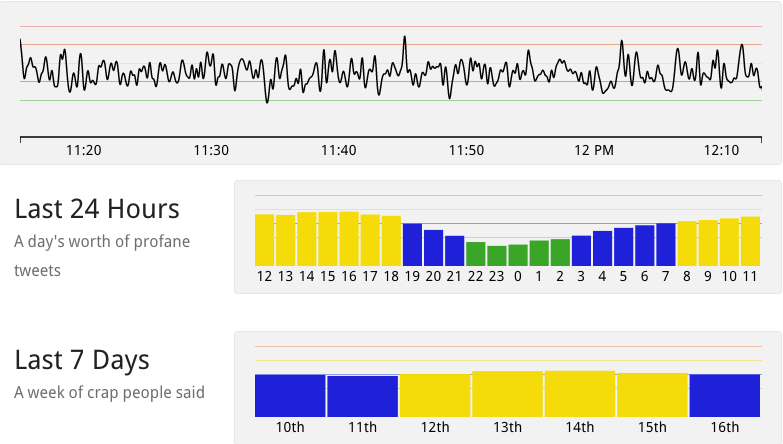
A new website WTFlevel.com (SFW, but makes siren noises) does real-time monitoring of the intensity of swearing on Twitter (only in English, unfortunately).

The record level so far was on US election day, where nearly 11% of tweets contained language unsuitable for those of a delicate constitution, most commonly in combination with the words “Romney” “Obama”, “election”, “stupid”, “white”, and “black”.

infoGRAPHIC

Infographics can be useful — the New York Times ones usually are — but often they are just dubiously-illustrated lists of information.  Or, not even information.

One that is doing the rounds of the Internet at the moment purports to list the best-selling science-fiction novels of all time.  It’s not entirely correct.  For example, its entry for “Twenty Thousand Leauges[sic] Under The Sea”, says

Twenty Thousand Leagues Under The Sea – Jules Verne has sold over 10,000 COPIES and has been translated into 147 languages.

That would be over 68 copies per language. No wonder they kept translating it.

No-one seems to know the original source of this infographic, and my guess is that the true author won’t be eager to change  this situation.

(via)

November 16, 2012

Consider vs actually do

Stuff reports on an Ipsos poll saying that about 1 in 3 people across many countries would consider travelling for medical treatment (and 18% “definitely would consider”).  For the USA, specifically, the figure was 38%.

The story also reports estimates of the actual number of people each year who travel from the USA for health reasons: 60 000 to 750 000. That sounds like a lot, but it’s actually 0.02%-0.25% of the US population, a bit of context that would have be useful in the story.

Ethnic diversity here and US

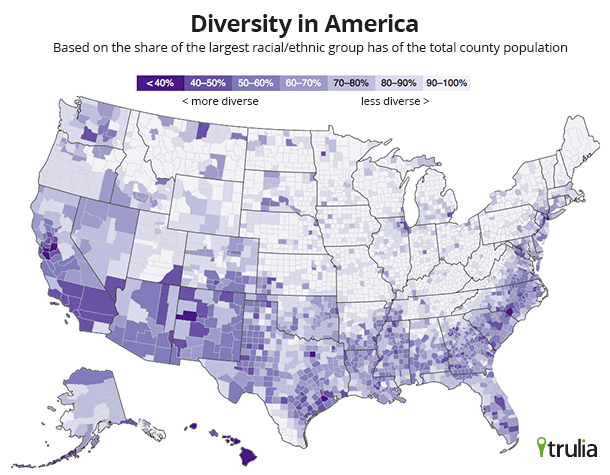
Real-estate data company Trulia has an article on their blog about ethnic diversity in the US, which they measure by the proportion of the population in the largest ethnic group (so low proportions mean more diversity).  Here’s their national map (they also have maps of some cities)

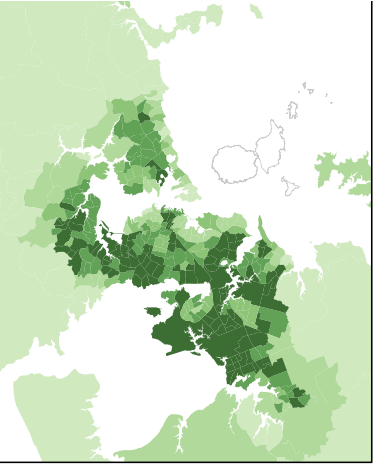
Stats New Zealand have also released maps, though just for Auckland.  Their index of ethnic diversity is 100% minus Trulia’s index, so they are equivalent, though the NZ color scheme is darker in the mid-range than the US one.  The 2006 map of Auckland looks like

It would be interesting to do this for the whole of NZ using the Census meshblock dataset, but I don’t have time right now.  The Auckland map makes the point I made a few weeks ago about modern NZ having more, and more varied, immigration than most people outside the country realise.


Screening anticancer compounds: how it’s really done

I’ve commented a number of times about stories in the papers where researchers have, basically, dripped herbal tea on cancer cells in a Petri dish and found it killed them (the cells, not the researchers).  Screening anticancer compounds this way does work, it’s just that it doesn’t work very often, and when it does work it’s just the first step of years of likely failure.

Derek Lowe, at In The Pipeline, writes today about a research paper looking for things that might kill cancer stem cells.  These are a tiny fraction of cells in a tumour, but are thought to be responsible for a lot of the treatment resistance and relapse.  The researchers couldn’t work with actual cancer stem cells, which aren’t available in large quantities, so they used imitations produced by gene knockout. They screened 300 000 compounds from a large collection maintained by the National Institutes of Health.  About 3000 killed the imitation stem cells.  They then threw out all the compounds known to be highly toxic to normal cells, and those that repeatedly show up in screens for interesting properties.  The problem with the latter group is that either they cheat (ie, they interfere with the assays being used) or they really do so many different things that they probably won’t be practical tools.

Of the remaining 2200 compounds that killed the imitation stem cells, nearly all of them also killed the original cancer cells that didn’t have the gene knockout, so however they might work it’s probably nothing useful for cancer stem cells.  Finally, they rechecked the results with independent samples of the compounds (since if you have a collection of 300 000 compounds, no matter how careful you try to be, they aren’t all going to be what they say on the tin).

After all of this, they ended up with two compounds that appear to be selectively toxic against cancer stem cells.  These aren’t drugs, even potentially, but they should be useful for finding out more about the biological differences in cancer stem cells and that, in turn, may lead to new treatments.