Posts written by Thomas Lumley (2645)

avatar

Thomas Lumley (@tslumley) is Professor of Biostatistics at the University of Auckland. His research interests include semiparametric models, survey sampling, statistical computing, foundations of statistics, and whatever methodological problems his medical collaborators come up with. He also blogs at Biased and Inefficient

May 16, 2018

Briefly

  • “The Home Office seems to have used some sort of voice identification test in an effort to find international students who got someone else to take their mandatory English exam. And this went about as well as you might have expected if you read this blog. from the Yorkshire Ranter
  • NZ supermarkets have apparently been using computerised facial recognition systems to identify shoplifters.  Here’s the Privacy Commissioner on Radio NZ.  Of course, supermarkets have used non-computerised facial recognition systems for a long time, and there have definitely been concerns about the bias of these, too.  And while the current systems seem to have high error rates, that’s temporary: they are going to get better.
  • From the Washington Post, a video on how opinion polls work
  • “To work for society, data scientists need a Hippocratic oath with teeth” Cathy O’Neil in Wired.  I agree on the basic ethics and design principles, but statistics, unlike medicine or law or engineering, has never had a wall to keep people out: anyone can practise statistics. That makes professional regulation hard.
  • Across the city, black people were arrested on low-level marijuana charges at eight times the rate of white, non-Hispanic people over the past three years, The New York Times found.” This won’t actually surprise most people, but the NYT has done a good job of showing that the usual excuses don’t explain the bias.
  • Beautiful infographic/visualisation of different types of alcoholic drinks by Rego Sen
  • The birth cohort study Growing Up In New Zealand has been refunded
  • The story of the HP-35 calculator, the first scientific pocket calculator. I’ve used the next model, the HP-45. Calculators were much better engineered when they cost the equivalent of what a Macbook does now.
  • “Baking the most average chocolate chip cookie” from pudding.cool
  • Why not to use two y-axes on a graph, from Datawrapper
May 10, 2018

Hair apparent?

There’s a story in Stuff about a potential new cure for baldness

A cure for baldness could be on the horizon after British scientists discovered that an osteoporosis drug stimulates hair growth three times quicker than other drugs.

The first thing to notice about the story is the name of the new drug, WAY-316606. That’s not a drug name. That’s a drug-company internal name of a research compound. This isn’t a story about repurposing an already-approved drug. The name of the cancer drug “CsA” they supposedly started with also looks a bit weird.

The next thing to note is that we aren’t given much source information, apart from the Daily Telegraph. The story there has the headline Baldness cure could come from side-effect of cancer drug. You’d need to sign up there to actually read it; I wouldn’t bother if I were you.  Searching for keywords like “baldness” and “Manchester” finds the press release.

The press release tells us some interesting new facts. First, “CsA” isn’t a cancer drug at all. It’s cyclosporine A, the immune-suppressant drug that made organ transplants really feasible in the 1980s.  It looks as thought the Telegraph invented the connection with cancer — maybe by misunderstanding the fact cyclosporine increases cancer risk. Second, the research paper is in the journal PLoS Biology — unlike the Daily Telegraph story, it’s open-access.   The press release is also more measured about the medical potential, saying “Clearly though, a clinical trial is required next to tell us whether this drug or similar compounds are both effective and safe in hair loss patients.” As far as I can tell, WAY-316606 hasn’t ever been tested even for safety in humans.

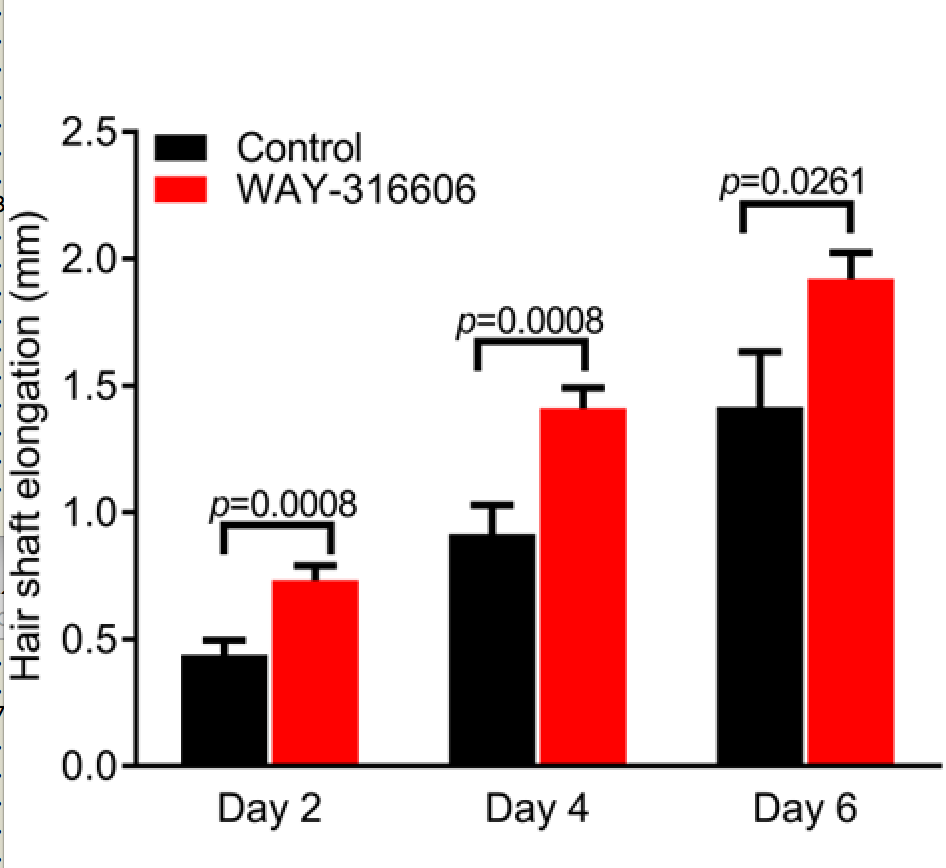
The research paper is harder going. It does have this graph (Figure 3A) comparing hair growth in hair follicles treated with WAY-316606 and untreated controls. It’s true that the treated hair grew faster, and it’s true it was 2mm after 6 days, but the difference from untreated hair was a lot smaller than that.

The research paper links to another paper about WAY-316606, which is not open-access.  That paper gives a hint as to why WAY-316606 isn’t a drug already: it doesn’t last long enough in the body (at least, the bodies of rats). It might work better applied to the scalp. Or not.

So, this is interesting biochemical research that might turn out to have practical applications for hair growth, but it’s not really a way to use an existing drug to cure baldness.

May 7, 2018

Briefly

  • Creative arithmetic in some official statistics “an incident in the Rio Grande Valley Sector on February 14, 2017, involved seven U.S. Border Patrol Agents assaulted by six subjects utilizing three different types of projectiles (rocks, bottles, and tree branches), totaling 126 assaults.” 
  • Interesting, slightly-nerdy post on fake news, network structure, and Cambridge Analytica
  • Also on Cambridge Analytica: “The psychology ethics committee refused permission, and when he appealed to the [Cambridge] University Ethics Committee  this refusal was upheld”
  • “Seven Visualization Talks That Terrified Me At CHI”: Michael Correll on this year’s Conference on Human Factors in Computing Systems
  • Abstract art to a human; representational art to a neural network
  • The success of statistical models in horse-racing (Bloomberg: limited free articles)
  • The UK’s opt-out internet porn filter has lots of completely stupid false positives because of course it does (BoingBoing). There’s a site where you can search or browse them.  I think my favourite so far is Utopia Palms and Cycads, a nice ecologically-responsible tropical-plant supplier in Queensland, Australia.
  • And in other UK computerised false-positives newsHowever, when ETS’s automated voice analysis was checked against human analysis, its computer programme was found to be wrong in 20 per cent of cases, meaning that more than 7,000 students were likely to have been wrongly accused of cheating.”  Sometimes 80% is a fail, not  an A-

One lump or two?

Q: How many spaces do you use after a full stop?

A: Whatever LaTeX thinks is appropriate. We have computers so that people don’t have to worry about that sort of thing.

Q: How many spaces do you actually type?

A: Two. I was brainwashed by the program that taught me touch-typing.

Q: Me too! Science has just proved us right!

A: <eyeroll emoji>

Q: It’s in the Herald! And in the Washington Post!: One space between each sentence, they said. Science just proved them wrong.

A: I see what they did there. <unimpressed emoji>

Q: But Science?

A: The researchers took a group of people who used two spaces after full stops and another group who used one, and got them to read text with different spacing conventions.  They measured reading speed and comprehension

Q: And the one-space texts were read faster and comprehended better?

A: “In the analysis of reading speed, although there was not an overall significant effect of period spacing or typing condition, there was a significant effect of comma spacing such that readers read paragraphs faster when they were written with only one space after the commas, as is the common convention.”

Q: That’s… not really what the story says.

A: No. No, it isn’t. There was a slight tendency for people to read faster when the spacing in the text matched the spacing they personally tended to use.

Q: And what do they mean about “only one space after the comma”?

A: They looked at one or two spaces after the comma as well as after the full stop.

Q: <anguished face emoji>

A:  Indeed.

Q: But at least it shows two spaces at the end of the sentence is ok?

A: Under the conditions of the experiment, yes, there’s weak support for that point of view.

Q: I’m sensing an implied asterisk here

A: The Herald story says, near the start “Some said this was blasphemy. The designers of modern fonts had built the perfect amount of spacing, they said. Anything more than a single space between sentences was too much.”

Q: Yes?

A: The experiment was done in the monospaced font Courier New.

Q: How is that relevant to, like, anything in the modern world? I mean, even if you want a monospaced font for coding or something you can use Monaco or Hack or Consolas

A: Well, you might think that if two spaces was bad in real-world use it would be even worse in Courier New, but it’s not how I would have done the experiment.


h/t David Hogg

May 6, 2018

The Midas touch

There’s a shocked story on the internet about a New York restaurant serving chicken wings coated in gold for US$1000.

It’s a great example of not doing the maths. Gold currently costs $42/gram, and culinary gold leaf is easily available for not much more than twice that.  A gram of gold leaf is a lot: nearly a square metre.

In fact, if you track down a more detailed source — and in this case I’m sorry to say the Daily Mail qualifies — you find that 10 gold-covered wings sets you back $30, at a restaurant whose regular “small plates” wings are $15.

The $1000 price tag is for 50 wings plus a bottle of Champagne Armand de Brignac.  It’s the posh bubbly that explains the stratospheric price, not the gold.

May 3, 2018

Undercounting

Kirsty Johnson and Chris Knox have a report  in the Herald today on why the number of unresolved reports of sexual assault has gone up.

On the face of it, one could assume the driver behind the spike in unresolved cases was the overall increase in reporting rates. Data shows reporting has also climbed steadily since last decade.

That’s what I would have assumed. It’s true in a sense. But the change wasn’t more reporting to police; it was more reporting by police. Many cases where the police felt they could not get a conviction were classified for reporting purposes as not being reports of a crime and so were lumped together with false accusations and cases where the reported behaviour wasn’t criminal.

It’s good news that the police don’t do this any more, but it’s also important that the past minimisation of reports is now more widely known.

[I should also note that reporters show their working: there’s a page on the data and calculations, and plenty of links to police documents and other sources. ]


May 2, 2018

Briefly

  • From the journal BMJ “Data about the timing of when laboratory tests were ordered were more accurate than the test results in predicting survival in 118 of 174 tests (68%).” In particular, for one of the tests they looked at, having the blood test ordered at 5am (regardless of the result) was more of a bad sign than having it ordered at 5pm and giving an unfavourable result.  This isn’t all that surprising: if you get lab tests ordered at 5am there’s a problem, and a favourable result for the test just means the problem isn’t the one that the test was looking for. But it is potentially a problem for interpreting conclusions from large-scale data mining or, to be fair, from uninformed statistical analysis.
  • NBC News in Chicago did a story on direct-to-consumer genetic testing. As several journalists have done, they sent a DNA sample to multiple testing companies and compared the results.  They also did the same thing with a sample from a Labrador.  Most of the companies said the dog’s DNA didn’t genotype successfully. Most, but not all.
  • Tim Harford recommends books on understanding data-driven prediction algorithms
  • A talk by Jonathan Korum of the New York Times on graphics for science stories
  • From Karl Broman and Kara Woo: “Data Organization in Spreadsheets” If you, or someone you know, uses spreadsheets …
  • How to display uncertainty in election predictions. From The Crosstab.
  • Someone in the US was hit by lightning, bitten by a shark, bitten by a venomous snake, and attacked by a bear in one year. National Geographic says

Since each event is independent the odds of each are multiplied together, he said, making the odds of this happening 893.35 quadrillion to one.

         Of course, they really aren’t independent — and the next sentence pretty much points this out

McWilliams just chalks all this up to being in the wrong place at the wrong time. He encourages everyone to experience the outdoors. “I still go hiking, I still catch rattlesnakes, and I will still swim in the ocean,


The breakthrough problem

Here’s a blog post from CSIRO “Bloody data: biostatistics and the first blood test for Alzheimer’s”

Here are some of the media headlines:

New blood test detects Alzheimer’s disease up to 20 years before symptoms begin

New blood test could detect risk of Alzheimer’s disease 30 years early

‘Holy grail’ blood test for early Alzheimer’s indicators could help patients begin treatment before they show symptoms

World-first blood test to diagnose dementia

Science has created a simple blood test for Alzheimer’s

Here’s the research paper and  two press releases about it: from the Florey Institute and from Melbourne Uni 


As StatsChat readers will know, this isn’t the world-first early test for Alzheimer’s to end up in the media.  And as you’ll expect, the test hasn’t actually been able to detect Alzheimer’s disease 20 or 30 years before symptoms begin. That would require either waiting 20 or 30 years to see who developed symptoms, or having a test that could be run with blood samples from 20 or 30 years ago.

What the test actually does is predict quite accurately how much amyloid-beta protein people have in their brain using just a blood sample. That’s useful, because the current ways of measuring amyloid in the brain are expensive and involve radiation and/or sampling fluid from the spine, and these aren’t things anyone wants to do at the level of population screening.

We don’t currently know if measuring amyloid in the brain gives good 20-year predictions of Alzheimer’s — there’s increasing suspicion that the relationship between Alzheimer’s and amyloid is more complicated than was thought.   But it’s the best candidate we’ve got for an early test, and a low-cost, low-risk, low-pain version of it would be very useful in selecting people for clinical trials targeting amyloid levels — as I’ve said about a few of the other “first blood test for Alzheimer’s” candidates.

The research paper did look at using the test to distinguish people with definite, known Alzheimer’s from a healthy comparison group.  They found the test picked up almost all of the Alzheimer’s cases, but gave false positives in nearly 20% of the healthy controls.  Maybe that’s just saying that 20% of the controls will end up with the disease in 20-30 years, but there’s no way to know that in the short term.

This is good research, giving a genuine improvement on an important component of one step in testing potential future drugs to prevent Alzheimer’s. And the actual text of some of the stories is quite reasonable.  The headlines, however, are actively misleading, because of the need to frame science stories as  breakthroughs.

This isn’t the Holy Grail. Indiana Jones isn’t just ten minutes and three plot twists away from the final credits. That just isn’t how science typically works.

April 23, 2018

Bogus poll headlines

From StuffOne in six Kiwi drivers use their phone at traffic lights, poll finds

This is a bogus poll from Neighbourly, the local bulletin board/discussion site owned by Stuff‘s publisher.  It’s based on “more than 3900” self-selected members of the site, without any attempt to make the figures representative. And that’s before you get to the issue of how honest people are being about their law breaking.

There’s almost no limit to how wrong bogus polls can be. Thanks to anchoring bias, there’s a good chance you’re better informed if you don’t see the results than if you do.

For a while, the NZ media had stopped writing stories and headlines based on bogus polls, but it’s been starting up again.


April 13, 2018

Nibiru watch

The Herald website has just published another story about the imaginary and invisible planet Nibiru. That’s in addition to the nine from last year.

  • 18 Nov: Conspiracy theorists claim mysterious planet Nibiru will trigger apocalyptic earthquakes
  • 25 Sep: Nibiru: How the nonsense Planet X Armageddon and Nasa fake news theories spread globally
  • 30 Oct: The end of the world as we know it (again)
  • 23 Sep: How the nonsense Planet X Armageddon, Nasa fake news spread globally
  • 19 Sep: The world is about to end, if you believe this doomsday claim
  • 30 Aug: Claims new planet ‘about to destroy Earth’ and clues written on pyramids
  • 23 Sep: ‘Extremely violent times will come’: TV broadcast interrupted with end-of-world prediction
  • 9 Aug: Rogue planet about to smash into Earth, claim conspiracy theorists
  • 4 Jan: Conspiracy theorist claims mysterious planet Nibiru will smash into Earth and the world will end in October 2017

As you see, two of the stories ask how this nonsense theory spread globally.

One says, with a splendid lack of self-awareness

Despite absolutely no scientific evidence to back up the suggestions of a rogue planet getting rapidly closer to Earth, myths about Planet X continue to be perpetuated online, according to the Telegraph UK.

Indeed they do.