Posts written by Thomas Lumley (2645)

avatar

Thomas Lumley (@tslumley) is Professor of Biostatistics at the University of Auckland. His research interests include semiparametric models, survey sampling, statistical computing, foundations of statistics, and whatever methodological problems his medical collaborators come up with. He also blogs at Biased and Inefficient

January 2, 2013

Nation’s favorite plant

At this time of year you see a lot of predictions, but it’s hard to remember them long enough to track how well they do.

A nice exception came in the ChCh Press  story about the NZ Plant Conservation Network annual poll for NZ’s favorite plant.

New Zealand may be renowned for its distinctive flora and fauna, but it seems Kiwis prefer endangered herbs and wildflowers over pohutukawa and kowhai.

While earlier polls revealed Kiwi-favourites the pohutukawa and cabbage tree as New Zealanders’ plant of choice, in recent years lesser known species such as tree nettle, Cook’s scurvy grass and willowherb have climbed the ranks.

The results are now out, as the Herald reports, and the top three are kauri, pohutukawa, and puriri.  Northern and southern rata and one of the cabbage tree species are also in the top ten, so familiar, common, distinctive trees did well this year.

Predicting results of small self-selected polls is very hard, because the results can be very sensitive to voting by enthusiasts or enemies of one of the candidates. That’s why the results aren’t very useful for telling you what people think, though they can make for good publicity.


January 1, 2013

Looking a lot like Christmas

Stuff says

Facebook’s Instagram lost almost a quarter of its daily users a week after it rolled out and then withdrew policy changes that incensed users who feared the photo-sharing service would use their pictures without compensation.

There’s two things wrong with this (apart from almost-explicit post hoc ergo propter hoc).  The first is that the ‘quarter of its daily users’ is actually an estimate based on people who use Instagram in a way that shows up on AppData’s counters for Facebook apps. As AppData says

This application is integrated into Facebook from one or more platforms outside the Facebook.com canvas. As such, only users who connect to the app using Facebook are included in the active user counts above & below.  

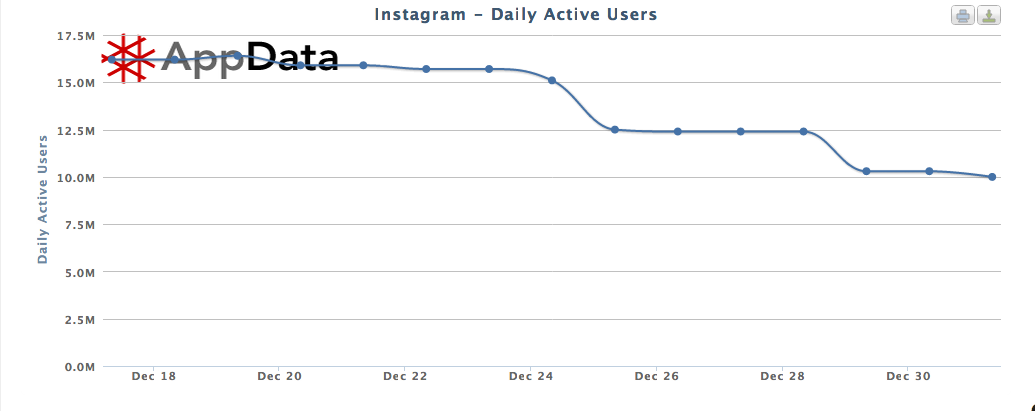
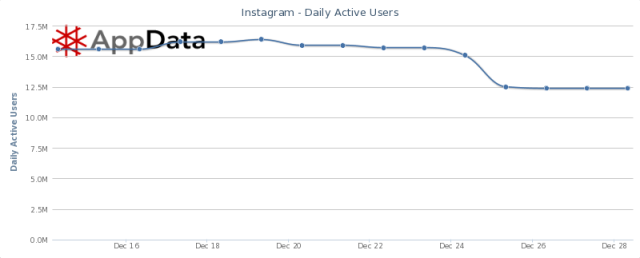
The Stuff story actually admits to this later, contradicting the lead. Even with the data just coming from a non-representative sample, the change in use is pretty dramatic, but the phrase ‘a week after’ in the story is also important.  AppData shows just two weeks of data free, but we can put together the Dec 14-28 graph shown by Quartz when they covered this with the current graph from Dec 17 to now:

chart


chart2


The new license agreement came out on Dec 17.  Nothing happened for a week, then there was a decrease.  On December 29 there was another decrease.

AppData’s results for weekly active users of Instagram didn’t change much over this period, and other apps also saw a decrease in daily users via Facebook — Stuff mentions Yelp, but I also saw it for Scribd, Spotify, Bing, and TripAdvisor.  In fact, StatsChat has also seen a decrease in users via Facebook over the past week.

It could be that Instagram’s license mistake is reponsible for its decrease, but at this time of year there are other possible explanations for people changing their computer use habits. We’ll be able to tell in a month or so whether the decrease is persistent. Perhaps Stuff can revisit the issue then.


December 31, 2012

Duck! Here comes another year!

Our most-viewed posts in the past year, according to the Jetpack backend

  1. Tip of the icecube: on the ‘hundreds of unfit teachers’
  2. Who is really buying New Zealand: dramatically bad bubble graphs
  3. A story from last year, about the suicide rate at the Foxconn plant 
  4. David Scott’s Super 15 predictions for round 2
  5. Another one from last year, on lottery odds.

This only counts hits directly on the page (eg from Twitter or RSS feeds), not from browsing the site, so it misses about 1/3 of the traffic.

The lottery post shows an interesting pattern of hits

Big Wednesday

The second burst of popularity was a building jackpot, with the spikes on Tuesday/Wednesday each week. There’s a similar pattern on Google Trends for the phrase ‘Big Wednesday’.


There were 31 posts in the new ‘Denominator’ category, which mostly follows violations of two of the most basic numeracy principles for reporting:

  1. Auckland is bigger than the other cities, so simply having more of something in Auckland is not news
  2. If you have two years of data, either take an average or a difference. Don’t report a total.


Approximately 95% of our comments were spam, but the filters caught 99.8% of it. The 5% of real comments are much appreciated.

And finally, the title of this post is from an Ogden Nash poem.

Briefly

  • Merriam-Webster gives their most-searched words of 2012.  At the top, “capitalism” and “socialism”, especially during the US election and the health insurance debates.  As Fred Clark points out, this means a depressingly large number of Americans were constructing political arguments of the form “According to the Merriam-Webster dictionary, X is defined as …” 
  • FakeAPStyleBook on Twitter advises journalists: “When quoting from a news release, pick the most nonsensical sentences to let people know what it’s like to have to read those things.” 
  • Almost 75% of Kiwis oppose testing ‘legal highs’ on animals.  It would be interesting to know the figure among those who think these drugs should be legal and regulated.  If you think they should be comprehensively banned or, at the other extreme, just left alone, then presumably you would be against requiring animal tests.
  • In the same Herald survey, 29% were against animal testing for any purpose whatsoever.  That’s a slightly higher level of opposition to modern medicine than I would have expected.
  • Stuff had a good story about celebrity bad science, from the UK charity Sense About Science
December 23, 2012

Metareviews: The Signal and the Noise

Andrew Gelman has a review of two reviews of Nate Silver’s book, The Signal and the Noise. Unlike him, I’ve actually read the book, but I think his review of the reviews captures the good and bad points well.

Christmas tree cloning

Oddstuff has a story on German research involving cloning good-looking Christmas trees.

The story shouldn’t really seem odd to Kiwis: we’ve got whole industries based on cloned trees, including vast plantations of cloned pine trees.  And even in the northern hemisphere, parts of the Christmas tree industry already use cloned trees because some popular plants are sterile hybrids that can only be propagated as clones.

I’ve occasionally thought it would be entertaining to stage a protest about cloned apples outside a supermarket, just to see how people react…

Safety rules for psychoactive drugs

In the early 1980s there was a significant advance in research on Parkinson’s Disease, when a number of young drug users showed up with a sudden onset of the disease.  Investigations showed that a synthetic opioid ‘legal high’ called MPPP was responsible; the methods used to synthesize it produced a byproduct MPTP that was metabolised into a potent neurotoxin and selectively absorbed into cells that thought they were getting dopamine.   Of course, this is a one-off problem with that specific drug, and not something that’s ever likely to happen again.

This sort of thing is why both animal and human safety testing is required before medications are approved, and it’s why medical chemists get rather upset at people who market untested compounds. However, it isn’t the main point behind the current NZ plans for testing legal highs, since none of the cannabis analogues Mr Dunne has banned using the interim laws would have failed basic toxicity tests. In fact, the safety problem with the cannabis analogues seems to be precisely that they are psychoactive, and that they are much easier to overdose on than real cannabis (they are ‘full agonists’, THC is a ‘partial agonist’ at the same receptors).

The problem with the new laws is that they are trying to reconcile inconsistent views of the level of safety needed.  Before Kronic started large-scale marketing and distribution, the cannabis analogues were in the sort of slightly dodgy market where you wouldn’t expect a great deal of safety testing, users knew this, and we had a pretty good compromise. When the drugs started being advertised and sold in dairies (and not just ones on K Rd), the implied level of safety was a lot higher, there were more overdose in young users, and their parents got, quite reasonably, upset.  After Mr Dunne grants his nihil obstat on production and sale, the implied safety level will even higher, and probably not achievable.

That’s why I think the animal testing issue is largely a distraction. If the regulations are going to be consistent with Mr Dunne’s bans over the past year or so, anything that has a high enough chance of approval to make the tests commercially feasible is likely to be pretty much a placebo (or placebo plus caffeine for party pills).   Whether the net health effect is positive or negative depends a lot on what is substituted for the previously-legal highs.  If it’s healthy exercise or meditation, we might come out ahead. If it’s alcohol, the impact is going to be negative.  Unfortunately, although I’m betting on a negative effect, I don’t see any easy way of getting back to the pre-Kronic situation.


[PS to Eric Crampton: Yes, I am indeed ignoring the benefits people get from being high. I’m pretty sure Peter Dunne is, too]

December 22, 2012

Making a list, checking it less than twice

It’s the season for lists from the year in review.  Buzzfeed has one entitled “27 Science Fictions That Became Science Facts In 2012”. Some of these are real, but some became science facts quite a while ago, others are still in the future, and some appear to be completely bogus.

Good:

  • a quadriplegic has a robot arm controlled directly by her brain.
  • Voyager I leaves the solar system

Badly headlined

  • DNA photographed for the first time. No, DNA is easy to extract and has been photographed many times. Individual chromosomes under a microscope were photographed years ago, and Crick and Watson used X-ray photographs to work out the structure.  What’s new is an electron microscope photograph of DNA where you can actually see the helix.
  • Genetically Modified Silk Is Stronger Than Steel. This is about genetically modified silkworms that produce something closer to spider silk. Spider silk is the strongest natural fibre, and has higher tensile strength than steel, weight for weight, but actually so does ordinary silkworm silk.

Still Science Fiction

  • Stem Cells Could Extend Human Life by Over 100 Years. This is actually a story about stem cells extending the life of mutant rapidly-aging mice by 50 days.  Not quite the same thing.  Stem cells extending human life is definitely still science fiction.

Probably bogus

  • Invisibility Cloak Technology Took a Huge Leap Forward. You have all seen the ‘invisibility cloak’ stories that turn out to be about bending microwaves around a small toy.  This one is different. It has a perfect camouflage cloak that even knows which things behind it you want to hide, and which ones you want to reveal. It’s almost as good as Photoshop. Um. yes. Never mind.

That still leaves 21 for you to check if you get bored over the holidays

December 21, 2012

Happy New B’ak’tun

Welcome to the 14th B’ak’tun in the Mayan Long Count calendar. That wasn’t so bad, was it?

In case anyone has any New B’ak’tun Resolutions about charities, I wanted to link to GiveWell, an organisation that tries to find evidence about the most cost-effective and transparent charities, and also provides a way to donate to these charities.

An encouraging feature is that they don’t only publish what they found about each charity, they publish a detailed review of their mistakes.

Their current top 3 charities are one that distributes anti-mosquito bed nets, one that sends cash directly to very poor people in Kenya (via a very cheap cell-phone based system), and one that treats schistosomiasis.

December 20, 2012

Glad tidings of great joy

The Herald has a story on the happiest countries in the world.  This is a sensible thing to measure, but it’s hard to know if you have got it right, or whether the differences between countries just reflect differences in responding to survey questions. At least it was from a real survey.

Another recent survey result was the US companies with the happiest employees.  Pfizer was on top of the list.  Pfizer is perhaps more notable recently for its layoffs, with the last round just this week, so the survey has been greeted with a certain bemusement in some parts of the internet.  The provenance of these data is a bit dubious:


To reveal the top happiest companies, CareerBliss analyzes thousands of independent employee-submitted reviews. 

Post a quick company review to nominate your company for next year!

and, yes, this means it’s just a self-selected bogus poll.