September 29, 2014

Stat of the Week Competition: September 27 – October 3 2014

Each week, we would like to invite readers of Stats Chat to submit nominations for our Stat of the Week competition and be in with the chance to win an iTunes voucher.

Here’s how it works:

  • Anyone may add a comment on this post to nominate their Stat of the Week candidate before midday Friday October 3 2014.
  • Statistics can be bad, exemplary or fascinating.
  • The statistic must be in the NZ media during the period of September 27 – October 3 2014 inclusive.
  • Quote the statistic, when and where it was published and tell us why it should be our Stat of the Week.

Next Monday at midday we’ll announce the winner of this week’s Stat of the Week competition, and start a new one.

(more…)

September 26, 2014

Small multiples and graphical details

A really great long-form post on graphics and design by Lena Groeger at the ProPublica Nerd Blog

Waldo, and the eternal search for him, can actually tell us quite a lot about design. In many ways, Waldo is a great example of what NOT to do when using wee things in your own work. So with Waldo as our anti-hero, let’s take a look at how people read and interpret small visual forms, why tiny details can be hugely useful, and what principles we can apply to make all these little images and moments work for us as designers.


Thomas Lumley at random

This from the latest Thomas Lumley Listener column: “Statistics uses both real and theoretical randomness for a lot of things, from selecting phone numbers in polling and allocating treatments in clinical trials, to proving that a set of mathematical assumptions does or doesn’t let you distinguish correlation from causation.

“So what do we think “random” really means?”

Read the column here.


Screening is harder than that

From the Herald

Calcium in the blood could provide an early warning of certain cancers, especially in men, research has shown.

Even slightly raised blood levels of calcium in men was associated with an increased risk of cancer diagnosis within one year.

The discovery, reported in the British Journal of Cancer, raises the prospect of a simple blood test to aid the early detection of cancer in high risk patients.

In fact, from the abstract of the research paper, 3% of people had high blood levels of calcium, and among those,  11.5% of the men developed cancer within a year. That’s really not strong enough prediction to be useful for early detection of cancer. For every thousand men tested you would find three cancer cases, and 27 false positives. What the research paper actually says under “Implications for clinical practice” is

“This study should help GPs investigate hypercalcaemia appropriately.”

That is, if a GP happens to measure blood calcium for some reason and notices that it’s abnormally high, cancer is one explanation worth checking out.

The overstatement is from a Bristol University press release, with the lead

High levels of calcium in blood, a condition known as hypercalcaemia, can be used by GPs as an early indication of certain types of cancer, according to a study by researchers from the universities of Bristol and Exeter.

and later on an explanation of why they are pushing this angle

The research is part of the Discovery Programme which aims to transform the diagnosis of cancer and prevent hundreds of unnecessary deaths each year. In partnership with NHS trusts and six Universities, a group of the UK’s leading researchers into primary care cancer diagnostics are working together in a five year programme.

While the story isn’t the Herald’s fault, using a photo of a man drinking a glass of milk is. The story isn’t about dietary calcium being bad, it’s about changes in the internal regulation of calcium levels in the blood, a completely different issue. Milk has nothing to do with it.
Paracetamol and ADHD reporting

Everyone has a story about the new Auckland findings of correlation between paracetamol use in pregnancy and ADHD in kids.

Almost uniformly they don’t make it easy to the find actual (open-access) research paper, not even naming the journal: NZ Doctor’s reprint of the press release does best, with

“The study was published [date] in Plos One online at this link;” [sic]

without a link or a date. The paper is here.

The other thing the stories don’t really make clear is that this finding is important only because it confirms the surprising finding from a big Danish study published earlier this year. The evidence from the New Zealand research wouldn’t be at all convincing on its own, but the replication of an association with paracetamol but not other commonly-used medications is potentially important.   Even the Science Media Centre didn’t really make this clear in their post, though the University of Auckland website does better.

It’s still quite possible that chance or confounding explains this association, and we don’t know if other groups tried to replicate the association and failed, but the replication is a significant step.

PhD gender gap

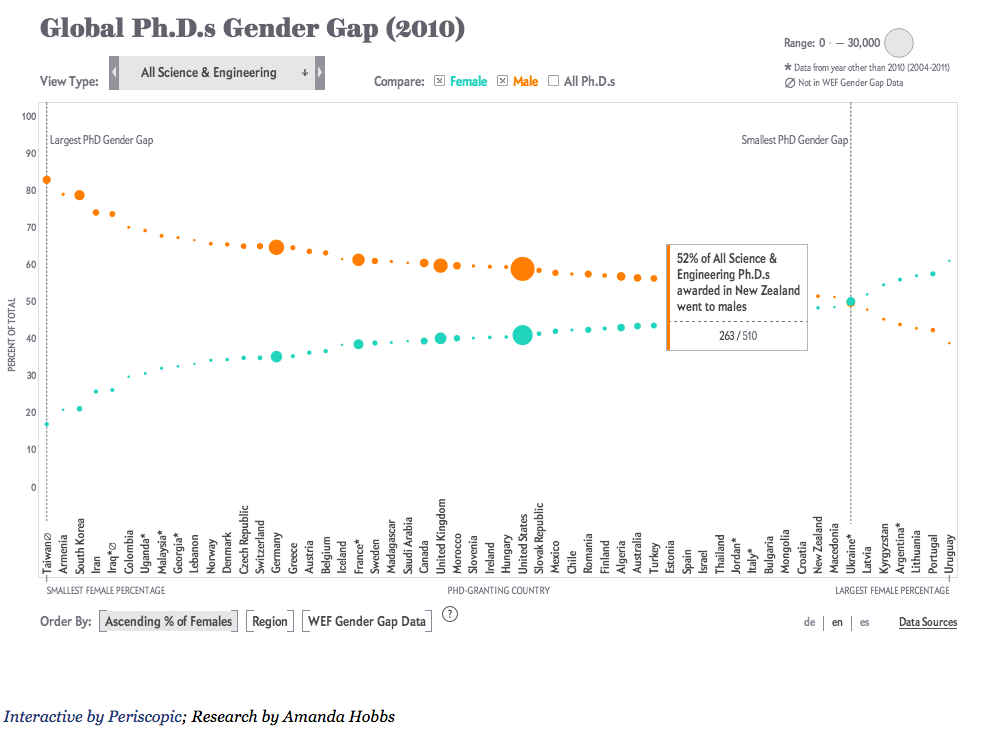
From Scientific American and Periscopic, an interactive display of international gender differences in PhDs awarded in various fields.

phd-gap

September 25, 2014

Asthma and job security

The Herald’s story is basically fine

People concerned that they may lose their jobs are more likely to develop asthma than those in secure employment, a new study suggests.

Those who had “high job insecurity” had a 60 per cent increased risk of developing asthma when compared to those who reported no or low fears about their employment, they found.

though it would be nice to have the absolute risks (1.3% vs 2.1% over two years) , and the story is really short on identifying information about the researchers, only giving the countries they work in (the paper is here).

The main reason to mention it is to link to the NHS “Behind the Headlines” site, which writes about stories like this one in the British Media (the Independent, in this case).

Also, the journal should be complimented for having the press release linked from the same web page as the abstract and research paper. It would be even better, as Ben Goldacre has suggested, to have authors listed for the press release, but this is at least a step in the direction of accountability.

September 24, 2014

That’s just a guess

oranges

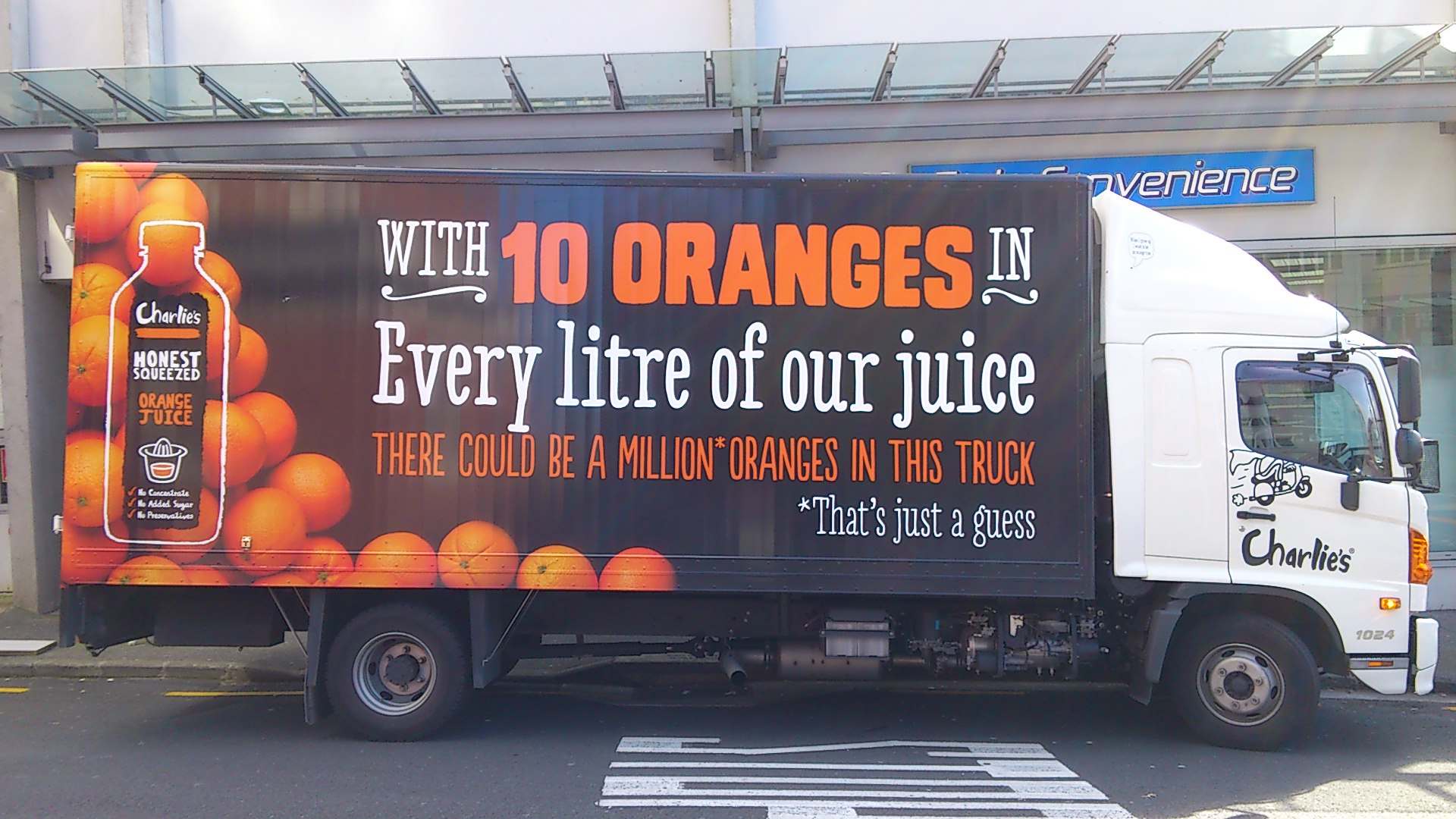
While it’s nowhere near as annoying as Phoenix Organics “Don’t drink science“, Charlie’s could do better than ‘just a guess’ as to whether there are a million oranges in this truck

If there are ten oranges in a litre of juice, there are ten thousand in a cubic metre of juice, so a million oranges would make 100 cubic metres of juice. The little juice bottles probably don’t pack that efficiently, so you’d need more than 100 cubic metres of truck.

So, how big is a truck?  A standard twenty-foot container is 6.1m long, 2.44m wide, and 2.59m high, with a volume of 38.5 cubic metres.  That truck doesn’t look three times as big as a twenty-foot container to me.

There could be a hundred thousand oranges in that truck. I don’t think a million is feasible.

NRL Predictions for the Preliminary Finals

Team Ratings for the Preliminary Finals

The basic method is described on my Department home page. I have made some changes to the methodology this year, including shrinking the ratings between seasons.

Here are the team ratings prior to this week’s games, along with the ratings at the start of the season.

Current Rating Rating at Season Start Difference
Rabbitohs 11.42 5.82 5.60
Roosters 9.66 12.35 -2.70
Cowboys 9.46 6.01 3.40
Storm 4.47 7.64 -3.20
Panthers 4.45 -2.48 6.90
Broncos 3.86 -4.69 8.50
Warriors 2.82 -0.72 3.50
Sea Eagles 2.78 9.10 -6.30
Bulldogs 0.42 2.46 -2.00
Knights -0.28 5.23 -5.50
Dragons -2.10 -7.57 5.50
Raiders -7.64 -8.99 1.40
Eels -8.12 -18.45 10.30
Titans -8.40 1.45 -9.90
Sharks -10.92 2.32 -13.20
Wests Tigers -13.68 -11.26 -2.40


Performance So Far

So far there have been 198 matches played, 116 of which were correctly predicted, a success rate of 58.6%.

Here are the predictions for last week’s games.

Game Date Score Prediction Correct
1 Roosters vs. Cowboys Sep 19 31 – 30 5.70 TRUE
2 Sea Eagles vs. Bulldogs Sep 20 17 – 18 3.20 FALSE


Predictions for the Preliminary Finals

Here are the predictions for the Preliminary Finals. The prediction is my estimated expected points difference with a positive margin being a win to the home team, and a negative margin a win to the away team.

Game Date Winner Prediction
1 Rabbitohs vs. Roosters Sep 26 Rabbitohs 6.30
2 Panthers vs. Bulldogs Sep 27 Panthers 4.00


Currie Cup Predictions for Round 8

Team Ratings for Round 8

The basic method is described on my Department home page. I have made some changes to the methodology this year, including shrinking the ratings between seasons.

Here are the team ratings prior to this week’s games, along with the ratings at the start of the season.

Current Rating Rating at Season Start Difference
Western Province 6.47 3.43 3.00
Sharks 2.98 5.09 -2.10
Lions 2.44 0.07 2.40
Cheetahs -0.88 0.33 -1.20
Blue Bulls -2.90 -0.74 -2.20
Pumas -5.72 -10.00 4.30
Griquas -7.69 -7.49 -0.20
Kings -14.04 -10.00 -4.00


Performance So Far

So far there have been 28 matches played, 21 of which were correctly predicted, a success rate of 75%.

Here are the predictions for last week’s games.

Game Date Score Prediction Correct
1 Lions vs. Pumas Sep 19 29 – 15 13.00 TRUE
2 Western Province vs. Griquas Sep 20 36 – 12 18.40 TRUE
3 Blue Bulls vs. Sharks Sep 20 15 – 26 0.60 FALSE
4 Kings vs. Cheetahs Sep 20 22 – 37 -7.10 TRUE


Predictions for Round 8

Here are the predictions for Round 8. The prediction is my estimated expected points difference with a positive margin being a win to the home team, and a negative margin a win to the away team.

Game Date Winner Prediction
1 Cheetahs vs. Blue Bulls Sep 26 Cheetahs 7.00
2 Griquas vs. Lions Sep 27 Lions -5.10
3 Pumas vs. Western Province Sep 27 Western Province -7.20
4 Sharks vs. Kings Sep 27 Sharks 22.00