August 28, 2014
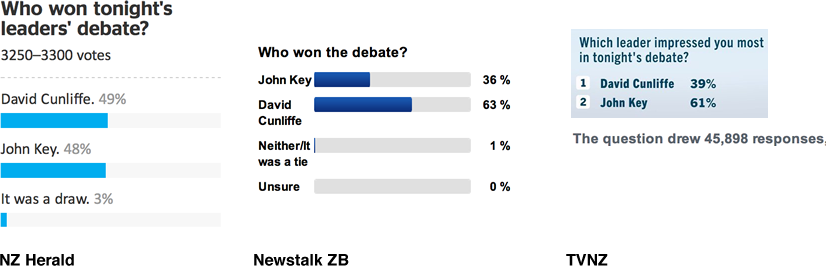
Bogus polls
This is a good illustration of why they’re meaningless…
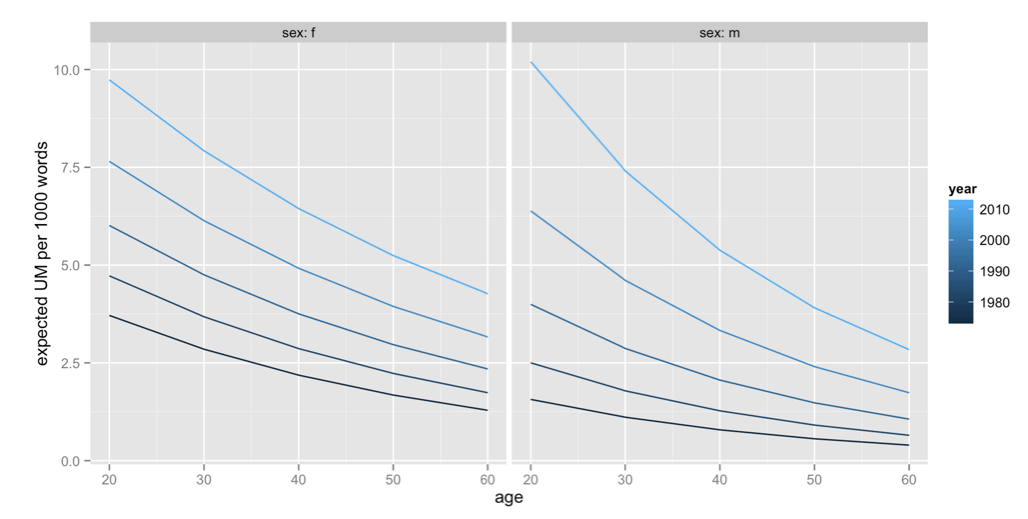
A recurring issue with trends over time is whether they are ‘age’ trends, ‘period’ trends, or ‘cohort’ trends. That is, when we complain about ‘kids these days’, is it ‘kids’ or ‘these days’ that’s the problem? Mark Liberman at Language Log has a nice example using analyses by Joe Fruehwald.
If you look at the frequency of “um” in speech (in this case in Philadelphia), it decreases with age at any given year
On the other hand, it increases over time for people in a given age cohort (for example, the line that stretches right across the graph is for people born in the 1950s)
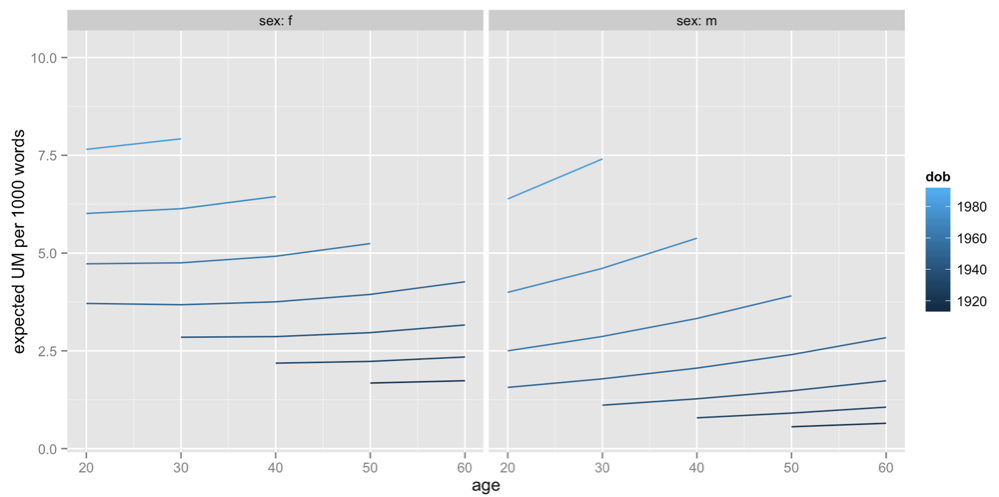
It’s not that people say “um” less as they get older, it’s that people born a long time ago say “um” less than people born recently.
‘Dodgy use of data’ edition [Background: the Washington Post is the serious DC paper. The Washington Times, not so much]
The basic method is described on my Department home page. I have made some changes to the methodology this year, including shrinking the ratings between seasons.
Here are the team ratings prior to this week’s games, along with the ratings at the start of the season.
| Current Rating | Rating at Season Start | Difference | |
|---|---|---|---|
| Roosters | 11.22 | 12.35 | -1.10 |
| Rabbitohs | 10.50 | 5.82 | 4.70 |
| Cowboys | 10.23 | 6.01 | 4.20 |
| Storm | 7.48 | 7.64 | -0.20 |
| Sea Eagles | 5.54 | 9.10 | -3.60 |
| Broncos | 4.60 | -4.69 | 9.30 |
| Warriors | 1.54 | -0.72 | 2.30 |
| Panthers | 1.15 | -2.48 | 3.60 |
| Dragons | 0.25 | -7.57 | 7.80 |
| Bulldogs | -2.89 | 2.46 | -5.40 |
| Knights | -4.94 | 5.23 | -10.20 |
| Eels | -4.96 | -18.45 | 13.50 |
| Titans | -6.12 | 1.45 | -7.60 |
| Raiders | -9.08 | -8.99 | -0.10 |
| Sharks | -11.55 | 2.32 | -13.90 |
| Wests Tigers | -14.75 | -11.26 | -3.50 |
So far there have been 176 matches played, 99 of which were correctly predicted, a success rate of 56.2%.
Here are the predictions for last week’s games.
| Game | Date | Score | Prediction | Correct | |
|---|---|---|---|---|---|
| 1 | Bulldogs vs. Wests Tigers | Aug 21 | 30 – 10 | 15.40 | TRUE |
| 2 | Eels vs. Sea Eagles | Aug 22 | 22 – 12 | -9.50 | FALSE |
| 3 | Broncos vs. Knights | Aug 23 | 48 – 6 | 8.40 | TRUE |
| 4 | Rabbitohs vs. Cowboys | Aug 23 | 10 – 22 | 8.40 | FALSE |
| 5 | Warriors vs. Roosters | Aug 24 | 12 – 46 | 0.60 | FALSE |
| 6 | Sharks vs. Raiders | Aug 24 | 12 – 22 | 4.70 | FALSE |
| 7 | Dragons vs. Titans | Aug 24 | 34 – 6 | 7.20 | TRUE |
| 8 | Panthers vs. Storm | Aug 25 | 10 – 24 | 0.90 | FALSE |
Here are the predictions for Round 25. The prediction is my estimated expected points difference with a positive margin being a win to the home team, and a negative margin a win to the away team
| Game | Date | Winner | Prediction | |
|---|---|---|---|---|
| 1 | Bulldogs vs. Rabbitohs | Aug 28 | Rabbitohs | -8.90 |
| 2 | Broncos vs. Dragons | Aug 29 | Broncos | 8.90 |
| 3 | Knights vs. Eels | Aug 30 | Knights | 4.50 |
| 4 | Raiders vs. Wests Tigers | Aug 30 | Raiders | 10.20 |
| 5 | Roosters vs. Storm | Aug 30 | Roosters | 8.20 |
| 6 | Warriors vs. Titans | Aug 31 | Warriors | 12.20 |
| 7 | Sea Eagles vs. Panthers | Aug 31 | Sea Eagles | 8.90 |
| 8 | Cowboys vs. Sharks | Sep 01 | Cowboys | 26.30 |
Here are the team ratings prior to Round 3, along with the ratings at the start of the season. I have created a brief description of the method I use for predicting rugby games. Go to my Department home page to see this.
Here are the team ratings prior to this week’s games, along with the ratings at the start of the season.
| Current Rating | Rating at Season Start | Difference | |
|---|---|---|---|
| Canterbury | 19.69 | 18.09 | 1.60 |
| Tasman | 9.09 | 5.78 | 3.30 |
| Wellington | 8.20 | 10.16 | -2.00 |
| Auckland | 3.31 | 4.92 | -1.60 |
| Counties Manukau | 2.19 | 2.40 | -0.20 |
| Hawke’s Bay | 1.75 | 2.75 | -1.00 |
| Waikato | 0.77 | -1.20 | 2.00 |
| Otago | -1.29 | -1.45 | 0.20 |
| Taranaki | -3.68 | -3.89 | 0.20 |
| Southland | -5.25 | -5.85 | 0.60 |
| Bay of Plenty | -8.38 | -5.47 | -2.90 |
| Northland | -9.09 | -8.22 | -0.90 |
| Manawatu | -9.45 | -10.32 | 0.90 |
| North Harbour | -9.93 | -9.77 | -0.20 |
So far there have been 14 matches played, 10 of which were correctly predicted, a success rate of 71.4%.
Here are the predictions for last week’s games.
| Game | Date | Score | Prediction | Correct | |
|---|---|---|---|---|---|
| 1 | North Harbour vs. Southland | Aug 21 | 21 – 25 | -0.70 | TRUE |
| 2 | Waikato vs. Canterbury | Aug 22 | 27 – 58 | -14.90 | TRUE |
| 3 | Hawke’s Bay vs. Taranaki | Aug 22 | 29 – 26 | 9.40 | TRUE |
| 4 | Northland vs. Wellington | Aug 23 | 35 – 5 | -13.30 | FALSE |
| 5 | Counties Manukau vs. Otago | Aug 23 | 29 – 25 | 7.50 | TRUE |
| 6 | Manawatu vs. Auckland | Aug 24 | 7 – 35 | -8.80 | TRUE |
| 7 | Bay of Plenty vs. Tasman | Aug 24 | 27 – 56 | -8.90 | TRUE |
Here are the predictions for Round 3. The prediction is my estimated expected points difference with a positive margin being a win to the home team, and a negative margin a win to the away team.
| Game | Date | Winner | Prediction | |
|---|---|---|---|---|
| 1 | Waikato vs. Taranaki | Aug 27 | Waikato | 8.50 |
| 2 | Canterbury vs. Northland | Aug 28 | Canterbury | 32.80 |
| 3 | Wellington vs. Manawatu | Aug 29 | Wellington | 21.60 |
| 4 | Counties Manukau vs. Hawke’s Bay | Aug 30 | Counties Manukau | 4.40 |
| 5 | Southland vs. Otago | Aug 30 | Southland | 0.00 |
| 6 | North Harbour vs. Waikato | Aug 30 | Waikato | -6.70 |
| 7 | Taranaki vs. Bay of Plenty | Aug 31 | Taranaki | 8.70 |
| 8 | Auckland vs. Tasman | Aug 31 | Tasman | -1.80 |
The basic method is described on my Department home page. I have made some changes to the methodology this year, including shrinking the ratings between seasons.
Here are the team ratings prior to this week’s games, along with the ratings at the start of the season.
| Current Rating | Rating at Season Start | Difference | |
|---|---|---|---|
| Western Province | 5.29 | 3.43 | 1.90 |
| Sharks | 4.37 | 5.09 | -0.70 |
| Lions | 2.37 | 0.07 | 2.30 |
| Cheetahs | -0.28 | 0.33 | -0.60 |
| Blue Bulls | -3.43 | -0.74 | -2.70 |
| Griquas | -8.02 | -7.49 | -0.50 |
| Pumas | -8.15 | -10.00 | 1.80 |
| Kings | -11.47 | -10.00 | -1.50 |
So far there have been 12 matches played, 11 of which were correctly predicted, a success rate of 91.7%.
Here are the predictions for last week’s games.
| Game | Date | Score | Prediction | Correct | |
|---|---|---|---|---|---|
| 1 | Pumas vs. Griquas | Aug 22 | 33 – 15 | 3.00 | TRUE |
| 2 | Blue Bulls vs. Kings | Aug 23 | 30 – 25 | 14.20 | TRUE |
| 3 | Western Province vs. Lions | Aug 23 | 27 – 14 | 7.10 | TRUE |
| 4 | Sharks vs. Cheetahs | Aug 23 | 19 – 16 | 10.60 | TRUE |
Here are the predictions for Round 4. The prediction is my estimated expected points difference with a positive margin being a win to the home team, and a negative margin a win to the away team.
| Game | Date | Winner | Prediction | |
|---|---|---|---|---|
| 1 | Pumas vs. Sharks | Aug 29 | Sharks | -7.50 |
| 2 | Griquas vs. Cheetahs | Aug 30 | Cheetahs | -2.70 |
| 3 | Blue Bulls vs. Western Province | Aug 30 | Western Province | -3.70 |
| 4 | Kings vs. Lions | Aug 30 | Lions | -8.80 |
Infographic edition
1. Thomson Reuters illustrated the importance of fine detail in graphic in one of their ads. It looks like a Venn diagram. Oops.

Removing the transparent overlap and changing the colours makes it less Venn-ish

2. Kevin Schaul in the Washington Post came up with this neat graphical summary of state data
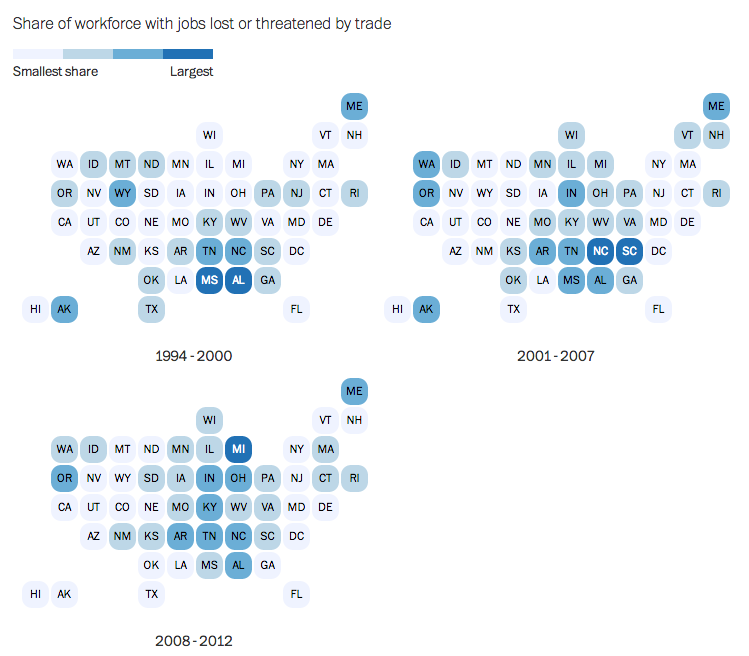
Because the basic outline of the US is so familiar (especially to people who live there), the huge spatial distortions aren’t actually all that disturbing. Mark Monmonier, a geographer, seems to have been the first person to move in this direction (eg). I suggested to Kevin, on Twitter, that this technique would also allow Alaska to be moved from the tropical Pacific to its proper home in the north, and he agreed.
3. That’ll wake you up
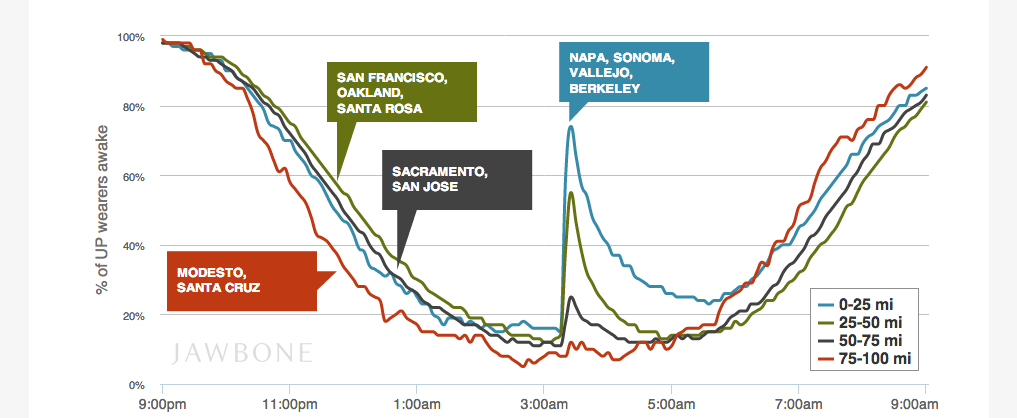
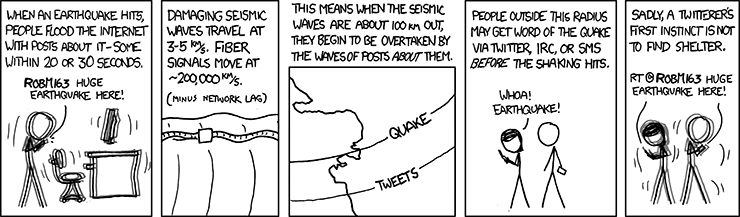
Jawbone, who make products that tell you if you are awake and walking around, looked at the impact of this week’s Napa earthquake. The data resolution isn’t quite fine enough to see the time taken for the ground waves to propagate — compare XKCD on the Twitter event horizon
Each week, we would like to invite readers of Stats Chat to submit nominations for our Stat of the Week competition and be in with the chance to win an iTunes voucher.
Here’s how it works:
Next Monday at midday we’ll announce the winner of this week’s Stat of the Week competition, and start a new one.
The 3% ‘margin of error’ usually quoted for poll is actually the ‘maximum margin of error’, and is an overestimate for minor parties. On the other hand, it also assumes simple random sampling and so tends to be an underestimate for major parties.
In case anyone is interested, I have done the calculations for a range of percentages (code here), both under simple random sampling and under one assumption about real sampling.
Lower and upper ‘margin of error’ limits for a sample of size 1000 and the observed percentage, under the usual assumptions of independent sampling
| Percentage | lower | upper |
|---|---|---|
| 1 | 0.5 | 1.8 |
| 2 | 1.2 | 3.1 |
| 3 | 2.0 | 4.3 |
| 4 | 2.9 | 5.4 |
| 5 | 3.7 | 6.5 |
| 6 | 4.6 | 7.7 |
| 7 | 5.5 | 8.8 |
| 8 | 6.4 | 9.9 |
| 9 | 7.3 | 10.9 |
| 10 | 8.2 | 12.0 |
| 15 | 12.8 | 17.4 |
| 20 | 17.6 | 22.6 |
| 30 | 27.2 | 32.9 |
| 50 | 46.9 | 53.1 |
Lower and upper ‘margin of error’ limits for a sample of size 1000 and the observed percentage, assuming that complications in sampling inflate the variance by a factor of 2, which empirically is about right for National.
| Percentage | lower | upper |
|---|---|---|
| 1 | 0.3 | 2.3 |
| 2 | 1.0 | 3.6 |
| 3 | 1.7 | 4.9 |
| 4 | 2.5 | 6.1 |
| 5 | 3.3 | 7.3 |
| 6 | 4.1 | 8.5 |
| 7 | 4.9 | 9.6 |
| 8 | 5.8 | 10.7 |
| 9 | 6.6 | 11.9 |
| 10 | 7.5 | 13.0 |
| 15 | 12.0 | 18.4 |
| 20 | 16.6 | 23.8 |
| 30 | 26.0 | 34.2 |
| 50 | 45.5 | 54.5 |
From XKCD. Both the data and the display technique are worth looking at
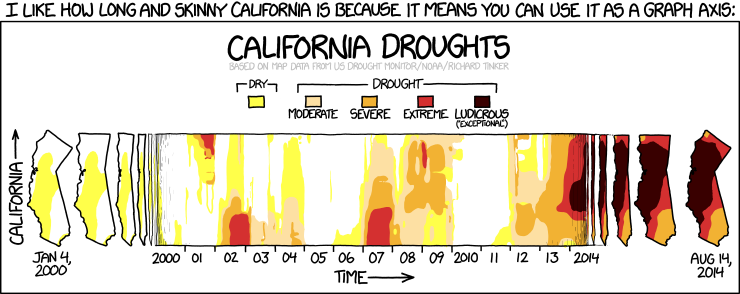
Presumably you could do something similar with New Zealand, which is roughly the same shape.
Recent comments