June 23, 2014

Stat of the Week Competition: June 21 – 27 2014

Each week, we would like to invite readers of Stats Chat to submit nominations for our Stat of the Week competition and be in with the chance to win an iTunes voucher.

Here’s how it works:

  • Anyone may add a comment on this post to nominate their Stat of the Week candidate before midday Friday June 27 2014.
  • Statistics can be bad, exemplary or fascinating.
  • The statistic must be in the NZ media during the period of June 21 – 27 2014 inclusive.
  • Quote the statistic, when and where it was published and tell us why it should be our Stat of the Week.

Next Monday at midday we’ll announce the winner of this week’s Stat of the Week competition, and start a new one.
(more…)

June 18, 2014

NRL Predictions for Round 15

Team Ratings for Round 15

The basic method is described on my Department home page. I have made some changes to the methodology this year, including shrinking the ratings between seasons.

Here are the team ratings prior to this week’s games, along with the ratings at the start of the season.

Current Rating Rating at Season Start Difference
Roosters 9.74 12.35 -2.60
Rabbitohs 7.89 5.82 2.10
Sea Eagles 5.23 9.10 -3.90
Broncos 5.07 -4.69 9.80
Cowboys 4.44 6.01 -1.60
Panthers 2.25 -2.48 4.70
Warriors 1.83 -0.72 2.50
Bulldogs 1.30 2.46 -1.20
Storm 0.27 7.64 -7.40
Knights -2.98 5.23 -8.20
Eels -4.24 -18.45 14.20
Titans -4.66 1.45 -6.10
Wests Tigers -4.77 -11.26 6.50
Dragons -6.84 -7.57 0.70
Raiders -7.27 -8.99 1.70
Sharks -9.04 2.32 -11.40


Performance So Far

So far there have been 104 matches played, 59 of which were correctly predicted, a success rate of 56.7%.

Here are the predictions for last week’s games.

Game Date Score Prediction Correct
1 Rabbitohs vs. Wests Tigers Jun 13 32 – 10 15.90 TRUE
2 Panthers vs. Dragons Jun 14 18 – 14 15.80 TRUE
3 Roosters vs. Knights Jun 14 29 – 12 17.30 TRUE
4 Bulldogs vs. Eels Jun 15 12 – 22 14.30 FALSE
5 Titans vs. Storm Jun 16 20 – 24 0.50 FALSE


Predictions for Round 15

Here are the predictions for Round 15. The prediction is my estimated expected points difference with a positive margin being a win to the home team, and a negative margin a win to the away team.

Game Date Winner Prediction
1 Raiders vs. Bulldogs Jun 20 Bulldogs -4.10
2 Warriors vs. Broncos Jun 21 Warriors 1.30
3 Sharks vs. Sea Eagles Jun 21 Sea Eagles -9.80
4 Storm vs. Eels Jun 22 Storm 9.00
5 Titans vs. Dragons Jun 22 Titans 6.70
6 Knights vs. Cowboys Jun 23 Cowboys -2.90


Counts and proportions

Phil Price writes (at Andrew Gelman’s blog) on the impact of bike-share programs:

So the number of head injuries declined by 14 percent, and the Washington Post reporter — Lenny Bernstein, for those of you keeping score at home — says they went up 7.8%.  That’s a pretty big mistake! How did it happen?  Well, the number of head injuries went down, but the number of injuries that were not head injuries went down even more, so the proportion of injuries that were head injuries went up.


To be precise, the research paper found 638 hospitalised head injuries in 24 months before the bike share program, and 273 in the 12 months afterwards. In a set of control cities that didn’t start a bike-share program there were 712 head injuries in the 24 months before the matching date and 342 in the 12 months afterwards. That is, a 14.4% decrease in the cities that added bike-share programs and a 4% decrease in those that didn’t.


The screening problem

Nicely summarised by two paragraphs from a story in the Herald

In a separate breast cancer study published online by the British Medical Journal(BMJ), researchers from Norway and the United States found that mammograms carried out once every two years may reduce death risk by about 28 per cent.

About 27 deaths from breast cancer can be avoided for every 10,000 women who did mammography screening – or about one in 368, said the team after analysing data from all women in Norway aged 50 to 79 between 1986 and 2009.

The two prevention numbers — 28% of breast cancer deaths, or one breast cancer death for every 368 women screened — are the same, but they give a very different impression. [Note that this is the age range where mammography works best]

June 17, 2014

Margins of error

From the Herald

The results for the Mana Party, Internet Party and Internet-Mana Party totalled 1.4 per cent in the survey – a modest start for the newly launched party which was the centre of attention in the lead-up to the polling period.

That’s probably 9 respondents. A 95% interval around the support for Internet–Mana goes from 0.6% to 2.4%, so we can’t really tell much about the expected number of seats.

Also notable

Although the deal was criticised by many commentators and rival political parties, 39 per cent of those polled said the Internet-Mana arrangement was a legitimate use of MMP while 43 per cent said it was an unprincipled rort.

I wonder what other options respondents were given besides “unprincipled rort” and “legitimate use of MMP”.

June 16, 2014

Stat of the Week Competition: June 14 – 20 2014

Each week, we would like to invite readers of Stats Chat to submit nominations for our Stat of the Week competition and be in with the chance to win an iTunes voucher.

Here’s how it works:

  • Anyone may add a comment on this post to nominate their Stat of the Week candidate before midday Friday June 20 2014.
  • Statistics can be bad, exemplary or fascinating.
  • The statistic must be in the NZ media during the period of June 14 – 20 2014 inclusive.
  • Quote the statistic, when and where it was published and tell us why it should be our Stat of the Week.

Next Monday at midday we’ll announce the winner of this week’s Stat of the Week competition, and start a new one.

(more…)

June 15, 2014

A thousand words

Compare these two stories:

The second story actually gives more context and explanation, but the first one is (to me) more effective.  It also shows something surprising: the size distribution splits into separate modes in recent years, perhaps reflecting specialisation in playing positions.

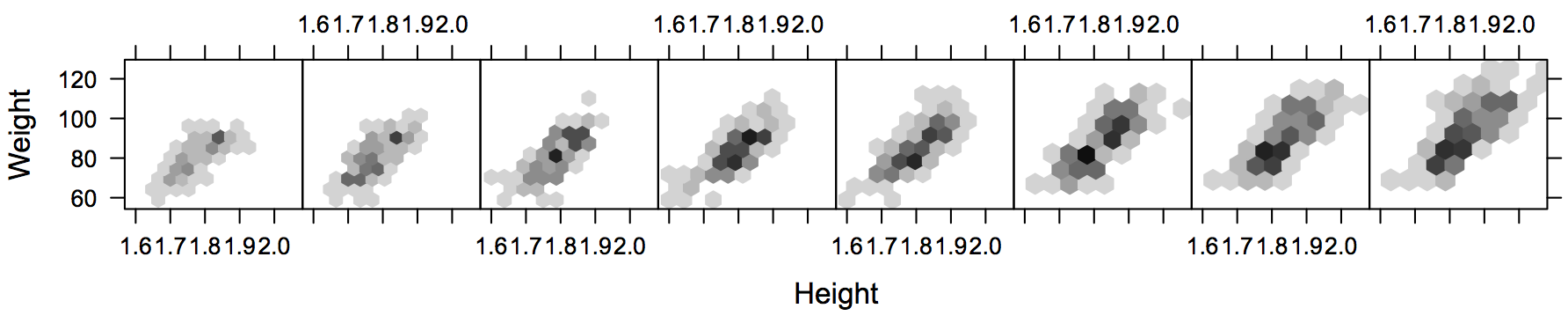
The second story actually argues that there isn’t a similar divergence in builds of rugby players, so I went to look at the data (which involved scraping it off the NZ Rugby Museum website).  The pattern over time I get is (click to embiggen)

rugby


which suggests that rugby players aren’t just getting bigger, they are showing a little of the same separation into big and very big seen in the NFL players


June 14, 2014

Science communication links

The need for science communication:

 Stephen Curry, writing at The Guardian

Even so, I think we need to work on our relationship. Approval ratings may be high and over two-thirds of you may also be happy to leave it to the ‘experts’ to advise the government on science, but a similar proportion still believe that scientists don’t try hard enough to listen to what ordinary people think or to inform them about their work.


Robert Finn, writing at Scientific American

The journalist reached out to Dr. A and also to two other researchers (Drs. X and Y), who work in related fields, to get independent comment. Boy oh boy did Dr. X and Dr. Y comment, and those comments surely were independent, which is what any journalist wants. But in the same emails in which they eviscerated the study they also insisted that their comments remain off the record.

Because our sources said that their comments were off the record, we couldn’t use them in any way, and I can’t quote them here, not even anonymously. At this writing, the journalist has been unsuccessful in finding sources willing to offer on-the-record comments or criticisms of the study.


And, for some promising news, there is a new science column in the ChCh Press, that gives brief summaries of science stories over the week. It’s written by Sarah-Jane O’Connor, who is both a scientist with a PhD in Ecology and a journalist.

Why is this week unlike every other week?

Keith Humphreys, writing in New York Magazine

clever new study in the journal Addiction provides clues about who is worst at owning up to the full extent of their drinking.

The researchers surveyed over 40,000 people with standard alcohol survey questions about their quantity and frequency of alcohol consumption — “How many drinks have you had in the past month?” and so on. But in a smart twist, they then asked a more immediate question: “How many drinks did you have yesterday?”

I’ve written about this technique before; it can be very powerful, though it won’t help much if people are intentionally misleading you.

June 13, 2014

How useful is public health screening?

Thomas Lumley’s latest New Zealand Listener column points out that while people love the sound of public screening for disease,  it has a significant problem: Most people who are screened aren’t sick. And that’s when the spectre of false positives arises …

Read the column here: Failing the screen test