June 14, 2014

Science communication links

The need for science communication:

 Stephen Curry, writing at The Guardian

Even so, I think we need to work on our relationship. Approval ratings may be high and over two-thirds of you may also be happy to leave it to the ‘experts’ to advise the government on science, but a similar proportion still believe that scientists don’t try hard enough to listen to what ordinary people think or to inform them about their work.


Robert Finn, writing at Scientific American

The journalist reached out to Dr. A and also to two other researchers (Drs. X and Y), who work in related fields, to get independent comment. Boy oh boy did Dr. X and Dr. Y comment, and those comments surely were independent, which is what any journalist wants. But in the same emails in which they eviscerated the study they also insisted that their comments remain off the record.

Because our sources said that their comments were off the record, we couldn’t use them in any way, and I can’t quote them here, not even anonymously. At this writing, the journalist has been unsuccessful in finding sources willing to offer on-the-record comments or criticisms of the study.


And, for some promising news, there is a new science column in the ChCh Press, that gives brief summaries of science stories over the week. It’s written by Sarah-Jane O’Connor, who is both a scientist with a PhD in Ecology and a journalist.

Why is this week unlike every other week?

Keith Humphreys, writing in New York Magazine

clever new study in the journal Addiction provides clues about who is worst at owning up to the full extent of their drinking.

The researchers surveyed over 40,000 people with standard alcohol survey questions about their quantity and frequency of alcohol consumption — “How many drinks have you had in the past month?” and so on. But in a smart twist, they then asked a more immediate question: “How many drinks did you have yesterday?”

I’ve written about this technique before; it can be very powerful, though it won’t help much if people are intentionally misleading you.

June 13, 2014

How useful is public health screening?

Thomas Lumley’s latest New Zealand Listener column points out that while people love the sound of public screening for disease,  it has a significant problem: Most people who are screened aren’t sick. And that’s when the spectre of false positives arises …

Read the column here: Failing the screen test

June 12, 2014

NRL Predictions for Round 14

Team Ratings for Round 14

The basic method is described on my Department home page. I have made some changes to the methodology this year, including shrinking the ratings between seasons.

Here are the team ratings prior to this week’s games, along with the ratings at the start of the season.

Current Rating Rating at Season Start Difference
Roosters 9.78 12.35 -2.60
Rabbitohs 7.28 5.82 1.50
Sea Eagles 5.23 9.10 -3.90
Broncos 5.07 -4.69 9.80
Cowboys 4.44 6.01 -1.60
Bulldogs 3.42 2.46 1.00
Panthers 3.36 -2.48 5.80
Warriors 1.83 -0.72 2.50
Storm -0.19 7.64 -7.80
Knights -3.02 5.23 -8.20
Wests Tigers -4.16 -11.26 7.10
Titans -4.20 1.45 -5.70
Eels -6.36 -18.45 12.10
Raiders -7.27 -8.99 1.70
Dragons -7.94 -7.57 -0.40
Sharks -9.04 2.32 -11.40


Performance So Far

So far there have been 99 matches played, 56 of which were correctly predicted, a success rate of 56.6%.

Here are the predictions for last week’s games.

Game Date Score Prediction Correct
1 Sea Eagles vs. Bulldogs Jun 06 32 – 10 2.90 TRUE
2 Eels vs. Cowboys Jun 06 18 – 16 -8.30 FALSE
3 Titans vs. Panthers Jun 07 14 – 36 1.00 FALSE
4 Dragons vs. Sharks Jun 07 30 – 0 0.60 TRUE
5 Rabbitohs vs. Warriors Jun 07 34 – 18 8.50 TRUE
6 Knights vs. Wests Tigers Jun 08 20 – 23 7.70 FALSE
7 Storm vs. Roosters Jun 08 12 – 32 -2.30 TRUE
8 Raiders vs. Broncos Jun 09 4 – 26 -4.70 TRUE


Predictions for Round 14

Here are the predictions for Round 14. The prediction is my estimated expected points difference with a positive margin being a win to the home team, and a negative margin a win to the away team.

Game Date Winner Prediction
1 Rabbitohs vs. Wests Tigers Jun 13 Rabbitohs 15.90
2 Panthers vs. Dragons Jun 14 Panthers 15.80
3 Roosters vs. Knights Jun 14 Roosters 17.30
4 Bulldogs vs. Eels Jun 15 Bulldogs 14.30
5 Titans vs. Storm Jun 16 Titans 0.50


June 11, 2014

But did he ever return?

An excellent visualisation of very detailed data from the Boston subway system:

Boston’s Massachusetts Bay Transit Authority (MBTA) operates the 4th busiest subway system in the U.S. after New York, Washington, and Chicago. If you live in or around the city you have probably ridden on it. The MBTA recently began publishing substantial amount of subway data through its public APIs. They provide the full schedule in General Transit Feed Specification (GTFS) format which powers Google’s transit directions. They also publish realtime train locations for the Red, Orange, and Blue lines (but not Green or Silver lines). The following visualizations use data captured from these feeds for the entire month of February, 2014. Also, working with the MBTA, we were able to acquire per-minute entry and exit counts at each station measured at the turnstiles used for payment.

[No, he never returned]

June 10, 2014

Eat your greens

Stuff has a story about ‘Powerhouse Fruits and Vegetables”.  They get points for linking to the source, and for pointing out that although

“The rankings provide clarity on the nutrient quality of the different foods

the rankings are quite different from other rankings that are supposed to do the same thing.

They don’t point out that it’s silly to list scores to four digit accuracy when nutrient content varies enough to make the first digit somewhat unreliable.They also don’t point out that these are nutrient scores not per serving, but per 100 Calories of the food. Google thinks watercress has about 11 Calories/100g, so that’s 900g of watercress. The data are for raw watercress — the research paper doesn’t say how much the score goes down if you stir-fry it, Chinese-style.

If you much through a couple of pounds of watercress, it’s not surprising you’d pick up a few nutrients along the way. The applicability of this fact to NZ daily life must be a bit limited, though.

June 9, 2014

Sticking it to ACC

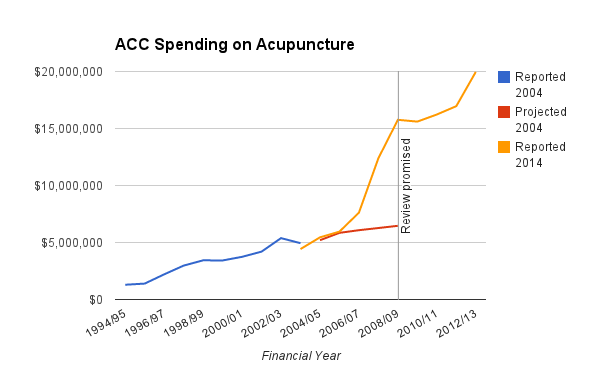
From Mark Hanna on Twitter, ACC expenditures on acupuncture (the sources are in the Twitter conversation)

acupuncture


The graph shows three things. Firstly, there was a review promised. Second, the expenditure on acupuncture is vastly different from the projections. Third, it’s getting to be a moderately large sum of money.

Comparing to the 2012 Pharmac report (PDF, p5), there were only seven prescription items where Pharmac spends more per year than the $17 million ACC spent on acupuncture that year (and one about the same). Things like diabetes test strips and the breast-cancer drug Herceptin.

I’m not as opposed as Mark to spending taxpayer money on the placebo effect, but at some point you have to wonder whether there might be more cost-effective ways to get it.

Chasing factoids

The Herald says

Almost four in 10 young UK adults describe themselves as digital addicts, according to research published by Foresters, the financial services company.

The story does quote an independent expert who is relatively unimpressed with the definition of ‘digital addict’, but it doesn’t answer the question ‘what sort of research?”

Via Google, I found a press release of a digital addiction survey promoted by Foresters. It’s not clear if the current story is based on a new press release from this survey or a new version of the survey, but the methodology is presumably similar.

So, what is the methodology?

Over 1,100 people across the UK responded to an online survey in November 2013 , conducted by Wriglesworth Research

There’s also a related press release from Wriglesworth, but without any more methodological detail. If I Google for “wriglesworth survey”, this is what comes up

wriglesworth

That is, the company is at least in the habit of conducting self-selected online polls, advertised on web forums and Twitter.

I tried, but I couldn’t find any evidence that the numbers in this online survey were worth the paper they aren’t written on.

Stat of the Week Competition: June 7 – 13 2014

Each week, we would like to invite readers of Stats Chat to submit nominations for our Stat of the Week competition and be in with the chance to win an iTunes voucher.

Here’s how it works:

  • Anyone may add a comment on this post to nominate their Stat of the Week candidate before midday Friday June 13 2014.
  • Statistics can be bad, exemplary or fascinating.
  • The statistic must be in the NZ media during the period of June 7 – 13 2014 inclusive.
  • Quote the statistic, when and where it was published and tell us why it should be our Stat of the Week.

Next Monday at midday we’ll announce the winner of this week’s Stat of the Week competition, and start a new one.

(more…)

June 8, 2014

Foreign drivers

From the ChCh Press

Foreign drivers cause more fatal and injury crashes in the South Island than the national average – and the West Coast is the worst spot.

They don’t actually mean “more,” they mean “a higher proportion of”.

New Zealand Transport Agency (NZTA) safety directions chief adviser Lisa Rossiter said its crash statistics for the past 10 years showed foreign drivers were involved in about 6 per cent of all fatal or injury crashes in New Zealand, and were at fault in about 2 per cent.

On average, short-term visitors make up roughly 2.5% of people in New Zealand (2.78 million visitors in the year to April 2014, median visit of 9 days, so I’m guessing mean visit about two weeks). About another 2% of people in New Zealand are international students, who are at least sometimes counted as foreign drivers.

So, the risk seems to be a bit higher for foreign drivers, but probably not twice as high. Some of the excess can probably be explained by age: international students, backpackers, and drunk Australians in Queenstown are younger than the population average.

It’s different in parts of the South Island

The tourist hot spots of Otago and the West Coast fared worst.

A foreign driver was identified as a factor in 13 per cent of fatal crashes on the coast, and 5 per cent of fatal crashes in Otago from 2004 to 2013.

A lot of this must be because tourists are over-represented in tourist hot spots: that’s what ‘tourist hot-spot’ means. The proportion of short-term visitors is about 2.5% nationwide, but it’s probably rather lower that than in Gisborne and rather higher on the West Coast.

It’s also worth noting that “identified as a factor” is fairly weak. If you go to the Ministry of Transport reports and add up the percentage of times different factors were involved in a crash, you get a lot more than 100% (for the 2010 report I get 225% for fatal crashes and 185% for injury crashes)

For crashes involving a tourist driver and more than one car, the foreign driver was fully or partly responsible two out of three times.

This at least gets rid of the denominator problem, but the “partly” responsible is still a problem. We aren’t told what proportion of the time the local driver was fully or partly responsible — based on the information given, that could also be two out of three times.

It’s quite likely that foreign drivers are at higher risk, especially those from countries that drive on the right, but the problem is not a big fraction of the NZ road toll. It’s worth considering things that can sensibly be done to reduce it — which doesn’t include withdrawing from the U.N. Convention on Road Traffic — but if you’re trying to stop road deaths it may be more effective to concentrate on interventions that don’t just affect foreign drivers.  Clearer signage, guard rails and median barriers, separated bike lanes, improved public transport… there are many things that might knock a percentage point off road deaths more easily than targetting foreign drivers.