May 21, 2014

Sea rise visualisation

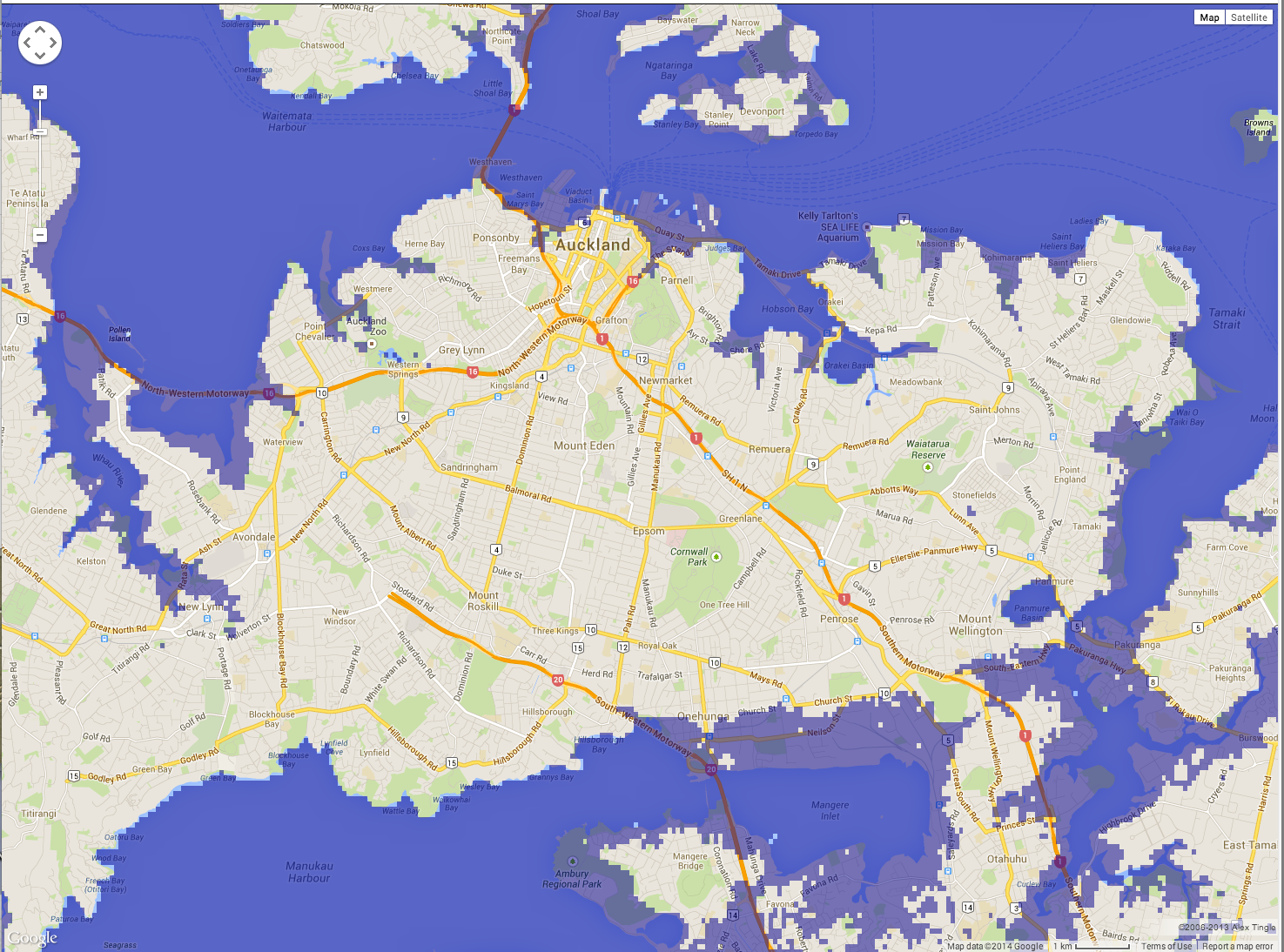
A new map to let you see the impact of rises in sea levels on your area: this is Auckland with 13m sea rise

flood


This doesn’t show the impact of storm surges, which are the big problem for a lot of eastern coastal Auckland (though not so much for Manukau Harbour).

(via everyone on twitter)

Revolutionary new advertising success

The Daily Mail (and the Telegraph) recently ran puff pieces advertising a new ‘drinkable sunscreen’

Those who make the product, which is available to buy, claim that once the elixir is ingested, molecules of the product vibrate on the skin to cancel out 97 per cent of UVA and UVB rays.

Actually, the Telegraph headline was “Could this be the first drinkable sunscreen?”, and, following Betteridge’s Law, the answer is “Fsck, no!” A blog at the Guardian has a good demolition of the stories, and the illuminating byline

Dean Burnett is acutely aware of how many ways he could be sued if he wrote his initial reactions to the articles about this sunscreen. He is on Twitter, @garwboy

British libel law has been modified after the notorious attack on Simon Singh, but it’s not surprising that no-one wants to be a test case for the new law.

After seeing the reaction, the Mail has at least modified their article to add a concluding warning

Hermoine Lawson, spokesman at the British Skin Foundation, said: ‘We would advise extreme caution of any product claiming UV protection using methods not supported by clinical research. 

‘When it comes to an issue as serious as preventing skin cancer, customer testimonials cannot take the place of scientific evidence, for which this particular product cannot provide.

The Telegraph has a story about the implausibility of the claim and the lack of supporting evidence, though it carefully doesn’t mention how you might have come to hear about the claim, and there certainly isn’t an apology or a retraction.

That’s all on the other side of the world.  Here, where we have one of the highest rates of melanoma, you’d expect a bit more of a clue about sunscreen. But, no, One News has the story. They don’t have the testimonial from someone who used it on a toddler, but they do have the inventor claiming it is effective for more than 99% of people.

Although One News just describes them as a US skincare company, they have a New Zealand distributor with a New Zealand company registration and .co.nz website, and a whole bunch of ‘harmonized water’ products with superficially implausible claims, and they do include the ‘sunscreen’ and the claims:

•Neutralizes UV radiation 
•Allows for increased sun exposure (30x more than normal) 
•Enhances tanning effect from the sun 

Perhaps someone might like to ask the Advertising Standards Authority to verify that the claims are indeed valid and substantiated?

May 20, 2014

International Clinical Trials Day: Alltrials

Video from the Alltrials campaign. It’s fair to point out that this is well-designed propaganda, even though it’s absolutely right about the problem


You can also read what a drug-discovery chemist says about the results of the campaign to get all the Tamiflu trials analysed.

International Clinical Trials Day

May 20 is International Clinical Trials Day, commemorating James Lind’s trial of treatments for scurvy in 1747.

New York transit visualisation

We’ve seen animated pictures of mass transit routes before, but mta.me has the wonderful touch of lines that behave like plucked guitar strings when they cross. Not all that useful, but pretty and soothing. And a reminder that New York has a whole lot of trains, just like we don’t. By Alexander Chen

mta-me

(via @_inundata)

May 19, 2014

Piechart of the week

Bn-cg6IIEAA0e7J

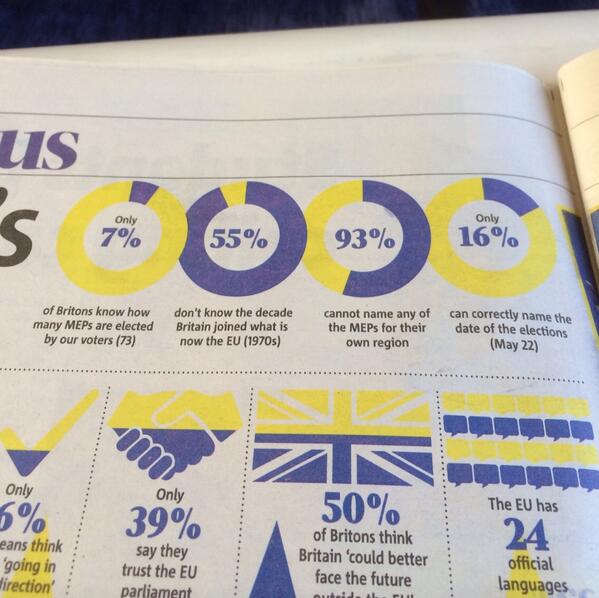
Yes, it’s a simple swap of two numbers, but if anyone actually read the thing…

(via @WINDY_BUTT)

Stat of the Week Competition: May 17 – 23 2014

Each week, we would like to invite readers of Stats Chat to submit nominations for our Stat of the Week competition and be in with the chance to win an iTunes voucher.

Here’s how it works:

  • Anyone may add a comment on this post to nominate their Stat of the Week candidate before midday Friday May 23 2014.
  • Statistics can be bad, exemplary or fascinating.
  • The statistic must be in the NZ media during the period of May 17 – 23 2014 inclusive.
  • Quote the statistic, when and where it was published and tell us why it should be our Stat of the Week.

Next Monday at midday we’ll announce the winner of this week’s Stat of the Week competition, and start a new one.

(more…)

May 17, 2014

Robustly null


A new study pooled data from previous studies of vaccination and autism, and as Emily Willingham writes, it gives what you’d expect.

Five cohort studies involving 1,256,407 children and five case-control studies involving 9920 children were included in this analysis.

  • There was no relationship between vaccination and autism (OR: 0.99; 95% CI: 0.92 to 1.06).
  • There was no relationship between vaccination and [autism spectrum disorder] (OR: 0.91; 95% CI: 0.68 to 1.20).
  • There was no relationship between  [autism spectrum disorder] and MMR (OR: 0.84; 95% CI: 0.70 to 1.01).
  • There was no relationship between  [autism spectrum disorder] and thimerosal (OR: 1.00; 95% CI: 0.77 to 1.31).
  • There was no relationship between  [autism spectrum disorder] and mercury (Hg) (OR: 1.00; 95% CI: 0.93 to 1.07).

Findings of this meta-analysis suggest that vaccinations are not associated with the development of autism or autism spectrum disorder.

These results basically rule out any substantial effect due to vaccination. To the extent that they suggest any effect, it is protective, but that’s probably just chance.

This sort of result is pretty boring, so it’s unlikely to get anywhere near the same media coverage as the claims that there is an effect.


May 16, 2014

On keeping your own score…

“People and institutions cannot keep their own score accurately. Metrics soon become targets and then pitches, and are thereby gamed, corrupted, misreported, fudged…

Examples: premature revenue recognition, Libor rates, beating the quarterly forecast by a single penny, terrorist attacks prevented, Weapons of Mass Destruction, number of Twitter followers, all body counts (crowd sizes, civilians blown up). Sometimes call the Principle of Lake Woebegone, where all children are above average.”

– Edward Tufte

Averages, percentages, nets, and GST

Our only Prime Minister, on Radio NZ

“I utterly reject those propositions. Twelve percent of households pay 76 percent of all net tax in New Zealand,” he said.

I’ve written about “net tax” before, both on StatsChat and elsewhere. It has to be defined and analysed carefully and non-intuitively in order to get these sorts of results.

Suppose we had an imaginary population divided into three groups. The ‘Low’ group, of 10 people, each pay $1000 in income tax, $1000 in GST, and receive $1500 in cash benefits. The “Middle” group, of 5 3 people, each pays $4000 in income tax, $3000 in GST, and receives no cash in benefits. The one person in the “High” group pays $17000 in income tax, $8000 in GST, and receives no cash in benefits.

According to Mr Key’s definition, the high-income group pays 71% of the “net tax”.  The middle-income group pays 50% of the “net tax”, and the low-income group pays -21% of the “net tax”.  That’s even though every person in this imaginary population pays more in tax than they receive in cash benefits.

There are three strange things going on here. The first is that GST is ignored. That’s obviously just wrong — GST is just as real as income tax.  The second is that cash benefits are treated differently from all other categories of government expenditure, even other categories such as subsidised medications that provide a direct, quantifiable individual benefit.  The third is that percentages behave strangely when you have a mixture of negative and positive numbers.  It’s quite possible, by choosing the subsets of the NZ population correctly, to find a group that pays well over 100% of the “net tax”.

Percentages become a lot less useful when they aren’t bounded by 100, and people who want to communicate accurately should avoid them in that situation.  And if you want to distinguish income tax revenue from GST revenue, you should clearly explain what you’re doing and why.