Posts filed under Medical news (341)

April 14, 2013

Infectious disease science communcation

Today we have two examples of the important issue of communicating scientific knowledge about infectious disease epidemics.

The first is the WHO, which is doing an excellent job of describing the limited information about the new H7N9 influenza outbreak in China. Their media release is here, and they’ve had someone answering questions on Twitter as well as more traditional venues.  There’s currently evidence of a small amount of human-to-human transmission, but not enough to sustain a pandemic. On the other hand, the virus does appear to have mutated to live more successfully in people, and this could continue.  They don’t advise actually doing anything specific at the moment.


The second is the UK measles epidemic, where The Independent, has as its top front-page headline “MMR scare doctor: this outbreak proves I was right”.  Of course,  it does nothing of the sort, as the story admits later . He’s claiming that the MMR vaccine should have been replaced by three single vaccines, and even if you believe that anti-vaccination campaigners would then suddenly have stopped their misrepresentations, having three single vaccinations is actually more dangerous than one combined one.

The Independent is maintaining that its story is accurate if you read the whole thing. Even if that were so, it’s still hard to imagine why the opinion of a discredited researcher and struck-off former doctor is the single most important piece of information they have about epidemic and the world today. And, as  Martin Robins writes in New Statesman

 It would be a great example of the false balance inherent in ‘he-said, she-said’ reporting, except that it isn’t even balanced – Laurance provides a generous abundance of space for Wakefield to get his claims and conspiracy theories across, and appends a brief response from a real scientist at the end. 
April 10, 2013

Health claims not berry well supported

I don’t usually bother with general nutrition stories that don’t contain any direct reference to research, but the Herald story about berries was irresistible. There are lots of biologically active compounds in berries, and many of them have been shown to have interesting properties in test-tubes or mice. As you know by now,  this sort of interesting biochemistry is important because it occasionally translates to genuine health benefits, so you should be asking what the human clinical research shows.

If you go to the Cochrane Library (which is free to everyone in New Zealand), and look for clinical research in humans involving blueberries or cranberries you don’t find much. The only topic with enough information to draw any sort of conclusion is on cranberry juice to prevent urinary tract infections. Which it basically doesn’t. The plain-language summary says

Cranberries (usually as cranberry juice) have been used to prevent urinary tract infections (UTIs). Cranberries contain a substance that can prevent bacteria from sticking on the walls of the bladder. This may help prevent bladder and other UTIs. This review identified 24 studies (4473 participants) comparing cranberry products with control or alternative treatments. There was a small trend towards fewer UTIs in people taking cranberry product compared to placebo or no treatment but this was not a significant finding. Many people in the studies stopped drinking the juice, suggesting it may not be a acceptable intervention. Cranberry juice does not appear to have a significant benefit in preventing UTIs and may be unacceptable to consume in the long term. 

As with many fruits and vegetables, eating more of them instead of other stuff is both enjoyable and probably healthy. As with pretty much any food, there might be some specific additional benefits (or harms), but if so we don’t yet have much evidence for them.

What genetics is good for

There’s an article in Nature News about one of the most interesting findings from large-scale genomic studies.  People with mutations in a gene called PCSK9 have low levels of cholesterol, and since the protein produced by that gene is active outside cells, it is relatively easy to target.  Also, people with mutations in both of their copies of the PCSK9 gene seem to be healthy, so it looks as though it should be a safe target for treatment

Synthetic antibodies against PCSK9 reduced LDL (bad) cholesterol by 73% in initial trials in a small group of patients, which is huge. There’s a huge trial going on at the moment to see if this translates to a reduction in heart attacks, strokes, etc.  It could still easily fail — several other drugs giving big cholesterol improvements have turned out not to prevent heart disease — but it is very promising.

April 9, 2013

We’re all mutants?

From the Herald (actually from the Independent)

The rise in the number of overweight children in Western countries may be as much to do with their genes as their diet and exercise levels,

In fact, just about the only completely uncontroversial fact about the increase in obesity is that it is entirely due to environmental changes of some sort. There’s disagreement on precisely which environmental changes, and on the likely public health impact, but not on the general principle. The reason is very simple: the genes of this generation’s children came from their parents, with almost no changes. There simply hasn’t been enough time for genetic differences to contribute.

The research paper is looking for mechanisms: they aren’t studying a representative population sample, but a group of 1500 children with severe obesity.  Most of the genetic variants they found are very rare, and did not show up in the previous huge genetic study of weight and height that combined genetic data on quarter of a million people. That means these genetic variants can’t contribute much even to explaining or predicting which children are overweight. The last sentence of the research paper is illustrative of the point of the research

 As we observed a significant enrichment for CNVs that deleted GPCRs, which are key targets for drug development, these findings may have potential therapeutic implications.

In English: there were lots of mutations that affected one particular type of cell signalling molecule, one that we’re pretty good at turning on and off with drugs. This could be useful.

April 8, 2013

All clinical trial results should be published

If you’re one of the 40,000 or so people who has signed the Alltrials petition you will have received an email from Ben Goldacre asking for more help.

The  Declaration of Helsinki, the major document on research ethics in medicine, already states

30. Authors, editors and publishers all have ethical obligations with regard to the publication of the results of research. Authors have a duty to make publicly available the results of their research on human subjects and are accountable for the completeness and accuracy of their reports. They should adhere to accepted guidelines for ethical reporting. Negative and inconclusive as well as positive results should be published or otherwise made publicly available. Sources of funding, institutional affiliations and conflicts of interest should be declared in the publication. Reports of research not in accordance with the principles of this Declaration should not be accepted for publication.

The petition is trying to get these principles enforced. Publication bias isn’t just a waste of the voluntary participation of (mostly sick) people in research. Publication bias means we don’t know which treatments really work.

In my first job (as a lowly minion) in medical statistics, my boss was Dr John Simes, an oncologist. Back in the 1980s he had shown that publication bias in cancer trials gave the false impression that a more toxic chemotherapy regimen for ovarian cancer had substantial survival benefits to weigh against the side-effects.  Looking at all registered (published and unpublished) trials showed the survival benefit was small and quite possibly non-existent.  The specific treatment regimens he studied have long been outmoded, but his message is still vitally important.

These examples illustrate an approach to reviewing the clinical trial literature, which is free from publication bias, and demonstrate the value and importance of an international registry of all clinical trials.

Nearly thirty years later, we are still missing information about the benefits and risks of drugs.

For example, influenza researchers have used detailed simulation models to assess control strategies for pandemic flu. These simulation models need data about the effectiveness of drugs and vaccines.  When the next flu pandemic hits, we really need these models to be accurate, so it’s especially disturbing that Tamiflu is one of the drugs with substantial unpublished clinical trial data.

March 31, 2013

Briefly

Easter trading rules don’t appear to forbid blogging today, so a few links

  • Using words like “common”, “uncommon”, “rare”, “very rare” to describe risks of drug side-effects is recommended by guidelines,  and patients like it better than numbers, but it leads to serious overestimation of the actual risks (PDF poster, via Hilda Bastian)
  • A map of gun deaths in the US since the Sandy Hook shootings
  • Stuff’s small-business section says: “Scientists believe the Kiwifruit virus Psa came to New Zealand in a 2009 shipment of flowers.” I hope it’s just the newspaper, not the scientists, that thinks Psa is a virus
  • Another story about petrol prices in the Herald, linked to remind you all that the government collects and publishes data.  You can find it, even if AA, the petrol companies, and the media can’t.  This time AA seems to be right: the importer margin is about 4c above the trend line, which itself is up 5c on last year.
March 30, 2013

Confirmation bias

From the Waikato Times, two quotes from a story on emergency services

He would not comment on what motivated the fracas or whether it was gang-related.

“We’re not jumping to conclusions.”

and

Though science dismisses any link between human behaviour and the moon, it’s cold comfort for hospitality staff and emergency workers who say the amount of trouble often spikes when the moon is at its brightest.

Ms Gill said staff reported that “the full moon often has an impact on the nature of presentations through ED”.

Science doesn’t dismiss a link.  There’s nothing unscientific about the idea of a link. It’s  just that people have looked carefully and it’s not true.

(via @petrajane)

March 27, 2013

Sensor data and the monitored life

The Herald’s has two good stories recently (and other outlets are similar) about new data collection and analysis with smartphone apps.   If you read the stories carefully there’s been an outbreak of synecdoche in the newsroom — they are actually stories about new sensors that collect data, and smartphone apps that can be used to monitor the sensors — but that’s a minor detail.

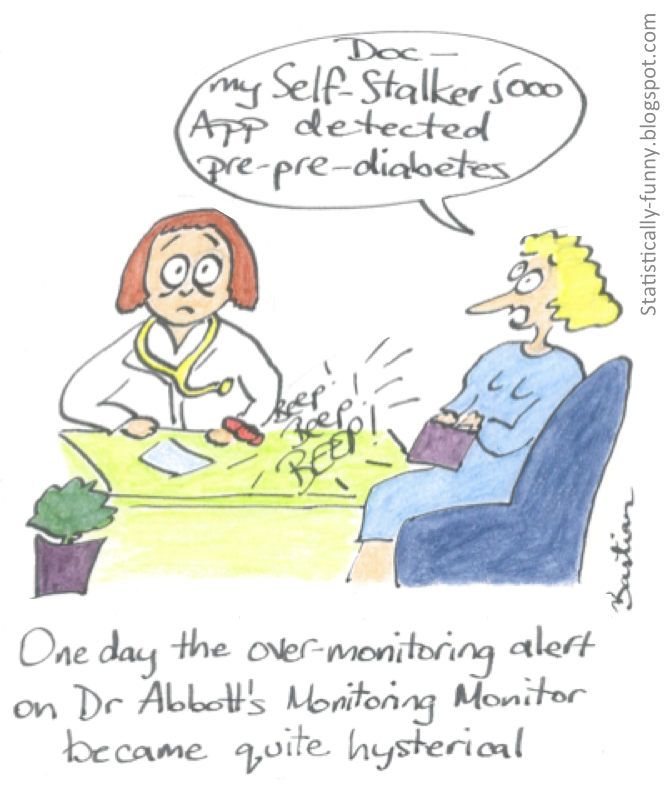
As sensors based on electronics and micromechanics become cheap, it’s easy to collect more and more data.  This can be valuable — measuring blood glucose, or pollutants in the air — but it can also get out of hand.  Epidemiologist Hilda Bastian gives us this cartoon of the “Self-Stalker 5000” and writes about evidence-based monitoring in her blog at Scientific American

Self-Stalker-5000


and Nick Alex Harrowell points out

The stereotype application could be defined as “bugging granny”. We’re going to check some metrics at intervals, stick them into a control chart, and then badger you about it.

To be fair, he’s worrying most about sensors that don’t send to a smartphone app, but many of the same principles apply.

March 22, 2013

Briefly

  • A post at Scientific American about covering clinical trials, for journalists and readers.  It’s a summary from the Association of Health Care Journalists annual conference. Starts out “My message: Ask the hard questions.”
  • Asking the hard questions is also useful in covering surveys.  Stuff reports “Kiwi leaders amongst the world’s riskiest”,
  • New Zealand leaders are among the most likely in the world to ignore data and fail to seek a range of opinions when making decisions

    with no provenance except that this was based on a 600,000 person survey of managers and professionals by SHL.  Before trying to track down any more detail, just think: how could this have worked? How would you get reliable information to support those conclusions from each of 600,000 people? 

  • You may have heard about the famous Hawthorne experiment, where raising light levels in a factory improved output, as did lowering them, as did anything else experimental. The original data have been found and this turns out not to be the case.
March 19, 2013

How could this possibly go wrong?

There’s a new research paper out that sequences the genome of one of the most important cancer cell lines, HeLa.  It shows the fascinating genomic mess that can arise when a cell is freed from the normal constraints against genetic damage, and it gives valuable information about a vital research resource.

However, the discussion on Twitter (or at least the parts I frequent) has been dominated by another fact about the paper.  The researchers apparently didn’t consult at all with the family of Henrietta Lacks, the person whose tumour this originally was.  There are two reasons this is bad.

Firstly, publishing a genome of  an ancestor of yours allows people to learn a lot about your genome. The high levels of mutation in the cancer cell line reduces this information a bit, but there’s still a lot there. As a trivial example, even without worrying about genetic disease risks, you could use the data to tell if someone who thought they were a descendant of Ms Lacks actually was or wasn’t. Publishing a genome without consent from, or consultation with, anyone is at best rude.

And secondly: come on, guys, didn’t you read the book? From the author’s summary

In 1950, Henrietta Lacks, a young mother of five children, entered the colored ward of The Johns Hopkins Hospital to begin treatment for an extremely aggressive strain of cervical cancer. As she lay on the operating table, a sample of her cancerous cervical tissue was taken without her knowledge or consent and given to Dr. George Gey, the head of tissue research. Gey was conducting experiments in an attempt to create an immortal line of human cells that could be used in medical research. Those cells, he hoped, would allow scientists to unlock the mysteries of cancer, and eventually lead to a cure for the disease. Until this point, all of Gey’s attempts to grow a human cell line had ended in failure, but Henrietta’s cells were different: they never died.

Less than a year after her initial diagnosis, Henrietta succumbed to the ravages of cancer and was buried in an unmarked grave on her family’s land. She was just thirty-one years old. Her family had no idea that part of her was still alive, growing vigorously in laboratories—first at Johns Hopkins, and eventually all over the world.

That’s how they did things back then.  It’s not how we do things now. If there was a symbolically worse genome to sequence without some sort of consultation, I’d have a hard time thinking of it.

I don’t think anyone’s saying laws or regulations were violated, and I’m not saying that the family should have had veto power, but they should at least have been talked to.