Posts filed under Medical news (341)

January 17, 2013

Briefly

  • An illustration of what happens to promising new medical treatments: the first randomized trial of fish oil found a 70% reduction in rate of deaths, though the study was too small to be reliable.  After the second study, the estimate was down to 20%.  It’s now 4%, with a margin-of-error of 6%. 
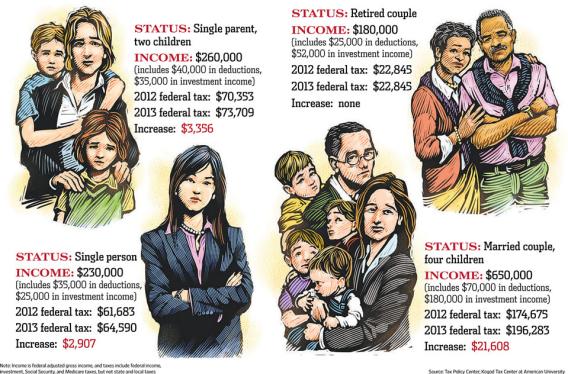
  • A Wall Street Journal infographic that’s doing the rounds, on the impact of the ‘fiscal cliff’.  Includes a representative solo mother with two children, who faces a $3300 tax increase. On her income of US$260,000.  The median household income for families with female householder and no husband is US$32978 (that also includes a subset of the unmarried couples with children, but there’s fewer of them in the US than here).
  • Roger Peng writes about the Beijing air pollution. It is indeed ‘crazy bad’, but the Great London Fog was substantially worse.  Similarly, when you read about developing-country water pollution, remember that the Cuyahoga River, in Cleveland, caught fire several times.
January 15, 2013

Cannabis, teenagers, and poverty

You may have heard some under-rehearsed radio wittering from me on this topic, so I thought I should write something more coherent.

Last August, researchers from the Dunedin Cohort Study published a paper showing that people who had been heavy cannabis users as teenagers performed worse on cognitive function tests later in life, where this wasn’t true of people who started using cannabis as adults. One natural interpretation of these associations is that cannabis has toxic effects during brain development.  As I pointed out at the time, the evidence isn’t overwhelming (since it’s a relatively small study and we know environmental factors can lead to differences as big as those observed) but was somewhat persuasive and is probably better than other studies on this topic.

Now, a Norwegian economist has argued that the results could be explained by purely sociological factors: that people from low-socioeconomic status backgrounds are more likely to use cannabis, and to perform worse on cognitive function tests, and that the difference in cognitive function tests tends to increase over time after school.  He is correct; this could explain the published results.  However, the Dunedin Cohort Study researchers have done further analyses in response, and while the socioeconomic explanation was reasonable, it seems to not be true.  Both the relationship between socioeconomic status and cannabis use, and the relationship between low socioeconomic status and change over time in cognitive function test results were weak in this particular data set.

Even if the association is real and causal there could still be explanations that don’t involve brain toxicity.  For example, imagine that people who enjoy being stoned are less likely to choose jobs and recreational activities that are cognitively demanding.  They would then to some extent tend to end up scoring lower on cognitive function tests in later life.  This, if it were true, would be an explanation that does depend on the properties of cannabis, but not on toxic effects.

Over all, this result doesn’t have huge implications for drug policy.  It doesn’t change the basic fact that cannabis is far from innocuous but is also much safer than alcohol or tobacco.  It doesn’t affect the relevant international treaties and probably won’t shift domestic public opinion.  Differences of opinion on cannabis policy questions depend mostly on different preferences, and partly on other uncertainties. For example, would legal cannabis lead to more or less alcohol consumption?

I’d recommend the book “Marijuana legalization: what everyone needs to know”.  This is written by a group of public-policy academics, who have varying policy preferences, but looked at what evidence they could agree on. It gives a series of questions and what is known about their answers. Unfortunately it’s not (yet?) in the Auckland city library.

Links: Stuff, Science Media Centre


January 13, 2013

Fascinating research into the placebo effect

Harvard Magazine has an article on Ted Kaptchuk’s research into how (not if) the placebo effect works. From a new clinical trial, his team has found that the methods of placebo administration are as important as the administration itself:

“It’s valuable insight for any caregiver: patients’ perceptions matter, and the ways physicians frame perceptions can have significant effects on their patients’ health.”

Read more »

January 12, 2013

Some kind of bizarre coincidence?

The current H3N2 flu strain is causing serious illness in the US.

From the journalism blog heads-up, two adjacent headlines at Fox News


January 8, 2013

Spying on your genes

Stuff has a story about genetic testing today, which leads off

Those sending their DNA to be analysed cheaply overseas are obliged to share the results with life insurers and risk losing control of their most sensitive information.

If you read further, it turns out that all the information about insurance and law is Australian.

In October, they had a similar story, with information on the relevant US law.

Perhaps next time there will be some NZ context.

January 5, 2013

Pomegranates revisited

Back in May, there was a really bad Herald story on pomegranates.  At the time, I said,

Well, what we have is a story based on a press release about a small, unpublished, uncontrolled, open-label study. The most positive one could possibly be about this is “It will be worth waiting for the real publication” or,  perhaps, “I hope it’s not true, because messing with steroid hormones like that is scary”. 

Since bloggers always complain about the lack of follow-up in mainstream media, I should report back on what has happened since.  There still isn’t a publication, but there is an abstract of a conference presentation.

It’s still a small non-randomized open-label study, and one that I would call uncontrolled (in the sense that there aren’t any control participants). The researchers call it ‘controlled’, presumably because there are control measurements before the pomegranate juice was started.  There was a decrease in blood pressure and an increase in salivary testosterone. The blood pressure decrease (4/2.5 mmHg) isn’t very impressive, especially for an open-label study.  I don’t know how impressive the testosterone difference is.

The abstract, amazingly, doesn’t actually give the dose of pomegranate juice that was used. The abstract for a previous study of the same size and duration by the same researchers used 500ml/day.  According to a newspaper story this was PomeGreat brand juice, meaning that 500ml is 5 times the serving size on the package. I found a price of GBP3.39 (about NZ$ 6.60) for this daily dose (that’s the pure juice as used in the research; there are cheaper blends).

The abstract specifically says there were no conflicts of interest and no direct external funding. In previous studies the pomegranate juice has been supplied by a manufacturer, which I would have considered worth reporting as a conflict and as a source of funding.  However, the research idea did come from the researchers, not the company.

So, what other research is there that might be relevant? A PubMed search for “pomegranate testosterone” gives just four papers. Only one is in live people, a study looking at pomegranate extract in prostate cancer. This didn’t find any differences in testosterone between the two doses they examined. Interestingly, this study was motivated by the idea that pomegranate would help by reducing the production of male sex hormones.

The problem with the pomegranate research is that it’s extremely widely publicised, without having been published in peer-reviewed journals.  This gives the impression of more scientific scrutiny of the results than has actually occured. And it’s not that this publicity just happened. Since the results weren’t published, no-one would know about them without the help of some professional publicity machine.  This phenomenon is clearly to the benefit of people selling pomegranates, but not to science or nutrition. An Ireland Advertising Standard Authority decision does illustrate one way that individuals can fight back.

The conclusion is still the same as last time:

The findings about pomegranate juice could be true, but it’s clear that the target isn’t people who actually care whether they are true.



December 31, 2012

Briefly

  • Merriam-Webster gives their most-searched words of 2012.  At the top, “capitalism” and “socialism”, especially during the US election and the health insurance debates.  As Fred Clark points out, this means a depressingly large number of Americans were constructing political arguments of the form “According to the Merriam-Webster dictionary, X is defined as …” 
  • FakeAPStyleBook on Twitter advises journalists: “When quoting from a news release, pick the most nonsensical sentences to let people know what it’s like to have to read those things.” 
  • Almost 75% of Kiwis oppose testing ‘legal highs’ on animals.  It would be interesting to know the figure among those who think these drugs should be legal and regulated.  If you think they should be comprehensively banned or, at the other extreme, just left alone, then presumably you would be against requiring animal tests.
  • In the same Herald survey, 29% were against animal testing for any purpose whatsoever.  That’s a slightly higher level of opposition to modern medicine than I would have expected.
  • Stuff had a good story about celebrity bad science, from the UK charity Sense About Science
December 23, 2012

Safety rules for psychoactive drugs

In the early 1980s there was a significant advance in research on Parkinson’s Disease, when a number of young drug users showed up with a sudden onset of the disease.  Investigations showed that a synthetic opioid ‘legal high’ called MPPP was responsible; the methods used to synthesize it produced a byproduct MPTP that was metabolised into a potent neurotoxin and selectively absorbed into cells that thought they were getting dopamine.   Of course, this is a one-off problem with that specific drug, and not something that’s ever likely to happen again.

This sort of thing is why both animal and human safety testing is required before medications are approved, and it’s why medical chemists get rather upset at people who market untested compounds. However, it isn’t the main point behind the current NZ plans for testing legal highs, since none of the cannabis analogues Mr Dunne has banned using the interim laws would have failed basic toxicity tests. In fact, the safety problem with the cannabis analogues seems to be precisely that they are psychoactive, and that they are much easier to overdose on than real cannabis (they are ‘full agonists’, THC is a ‘partial agonist’ at the same receptors).

The problem with the new laws is that they are trying to reconcile inconsistent views of the level of safety needed.  Before Kronic started large-scale marketing and distribution, the cannabis analogues were in the sort of slightly dodgy market where you wouldn’t expect a great deal of safety testing, users knew this, and we had a pretty good compromise. When the drugs started being advertised and sold in dairies (and not just ones on K Rd), the implied level of safety was a lot higher, there were more overdose in young users, and their parents got, quite reasonably, upset.  After Mr Dunne grants his nihil obstat on production and sale, the implied safety level will even higher, and probably not achievable.

That’s why I think the animal testing issue is largely a distraction. If the regulations are going to be consistent with Mr Dunne’s bans over the past year or so, anything that has a high enough chance of approval to make the tests commercially feasible is likely to be pretty much a placebo (or placebo plus caffeine for party pills).   Whether the net health effect is positive or negative depends a lot on what is substituted for the previously-legal highs.  If it’s healthy exercise or meditation, we might come out ahead. If it’s alcohol, the impact is going to be negative.  Unfortunately, although I’m betting on a negative effect, I don’t see any easy way of getting back to the pre-Kronic situation.


[PS to Eric Crampton: Yes, I am indeed ignoring the benefits people get from being high. I’m pretty sure Peter Dunne is, too]

December 17, 2012

Briefly

  • A zombie story:  Stuff has an opinion piece about chocolate and intelligence, based on the joke article in the New England Journal of Medicine back in October. We covered what was wrong with it then, and showed that you get better correlation with the number of letters in the country’s name than with chocolate consumption.  [Update: the piece is really from an Australian publication, with a light makeover for the Kiwi audience.]
  • A better joke.  An article in the Canadian Medical Association Journal looks at the impact on clinical trials if the world ends on December 21, as the Mayan calendar does not give the slightest suggestion will happen.
  • Language Log examines the inability of journalists around the world to get the basic numbers right in reporting a study on water chlorination and allergies (a story that the NZ media seem to have had the good sense not to pick up).
  • “Good data-driven journalism both publishes as much data as possible, and uses the data to drive conclusions, rather than simply dropping numbers into a foreordained article.”  Felix Salmon, complaining about a New York Times story.
  • The American Statistical Association has a new prize for “Causality in Statistics Education”, aimed at encouraging the teaching of basic causal inference in introductory statistics courses.
December 15, 2012

Experiment with your vegetables

The Herald has a story on anticancer compounds in broccoli that is actually pretty good. Even the headline only says “Broccoli compound can kill cancer”.

Like all early-stage lab research, the findings will almost certainly not lead to improved treatments, and they don’t provide an additional reason to eat broccoli, but the story does describe what the research found.