Predictions and constraints
Producing plausible but newsworthy predictions can be hard. It’s especially hard in areas where there are constraints that the predictions should really satisfy.
In the NZ$ Herald,
Professor Tim Congdon from the Institute for International Monetary Research said it is extremely unlikely that the excess money will be sucked out of the system again. He warned US inflation could explode to double-digit levels before the end of next year.
“The likelihood of US inflation exceeding 3 per cent is very, very high. In my view, it is more likely to be 5pc to 10pc when it peaks, probably before mid-2022,” he said. Such an outcome would turn the global financial system upside and have dramatic ramifications for asset prices of all kinds.
One constraint here is the that the US Treasury sells both ordinary bonds and inflation-protected bonds. The ordinary bonds pay ordinary interest; the inflation-protected ‘TIPS’ pay out interest plus inflation-adjustment. So, if you expect inflation to be 2%, you will be willing to accept 2% lower interest on the inflation-protected bonds. The gap between TIPS and ordinary bonds tells us about the market’s expectations of inflation
Here’s a graph from FRED, the wonderful economic stats website of the Federal Reserve Bank of St Louis, showing the five-year-average inflation rate at which you’d break even by buying TIPS.
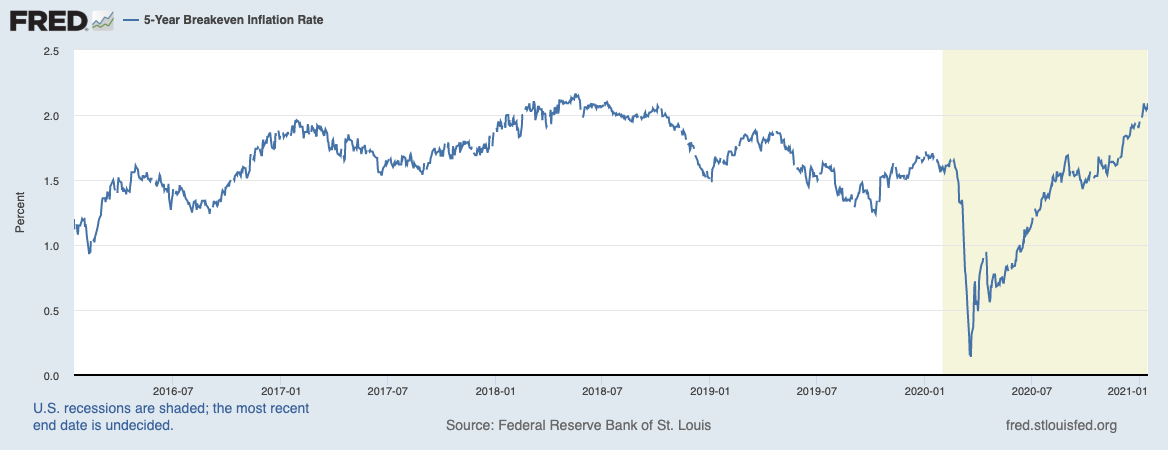
The breakeven inflation rate has been rising, but it’s still only about 2%. If inflation is going to average 2% over five years, it’s not going to hit 5% next year and 10% in 2022.
Now, the US financial markets aren’t infallible. You could tell a coherent story about how the US financial markets are wrong, and how there is some good reason to expect inflation that they don’t know about or don’t believe. Perhaps the M2 money supply indicator is much more important than anyone except this guy realises. I’m not an economist; I wouldn’t know. But that’s not the story that’s being told.
Recent comments