June 6, 2018

Methamphetamine testing

The report from Dr Anne Bardsley and Dr Felicia Low for the Office of the Chief Science Adviser makes clear that testing of houses for methamphetamine has been a complete failure for the sort of evidence-based risk-benefit analysis the NZ governments are claiming to care about.

It’s not just that Housing NZ used an Australian guideline for how clean a former meth lab should be after you’ve cleaned it as a screening threshold. Or that there’s an explicit 300-fold safety factor underlying that threshold even for the most susceptible people (toddlers crawling around and putting things in their mouths). Or that they not only evicted people but sometimes took away their personal belongings as too unclean to touch.  

In a situation where Housing NZ now claims they knew their standard was not very well founded, they didn’t try to do any better.  Faced with a huge testing and remediation bill, whose necessity was — at the most generous evaluation — unclear, they didn’t spend the relatively small amounts that would be needed to find out whether they were wasting public money. They didn’t even ask for help from, say,  the Chief Science Adviser, or the Royal Society Te Apārangi.

More importantly, though, they ignored the harm done by evicting vulnerable people.  The fundamental assumption of any cost-benefit or risk-benefit analysis is that you’ve got the costs and risks and benefits right, or at least that you’ve made an honest effort to get them right and been explicit about your uncertainty.  There are difficult second-order questions of whose costs and benefits you include, and how you account for hard-to-quantify factors like cultural preferences and reputational costs. But if you don’t even put in some of the major costs of a policy, you’re admitting up front that you don’t care about the right answer.

There currently seems pretty broad consensus among people who don’t work there that Housing NZ needs to be remediated. But the ability of the meth screening policies to last that long will — and should — raise doubts about evidence-based decision-making across the NZ public sector. Which is a pity.

 

June 5, 2018

NRL Predictions for Round 14

Team Ratings for Round 14

The basic method is described on my Department home page.
Here are the team ratings prior to this week’s games, along with the ratings at the start of the season.

Current Rating Rating at Season Start Difference
Storm 8.88 16.73 -7.90
Panthers 5.75 2.64 3.10
Rabbitohs 4.03 -3.90 7.90
Dragons 3.94 -0.45 4.40
Sharks 3.10 2.20 0.90
Roosters 1.86 0.13 1.70
Cowboys 0.54 2.97 -2.40
Broncos 0.15 4.78 -4.60
Raiders -0.15 3.50 -3.70
Wests Tigers -0.70 -3.63 2.90
Sea Eagles -2.08 -1.07 -1.00
Bulldogs -2.16 -3.43 1.30
Warriors -4.13 -6.97 2.80
Eels -6.11 1.51 -7.60
Knights -7.42 -8.43 1.00
Titans -7.81 -8.91 1.10


Performance So Far

So far there have been 100 matches played, 59 of which were correctly predicted, a success rate of 59%.
Here are the predictions for last week’s games.

Game Date Score Prediction Correct
1 Sea Eagles vs. Cowboys May 31 12 – 26 2.70 FALSE
2 Rabbitohs vs. Sharks Jun 01 22 – 14 3.30 TRUE
3 Eels vs. Knights Jun 02 4 – 30 9.20 FALSE
4 Roosters vs. Wests Tigers Jun 03 16 – 14 6.10 TRUE


Predictions for Round 14

Here are the predictions for Round 14. The prediction is my estimated expected points difference with a positive margin being a win to the home team, and a negative margin a win to the away team.

Game Date Winner Prediction
1 Raiders vs. Panthers Jun 08 Panthers -2.90
2 Titans vs. Rabbitohs Jun 08 Rabbitohs -8.80
3 Sea Eagles vs. Warriors Jun 09 Sea Eagles 6.50
4 Knights vs. Roosters Jun 09 Roosters -6.30
5 Eels vs. Cowboys Jun 09 Cowboys -3.70
6 Sharks vs. Wests Tigers Jun 10 Sharks 6.80
7 Storm vs. Broncos Jun 10 Storm 11.70
8 Bulldogs vs. Dragons Jun 11 Dragons -3.10


May 29, 2018

Super 15 Predictions for Round 16

Team Ratings for Round 16

The basic method is described on my Department home page.
Here are the team ratings prior to this week’s games, along with the ratings at the start of the season.

Current Rating Rating at Season Start Difference
Crusaders 14.86 15.23 -0.40
Hurricanes 13.73 16.18 -2.40
Lions 8.48 13.81 -5.30
Chiefs 8.30 9.29 -1.00
Highlanders 6.73 10.29 -3.60
Sharks 0.78 1.02 -0.20
Waratahs 0.76 -3.92 4.70
Jaguares 0.62 -4.64 5.30
Stormers -0.58 1.48 -2.10
Blues -1.70 -0.24 -1.50
Brumbies -2.64 1.75 -4.40
Bulls -2.90 -4.79 1.90
Reds -8.92 -9.47 0.60
Rebels -9.30 -14.96 5.70
Sunwolves -15.66 -18.42 2.80


Performance So Far

So far there have been 94 matches played, 66 of which were correctly predicted, a success rate of 70.2%.
Here are the predictions for last week’s games.

Game Date Score Prediction Correct
1 Crusaders vs. Hurricanes May 25 24 – 13 3.80 TRUE
2 Rebels vs. Sunwolves May 25 40 – 13 8.10 TRUE
3 Jaguares vs. Sharks May 25 29 – 13 2.20 TRUE
4 Chiefs vs. Waratahs May 26 39 – 27 11.50 TRUE
5 Reds vs. Highlanders May 26 15 – 18 -12.80 TRUE
6 Bulls vs. Brumbies May 26 28 – 38 5.60 FALSE
7 Stormers vs. Lions May 26 23 – 26 -5.90 TRUE


Predictions for Round 16

Here are the predictions for Round 16. The prediction is my estimated expected points difference with a positive margin being a win to the home team, and a negative margin a win to the away team.

Game Date Winner Prediction
1 Highlanders vs. Hurricanes Jun 01 Hurricanes -3.50
2 Blues vs. Rebels Jun 02 Blues 11.60
3 Chiefs vs. Crusaders Jun 02 Crusaders -3.10
4 Reds vs. Waratahs Jun 02 Waratahs -6.20
5 Brumbies vs. Sunwolves Jun 03 Brumbies 17.00


NRL Predictions for Round 13

Team Ratings for Round 13

The basic method is described on my Department home page.
Here are the team ratings prior to this week’s games, along with the ratings at the start of the season.

Current Rating Rating at Season Start Difference
Storm 8.88 16.73 -7.90
Panthers 5.75 2.64 3.10
Dragons 3.94 -0.45 4.40
Rabbitohs 3.69 -3.90 7.60
Sharks 3.43 2.20 1.20
Roosters 2.15 0.13 2.00
Broncos 0.15 4.78 -4.60
Raiders -0.15 3.50 -3.70
Cowboys -0.63 2.97 -3.60
Sea Eagles -0.91 -1.07 0.20
Wests Tigers -0.99 -3.63 2.60
Bulldogs -2.16 -3.43 1.30
Eels -3.65 1.51 -5.20
Warriors -4.13 -6.97 2.80
Titans -7.81 -8.91 1.10
Knights -9.88 -8.43 -1.40


Performance So Far

So far there have been 96 matches played, 57 of which were correctly predicted, a success rate of 59.4%.
Here are the predictions for last week’s games.

Game Date Score Prediction Correct
1 Broncos vs. Eels May 24 18 – 10 6.60 TRUE
2 Raiders vs. Sea Eagles May 25 21 – 20 4.20 TRUE
3 Cowboys vs. Storm May 25 6 – 7 -7.40 TRUE
4 Roosters vs. Titans May 26 34 – 14 11.80 TRUE
5 Warriors vs. Rabbitohs May 26 10 – 30 -0.60 TRUE
6 Panthers vs. Dragons May 26 28 – 2 1.40 TRUE
7 Knights vs. Sharks May 27 10 – 48 -5.80 TRUE
8 Wests Tigers vs. Bulldogs May 27 14 – 10 4.20 TRUE


Predictions for Round 13

Here are the predictions for Round 13. The prediction is my estimated expected points difference with a positive margin being a win to the home team, and a negative margin a win to the away team.

Game Date Winner Prediction
1 Sea Eagles vs. Cowboys May 31 Sea Eagles 2.70
2 Rabbitohs vs. Sharks Jun 01 Rabbitohs 3.30
3 Eels vs. Knights Jun 02 Eels 9.20
4 Roosters vs. Wests Tigers Jun 03 Roosters 6.10


Briefly

  • “It is important that guidelines for mitigation measures are proportionate to the risk posed, and that remediation strategies should be informed by a risk-based approach.” That’s not the money quote from Sir Peter Gluckman’s report on methamphetamine testing for houses (PDF), but it’s the generic StatsChat message.  For more, see Russell Brown’s story; he has been a consistent journalistic voice against panic-based testing.
  • From an NY Times oped “Knowing a person’s political leanings should not affect your assessment of how good a doctor she is — or whether she is likely to be a good accountant or a talented architect. But in practice, does it?  Recently we conducted an experiment to answer that question”.  As Andrew Gelman explains, they totally didn’t.
  • A new UK Parliament report “Algorithms in Decision Making”
  • “Why Government needs sustainable [statistical] software, too”
May 25, 2018

Tweet dreams

Q: Did you see using a mobile phone after 10pm leads to depression and loneliness, depression, bipolar disorder and neuroticism?

A: Where?

Q: The Independent, the Daily Mail, news.com.au, the Geelong Advertiser, Student Problems, …

A: So, what are we supposed to check first?

Q: Mice. It isn’t mice, it’s people.  “However, now a study of more than 91,000 people has found that scrolling through your Instagram and Twitter feeds from the comfort of your pillow in the wee hours could increase the likelihood of developing a number of psychological problems such as depression, bipolar disorder and neuroticism.”

A: Ok, ok.  Do any of them link?

Q: The Independent does. But it’s behind a paywall

A: <sighs> Ok. Here’s the press release. 

Q: But that doesn’t mention mobile phones. Or Twitter or Instagram.

A: No, it doesn’t.

Q: It looks like they used fitbits, though

A: Yes, or near offer.

Q: Could they tell from those when someone was using their phone?

A: I don’t know if they could, but they didn’t. They just looked at how much people’s physical activity differed between night and day.

Q: What’s that got to do with mobile phones?

A: If using your phone late at night stops you sleeping, then you might have less difference in activity between night and day.

Q: I suppose. Did they look at actual sleep?

A: Not in this study

Q: So, the people with less day-night difference in physical activity ended up with more mental health problems?

A: No, they started off with more mental health problems.  As the comment at the bottom of the press release says “The study population (median age at baseline of 62 years, IQR 54-68 years) is not ideal to examine the causes of mental health, given that 75% of disorders start before the age of 24 years.”

Q: These were 60-year olds?

A: Yes. In 2013-14.

Q: Did British 60-year-olds even use Twitter and Instagram in 2013-14? Instagram was only on iPhones back then, wasn’t it?

A: About a third of Brits between 55-64 had a smartphone then, and about 10% of older people.

Does bacon prevent cancer?

No.

This isn’t even supposed to be new research: it’s just a new set of guidelines based on all the same existing research. Since it’s a new set of public guidelines, you’d think a link would be appropriate: here it is.

The story says “”No level of intake” of processed meats will reduce cancer risks.”  and the quote from the report is The data show that no level of intake can confidently be associated with a lack of risk.  I don’t think that will surprise many people, and it’s what we’ve been told for a long time. There isn’t a magic threshold where bacon switches from being a health food to being bad for you. If you want something more quantitative, the figures we had last bacon panic haven’t changed: eating an extra serving of bacon every day is estimated to increase your lifetime bowel cancer risk by a factor of 1.2, or a bit under two extra cases per hundred people.

For alcohol, the focus on cancer is a bit misleading.  Low levels of alcohol consumption increase cancer risk but reduce heart disease risk, and there’s a range where it’s pretty much a wash — there isn’t a ‘safe level’ from a cancer viewpoint, but there probably is from a not-dying viewpoint. Still, there are lots of people who’d be healthier if they drank less alcohol — and that’s probably not the first time they’ve heard the message.

May 24, 2018

Reading the fine print

From Toby Manhire at The Spinoffquoting Reuters

“New Zealand’s dairy-fuelled economy has for several years been the envy of the rich world, yet despite the rise in prosperity tens of thousands of residents are sleeping in cars, shop entrances and alleyways.”

There was something similar in the Guardian, too. As Toby says

The juxtaposition is compelling and well made. The number is compelling and nonsense.

I’ve posted about this issue before. The OECD report that people use (directly or indirectly) as source, says

Australia, the Czech Republic and New Zealand report a relatively large incidence of homelessness, and this is partly explained by the fact that these countries adopt a broad definition of homelessness…..In New Zealand homelessness is defined as “living situations where people with no other options to acquire safe and secure housing: are without shelter, in temporary accommodation, sharing accommodation with a household or living in uninhabitable housing.

That’s much broader than ‘sleeping in cars, shop entrances and alleyways.” One of the researchers behind the NZ figure said, in a Herald interview in 2016

“If the homeless population were a hundred people, 70 are staying with extended family or friends in severely crowded houses, 20 are in a motel, boarding house or camping ground, and 10 are living on the street, in cars, or in other improvised dwellings.”

Homelessness is a real problem in New Zealand. Because it’s a real problem, it’s important to focus on what the problem actually is, and not to make up a different problem.

Reuters has corrected the figure but hasn’t otherwise changed the story.  The fact that reducing the figure by a factor of ten doesn’t otherwise change the story might tell you something about the story.


(update: ok, now I’ve actually read all of Toby’s post, not just the first few paragraphs, he basically says all this already)

May 23, 2018

Graph of the week

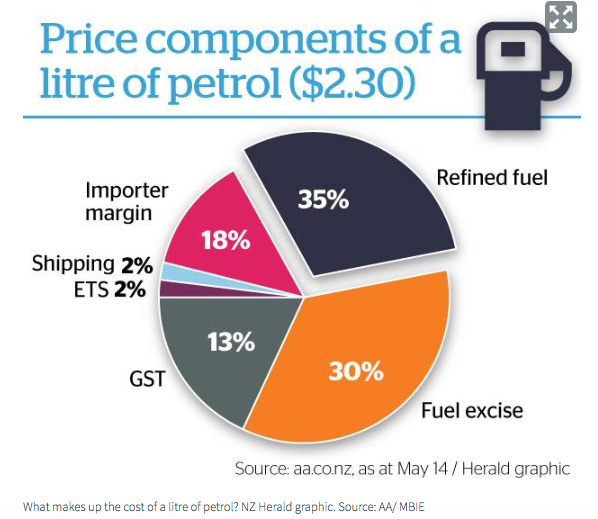
From the Herald (via @aw_nz on Twitter)

One of the features of pie charts is that it’s relatively hard to judge angles and compare segments. Still, if you get them wrong enough, people can tell.   For example, the taxes — the grey and orange wedges — are clearly more than half the circle, but the numbers add to only 43%.  Less dramatically, the 13% wedge for GST is larger than the 18% wedge for importer margin, and the 30% wedge for fuel excise is larger than the 35% wedge for refined fuel.  You don’t have to be very cynical to wonder whether it’s a coincidence that the tax components are being exaggerated. [update: you don’t, but you’d probably be wrong — see comments]

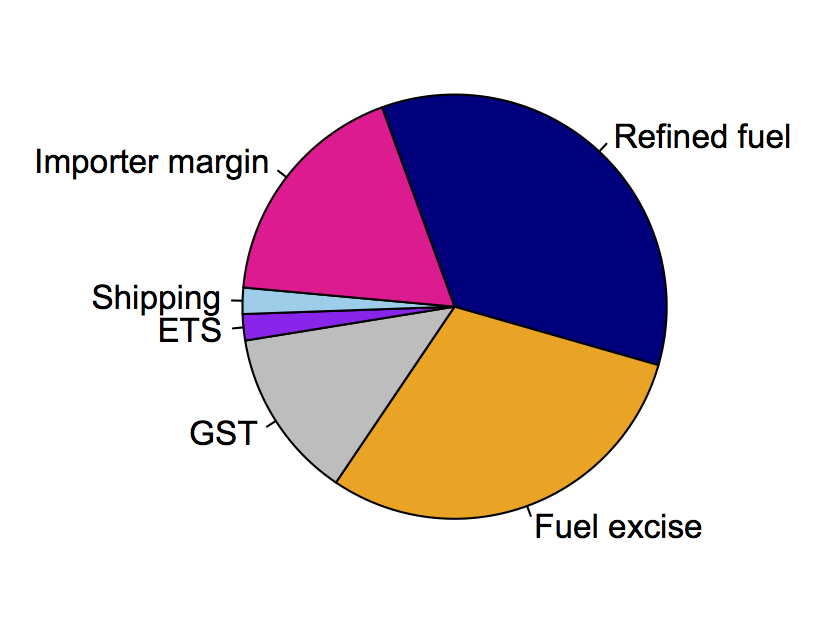
Here’s an accurate piechart, assuming the numbers are correct:

May 22, 2018

Super 15 Predictions for Round 15

Team Ratings for Round 15

The basic method is described on my Department home page.
Here are the team ratings prior to this week’s games, along with the ratings at the start of the season.

Current Rating Rating at Season Start Difference
Crusaders 14.43 15.23 -0.80
Hurricanes 14.16 16.18 -2.00
Lions 8.66 13.81 -5.10
Chiefs 8.27 9.29 -1.00
Highlanders 7.32 10.29 -3.00
Sharks 1.61 1.02 0.60
Waratahs 0.80 -3.92 4.70
Jaguares -0.21 -4.64 4.40
Stormers -0.75 1.48 -2.20
Blues -1.70 -0.24 -1.50
Bulls -1.96 -4.79 2.80
Brumbies -3.57 1.75 -5.30
Reds -9.51 -9.47 -0.00
Rebels -10.43 -14.96 4.50
Sunwolves -14.52 -18.42 3.90


Performance So Far

So far there have been 87 matches played, 60 of which were correctly predicted, a success rate of 69%.
Here are the predictions for last week’s games.

Game Date Score Prediction Correct
1 Hurricanes vs. Reds May 18 38 – 34 30.90 TRUE
2 Sunwolves vs. Stormers May 19 26 – 23 -11.50 FALSE
3 Blues vs. Crusaders May 19 24 – 32 -13.30 TRUE
4 Waratahs vs. Highlanders May 19 41 – 12 -6.80 FALSE
5 Sharks vs. Chiefs May 19 28 – 24 -3.60 FALSE
6 Lions vs. Brumbies May 19 42 – 24 16.00 TRUE
7 Jaguares vs. Bulls May 19 54 – 24 2.40 TRUE


Predictions for Round 15

Here are the predictions for Round 15. The prediction is my estimated expected points difference with a positive margin being a win to the home team, and a negative margin a win to the away team.

Game Date Winner Prediction
1 Crusaders vs. Hurricanes May 25 Crusaders 3.80
2 Rebels vs. Sunwolves May 25 Rebels 8.10
3 Jaguares vs. Sharks May 25 Jaguares 2.20
4 Chiefs vs. Waratahs May 26 Chiefs 11.50
5 Reds vs. Highlanders May 26 Highlanders -12.80
6 Bulls vs. Brumbies May 26 Bulls 5.60
7 Stormers vs. Lions May 26 Lions -5.90