January 11, 2017

Bogus poll stories, again

We have a headline today in the HeraldNew Zealand’s most monogamous town revealed“.

At first sight you might be worried this is something new that can be worked out from your phone’s sensor data, but no. It’s the result of a survey, and not even a survey of whether people are monogamous, but of whether they say they agree with the statement “I believe that monogamy is essential in a relationship” as part of the user data for a dating site that emphasises lasting relationships.

To make matters worse, this particular dating site’s marketing focuses on how different its members are from the general population.  It’s not going to be a good basis for generalising to “Kiwis are strongly in favour of monogamy

You can find the press release here (including the embedded map) and the dating site’s “in-depth article” here.

It’s not even that nothing else is happening in the world this week.

January 9, 2017

News to look forward to

Last year, we had a bunch of early-stage Alzheimer’s trials in the news. I thought I’d look at what’s due out in the clinical trial world this year.

Perhaps most importantly, in March we should see the first real results on a new set of cholesterol-lowering drugs.  The ‘PCSK9’ inhibitors are one of the first drugs outside the cancer world to come from large-scale genetic studies without a particular hypothesis in mind. As the gene name ‘PCSK9’ indicates to those in the know, the gene was originally named just as the ninth in a series of genes that looked similar in structure.  It turned out that mutations in PCSK9 had big effects on LDL (‘bad’) cholesterol levels. Also, importantly, there is at least one person walking around alive and healthy with disabling mutations in both her copies of the gene — so there was a good chance that inhibiting the protein would be safe.  At least three companies have drugs (monoclonal antibodies) that target PCSK9 and reduce cholesterol by a lot; though the drugs need to be given by intravenous injection.

Although the drugs have been shown to reduce cholesterol, and have been approved for sale in the US for people with very high cholesterol not otherwise treatable, they haven’t been shown to prevent heart attacks (which is the point of lowering your cholesterol). The first trial looking at that sort of real outcome has finished, and there’s a good chance the results will be presented at the American College of Cardiology meeting in March.  For people in NZ the main interest isn’t in the new treatments — it’s hard to see them being cost-effective initially — but in the impact on understanding cholesterol.  If these drugs do prevent heart attacks, they will increase our confidence that LDL cholesterol really is a cause of disease; if they don’t, they will give aid and comfort to the people who think cholesterol is missing the whole point.

What else? There are some interesting migraine trials due out: both using a new approach to prevention and using a new approach to giving the current treatments.  The prevention approach is based on inhibiting something called CGRP in the brain, which appears to be a key trigger; the drug is injected, but only every few months.  The treatment approach is based on a new sort of skin patch to try to deliver the ‘triptan’ drugs, which they hope will be as fast as inhaling or injecting them and less unpleasant.

Also, there’s an earlier-stage New Zealand biotech product that will have results early in the year: using cells from specially bred pigs, coated so the immune system doesn’t notice them, to treat Parkinson’s Disease.


Stat of the Week Competition: January 7 – 13 2017

Each week, we would like to invite readers of Stats Chat to submit nominations for our Stat of the Week competition and be in with the chance to win an iTunes voucher.

Here’s how it works:

  • Anyone may add a comment on this post to nominate their Stat of the Week candidate before midday Friday January 13 2017.
  • Statistics can be bad, exemplary or fascinating.
  • The statistic must be in the NZ media during the period of January 7 – 13 2017 inclusive.
  • Quote the statistic, when and where it was published and tell us why it should be our Stat of the Week.

Next Monday at midday we’ll announce the winner of this week’s Stat of the Week competition, and start a new one.

(more…)

January 8, 2017

The drug-driving problem

The AA are campaigning again for random drug tests of drivers. I’m happy to stipulate that in NZ lots of people smoke cannabis, and some of these people drive when stoned, and sometimes when drunk as well, and this is bad. As the ads say.

On the other hand, science has not yet provided us with a good biochemical roadside test for impairment from cannabis. For alcohol, yes. For THC, no. That’s even more of an issue in the US states where recreational marijuana use is legal, since the option of just taking away driving licences for anyone with detectable levels isn’t even there.

This isn’t just a point about natural justice. There’s empirical reason (though not conclusive) to believe that many people who might fail a biochemical test are reasonably careful about driving while high.

First, there hasn’t been any evidence of an increase in road deaths in the US states where medical or recreational marijuana use is legal, even though there has been an increase in people driving with detectable levels of the drug.

Second, if you look at the 2010 ESR report (PDF) that the AA are relying on, you find (p20)

The culpability of the drivers using cannabis by itself was determined and odds ratios have been calculated as described in the alcohol section and in Appendix two. The results are given in Table seven. The odds ratio calculated for cannabis only use is only slightly greater than one, implying that cannabis does not significantly impact on the likelihood of having a crash.

Now, the report says, correctly, that this disagrees with other evidence and that we shouldn’t assume driving while stoned is safe. But they tried quite hard to do alternative analyses showing cannabis was bad, and were unsuccessful.

In 2012, there was another AA campaign, and a story in the Herald

But Associate Minister of Transport Simon Bridges said the Government would wait for saliva testing technology to improve before using it.

A government review of the drug testing regime in May concluded the testing devices were not reliable or fast enough to be effective.

It ruled the saliva screening takes at least five minutes, is unlikely to detect half of cannabis users, and results are not reliable enough for criminal prosecution.

“The real factor is reliability … we can’t have innocent people accused of drug driving if they haven’t been.

“But as the technology improves, I’m sure in the future we will have a randomised roadside drug test.”

That seems like a sensible policy.

Briefly

  • Graphics, overquantified life: Andrew Elliott’s graph of his baby’s first six months of sleep
  • Graphics: Bird migrations in the Americas (click for animation)bird_map
  • Public policy: Graeme Edgeler has better numbers on the three-strikes law, and a new post
  • Graphics: Weather forecast around the British Isles, shipping
    from the people who tweet the Shipping Forecast
  • From the Washington Post: more people die between Christmas and New Year than you’d expect. It’s true in NZ, so it’s not the weather.
  • The alt-right movement finds more dumb things to do with genetic testing: the Atlantic
  • A (moderately technical) short course on Fairness and Transparency in Machine Learning.
  • “Missing Datasets”: a partial list of useful and important public datasets that don’t (and won’t) exist.
  • Surash Venkat explains why modern data-based ‘algorithms’ aren’t at all like recipes — which is why they need to be studied statistically, not just by looking at the code or asking if the developers were pure of heart.
  • “The Great AI Awakening”. From the NY Times, on Google, the revolution in machine translation, and big data.
  • Companies Ponder a Rating of Workers’ Health”. From the Wall St Journal.  One one hand, having big companies report summaries of their employees’ health might give them better incentives.  On the other hand, they’d need to get the data, and if you think about what else they might do with it…
January 7, 2017

Social data analytics: how not to do it

Over the holidays, problems began emerging with the new data-based approach to detecting benefit overpayments in Australia. I learned about this from @Asher_Wolf, an Australian privacy advocate.  In a significant number of cases the computer system was  inaccurate as to whether people owed money.  Documentation to correct the errors is the sort of thing a lot of people don’t have lying around (though perhaps technically they should) and in at least some cases the computer system didn’t allow the correct information to be submitted.   The Sydney Morning Herald has a piece (warning: autoplaying audio ads) referencing Cathy O’Neil’s book Weapons of Math Destruction.

Australian regulations on government data-matching systems call for the development of a ‘program protocol’, including “description of the data to be provided and the methods used to ensure it is of sufficient quality for use in the program” and “a statement of the costs and benefits of the program.” However, in Appendix C describing the cost-benefit statement it’s made clear than only cash costs and benefits to the Commonwealth count. Monetary compliance costs to individuals don’t count, and non-monetary costs don’t count. Sending out more letters seems to counts as beneficial as long as it raises more money than you spend doing it — whether or not that money is legally owed.

The ‘technical standards’ report is supposed to cover data integrity and risks “including, but not limited to, risks to the privacy of individuals, reputational risks, and risks relating to incorrect matches.”  In particular, it’s supposed to describe “the sampling techniques used to verify the validity/accuracy of matches”.  That would be interesting to see, given that it seems to take a lot of work to prove that a match is incorrect.

In principle this might all  be worked out in the appeals process, by real humans — or, at least, the amounts of repayments might be. The stress inflicted on the recipients of the letters and the harm done to the reputation of Australia’s government data systems are harder to fix.  In the short term, the former is (rightly) getting more attention; in the long term it might be the latter that does the greater damage.

January 6, 2017

Detox isn’t a thing

The New Year is traditionally a time for short-term, one-off attempts to improve one’s health, like going to the gym for two weeks. One fashionable form is ‘detox’, where you take a few components of what might be a sensible change in diet, massively overdo them for a short time, then go back to your usual diet. The idea is that your body builds up ‘toxins’ that it’s unable to get rid of by normal biological processes, but that it can easily be tricked into getting rid of them rapidly by some special ritual.  Here’s a good piece from the Observer describing the problem. [update: and Michelle ‘Nanogirl’ Dickinson’s column this week, too]

The NZ media did ok on detox this year. There was a UK story about a particular herbal mixture causing dangerous sodium loss; there was one positive but somewhat restrained story; I’ve only seen one completely bogus one.

The moderately restrained story was in the Herald. It talked about a bunch of sensible dietary changes,  a bunch of basically unsupported herbal stuff, and for completeness, Native American sweat lodges. However, at least the main idea was to make long-term changes in one’s diet rather than to have some magical purification experience.  The story even had a couple of links to scientific papers, though they were to research showing that pollution might be harmful, which is not the problematic component of the detox myth.

On the other hand, on Twitter today, Peter Green posted a headline from the cover of “M2” magazine: “Six manly foods to detox your liver”. No, I’m not making this up.

It may help to know that other recent health headlines include “Experts Say Wearing This Colour Will Help You Have A More Effective Workout”, and Neuroscience Says That This Song Reduces Anxiety By 65%”

If you’re wondering what detox foods are considered “manly” in the 21st century, the list includes turmeric, green tea, and broccoli sprouts. Quiche is still out.

January 5, 2017

Traffic and the brain

Q: Do we need to move?

A: Um. No?

Q: “Living near a busy road could cause dementia”, it says.

A: No, that’s ok. We don’t live near a busy road, even to the extent that rhetorical constructs live anywhere.

Q: So what’s a ‘busy’ road, then?

A: An arterial or highway.  We’re more than 100m from the nearest one.

Q: That doesn’t sound very far.

A: The 1.07 times higher risk estimated in the research paper is for people within 50m of a major road.

Q: How many people is that?

A: In Ontario (mostly Toronto), 20%.  In Auckland, not so many.

Q: But we’re supposed to be in favour of population density and cities, aren’t we?

A: Yes. But even if the effect is real, it’s pretty small.

Q: The story says roads are responsible for 1 in 9 cases. That’s not so small.

A: One in 9 cases among people who live within 50m of a major road. Or, using one of the other estimates from the research, one in 14 cases among people who live within 50m of a major road.

Q: And 150m from a major road?

A: About one in 50 cases.

Q: Ok, that’s pretty small. Can they really detect it?

A: They’ve got data on a quarter of a million cases of dementia, so it’s borderline.

Q: But still?

A: Well, the the statistical evidence isn’t all that strong. A p-value of 0.035 from one of the three neurological diseases they looked at, isn’t much in a data set that large.

Q: And it’s just a correlation, right?

A: They’ve been able to do a reasonable job of removing other factors, and the road proximity was measured a long time before the dementia, so at least they don’t have cause and effect backwards.  But, yes, it could be something they didn’t have good enough data or modelling for.

Q: How about age? That’s a big issue with modelling dementia, isn’t it?

A: These are epidemiologists — “physicians broken down by age and sex”, as the old joke says — they know about age. They only compared groups of people of exactly the same age.

Q: But what does ‘exactly the same age’ even mean for something that doesn’t have a precise starting time?

A: That’s more of a problem. If people living near major roads got dementia at the same rate, but had it diagnosed six months earlier on average, that would be enough to explain the difference. There’s no particular reason that should happen, but it’s not impossible.

Q: So is the research worth looking at?

A: Worth looking at for consenting scientists in private, but not really worth international publicity.


 

January 2, 2017

Stat of the Week Competition: December 31 2016 – January 6 2017

Each week, we would like to invite readers of Stats Chat to submit nominations for our Stat of the Week competition and be in with the chance to win an iTunes voucher.

Here’s how it works:

  • Anyone may add a comment on this post to nominate their Stat of the Week candidate before midday Friday January 6 2017.
  • Statistics can be bad, exemplary or fascinating.
  • The statistic must be in the NZ media during the period of December 31 2016 – January 6 2017 inclusive.
  • Quote the statistic, when and where it was published and tell us why it should be our Stat of the Week.

Next Monday at midday we’ll announce the winner of this week’s Stat of the Week competition, and start a new one.

(more…)

January 1, 2017

Kinds of fairness worth working for

Machine learning/statistical learning has a very strong tendency to encode existing biases, because it works by finding patterns in existing data.  The ability to find patterns is very strong, and simply leaving out a variable you don’t want used isn’t enough if there are ways to extract the same information from other data. Because computers look objective and impartial, it can be easier to just accept their decisions — or regulations or trade-secret agreements may make it impossible to find out what they were doing.

That’s not necessarily a fatal flaw. People learn from existing cases, too. People can substitute a range of subtler social signals for crude, explicit bigotry.  It’s hard to force people to be honest about how they made a decision — they may not even know. Computer programs have the advantage of being much easier to audit for bias given the right regulatory framework; people have the advantage of occasionally losing some of their biases spontaneously.

Audit of black-box algorithms can be done in two complementary ways. You can give them made-up examples to see if differences that shouldn’t matter do affect the result, and you can see if their predictions on real examples were right.  The second is harder: if you give a loan to John from Epsom but not to Hone from Ōtara, you can see if John paid on time, but not if Hone would have.  Still, it can be done either using historical data or by just approving some loans that the algorithm doesn’t like.  You then need to decide whether the results were fair. That’s where things get surprisingly difficult.

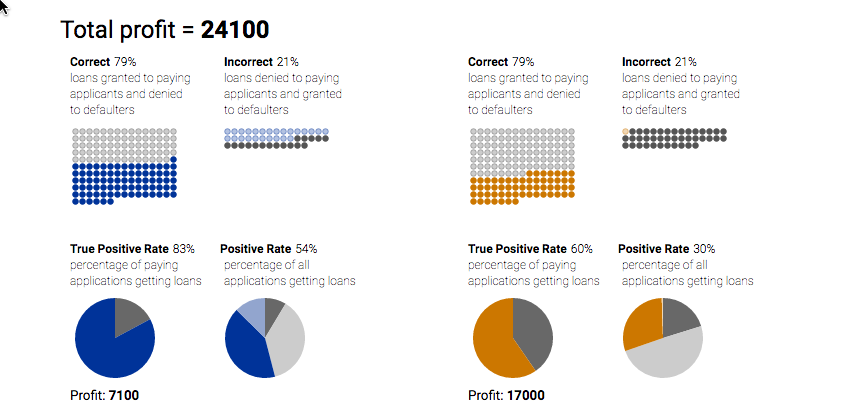
Here’s a picture from a Google interactivefairness

People are divided into orange and blue, with different distributions of credit scores. In this case the blue and orange people are equally likely on average to pay off a loan, but the credit score is more informative in orange people.  I’ve set the threshold so that the error rate of the prediction is the same in blue people as in orange people, which is obviously what you want. I could also have set the threshold so the proportion of approvals among people who would pay back the loan was the same in blue and orange people. That’s obviously what you want.  Or so the proportion of rejections among people who wouldn’t pay back the loan is the same. That, too, is obviously what you want.

You can’t have it all.

This isn’t one of the problems specific to social bias or computer algorithms or inaccurate credit scoring or evil and exploitative banks.  It’s a problem with any method of making decisions.  In fact, it’s a problem with any approach to comparing differences. You have to decide what summary of the difference you care about, because you can’t make them all the same.  This is old news in medical diagnostics, but appears not to have been considered in some other areas.

The motivation for my post was a post at Pro Publica on biases in automated sentencing decisions.  An earlier story had compared the specificity of the decisions according to race:  black people who didn’t end up reoffending were more likely to have been judged high risk than white people who didn’t end up reoffending. The company who makes the algorithm said, no, everything is fine because people who were judged high risk were equally likely to reoffend regardless of race. Both Pro Publica and the vendors are right on the maths; obviously they can’t both be right on the policy implications. We need to decide what we mean by a fair sentencing system. Personally, I’m not sure risk of reoffending should actually be a criterion, but if we stipulate that it is, there’s a decision to make.

In the new post, Julia Angwin and Jeff Larsen say

The findings were described in scholarly papers published or circulated over the past several months. Taken together, they represent the most far-reaching critique to date of the fairness of algorithms that seek to provide an objective measure of the likelihood a defendant will commit further crimes.

That’s true, but ‘algorithms’ and ‘objective’ don’t come into it. Any method of deciding who to release early has this problem, from judicial discretion in sentencing to parole boards to executive clemency. The only way around it is mandatory non-parole sentences, and even then you have to decide who gets charged with which crimes.

Fairness and transparency in machine learning are worth fighting for. They’re worth spending public money and political capital on. Part of the process must be deciding, with as much input from the affected groups as possible, what measures of fairness really matter to them. In the longer term, reducing the degree of disadvantage of, say, racial minorities should be the goal, and will automatically help with the decision problem. But a decision procedure that is ‘fair’ for disadvantaged groups both according to positive and negative predictive value and according to  specificity and sensitivity  isn’t worth fighting for, any more than a perpetual motion machine would be.