December 26, 2016

Stat of the Week Competition: December 24 – 30 2016

Each week, we would like to invite readers of Stats Chat to submit nominations for our Stat of the Week competition and be in with the chance to win an iTunes voucher.

Here’s how it works:

  • Anyone may add a comment on this post to nominate their Stat of the Week candidate before midday Friday December 30 2016.
  • Statistics can be bad, exemplary or fascinating.
  • The statistic must be in the NZ media during the period of December 24 – 30 2016 inclusive.
  • Quote the statistic, when and where it was published and tell us why it should be our Stat of the Week.

Next Monday at midday we’ll announce the winner of this week’s Stat of the Week competition, and start a new one.

(more…)

December 22, 2016

Mouthwash secrets: the embargo problem

On Tuesday, the Herald and some other media outlets, and the occasional journalist’s Twitter account published a story about mouthwash being able to prevent gonorrhea from spreading. Or, in some versions, cure it.  The research paper behind the story wasn’t linked and hadn’t been published. This time it seems to have been the newspapers’ fault: the stories appeared before the end of the news embargo.  The Herald story was pulled, then reappeared midday Wednesday with a link (yay)

Embargoes are an increasingly controversial topic in science journalism. The idea is that journalists get advance copies of a research paper and the press release, so they have time to look things up and ask for expert help or comment. There are organisations such as the NZ Science Media Centre to help with finding experts, or there’s your friendly neighbourhood university.

Sometimes, this works. Stories become more interesting and less slanted, or the journalist just decides the breakthrough wasn’t all that and the story is killed.  Without embargoes, allegedly, no-one would take the time to get it right. In medicine, too, there was the idea that doctors should be able to get the research paper by the time their patients saw the headlines.

On the other hand, embargoes feed into the idea that science stories are Breaking News that must be posted Right Now — that all published science is true (or important) for fifteen minutes. Ivan Oransky (who runs the Embargo Watch blog) argued recently at Vox that embargoes are no longer worthwhile; there’s also a rebuttal posted at Embargo Watch.

The Listerine/gonorrhea story, though, wasn’t new. Major outlets such as Teen Vogue and the BBC covered it in August(probably from a conference presentation). There are no details in the new Herald story that weren’t in the August stories.  It’s hard to see how anyone gains from the embargo here — except perhaps as a way of synchronising a wave of publicity.


December 21, 2016

Statistics: context and comparison

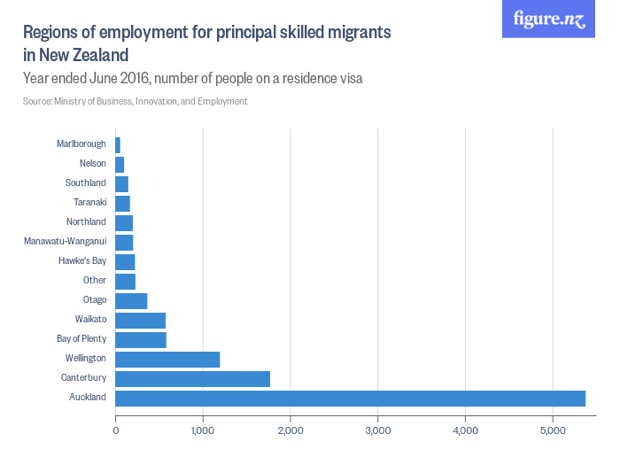
A story at Stuff today consists entirely of a graph from Figure.NZ

16917686

On one hand, it’s good to see this sort of data more widely circulated — that’s the point of Figure.NZ. On the other hand, it’s not clear what question the graph answers.

This distinction underlies two meaning of the word ‘statistics’.  Like Stats New Zealand, Figure.NZ provides a lot of statistics, collected and summarised information. This is a valuable public service, but the reason it’s valuable is that you can use the information to do statistics, to make comparisons and answer questions.

So, what comparisons should be most interesting for these numbers?  It’s probably not the raw totals — it would be surprising if Auckland didn’t get the majority biggest share of skilled migrants.  You might want to ask about skilled migrants as a fraction of the population, or as a fraction of the skilled labour force, or as a fraction of new members of the skilled labour force, or compared to previous years. You might be interested in regional GDP per skilled migrant, or regional council revenue for infrastructure.  You might want to compare the ratio of skilled and unskilled migrants in different regions.   But there’s almost always going to be a comparison involving another number.

Asking different questions about the numbers will lead to different stories; you don’t get a story without asking a question. The data don’t speak for themselves.

December 20, 2016

Briefly

  • “Algorithms can help stomp out fake news”, from the Atlantic.  They can, but if the algorithm is available to the public, you can just tweak your fake news until it passes. So there’s a moderately scary transparency tradeoff.
  • Donald Trump has managed the best Electoral College result by a white man since Bill Clinton. (data)
  • From NIWA: ocean currents around NZ

  • A lot of factoids on the internet are true, but only for very careful definitions of ‘true’, sometimes more than one in the same picture. (via @JulieB_92, @publicaddress)

Precision medicine?

  • Nicky Pellegrino, at Noted, “Genetic testing now offers personalised medicine, but just who should be tested?”
  • Nathaniel Comfort, in The Atlantic, “The Overhyping of Precision Medicine”
  • And again at Aeon, “Why the hype around medical genetics is a public enemy”

Lead and hope

The Flint water crisis is winding down: the city has been back on Detroit water for over a year, and in early December this year tests showed that nearly all the water supply was back within Federal standards for lead.  Criminal charges have been filed against some officials for their roles in creating or covering up the problems.

Flint residents were exposed to levels of lead in their drinking water that were well above the Federal safety threshold, and this translated, predictably, into higher levels of blood lead in children (and presumably in adults, too).  The proportion of kids under 5 with ‘elevated blood lead’, (>5μg/dL) increased from about 2% (close to the national average)  before the water crisis to about 4%.  Obviously, a national average of 2% means there are other places affected, but Flint was distinctive because the water-supply change was simple and deliberate.

On the other hand, lead is still one of the great victories over pollution. In the 2011-12 round of the US health survey NHANES, 95% of children had blood lead levels below 2.9 μg/dL.  In the 1976-1980 round(PDF), nearly 90% of  children had blood levels above 10 μg/dL, and 10% had levels above 30 μg/dL.  Abolishing lead in petrol has been a huge success and other restrictions have helped.  This year we’ve also seen signs that restricting CFCs has worked: the ozone hole may be slowly starting to heal.  Restricting CFCs was harder, and the improvement is slower, but we’re making progress.  It can work.


December 19, 2016

Sauna and dementia

Q: Did you see that saunas prevent dementia?

A: Well, even the Herald headline only says “could cut risk

Q: You don’t sound convinced.

A: No.

Q: Is this mice again?

A: No, I don’t think there are good animal models for saunas.

Q: Would it be inappropriate to attempt some sort of double entendre here?

A: Yes. The Finns would be offended.

Q: Ok. Back to business. You’re going to tell me that the research paper doesn’t make these claims and it’s all the fault of the British media, right?

A: No, the research paper has as one of its Key Points “Sauna bathing, an activity that promotes relaxation and well-being, may be a recommendable intervention to prevent or delay the development of memory diseases in healthy adults.”

Q: That’s pretty positive.

A: And the university press release is titled “Frequent sauna bathing protects men against dementia

Q: Is this one of those things that’s statistically significant but too small to care about?

A: No, they’re claiming a 2/3 reduction in dementia risk.

Q: Wow. That’s…umm…?

A: Larger than one would reasonably expect?

Q: Very diplomatically put.  Wait, so if that was true, you’d be able to see it in the national figures. Does Finland have a much lower dementia rate than you’d otherwise expect?

A: An excellent question.  No.

Q: [citation needed]

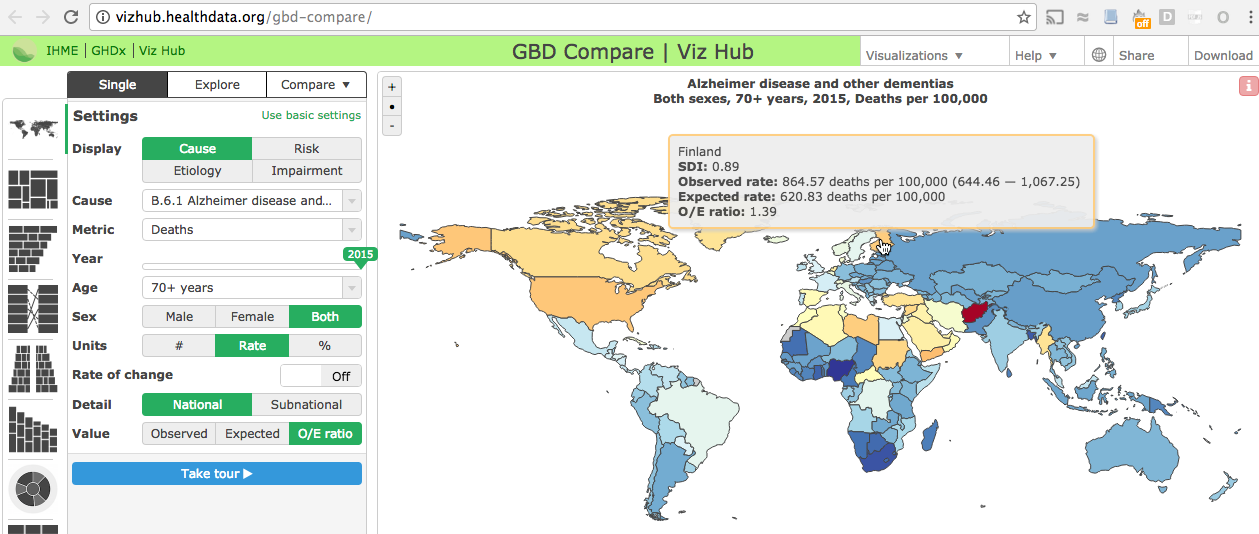
A: Well, ok, diagnosis bias makes it tricky, but the Institute for Health Metrics and Evaluation is making serious attempts to do international comparisons on all sorts of disease, and they think Finland has higher rates than expected, in contrast to the rest of Scandinaviasauna-alz
Q: So sauna isn’t protective?

A: Well, it’s not hugely, implausibly protective unless there’s some other Finland-specific risk factor that cancels it out
 

Stat of the Week Competition: December 17 – 23 2016

Each week, we would like to invite readers of Stats Chat to submit nominations for our Stat of the Week competition and be in with the chance to win an iTunes voucher.

Here’s how it works:

  • Anyone may add a comment on this post to nominate their Stat of the Week candidate before midday Friday December 23 2016.
  • Statistics can be bad, exemplary or fascinating.
  • The statistic must be in the NZ media during the period of December 17 – 23 2016 inclusive.
  • Quote the statistic, when and where it was published and tell us why it should be our Stat of the Week.

Next Monday at midday we’ll announce the winner of this week’s Stat of the Week competition, and start a new one.

(more…)

December 18, 2016

Magic Water?

Update: new reporting at the Herald, who got the stuff tested. It contains quite a lot of bleach (hypochlorite/hypochlorous acid). And it’s expensive.  When I wrote this, based on the Stuff article, I was willing to assume the assertions quoted in the article about the trial conduct and standards of research were true in the absence of evidence to the contrary. Not so much now.  Good work by the Herald. 


(more…)

Incriminating Claus-marks on her back

I was reminded by One News last night that I’d missed the annual ritual of the ACC Christmas Sermon.

ACC is supposed to be in the business of paying for accidents  and would prefer there to be fewer to pay for.  Every year, they issue warnings about Christmas risks, quoting large numbers of accidents and consequent medical costs. Often, the resulting stories omit the inconvenient fact that there are many fewer accidents over Christmas than at other times.  What actually happens at Christmas is a relatively small number of serious injuries, but often (as in the song) of distinctive  types, and often fairly easily preventable.

This year, the Manawatu Standard talks about specific Christmas risks, and mostly quotes numbers for those risks. They also quote local medics, who talk about types of risk rather than imply a high absolute level.

The Stuff Life & Style story fails at numbers. It leads with the total medical costs and number of injuries, not compared to a typical day and so giving a misleading impression.  It also has the regional-total comparisons that are a thing of the past for serious topics

Auckland had the highest rate of accidents anywhere in the country with 2866 claims over the three days, Christchurch had 945, Tauranga 469, Hamilton 451 and Wellington 399.

Auckland, of course, has more people — even at this time of year. Accounting for population, that’s a notably high rate for  Hamilton and Tauranga and a notably low rate for Wellington. Maybe Tauranga’s effective population is up because of tourists?

One News has a cost total, but $200,000,  singling out specifically Christmas-attributable injuries. In some ways that’s a problem in the other direction, since it misses out a lot of the ‘ordinary household tasks while stressed, tired, and/or drunk’ component. But they do give some good examples and advice.