February 4, 2015

Overegging it

Q: Did you see the headline in Stuff that eggs actually make you kinder?

A: Yes.

Q: A bit ironic, isn’t it?

A: You mean because of how eggs are usually produced?

Q: Yes. Did they use free-range eggs, or battery farmed?

A: No eggs were harmed in the research.

Q: But it says “eggs” in the headline

A: Yes, it does.

Q: Was it another mouse lab study?

A: No, this was real people (university students) in a randomized experiment. The story says that, and even links to the paper.

Q: So it’s real?

A: I wouldn’t go that far.

Q: But experiment. And causal. And Science. Yes?

A: Very small experiment with marginally-significant results that could easily be due to chance.

Q: You’ve got a thing about psychologists, like Andrew Gelman does, haven’t you?

A: No, I’ve got a thing about over-promoted, under-powered research, like Andrew Gelman does.

Q: Ok, let’s calm down and get back to the study. What did they use instead of eggs?

A:  800 mg of tryptophan powder (or placebo) in orange juice.

Q: Is that a lot?

A: They say it’s the equivalent of three eggs.

Q: Why do you sound dubious?

A: Because other websites think there’s less than that. I haven’t found any definitive primary source, but there’s about 6g of protein in a 50g egg, and from Table 2 in this 1973 paper you can compute that egg protein is about 1.8% tryptophan, which works out as 108mg.  Or in a 70g egg (‘Jumbo’ in NZ, ‘Large’ in Europe) about 150mg. It looks like you’d need more than five 70g eggs to get 800mg of tryptophan.

Q: How about other foods? Are eggs especially high in tryptophan?

A: Not especially. Chicken, or cheese, or oats, or chickpeas, for example, have more tryptophan per 100g.

Q: So if they didn’t use eggs in the experiment, and eggs aren’t particularly high in tryptophan, why are the headlines about eggs? Were they sponsored by the Egg Foundation?

A: No, nothing like that. And the university news post just talks about “the amino acid tryptophan, found in fish, soya, eggs and spinach.” It’s probably because the dose in the study was described in terms of eggs.
If drink we lack

As I’ve often said on StatsChat, if you’re eating dark chocolate or drinking red wine primarily for the health benefits, you’re doing it wrong. Now the problem is spreading to beer. Stuff has a headline “Could beer help fend off Alzheimer’s and Parkinson’s?” As you’d expect, the answer is “Not really.” 

The story is unusually light on information, not giving the journal name, the names of any of the researchers, or the names of any of their institutions.  Through Google, I found a story in the Telegraph, where the headline is even worse — “Beer could help ‘protect brain against Parkinson’s and Alzheimer’s'” — but at least they link to a press release.

The press release headline “Beer compound could help fend off Alzheimer’s and Parkinson’s diseases”  looks less extreme than the newspaper ones, but the lead is

The health-promoting perks of wine have attracted the spotlight recently, leaving beer in the shadows. But scientists are discovering new ways in which the latter could be a more healthful beverage than once thought.

They, finally, do link to the research paper, in the Journal of Agricultural and Food Chemistry. If you think that sounds a slightly strange place to publish research about the health effects of beer, well, it would be if that was what the research was about.  The abstract says

As an active component in beers, [xanthohumol]’s presence has been suggested to be linked to the epidemiological observation of the beneficial effect of regular beer drinking.

That is, the research assumes a beneficial effect of beer and is trying to work out what the mechanism might be. The research wasn’t in people, or even in mice, or even in mouse brain cells. It was in a standard lab cell line of nerve-like cells originally from a cancer of the adrenal gland in a rat.

You might also ask if there’s any research closer to live people. Last year, scientists at Oregon State University studied high doses of xanthohumol in mice.  They found it improved cognitive function in young mice, but not in old mice, and also pointed out

 the levels of xanthohumol used in this study were only possible with supplements. As a fairly rare micronutrient, the only normal dietary source of it would be through the hops used in making beer, and “a human would have to drink 2000 liters of beer a day to reach the xanthohumol levels we used in this research.”

That’s not really compatible with the new drink-driving limits.


Meet Statistics summer scholar Christopher Pearce

Chris PearceEvery year, the Department of Statistics offers summer scholarships to a number of students so they can work with staff on real-world projects. Christopher, right, is working on the OpenAPI project with Associate Professor Paul Murrell. Chris explains:

“Government data is becoming increasingly available. However, this does not mean it is readable – few individuals possess the knowledge and skills to make use of these data by themselves.

“In an ideal world, the code used by fellow statisticians would be available to everyone. It would be even more ideal if it were transferable. Sites like Wiki New Zealand  are doing a remarkable job of displaying some of New Zealand’s trends, but with no source code it can sometimes be impossible to recreate.

“The OpenAPI project is developing a flow-based framework that is primarily aimed at lowering the barriers to use of open data by the general public. My project is about creating an architecture for programmers and statisticians of all levels. Our goal is for anyone interested to have the ability to perform analyses on open government data. The idea is that there are publicly available snippets of code from fellow statisticians that can be easily linked in a meaningful way. The less expertise required by the end user, the better.

“My job is to come up with questions I am interested in answering, then figuring out how a potential lay observer would solve them. So far it has yielded some interesting results.

“I’m a third-year student at the University of Auckland, studying a Bachelor of Laws/Bachelor of Science conjoint. My skills lie in statistics and computer science, but I need the literal side to keep a balanced life.

“I got hooked on statistics when I discovered the Poisson distribution. There’s something about statistics that never seems to get old, and I’m discovering new things every day. It’s nice knowing I can actually attempt an answer to the curiosities in my head.”

February 3, 2015

Spotty coverage

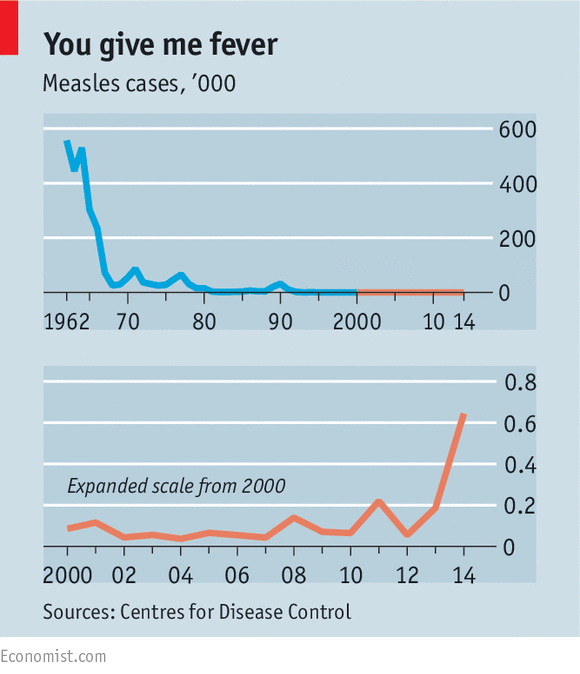
Here’s a graph from the Economist showing the impact of the measles vaccine:

20150131_USC861

The number of measles cases fell from over half a million per year to about 100 per year when the vaccine was introduced. That’s a 99.98% reduction, in a disease that (in a healthy population) kills about two people in a thousand.


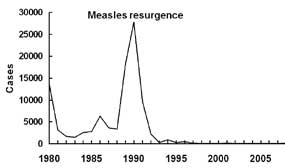
Here’s a graph from the Centers for Disease Control showing that little blip in 1990 on an expanded scale:

meas_fig_03

They say

The most important cause of the measles resurgence of 1989–1991 was low vaccination coverage. Measles vaccine coverage was low in many cities, including some that experienced large outbreaks among preschool-aged children throughout the early to mid-1980s. Surveys in areas experiencing outbreaks among preschool-aged children indicated that as few as 50% of children had been vaccinated against measles by their second birthday, and that black and Hispanic children were less likely to be age-appropriately vaccinated than were white children.

Vaccine coverage isn’t as bad as that now, but the profile of unvaccinated kids is different. Black and Hispanic children are just as likely as white children to have had at least one doses of the measles vaccine, and children in poverty have a rate only 1.5 percentage points lower. Now, a substantial chunk of the problem is parents who are anti-vaccine.

Kieran Healy has an interesting post on the ‘personal belief exemption’ data for kindergarten children in California.  They are only 3.36% of children, but they cluster.  That’s important because US is just on the edge of having high enough vaccine coverage to stop an epidemic from spreading, at least if the unvaccinated were evenly spread through the population. They aren’t:

the number of kindergarteners with PBEs, even in Berkeley, is not huge—about 67 kids out of 850 in the city. But 20 of those 67 are in the same school, and probably the same room.

Anti-vaccine hysteria is more prominent in the US than New Zealand: partly because our mainstream media don’t go in for it, and partly because everything is more prominent in the US. Similarly, reaction to the risks posed by unvaccinated children has been more prominent in the US. However,  New Zealand has a similar rate of measles vaccination. Our schools or early childhood services cannot refuse enrollment based on vaccination (no special paperwork is required as in California), and (like California) can only temporarily exclude unvaccinated children if they are known to have been exposed.

Last year, New Zealand had 283 cases of measles. Scaled for population, last year in NZ was about half as bad as the US in 1990, and about thirty times bigger than the current US outbreak (so far).

Meet Statistics summer scholar Daniel van Vorsselen

Every year, the Department of Statistics offers summer scholarships to a number of students so they can work with staff on real-world projects. Daniel, right, is working on a project called Working with data from conservation monitoring schemes with Associate Professor Rachel Fewster. Daniel explains:

Daniel Profile Picture“The university is involved in a project called CatchIT, an online system that aims to help community conservation schemes by proving users with a place where they can input and store their data for reference. The project also produces maps and graphics so that users can assess the effectiveness of their conservation schemes and identify areas where changes can be made.

“My role in the project is to help analyse the data that users put into the project. This involves correctly formatting and cleaning the data so that it is usable. I assist users in the technical aspects relating to their data and help them communicate their data in a meaningful way.

“It’s important to maintain and preserve the wildlife and plant species we have in New Zealand so that future generations have the opportunity to experience them as we have. Our environments are a defining factor of our culture and lifestyles as New Zealanders and we have a large amount of native species in New Zealand. It would be a shame to see them eradicated.

“I am currently studying a BCom/BA conjoint, majoring in Statistics, Economics and Finance. I’m hoping to do Honours in statistics and I am looking at a career in banking.

“Over summer, I hope to enjoy the nice weather, whether out on the boat fishing, at the beach or going for a run.”


February 2, 2015

Meet Statistics summer scholar Ole Geldschlager

OleEvery year, the Department of Statistics offers summer scholarships to a number of students so they can work with staff on real-world projects. Ole, right, is working on a project called Testing data-model fitness in phylogenetics with Dr Steffen Klaere. Ole explains:

“A continuously elusive question in phylogenetic inference is how to test data-to-model fitness. While there have been omnibus tests available for more than 20 years, their applicability was restricted due to issues of power and computability of the test statistics.

“In recent work, we have assessed the fitness of each site (or observation) separately by fitting simultaneous confidence regions.

“However, the more appropriate choice would be to do informed multiple testing on the sites and identify those sites for which the test finds evidence against model fitness. My task is to investigate a number of potential tests and assess their strength and weaknesses through simulation approaches.

“The maximum likelihood approach for phylogenetic inference resembles to some degree a logistic regression approach. Here, one uses deviance measures to assess the model-data fitness. Such approaches have been tested in phylogenetics as well, however, they often ignore the fact that the data are over-dispersed and zero-inflated.

“Consequently, in my project I will investigate the suitability of corrections to the deviance made by ecologists to account for overdispersion and zero-inflation to build statistics which are suitable to test model-data-fitness in phylogenetics.

“I am studying a masters in mathematics at the Ernst-Moritz-Arndt University Greifswald in Germany. I have a bachelor’s degree in biomathematics, also from Greifswaldl.

“Statistics is one of my favourite topics in mathematics. Statistics plays a big role in finance, economy and nature, and that’s why I want to learn and understand statistics.

“Over summer, I am looking forward to travelling around New Zealand. I want to learn more about this exciting country – it is completely new to me.”


January 31, 2015

Big buts for factoid about lying

At StatsChat, we like big buts, and an easy way to find them is unsourced round numbers in news stories. From the Herald (reprinted from the Telegraph, last November)

But it’s surprising to see the stark figure that we lie, on average, 10 times a week.

It seems that this number comes from an online panel survey in the UK last year (Telegraph, Mail) — it wasn’t based on any sort of diary or other record-keeping, people were just asked to come up with a number. Nearly 10% of them said they had never lied in their entire lives; this wasn’t checked with their mothers.  A similar poll in 2009 came up with much higher numbers: 6/day for men, 3/day for women.

Another study, in the US, came up with an estimate of 11 lies per week: people were randomised to trying not to lie for ten weeks, and the 11/week figure was from the control group.  In this case people really were trying to keep track of how often they lied, but they were a quite non-representative group. The randomised comparison will be fair, but the actual frequency of lying won’t be generalisable.

The averages are almost certainly misleading, because there’s a lot of variation between people. So when the Telegraph says

The average Briton tells more than 10 lies a week,

or the Mail says

the average Briton tells more than ten lies every week,

they probably mean the average number of self-reported lies was more than 10/week, with the median being much lower. The typical person lies much less often than the average.

These figures are all based on self-reported remembered lies, and all broadly agree, but another study, also from the US, shows that things are more complicated

Participants were unaware that the session was being videotaped through a hidden camera. At the end of the session, participants were told they had been videotaped and consent was obtained to use the video-recordings for research.

The students were then asked to watch the video of themselves and identify any inaccuracies in what they had said during the conversation. They were encouraged to identify all lies, no matter how big or small.

The study… found that 60 percent of people lied at least once during a 10-minute conversation and told an average of two to three lies.


January 30, 2015

Probably not

The Herald (from the Daily Mail) asks “Has an 8-year-old found a cancer cure?

According to the story,

Michael Lisanti asked his eight-year-old daughter how she would cure cancer, and it seems she may have got it right.

Camilla Lisanti suggested using antibiotics, “like when I have a sore throat”.

Her parents, a husband-wife cancer research team were sceptical at first but tested out her theory in their Manchester University lab. And to their surprise, several cheap and widely-used antibiotics killed the most dangerous cancer cells.

That’s not what they say in their research paper, where the idea is presented as coming from a large-scale objective search

These observations are also consistent with the idea that cancer is essentially a disease of “stemness” gone awry

Based on this rather simple premise, using unbiased quantitative proteomic profiling, we have focused on identifying a global phenotypic property of cancer stem cells (CSCs) that could be targeted across multiple tumor types. We have identified this property as a strict dependence on mitochondrial biogenesis, for the anchorage-independent clonal expansion and survival of the CSC population.

Here, we show that 4-to-5 different classes of FDA-approved antibiotics, which inhibit mitochondrial biogenesis as an “off-target” effect, can be used to eradicate cancer stem cells, in 12 different cancer cell lines, across 8 different tumor types 

Either way, are these antibiotics (which aren’t the ones recommended for ‘when I have a sore throat’)  a new idea that’s going to cure cancer?

Well, doxycycline, the apparent favourite, has been proposed before, based on at least two other theories about why it should work. A simple Google search would tell you that. A slightly more sophisticated search would tell you that this mechanism has been proposed before (in 1984)

Tetracyclines have even been tested before. A review article in 2011 says

Here we review the efforts to determine the efficacy of tetracyclines as chemotherapeutics in human cancer trials. While the majority of clinical trials have yielded disappointing results, tetracyclines have been shown to be generally well tolerated and have significant anti-proliferative effects in certain cancer types.

On the other hand, those trials were done in tumours chosen based on a different theory, and mostly used different tetracyclines. It would be wonderful if doxycycline did better in new trials, but I wouldn’t say that’s the way to bet.

A bit more complicated than that

On Twitter, I got a link to a Telegraph story “One glass of wine increases stroke risk by third”, with the request “Debunk please.”

Not all depressing health news is necessarily wrong. However, even if it’s describing a real risk you can be pretty confident that it will have been exaggerated a bit, and that’s the case here.  It’s probably true that alcohol consumption at not-particularly-high levels increases stroke risk, but it does pay to look more closely at what the research is claiming.

The first thing to notice is that the story shifts from

Middle aged drinkers who down just one large glass of wine a day increase their risk of stroke by a third, warns a new study.

to

The results showed drinkers in their fifties and sixties who had at least two alcoholic drinks a day…

That is, the research lumped together everyone who averaged two or more standard drinks per day (actually, 2.4 standard drinks/day in NZ units). This group, collectively, had a 34% higher stroke risk than the 0.5 drink/day group, but the group who had 1-2 standard drinks per day were not at any increased risk.  Unless there’s a magic threshold at 2.4 drinks/day of alcohol, the excess risk must be less than 1/3 for people just into the 2.4+ drinks range, and more for people far into the range.

The next step is to try to look at the actual alcohol consumption in each group, to see how far above 2.4/day the highest group was. That’s not given, but some interesting things are. First, only 3% of the people who had strokes drank more than 2.4 drinks/day, so this wasn’t a very good sample for looking at heavy drinking.  The researchers pointed this out themselves: “A potential limitation of our study could be a low proportion of heavy drinkers as alcohol consumption in Sweden is one of the lowest in Europe

What’s more surprising is that 3% of the people who didn’t have strokes also drank more than 2.4 drinks/day.  In fact, the mean and median alcohol consumption were slightly lower in the people who had strokes than in the people who didn’t.  How can this be?

Part of the explanation is given the Telegraph story

The findings show that blood pressure and diabetes appeared to take over as one of the main influences on having a stroke at around the age of 75.

That is, the alcohol effect was mostly in middle-aged people, where the actual stroke risk is lower. This was the main finding of the research, in fact. It still wouldn’t entirely explain the lack of difference in alcohol consumption, but there’s also probably a contribution from the statistical model they used and the way it handles people who die of something other than a stroke, and from lower risk in light drinkers than in non-drinkers.

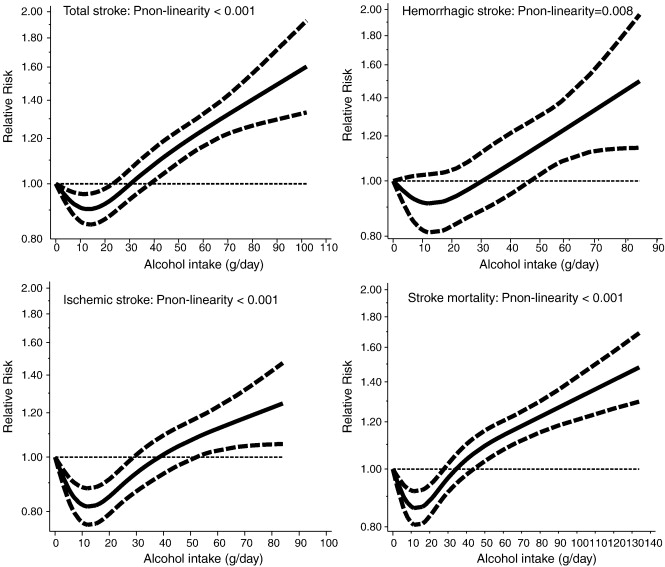
The other question to ask, always,  is what other research there is. Here’s a graph from a meta-analysis combining 27 alcohol and stroke studies published last year (click to embiggen). It also shows an increase, but not as dramatic as the new study.
1-s2.0-S0167527314009073-gr5

Since the new study wasn’t particularly well suited to looking at the effect of heavier drinking (it would have been better for looking at non-drinkers vs light drinkers), there isn’t much case for preferring the single new study estimate over the combined estimate.  According to this estimate, at 2 drinks/day there isn’t convincing evidence of increased risk. Above 3 drinks/day there is, and it goes up rapidly after that. Another meta-analysis in 2010 found broadly similar results, as did one in 2003 in the prestigious journal JAMA.

So, not really debunked, but not quite as bad as it sounds.

Meet Statistics summer scholar Ying Zhang

Ying Zhang Photo

Every year, the Department of Statistics offers summer scholarships to a number of students so they can work with staff on real-world projects. Ying, right, is working on a project called Service overview, client profile and outcome evaluation for Lifeline Aotearoa Face-to-Face Counselling Services  with the Department of Statistics’ Associate Professor David Scott and Christine Dong, research and clinical engagement manager, Lifeline and also an Honorary Research Fellow in the Department of Psychological Medicine at the University of Auckland. Ying explains:

“Lifeline New Zealand is a leading provider of dedicated community helpline services, face-to-face counselling and suicide prevention education. The project aims to investigate the client profile, the clinical effectiveness of the service and client experiences of, and satisfaction with, the face-to-face counselling service.

“In this project, my work includes three aspects: Data entry of client profiles and counselling outcomes; qualitative analysis of open-ended questions and descriptive analysis; and modelling for the quantitative variables using SAS.

“Very few research studies have been done in New Zealand to explore client profiles or find out clients’ experiences of, and satisfaction with, community face-to-face counselling services. Therefore, the study will add evidence in terms of both clinical effectiveness and client satisfaction. This study will also provide a systematic summary of the demographics and clinical characteristics of people accessing such services. It will help provide direction for strategies to improve the quality and efficiency of the service.

“I have just graduated from the University of Auckland with a Postgraduate Diploma in Statistics.  I got my bachelor and master degrees majoring in information management and information systems at Zhejiang University in China.

“My first contact with statistics was around 10 years ago when I was at university in China. It was an interesting but complex subject for me. After that, I did some internship work relating to data analysis. It helped me accumulate more experience about using data analysis to help inform business decisions.

“This summer, apart from participating in the project, I will spend some time expanding my knowledge of SAS – it’s a very useful tool and I want to know it better. I’m also hoping to find a full-time job in data analysis.”