September 24, 2014

Revised ITM Cup Predictions for Round 7

Reviewing the ratings I noticed I have been giving Wellington a ridiculously high rating given their disastrous performance this year. I discovered a problem with my code which meant I have not been updating ratings properly. I have some different code for the ITM Cup because of the strange nature of the fixtures where teams can play more than one game a week.

Team Ratings for Round 7

Here are the team ratings prior to Round 7, along with the ratings at the start of the season. I have created a brief description of the method I use for predicting rugby games. Go to my Department home page to see this.

Here are the team ratings prior to this week’s games, along with the ratings at the start of the season.

Current Rating Rating at Season Start Difference
Canterbury 21.23 18.09 3.10
Tasman 10.08 5.78 4.30
Auckland 5.32 4.92 0.40
Hawke’s Bay 4.02 2.75 1.30
Taranaki 2.96 -3.89 6.90
Wellington 1.25 10.16 -8.90
Counties Manukau 0.04 2.40 -2.40
Otago -1.62 -1.45 -0.20
Waikato -3.89 -1.20 -2.70
Northland -5.24 -8.22 3.00
Manawatu -7.06 -10.32 3.30
Southland -9.05 -5.85 -3.20
Bay of Plenty -9.73 -5.47 -4.30
North Harbour -10.37 -9.77 -0.60


Performance So Far

So far there have been 46 matches played, 30 of which were correctly predicted, a success rate of 65.2%.

Here are the predictions for last week’s games.

Game Date Score Prediction Correct
1 Southland vs. Tasman Sep 17 14 – 38 -13.30 TRUE
2 Northland vs. Taranaki Sep 18 20 – 31 -1.40 TRUE
3 Counties Manukau vs. Canterbury Sep 19 20 – 28 -13.50 TRUE
4 Hawke’s Bay vs. Bay of Plenty Sep 20 36 – 17 10.20 TRUE
5 Auckland vs. North Harbour Sep 20 32 – 7 18.50 TRUE
6 Manawatu vs. Southland Sep 20 41 – 20 -0.20 FALSE
7 Otago vs. Waikato Sep 21 38 – 7 1.60 TRUE
8 Wellington vs. Tasman Sep 21 20 – 42 0.10 FALSE


Predictions for Round 7

Here are the predictions for Round 7. The prediction is my estimated expected points difference with a positive margin being a win to the home team, and a negative margin a win to the away team.

Game Date Winner Prediction
1 North Harbour vs. Canterbury Sep 24 Canterbury -27.60
2 Bay of Plenty vs. Northland Sep 25 Northland -0.50
3 Taranaki vs. Auckland Sep 26 Taranaki 1.60
4 Waikato vs. Manawatu Sep 27 Waikato 7.20
5 Counties Manukau vs. Wellington Sep 27 Counties Manukau 2.80
6 North Harbour vs. Hawke’s Bay Sep 27 Hawke’s Bay -10.40
7 Tasman vs. Otago Sep 28 Tasman 15.70
8 Canterbury vs. Southland Sep 28 Canterbury 34.30


September 23, 2014

I’m not even sure where to begin on this highly important topic

New Zealand’s favourite biscuit.

I just clicked on a link on the homepage of the NZ Herald which says “NZ@Noon: NZ’s favourite biscuit revealed” which took me to an article with a snippet saying:

Bay of Plenty voters have taken to the polls. Find out which biscuit triumphed in the annual nationwide biscuit election.

This lead to another article with the headline: “Mallowpuffs voted Bay’s best biscuit” which includes the following (emphasis mine):

Bay of Plenty voters have taken to the polls and voted Mallowpuffs Original their favourite biscuit in an annual nationwide biscuit election.

Around the country, close to 5,000 votes were cast by biscuit-lovers who also voted Mallowpuffs Original as the national favourite, ahead of 57 other contenders.

Kiwi women were once again more passionate about pledging their support, contributing 94 percent of the votes nationwide.

The 2014 Bikkielections poll was conducted via an application on Griffin’s Facebook page from September 9 to 21 following weeks of campaigning via billboards, radio promotions, polling booths and street sampling. The poll has a margin of error of plus or minus zero percent.

That’s a first, right?

September 22, 2014

Blame it all on mum

Says the Herald (reprinting the Daily Mail)

If you have always found doing sums a struggle, you might just be able to blame your mother.

Because research has linked a woman’s hormone levels in pregnancy with her child’s maths skills at age five.

Boys and girls whose mothers were very low in the hormone thyroxine were almost twice as likely to do badly in arithmetic tests, it found.

The hormone in question is thyroxine, produced by the thyroid, and the basic issue is that iodine deficiency is getting more common again. In Australia and New Zealand, iodine has been added to bread since September 2009 to address this problem. In Australia, the fortification of bread has been fairly successful; there doesn’t seem to be data for New Zealand, but there’s no reason to expect it to be different. So the story  may not be applicable to New Zealanders.

Also, as with the cannabis paper a couple of weeks ago, the “twice as likely” is simply wrong.  Doing badly in arithmetic was defined as being in the bottom 50%, and it’s not plausible that low-thyroxine kids are twice as likely to be in the bottom half.  In fact, it’s the odds ratio for being in the lower 50% of students in maths that was 1.79.  Since the overall odds of being in the bottom half is 1:1, if you multiply by 1.79 you get 1.79:1, which is a probability of 64% of being in the bottom half.

A difference between 50% and 64% is not “almost twice as likely”, and “blame” is a completely inappropriate term — this is new research, so even if it’s true (it could be) and relevant to New Zealand (it probably isn’t) it would not be something for which ‘blame’ would be appropriate. There’s entirely too much blaming mothers already.

So, we had an election

Turnout of enrolled voters was up 3 percentage points over 2011, but enrollment was down, so as a fraction of the eligible population, turnout was only up half a percentage point.

From the Herald’s interactive, the remarkably boring trends through the count

There are a few electorates that are, arguably, still uncertain, but by 9pm the main real uncertainty at the nationwide level was whether Hone Harawira would win Te Tai Tokerau, and that wasn’t going to affect who was in government.  By 10pm it was pretty clear Harawira was out (though he hadn’t conceded) and that Internet Mana had been, in his opponent’s memorable phrase, “all steam and no hangi.”

Jonathan Marshall (@jmarshallnz) has posted swings in each electorate, for the party vote and electorate vote. He also has an interactive Sainte-Laguë seat allocation calculator and has published the data (complete apart from special votes) in a convenient form for y’all to play with.

David Heffernan (@kiwipollguy) collected a bunch of poll, poll average, and pundit predictions, and writes about them here. The basic summary is that they weren’t very good, though there weren’t any totally loony ones, as there were for the last US Presidential election. Our pundits seem to be moderately well calibrated to reality, but there’s a lot of uncertainty in the system and the improvement from averaging seems pretty small.  The only systematic bias is that the Greens did a bit worse than expected.

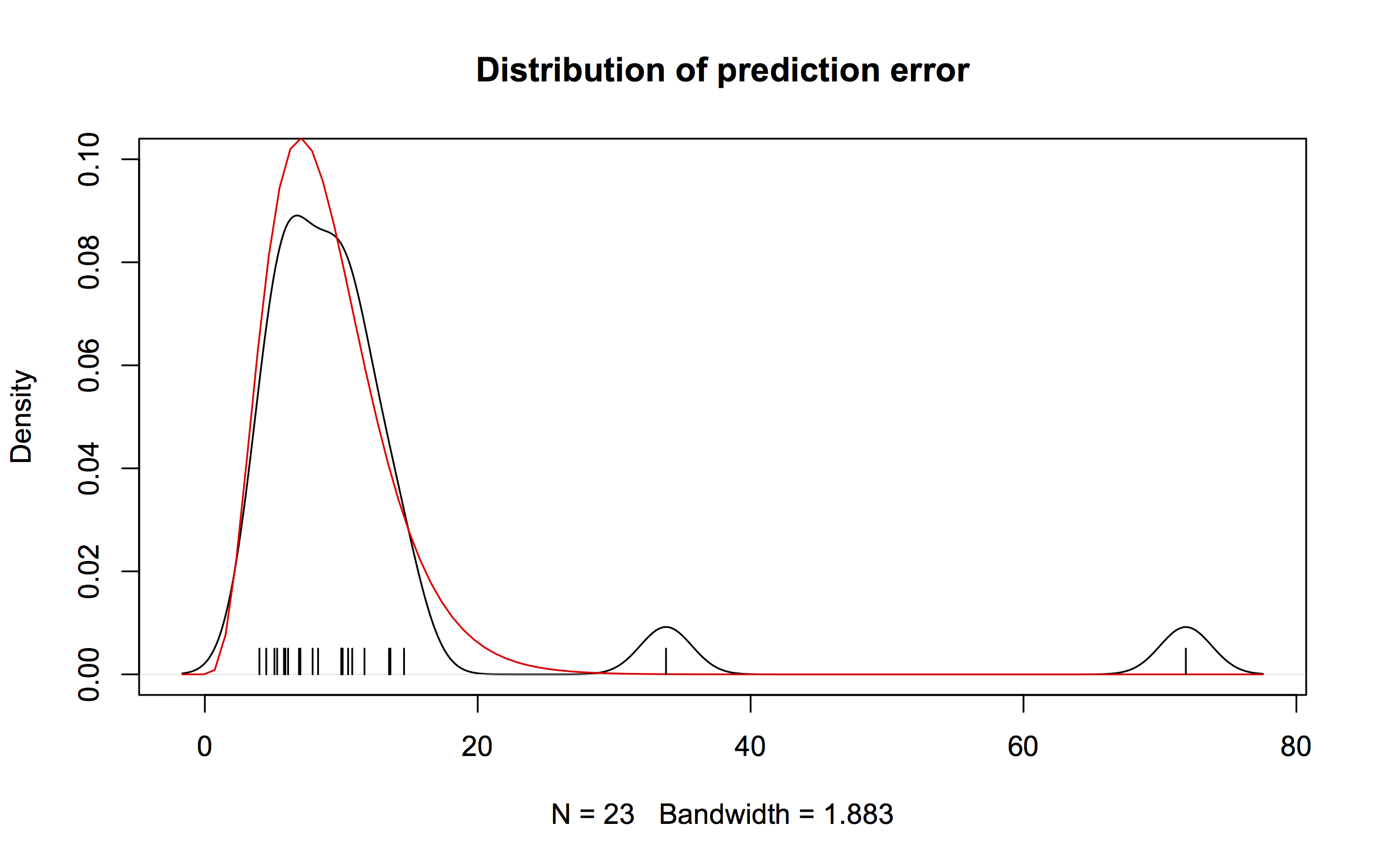
Based on his criterion, which is squared prediction error scaled basically by party vote, two single polls — 3 News/Reid at the high end and Herald Digipoll at the low end — spanned almost the entire range of prediction error.

The variation between predictions isn’t actually much bigger than you’d expect by chance. The prediction errors have the mean you’d expect from a random sample of about 400 people, and apart from two outliers they have the right spread as well. On the graph, the red curve is a chi-squared distribution with 9 degrees of freedom, and the black curve is the distribution of the 23 estimates. The outliers are Wikipedia and the last 3 News/Reid Research poll.

elections-dist

About half the predictions were qualitatively wrong: they had National needing New Zealand First or the Conservatives for a majority. The Conservatives were clearly treated unfairly by the MMP threshold. If someone is going to be, I’m glad it’s them, but a party with more votes than the Māori Party, Internet Mana, ACT, United Future, and Legalise Cannabis put together should have a chance to prove their unsuitability in Parliament.


Stat of the Week Competition: September 20 – 26 2014

Each week, we would like to invite readers of Stats Chat to submit nominations for our Stat of the Week competition and be in with the chance to win an iTunes voucher.

Here’s how it works:

  • Anyone may add a comment on this post to nominate their Stat of the Week candidate before midday Friday September 26 2014.
  • Statistics can be bad, exemplary or fascinating.
  • The statistic must be in the NZ media during the period of September 20 – 26 2014 inclusive.
  • Quote the statistic, when and where it was published and tell us why it should be our Stat of the Week.

Next Monday at midday we’ll announce the winner of this week’s Stat of the Week competition, and start a new one.

(more…)

September 21, 2014

Briefly

Data collection edition

  • Too Much Information:  Clemson University, in South Carolina, was “requiring students and faculty to complete an online course through a third party website that asks invasive questions about sexual history.
  • Too Little Information: New Zealand insurers are not willing to cooperate with price-comparison websites of the sort that exist elsewhere in the world.  These have led to lower prices where they have been introduced, but the insurers say their real concern is that people won’t get the most appropriate cover. (Herald today, Stuff back in March)
  • Just Right (maybe):  Apple says that with the new iOS8 operating system it is unable to unlock phones and decrypt data, and so will be able to refuse government demands to do so. Of course, the government can still grab lots of metadata, and as John Gilmore points out, there’s nothing but Apple’s bare word to go on.
September 19, 2014

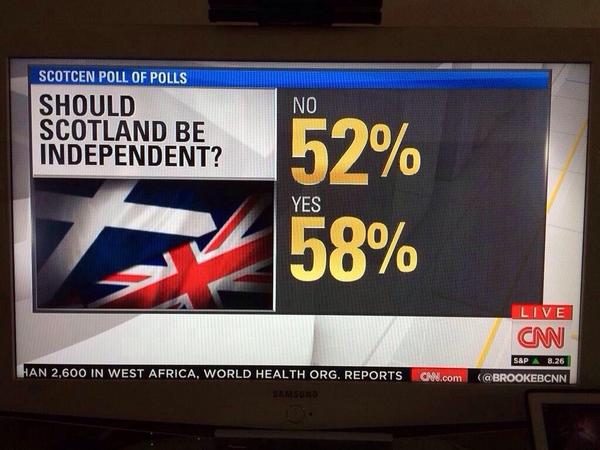
Scotland gives 110%

Not how polling works

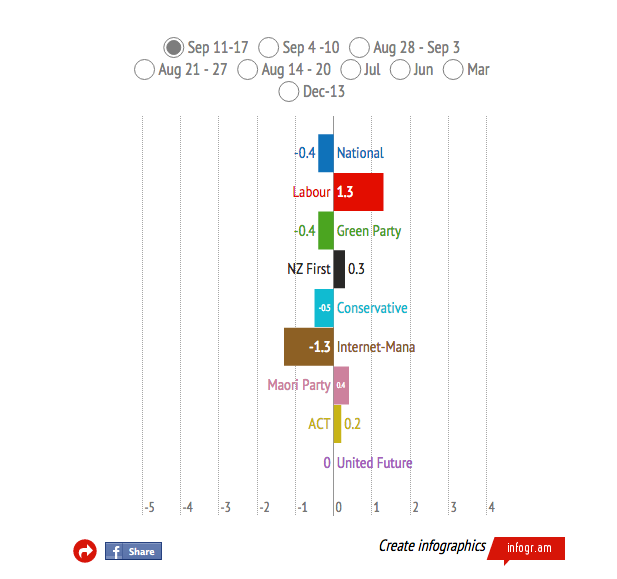
The Herald interactive for election results looks really impressive. The headline infographic for the latest poll, not so much. The graph is designed to display changes between two polls, for which the margin of error is 1.4 times higher than in a single poll: the margin of error for National goes beyond the edge of the graph.

election-diff


The lead for the story is worse

The Kim Dotcom-inspired event in Auckland’s Town Hall that was supposed to end John Key’s career gave the National Party an immediate bounce in support this week, according to polling for the last Herald DigiPoll survey.

Since both the Dotcom and Greenwald/Snowden Moments of Truth happened in the middle of polling, they’ve split the results into before/after Tuesday.  That is, rather than showing an average of polls, or even a single poll, or even a change from a single poll, they are headlining the change between the first and second halves of a single poll!

The observed “bounce” was 1.3%. The quoted margin of error at the bottom of the story is 3.5%, from a poll of 775 people. The actual margin of error for a change between the first and second halves of the poll is about 7%.

Only in the Internet Party’s wildest dreams could this split-half comparison have told us anything reliable. It would need the statistical equivalent of the CSI magic video-zoom enhance button to work.


September 18, 2014

Bald truth

From the Herald

Men who are bald at age 45 are more likely to develop aggressive prostate cancer compared with those who keep their hair.

US researchers found those who lose hair at the front of their heads and have moderate hair-thinning on the crown were 40 per cent more likely to develop a fast-growing tumour in their prostate.

This was compared with men with no baldness.

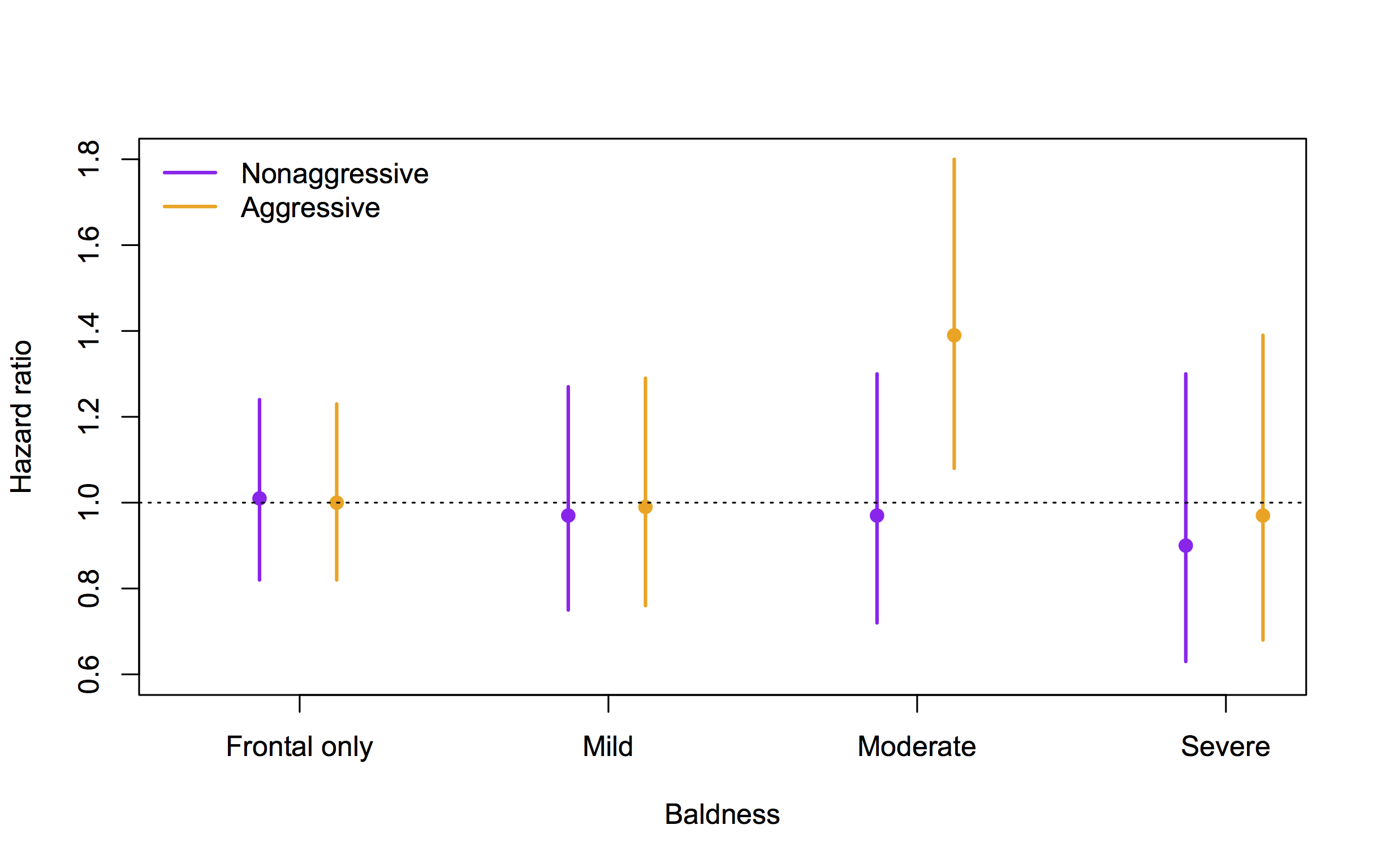
That’s all true, but what casts doubt on this finding is that you get the same results if you compare to men with severe baldness. That is, the research found a higher rate of aggressive prostate cancer in men who had ‘moderate’ baldness on the top of head, but not in those who had milder or more severe forms, and no increase in non-aggressive prostate cancer. Here are the estimated relative increases in risk, with confidence intervals

bald

When you consider the lack of a consistent trend, and the fact that the evidence isn’t all that strong for the moderate-baldness/aggressive-cancer combination, I don’t think this is worth getting all that excited about.

This one can mostly be blamed on the journal: the American Society of Clinical Oncology press release isn’t too bad in itself, but if you compare it to the other recent occasions when ASCO have issued a press release, it doesn’t really measure up.

Interactive election results map

The Herald has an interactive election-results map, which will show results for each polling place as they come in, together with demographic information about each electorate.  At the moment it’s showing the 2011 election data, and the displays are still being refined — but the Herald has started promoting it, so I figure it’s safe for me to link as well.

Mashblock is also developing an election site. At the moment they have enrolment data by age. Half the people under 35 in Auckland Central seem to be unenrolled,which is a bit scary. Presumably some of them are students enrolled at home, and some haven’t been in NZ long enough to enrol, but still.

Some non-citizens probably don’t know that they are eligible — I almost missed out last time. So, if you know someone who is a permanent resident and has lived in New Zealand for a year, you might just ask if they know about the eligibility rules. Tomorrow is the last day.