July 21, 2014

Survival of the fittest? Latest Thomas Lumley Listener column

Thomas Lumley writes in his latest Listener column: “Since 1980, your chance of surviving five years after a heart attack has increased from just over 70% to just under 80%. For breast cancer, the five-year survival rate has gone from about 60% to about 85% in the same period of time, and for melanoma it has risen from about 80% to over 90%.

“From these figures you might conclude that breast cancer treatment has improved a lot, treatment for melanoma has not improved as much and treatment for a heart attack has improved slightly less than for melanoma. It’s actually a bit more complicated than that.”

Read the rest of the column here. 

Stat of the Week Competition: July 19 – 25 2014

Each week, we would like to invite readers of Stats Chat to submit nominations for our Stat of the Week competition and be in with the chance to win an iTunes voucher.

Here’s how it works:

  • Anyone may add a comment on this post to nominate their Stat of the Week candidate before midday Friday July 25 2014.
  • Statistics can be bad, exemplary or fascinating.
  • The statistic must be in the NZ media during the period of July 19 – 25 2014 inclusive.
  • Quote the statistic, when and where it was published and tell us why it should be our Stat of the Week.

Next Monday at midday we’ll announce the winner of this week’s Stat of the Week competition, and start a new one.

(more…)

July 17, 2014

NRL Predictions for Round 19

Team Ratings for Round 19

The basic method is described on my Department home page. I have made some changes to the methodology this year, including shrinking the ratings between seasons.

Here are the team ratings prior to this week’s games, along with the ratings at the start of the season.

Current Rating Rating at Season Start Difference
Sea Eagles 7.87 9.10 -1.20
Roosters 6.97 12.35 -5.40
Warriors 5.98 -0.72 6.70
Rabbitohs 5.76 5.82 -0.10
Cowboys 2.96 6.01 -3.10
Bulldogs 2.96 2.46 0.50
Broncos 2.85 -4.69 7.50
Panthers 2.54 -2.48 5.00
Storm -0.05 7.64 -7.70
Knights -0.14 5.23 -5.40
Dragons -4.01 -7.57 3.60
Raiders -4.94 -8.99 4.10
Titans -5.61 1.45 -7.10
Sharks -7.67 2.32 -10.00
Wests Tigers -7.96 -11.26 3.30
Eels -9.30 -18.45 9.20


Performance So Far

So far there have been 128 matches played, 72 of which were correctly predicted, a success rate of 56.2%.

Here are the predictions for last week’s games.

Game Date Score Prediction Correct
1 Sea Eagles vs. Wests Tigers Jul 11 40 – 8 17.70 TRUE
2 Warriors vs. Eels Jul 12 48 – 0 14.10 TRUE
3 Storm vs. Bulldogs Jul 12 4 – 6 2.40 FALSE
4 Titans vs. Raiders Jul 13 20 – 36 8.00 FALSE
5 Sharks vs. Knights Jul 13 18 – 31 -0.70 TRUE
6 Panthers vs. Broncos Jul 14 35 – 34 5.00 TRUE


Predictions for Round 19

Here are the predictions for Round 19. The prediction is my estimated expected points difference with a positive margin being a win to the home team, and a negative margin a win to the away team.

Game Date Winner Prediction
1 Sharks vs. Cowboys Jul 18 Cowboys -6.10
2 Eels vs. Rabbitohs Jul 18 Rabbitohs -10.60
3 Roosters vs. Panthers Jul 19 Roosters 8.90
4 Storm vs. Raiders Jul 19 Storm 9.40
5 Broncos vs. Warriors Jul 19 Broncos 1.40
6 Knights vs. Titans Jul 20 Knights 10.00
7 Wests Tigers vs. Bulldogs Jul 20 Bulldogs -6.40
8 Dragons vs. Sea Eagles Jul 21 Sea Eagles -7.40


Super 15 Predictions for the Qualifying Finals

Team Ratings for the Qualifying Finals

The basic method is described on my Department home page. I have made some changes to the methodology this year, including shrinking the ratings between seasons.

Here are the team ratings prior to this week’s games, along with the ratings at the start of the season.

Current Rating Rating at Season Start Difference
Waratahs 9.66 1.67 8.00
Crusaders 8.78 8.80 -0.00
Sharks 5.92 4.57 1.40
Brumbies 2.97 4.12 -1.10
Hurricanes 2.89 -1.44 4.30
Bulls 2.88 4.87 -2.00
Chiefs 2.02 4.38 -2.40
Stormers 1.68 4.38 -2.70
Blues 1.44 -1.92 3.40
Highlanders -3.12 -4.48 1.40
Lions -3.39 -6.93 3.50
Force -4.67 -5.37 0.70
Reds -4.98 0.58 -5.60
Cheetahs -5.55 0.12 -5.70
Rebels -9.53 -6.36 -3.20


Performance So Far

So far there have been 120 matches played, 78 of which were correctly predicted, a success rate of 65%.

Here are the predictions for last week’s games.

Game Date Score Prediction Correct
1 Blues vs. Chiefs Jul 11 8 – 11 2.70 FALSE
2 Brumbies vs. Force Jul 11 47 – 25 8.50 TRUE
3 Bulls vs. Rebels Jul 11 40 – 7 14.20 TRUE
4 Crusaders vs. Highlanders Jul 12 34 – 8 12.80 TRUE
5 Reds vs. Waratahs Jul 12 3 – 34 -9.60 TRUE
6 Lions vs. Cheetahs Jul 12 60 – 25 0.80 TRUE
7 Stormers vs. Sharks Jul 12 10 – 29 0.60 FALSE


Predictions for the Qualifying Finals

Here are the predictions for the Qualifying Finals. The prediction is my estimated expected points difference with a positive margin being a win to the home team, and a negative margin a win to the away team.

Game Date Winner Prediction
1 Brumbies vs. Chiefs Jul 19 Brumbies 5.00
2 Sharks vs. Highlanders Jul 19 Sharks 13.00


July 14, 2014

Supermoon

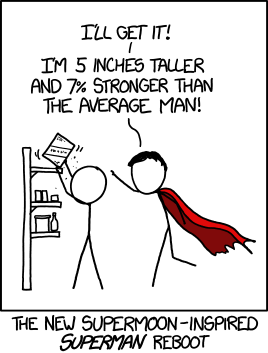
Why supermoons aren’t a big deal for earthquakes, based on XKCD

superm_n

Multiple testing, evidence, and football

There’s a Twitter account, @FifNdhs, that has five tweets, posted well before today’s game

  • Prove FIFA is corrupt
  • Tomorrow’s scoreline will be Germany win 1-0
  • Germany will win at ET
  • Gotze will score
  • There will be a goal in the second half of ET

What’s the chance of getting these four predictions right, if the game isn’t rigged?

Pretty good, actually. None of these events is improbable on its own, and  Twitter lets you delete tweets and delete accounts. If you set up several accounts, posted a few dozen tweets on each, describing plausible events, and then deleted the unsuccessful ones, you could easily come up with an implausible-sounding remainder.

Twitter can prove you made a prediction, but it can’t prove you didn’t also make a different one, so it’s only good evidence of a prediction if either the predictions were widely retweeted before they happened, or the event described in a single tweet is massively improbable.

If @FifNdhs had predicted a 7-1 victory for Germany over Brazil in the semifinal, that would have been worth paying attention to. Gotze scoring, not so much.

Stat of the Week Competition: July 12 – 18 2014

Each week, we would like to invite readers of Stats Chat to submit nominations for our Stat of the Week competition and be in with the chance to win an iTunes voucher.

Here’s how it works:

  • Anyone may add a comment on this post to nominate their Stat of the Week candidate before midday Friday July 18 2014.
  • Statistics can be bad, exemplary or fascinating.
  • The statistic must be in the NZ media during the period of July 12 – 18 2014 inclusive.
  • Quote the statistic, when and where it was published and tell us why it should be our Stat of the Week.

Next Monday at midday we’ll announce the winner of this week’s Stat of the Week competition, and start a new one.

(more…)

July 13, 2014

Age/period/cohort voting

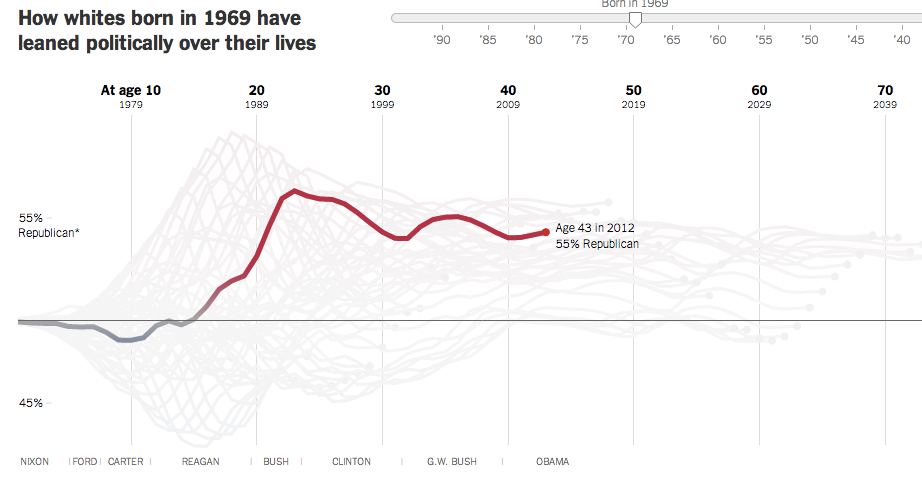
From the New York Times, an interactive graph showing how political leanings at different ages have changed over time

vote

Yes, voting preferences for kids are problematic. Read the story (and this link) to find out how they inferred them. There’s more at Andrew Gelman’s blog.

100% accurate medical testing

The Wireless has a story about a fatal disease where there’s an essentially 100% accurate test available.

Alice Harbourne has a 50% chance of Huntington’s Disease. If she gets tested, she will have either a 0% or 100% chance, and despite some recent progress on the mechanism of the disease, there is no treatment.

July 11, 2014

Another prostate cancer study

Today’s prostate cancer risk factor, per the Herald, is vasectomy. The press release is here; the paper isn’t open-access.

This is a much more reliable study than the one earlier in the week about cycling, and there’s reasonable case that this one is worth a press release.

In 1986, the researchers recruited about 50000 men (health professionals: mostly dentists and vets), then followed them up to see how their health changed over time.  This research involves the 43000 who hadn’t had any sort of cancer at the start of the study. As the Herald says, about a quarter of the men had a vasectomy, and there have been 6000 prostate cancer diagnoses. So there’s a reasonable sample size, and there is a good chance you would have heard about this result if no difference had been found (though probably not via the Daily Mail)

The relative increase in risk is estimated as about 10% overall and about 20% for ‘high-grade’ tumours, which is much more plausible than the five-fold increase claimed for cycling.  The researchers had information about the number of prostate cancer tests the men had had, so they can say this isn’t explained by a difference in screening — the cycling study only had total number of doctor visits in the past year. Also, the 20% difference is seen in prostate cancer deaths, not just in diagnoses, though if you only consider deaths the evidence is borderline.  Despite all this, the researchers quite rightly don’t claim the result is conclusive.

There are two things the story doesn’t say. First, if you Google the name of the lead researcher and ‘prostate cancer’, one of the top hits is another paper on prostate cancer (and coffee, protective). That is, the Health Professionals Followup Study, like its sister cohort, the Nurses Health Study, is in the business of looking for correlations between a long list of interesting exposures and potential effects. Some of what it finds will be noise, even if it appears to pass sanity checks and statistical filters. They aren’t doing anything wrong, that’s just what life is like.

Second, there were 167 lethal prostate cancers in men with vasectomies. If the excess risk of 20% is really due to vasectomy, rather than something else, that would mean about 27 cancers caused by 12000 vasectomies. Combining lethal and advanced cases, the same approach gives an estimated 38 cases from 12000 vasectomies. So, if this is causation, the risk is 2 or 3 serious prostate cancers for every 1000 vasectomies. That’s not trivial, but I think it sounds smaller than “20% raised risk”.