Posts filed under Medical news (341)

October 22, 2012

Ginger benefits not completely misrepresented

A story in Stuff about the benefits of ginger is to be commended for providing actual links to their supporting evidence for some of the claims (assuming you want more evidence than the approval of Confucius).

Unfortunately, if you provide links, there’s always the risk that people will follow them:

rich in antioxidants.  The linked paper describes chemical measurements of the antioxidant effects of ginger.  The abstract doesn’t support “rich” — the chemical analysis was of the antioxidant strength, not the concentrations of antioxidants and, at least in the abstract, didn’t compare to anything else (the journal, unusually, isn’t one that UoA library has access to).

combats nausea: This one appears to actually be true — it’s a combination of six randomised trials, and found ginger was better than placebo.  The researchers did note that publication bias was a concern and said the data are insufficient to draw firm conclusions.

natural pain relief.  The link here says that the result comes from the US National Library of Medicine.  That’s only true to the extent that it’s stored on their virtual shelves, like everything else published in biology and medicine. The study (by some Iranian scientists publishing in the Journal of Alternative and Complementary Medicine) compared ginger to two medications for period pain and didn’t find a statistically significant difference.  The researchers concluded that ginger was as effective, but their data don’t actually support this conclusion: you can’t conclude equivalence just from a lack of statistical signifiance.  If you look at the data in their Table 2 (which you can’t, since it’s not open-access), you can compute a 95% confidence interval for the difference in proportion of women who reported that the treatment helped: ibuprofen could have been 23 percentage points better than ginger, which is hardly a convincing demonstration of equivalence.

There’s also a link to some (then) unpublished research from the University of Sydney showing that chemicals in ginger inhibit the inflammation-related enzymes COX-1 and COX-2.  This link is from 2001 — I noticed how old it was because the researcher was talking enthusiastically about selectively inhibiting COX-2. As Vioxx did.  He said that he planned to do a study in actual patients. Nothing seems to have come of this study in the past decade: either it wasn’t done or it has succumbed to publication bias.

Natural arthritis relief.From the conclusion section of the linked abstract “Due to a paucity of well-conducted trials, evidence of the efficacy of Z. officinale to treat pain remains insufficient. However, the available data provide tentative support for the anti-inflammatory role of Z. officinale constituents,”

Stress reducer: The first link is to the Daily Mail. Enough said.  The second link  is introduced as “Ginger extract showed “significant antidepressant activity” in a study that was published in the International Research Journal of Pharmacy.”  A study in rats, if you follow the link.

 Anti-inflammatory: In test-tubes, ginger extracts inhibit some things related to inflammation. The abstract of the linked study concludes “Identification of the molecular targets of individual ginger constituents provides an opportunity to optimize and standardize ginger products with respect to their effects on specific biomarkers of inflammation. Such preparations will be useful for studies in experimental animals and humans.” In other words, we don’t know whether this translates to benefits in mice, let alone in people.

Antibiotic: This was the one that provoked me to write this post.  The story says “Ginger was more effective than antibiotic drugs in fighting two bacterial staph infections”.  The research says that high concentrations of ginger extract inhibited bacteria growing in a dish in lab more than low doses of antibiotics. No “infections” were involved in the research.

Common colds: The story says “Ginger contains almost a dozen anti-viral compounds and scientists have identified several that can fight the most common cold virus, the rhinoviruses.” The linked research doesn’t mention rhinoviruses, or any other kind of virus. It’s a lab study of four types of  bacteria.

Aids digestion: specifically, stimulates production of stomach acid and speeds emptying of the stomach.  The stomach-emptying is apparently true. No link is given for the stomach acid increase, but a Google search finds lots of web sites telling you how ginger can reduce stomach acid and help with gastric reflux.

Fights diabetes:  The story says “Ginger can help to manage blood sugar levels in long-term diabetic patients”.  The research says “one fraction of the extract was the most effective in reproducing the increase in glucose uptake by the whole extract in muscle cells grown in culture.” and “It is hoped that these promising results for managing blood glucose levels can be examined further in human clinical trials,”  So, again, this is lab bench research, not involving actual diabetic patients.

Boosts circulation: Ginger extracts inhibit blood clotting and platelet aggregation in blood samples in test-tubes.

So, we have one passing grade on nausea, and a partial pass on aiding digestion.  Two of the links provided absolutely no support for the claims, and the rest were mostly test-tube or rat research that might in the future lead to human research that might support the claims.
October 18, 2012

Never mind the numbers, look at the neuroscience.

Q:  Have you seen the headline: “Skipping breakfast makes you gain weight: study”?

A:  If that’s the one with the chocolate cupcake photo, yes.

Q:  Was this just another mouse study, or did they look at weight gain in people?

A: People, yes, but they didn’t measure weight gain.

Q: But doesn’t the headline say “makes you gain weight”?

A: Indeed.

Q: So what did they do?

A: They measured brain waves, and how much pasta lunch people ate. The people who skipped breakfast ate more.

Q: So it was a lab experiment.

A: You can’t really tell from the Herald story, which makes it sound as though the participants just chose whether or not to have breakfast, but yes.  If you look at the BBC version, it says that the same people were measured twice, once when they had breakfast and once when they didn’t.

Q: And how much more lunch did they eat when they didn’t eat breakfast?

A: An average of 250 calories more.

Q: How does that compare to how much they would have eaten at breakfast?

A:  There were brain waves, as well.

Q: How many calories would the participants have eaten at breakfast?

A: The part of the brain thought to be involved in “food appeal”, the orbitofrontal cortex, became more active on an empty stomach.

Q: Are you avoiding the question about breakfast?

A: Why would you think that?  The breakfast was 730 calories.  But the MRI imaging showed that fasting made people hungrier

Q: Isn’t 730 more than 250?

A: Comments like that are why people hate statisticians.

October 17, 2012

Consenting intellectual S&M activity

That’s how Ben Goldacre described the process of criticism and debate that’s fundamental to science, at a TED talk last year.  At this time of year we expose a lot of innocent young students to this process: yesterday it was the turn of statistical consulting course, next month it’s BSc(Hons) and MSc research projects, and then the PhD students.

Here’s Ben Goldacre’s whole talk


October 12, 2012

There’s nothing like a good joke.

Q:  Have you started eating more chocolate yet?

A: I assume this is about the New England Journal paper.

Q: Of course.  You could increase your chance of a Nobel Prize

A: There are several excellent reasons why I am not going to get a Nobel Prize, but in any case I don’t have to eat the chocolate: anyone in Australia or New Zealand would do just as well. You can have my share.

Q:  What do you mean?

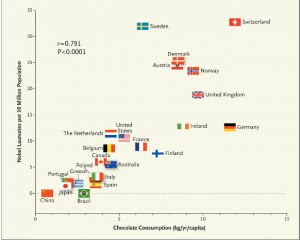
A: The article didn’t look at chocolate consumption by Nobel Prize winners, it looked at chocolate consumption in countries named in the official biographical information about Nobel Prize winners.  This typically includes where they were born and where they worked when they did the prize-winning research, and in some cases yet another country where they currently work.

Q: Does the article admit this?

A: In part.  The author admits that this is just per-capita data, not individual data.  Because he just got the Nobel Prize data from Wikipedia, rather than from the primary source, he doesn’t seem to have noticed that multiple countries per recipient are counted.

Q: Would the New England Journal of Medicine usually accept Wikipedia as a data source when the primary data are easily available?

A: No.

Q: What about the chocolate data?

A: The author doesn’t say whether the chocolate consumption measures weight as consumed (ie, including milk and sugar) or weight of actual chocolate content. That’s especially sloppy since he goes on and on about flavanols. Also, the Nobel Prize data is for 1901-2011 and the chocolate data is mostly just from 2010 or 2011: chocolate consumption in many countries has changed over the past century.

Q: Do you want to say something about correlation and causation now?

A: No, that’s what you say when you don’t know what causes spurious correlations.

Q: So what did cause this correlation?

A: There are at least two likely contributions.  The first is just that wealthy countries tend to have more chocolate consumption and more Nobel Prizes.  Chocolate and research are expensive.  The second is more interesting: it’s the same reason that storks per capita and birth rates are correlated.

Q: Storks bring chocolate as well as babies?

A: Not quite.  Birth rates and storks per capita tend to be correlated because they are both multiples of the reciprocal of population size.   Jerzy Neyman pointed this out in the prehistory of statistics, and Richard Kronmal brought it up again in 1993.  More recently, someone has done the computation with real data (p=0.008). Imperfect standardisation will induce correlation, and since Nobel Prizes almost certainly don’t depend linearly on population, the correction is bound to be imperfect.

Q: Why did the New England Journal publish this article?

A: It wasn’t published as a research article; it was in their ‘Occasional Notes’ series, which the journal describes as “accounts of personal experiences or descriptions of material from outside the usual areas of medical research and analysis.”

Q: Isn’t it good that stuffy medical journals do this sort of thing occasionally? There’s nothing like a good joke

A: Well, you might hope they would do it better, like the BMJ does.  This is nothing like a good joke.


October 4, 2012

Science communication training through blogging

Mind the Science Gap is a blog from the University of Michigan:

Each semester, ten Master of Public Health students from the University of Michigan participate in a course on Communicating Science through Social Media. Each student on the course is required to post weekly articles here as they learn how to translate complex science into something a broad audience can understand and appreciate. And in doing so they are evaluated in the most brutal way possible – by you: the audience they are writing for!

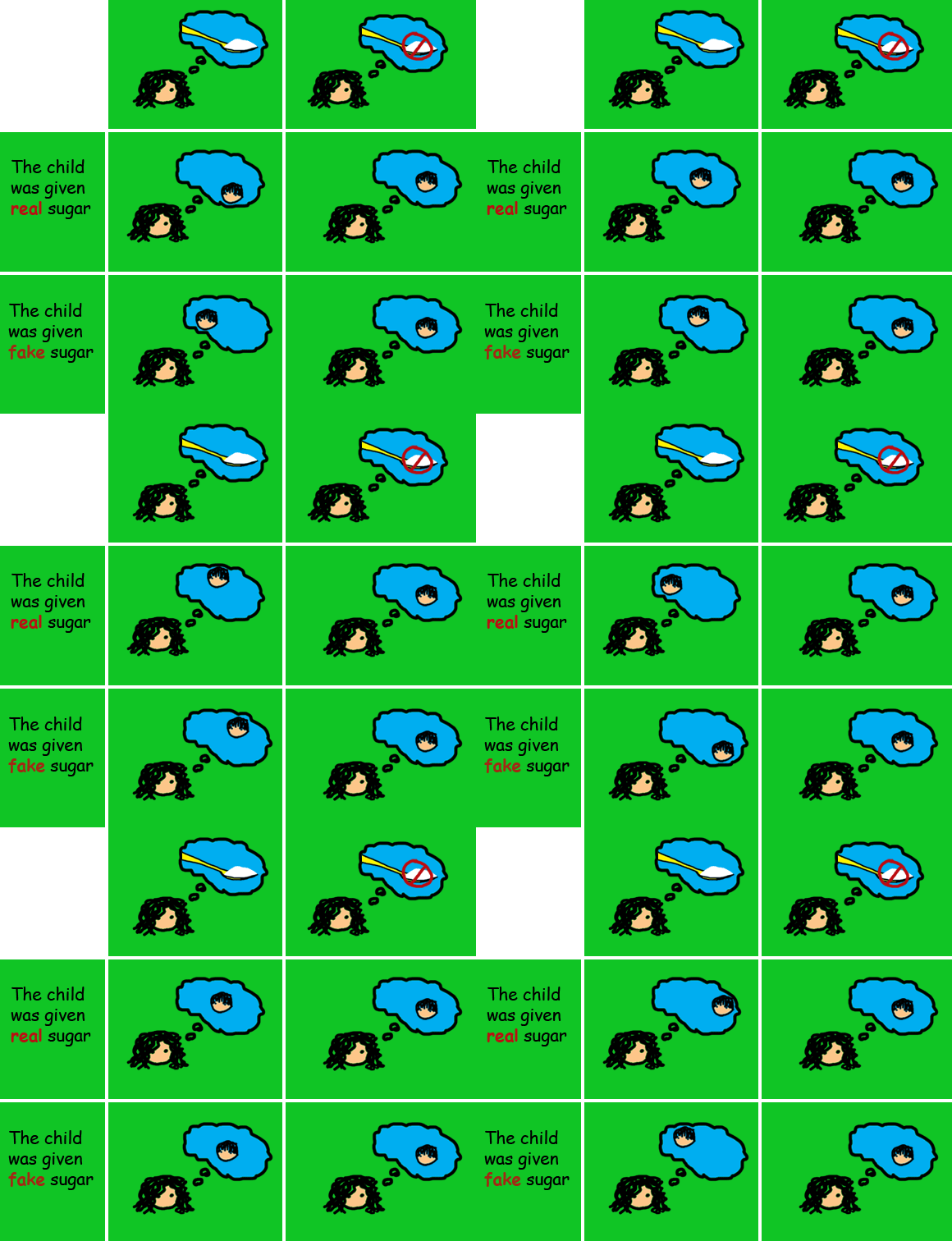
The post that attracted me to the blog was on sugar and hyperactivity in kids, not just for the science, but because someone has actually found a good use for animated GIFs in communicating information: click to see the effect, since embedding it in WordPress seems to kill it.

September 28, 2012

Visualising health findings

The Cochrane Collaboration are holding their annual conference in Auckland starting on Sunday.  They are a decentralised, grassroots effort to collate and summarise all randomised clinical trials, to make sure that the information isn’t buried, but is available to clinicians and patients.  The online Cochrane Library of Systematic Reviews is available free to anyone in New Zealand, thanks to funding from the DHBs and the Ministry of Health.  As with many organisations, they award a variety of prizes in their field of work.  In contrast to many organizations, one of the prizes is awarded for the best criticism of the organization’s work.

Anyway, the conference is an excuse to link to a video by the Cambridge “Understanding Uncertainty” group.  They are working on animations to further improve the summaries of health findings from the Cochrane systematic reviews.

September 23, 2012

Rates and counts

From the Stuff story you could be forgiven for thinking heart disease in women is getting worse

Women have overtaken men in dying from heart disease, and the situation is forecast to get worse…

Ministry of Health figures show 5038 women died of cardiovascular disease in 2009, compared with 4712 men, and are projected to increase as the effects of diabetes and obesity worsen.

 Both those statements are true, but the implication is false.  The only thing you can reasonably talk about in health terms (as opposed to economics) is age-specific death rates.  That is, we want to correct for two trends that are not really ‘health’ changes.  The first is population size.  There are more people in New Zealand now than in the past, so there will be more deaths.  The second is age: your chance and my chance of dying of cardiovascular disease next year is higher than it was last year because we’re a year older.  We want to look at rates (fractions) rather than counts, and compare people of the same age.

Age-specific death rates from heart disease are still falling in New Zealand, as they are essentially everywhere in the Western world, and have been for my entire lifetime. That is, a 70-year old woman is less likely to die of heart disease this year than a 70-year old woman was to die of heart disease in, say, 2001, or 1980.

The improvements have been driven by a range of factors including reductions in smoking, introduction of treatments for high blood pressure and high cholesterol, and better heart-attack care. The  fall has been faster in men, who are now catching up to women.   The fall is showing signs of levelling off now for both men and women, and there are reasonable concerns that the trend might reverse in the not-too-distant future.

Since heart disease is a major cause of death for women, and this isn’t as widely appreciated by the public, an increase in targeted health promotion would probably be a good thing.  But that doesn’t mean we should regret the falls in heart disease deaths among men: a better phrasing would be “Men have caught up to women in dying of heart disease, but the situation, for both sexes, is forecast to stop improving.”

September 21, 2012

Vitamin D study

Good story in the Herald about a randomized trial of Vitamin D supplementation being run in New Zealand. Healthier people tend to have higher vitamin D levels in their blood, but for other vitamins this hasn’t turned out to mean that supplements are helpful.  We don’t know for vitamin D, and we need to find out.

Long-time readers may remember that I’m betting against the vitamin, but I’d be very happy to be proved wrong.

September 14, 2012

Screening isn’t treatment or prevention

The US Preventive Services Taskforce has issued another recommendation against general population cancer screening, this time for ovarian cancer.  Although the USPTF guidelines don’t have regulatory force even in the US, let alone here, they are taken seriously because they are developed by people who, generally speaking, have a clue.

In some ways ovarian cancer is an obvious target for screening: it usually isn’t caught until quite late, and earlier diagnosis could theoretically be helpful in treatment.   The current screening approach in countries where screening is done is fairly sophisticated, using a combination of ultrasound imaging and a blood test for a protein produced by ovarian tumours. Even so, a large randomised trial didn’t show any benefit, and the harm from inevitable false positives was significant, since it takes surgery to follow up suspicious findings from screening.  All that can be done at the moment is to be aware of the symptoms of ovarian cancer and get them checked out. The Listener had a good article last year on the topic.

There are some cancer screening programs that are unquestionably lifesaving, eg, mammograms for breast cancer, smear tests for cervical cancer, colonoscopy for colon cancer, and (although the cost may not be justifiable) CT scans for lung cancer in smokers.  Some others, such as melanoma screening, are plausibly beneficial and unlikely to do much harm. In general, though, population screening of healthy people for uncommon diseases has a high bar to surmount: you have to find people with the disease who are treatable now but wouldn’t be treatable if you just waited.  Even more difficult, you also have to do sufficiently little collateral damage to the people (over 99.9% for ovarian cancer) who don’t currently have the disease.


September 6, 2012

The genomic 99%

Today was the release of phase 2 of the ENCODE project, the effort to catalogue all the stuff in the human genome that isn’t genes.  This is a big deal: nearly all our DNA isn’t genes, and ENCODE is a big step towards figuring out what, if anything, it does. (HeraldStuff have the Associated Press story, New York Times has more, Nature has some good news and comment articles).

Our chromosomes spend nearly all their time curled into little tangles, and some of the ENCODE experiments looked at which bits of the DNA are actually accessible on the outsides of these tangles. Other experiments measured where ‘transcription factors’, which turn genes on and off, attach to DNA. Others looked at which bits of DNA get transcribed into RNA by cells. For complete information, these experiments need to be done for the whole genome, and because the behaviour of DNA is different in every cell type, for many types of cells.  That’s only partially been done, and the project is going to contact indefinitely (or at least as long as they can get money — so far they have spent the equivalent of three full years of the NZ Health Research Council budget, or about 2% of the cost of the Large Hadron Collider).

The headline finding in the news stories is that about three-quarters of the genome can sometimes get copied from the DNA ‘reference’ version to temporary RNA.  We used to think that essentially all RNA copies were from genes, and were made for the purpose of translating the RNA into protein.   Over the years, it has become clear that there’s a lot more varied RNA around than can be explained by making proteins, but ENCODE’s results are much more extreme than expected (by me, at least).  We don’t know what most of the non-gene RNA does, and it’s possible that some of it doesn’t do anything, but some of it must do interesting things that we have no clue about.

ENCODE itself was a great opportunity primarily for US researchers, but the ENCODE results are an opportunity for the whole world, and New Zealand scientists will be looking for ways to take advantage of all this new data.