Posts filed under Medical news (341)

August 16, 2012

Attack of the killer eggyolk

The Herald tells us

Eating eggs yolks is almost as bad for your heart as smoking, new research suggests.

This one is not really the fault of the newspaper: that is what the researchers suggest, though it is not really what the research suggests.

 Researchers analysed lifestyle data from over 1200 men and woman aged about 60 who were attending a vascular prevention clinic in London. 

So we’re looking at patients who had been referred to a special clinic because of suspected atherosclerosis, not a representative sample (and that’s London, Ontario, not the better-known one slightly west of the Olympic stadium).

The researchers asked patients about egg consumption and smoking (but did ask for or didn’t use anything else about diet or exercise).  They found that patients with a lot of atherosclerotic plaque in their carotid arteries tended to be older, more likely to smoke, and more likely to eat eggs.   How much more likely? Well, the ‘almost as bad’ is seriously understating the association they found.  If their results are correct, eating one egg yolk has more than ten times the effect on carotid plaque of smoking one cigarette.  The estimates don’t look that extreme at first glance, because they count consumption in egg yolks per week, and packs of cigarettes per day.

This is the sort of situation where it’s important to look at what is already known.  There is a big US cohort study following up nurses and doctors, which didn’t find any adverse effects of egg consumption.  Short-term experimental studies with controlled diets have had mixed results.  A few other long-term studies have found heart disease effects specifically in diabetics, but only 11% of the people in this study were diabetics.

It’s possible that eggs increase heart disease risk, especially in diabetics, but the results of this study seem too extreme to be explained by a real risk.  Another possibility is that when you ask people about egg consumption, what you get is the number of times per week they consume a good solid traditional breakfast, where eggs are not the only dietary risk factor present.
July 26, 2012

Cancer deaths rates down (slightly)

The Herald has a story that, I think, satisfies all the best-practice guidelines for scientific news.

They are reporting on new Ministry of Health cancer mortality statistics for 2009, and trends up to that year. In particular

  • The source of the information is described well
  • They quote both total deaths and rates per 100,000 population, and explain why the trends are different.
  • They ask experts for comment and context, and give reasonable explanations of what might be causing the trends

A couple of things I would add to the story:  first, the mortality rates per 100,000 population are also age-adjusted, so they take into account the aging population, and second, an important contributing factor to the reduction in the cancer mortality rate over time is the reduction in smoking.  Improvements in diagnosis and treatment also help, but they are not the whole story, especially for lung cancer.

If you want the actual numbers, they are here.

July 21, 2012

Best practice guidelines: a worked example

Stuff has a headlineLiving by the sea is good for your health” (with the page title “Life’s a beach”). The story starts

Sick people have been sent to the seaside for centuries and now a study has proven that living by the coast is good for your health.

Let’s see how it rates against the guidelines

(more…)

July 17, 2012

You’re all individuals

The Herald  is at least showing some scepticism about Italian-style patisserie that is supposed to make you lose weight (they include green tea and guarana, ie, caffeine).  The manufacturer isn’t willing to give any numbers

But she said it was not possible to measure how much eating the treats would help boost the metabolism because ‘everyone is different’.

Of course, this is a pretty transparent excuse.  If the fact that everyone is different made measurements impossible, medical science would be in a bad way.  We can measure the average effect.  We can measure the variability in the effect.  We can measure the proportion of people helped.  And we do all these things.  For example,  we’ve known for years that angiotensin converting enzyme inhibitors reduce blood pressure on average by about 10mmHg.  More recently, some Sydney researchers reanalyzed the data from the randomized trials to look at how much person-to-person variation in effect there was, and found it was extremely small.

The story goes on to say

Registered public health nutritionist Charlotte Stirling-Reed said that consumers should always look for evidence before making purchases based on health claims.

True, but that would spoil all the fun.
July 13, 2012

When randomized trials don’t help

The Herald reports on a study of weight gain after quitting smoking, which is based on analyzing the results of 62 randomized trials of treatments to help quitting.  Ordinarily, data from randomized trials is what we want, so why is Professor Simon Chapman quoted as complaining the results are unreliable?

Well, it’s partly because he doesn’t like anything that might be construed as favorable about smoking, but he has a good point in this case.  Randomized trials give us fair and trustworthy comparisons between two treatments: in this case the 62 trials tell us something about which ways to quit actually lead to the most quitting.   The information on weight gain, on the other hand, isn’t a comparison of two randomized treatments, it’s a before-after comparison on the people who managed to quit.  The fact that the treatments were randomized is of no help at all, since the analysis lumps all quitters together.

In fact, it’s worse than that. A lot of smokers manage to quit with only moderate difficulty.  They tend not to end up in randomized trials.  Some smokers find quitting much harder, and they are much more likely to end up in randomized trials.  So the research actually has found that a group of people who probably found quitting hard have gained 4-5kg after quitting.   It’s quite likely that people who find quitting hard are also going to gain more weight than those who quit without major difficulties, so we may well be overestimating the impact of quitting on weight.


July 5, 2012

Counting deaths from power outages

The last big power blackout in the US, before this week’s one, was in 2003 in New York.  There’s a new paper out that estimates how many deaths it caused, and discussion at Simply Statistics.

At the time, the official report was 6 deaths, mostly due to carbon monoxide poisoning.  However, the number of deaths from all causes was 28% higher than usual, which implies an extra 90 deaths (obviously, with some uncertainty).

We don’t know which of the deaths during that period were caused by the power outage, but these “statistical deaths” were just as much real people as the 6 whose deaths were officially recognised.

The genome is big. Really big.

And to prove it, Yonder Biology is streaming the genome over the course of a year.  As you may remember from earlier posts, there are about 30 million seconds in a year, and 3 billion bases in the genome, so that comes to 100 bases per second for the entire year. (via)

July 4, 2012

Lazy scientific fraud

If you toss a coin 20 times, you will get 10 heads on average.  But if someone claims to have done this experiment 190 times and got exactly 10 heads of out 20 every single time they are either lying or a professional magician.

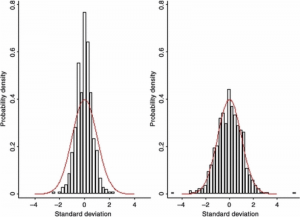
An anaesthesiology researcher, Yoshitaka Fujii, has the new record for number of papers retracted in scientific journals: 172 and counting. The fakery was uncovered by an analysis of the results of all his published randomized trials, showing that they had an unbelievably good agreement between the treatment and control groups, far better than was consistent with random chance.  For example, here’s the graph of differences in average age between treatment and control groups for Fujii’s trials (on the left) and other people’s trials (on the right), with the red curve indicating the minimum possible variation due only to chance.

The problem was pointed out more than ten years ago, in a letter to one of the journals involved, entitled “Reported data on granisetron and postoperative nausea and vomiting by Fujii et al. are incredibly nice!”  Nothing happened.  Perhaps a follow-up letter should have been titled “When we say ‘incredibly nice’, we mean ‘made-up’, and you need to look into it”.

Last year, Toho University, Fujii’s employer, did an investigation that found eight of the trials had not been approved by an ethics committee (because they hadn’t, you know, actually happened). They didn’t comment on whether the results were reliable.

Finally, the journals got together and gave the universities a deadline to come up with evidence that the trials existed, were approved by an ethics committee, and were reported correctly.  Any papers without this evidence would be retracted.

Statistical analysis to reveal fraud is actually fairly uncommon.  It requires lots of data, and lazy or incompetent fraud: if Prof Fujii had made up individual patient data using random number generators and then analysed it, there would have been no evidence of fraud in the results.   It’s more common  to see misconduct revealed by re-use or photoshopping of images, by failure to get ethics committee approvals, or by whistleblowers.  In some cases where the results are potentially very important, the fraud gets revealed by attempts to replicate the work.

June 30, 2012

Drug statistics

As you will have heard, the UN says that Kiwis smoke more pot than anyone else.  The figure quoted, eg, by the Herald is 9.1%-14.6% (they don’t say what the range means).  It’s useful to look at the actual survey data, the NZ Alcohol and Drug Use survey, which is conveniently available online.

The proportion of New Zealanders who used cannabis at least weekly in the past year is about 5.6%, and the proportion who used it more than 1-2 times/week is 3.8%.  For tobacco, the corresponding figure for more than 1-2 times per week is about 20% and for alcohol, 26%.

You can find statistics broken down by age, sex, ethnicity, frequency of use, and indicators of dependency (yes, people do get addicted to cannabis, just like to other drugs).

June 8, 2012

Liquorice even better than beer?

And this time it’s Stuff’s turn.  The headline “Liquorice loaded with health benefits” turns out to be an experiment on diabetic mice using not liquorice but specific chemicals extracted from liquorice root.

The story then admits

 “The amount of amorfrutin molecules in a piece of licorice available for human consumption is far too low to cause the same beneficial effects that were identified in the diabetic mice.”

But wait, there’s more!

Glycyrrhizin is the active agent in liquorice that combats illnesses such as upper respiratory infections, and is said to lessen the symptoms of chronic fatigue syndrome and fibromyalgia.

No actual evidence is adduced to support these claims (and we don’t even learn by whom ‘it is said‘), but it doesn’t really matter since

… the amount of real liquorice found in liquorice sweets is not standardised, making it far more safe and effective to take the recommended quantity of liquorice root or extract as a pill or powder.

so that doesn’t work either.

The take home message: the confectionery form of  liquorice  is loaded with sugar and starch, and some people like the taste.