October 25, 2017

Currie Cup Predictions for the Currie Cup Final

Team Ratings for the Currie Cup Final

The basic method is described on my Department home page.

Here are the team ratings prior to this week’s games, along with the ratings at the start of the season.

Current Rating Rating at Season Start Difference
Cheetahs 4.33 4.33 -0.00
Sharks 4.06 2.15 1.90
Western Province 4.02 3.30 0.70
Lions 3.45 7.41 -4.00
Blue Bulls 0.48 2.32 -1.80
Pumas -8.75 -10.63 1.90
Griquas -10.19 -11.62 1.40
Cheetahs2 -30.14 -30.00 -0.10


Performance So Far

So far there have been 44 matches played, 30 of which were correctly predicted, a success rate of 68.2%.
Here are the predictions for last week’s games.

Game Date Score Prediction Correct
1 Sharks vs. Blue Bulls Oct 21 37 – 27 7.70 TRUE
2 Western Province vs. Lions Oct 21 19 – 5 4.30 TRUE


Predictions for the Currie Cup Final

Here are the predictions for the Currie Cup Final. The prediction is my estimated expected points difference with a positive margin being a win to the home team, and a negative margin a win to the away team.

Game Date Winner Prediction
1 Sharks vs. Western Province Oct 28 Sharks 4.50


Not science yet

Three weeks ago there was a story in the Herald headlined Research reveals that divorce does run in the family (via Antonio Rinaldi on Twitter). The headline, as you’d expect, got the news wrong: the first sentence of the story is

Numerous studies have shown that children of divorced parents are more likely to get divorced when compared to those who grew up with parents who remained married.

The new claim was that divorce ‘runs in the family’ for genetic reasons. The researchers say

“Nearly all the prior literature emphasised that divorce was transmitted across generations psychologically.

“Our results contradict that, suggesting that genetic factors are more important.”

Now, when someone comes up with a finding that contradicts previous research and that they claim even they were surprised by, I’d want pretty good evidence. I’d want to look at what they actually found, and to see some discussion of how much the evidence is specific to adoptive families in a fairly homogeneous society such as Sweden.  In a perfect world, I’d want the story to have some independent input from someone who knows what ‘heritability’ means.  And I’d still worry about publication bias — maybe the academic journal would have published a paper saying ‘no, it’s still just environment’, but I bet the Herald wouldn’t have a story.

How good is the evidence in the story? Well, it has a link to the Daily Mail.

It’s pretty common for British science linkbait that turns up in the NZ papers to just link to the UK media. But here the research paper doesn’t even exist yet. The story says “will be published in an upcoming issue Journal Psychological Science.” Three weeks later, it’s still upcoming — this isn’t the usual problem of the embargo ending the day before a paper actually appears.

I can’t find a preprint or any other source of details, and as far as I can tell, the primary source for this story is a press release from Virginia Commonwealth University.

This isn’t science news.  It’s academic marketing.

October 23, 2017

Questions to ask

There’s a story in a lot of the British media (via Robin Evans on Twitter) about a plan to raise speed limits near highway roadworks. The speed limit is currently 50mph and the proposal is to raise it to 55mph or 60mph.

Obviously this is an significant issue, with potential safety and travel time consequences.  And Highways England did some research. This is the key part of the description in the stories (presumably from a press release that isn’t yet on the Highways England website)

More than 36 participants took part in each trial and were provided with dashcams and watches incorporating heart-rate monitors and GPS trackers to measure their reactions.

The tests took place at 60mph on the M5 between junction 4a (Bromsgrove) to 6 (Worcester) and at 55mph on the M3 in Surrey between junction 3 and 4a.

According to Highways England 60% of participants recorded a decrease in average heart rate in the 60mph trial zone and 56% presented a decrease on the 55mph trial.

That’s a bit light on detail — how many more than 36; does 60% decrease mean 40% increase; are they saying that the 4 percentage point difference between 55 and 60mph is enough to matter or not enough to matter?

More importantly, though, why is a heart rate decrease in drivers even the question?  I’m not saying it can’t be. Maybe there’s some good reason why it’s reliable information about safety, but if there is the journalists didn’t think to ask about it.

A few stories, such as the one in the Mirror, had a little bit more

“Increasing the speed limit to 60mph where appropriate also enables motorists who feel threatened by the close proximity of HGVs in roadworks to free themselves.”

Even so, is this a finding of the research (why motorists felt safer, or even that they felt safer)? Is it a conclusion from the heart rate monitors? Is it from asking the drivers? Is it just a hypothetical explanation pulled out of the air?

If you’re going to make a scientific-sounding measurement the foundation of this story, you need to explain why it answers some real question. And linking to more information would, as usual, be nice.

Stat of the Week Competition: October 21 – 27 2017

Each week, we would like to invite readers of Stats Chat to submit nominations for our Stat of the Week competition and be in with the chance to win an iTunes voucher.

Here’s how it works:

  • Anyone may add a comment on this post to nominate their Stat of the Week candidate before midday Friday October 27 2017.
  • Statistics can be bad, exemplary or fascinating.
  • The statistic must be in the NZ media during the period of October 21 – 27 2017 inclusive.
  • Quote the statistic, when and where it was published and tell us why it should be our Stat of the Week.

Next Monday at midday we’ll announce the winner of this week’s Stat of the Week competition, and start a new one.

(more…)

October 22, 2017

Bogus-poll headlines

The headline:

Kiwis want cannabis legalised – Herald Facebook poll

And in the text

An unscientific poll run on the NZ Herald Facebook page shows that the majority of New Zealanders want to see cannabis legalised.

The poll doesn’t show anything of the sort, because bogus polls can’t show anything of the sort.

According to the story there were about 15,500 ‘yes’ responses. A bogus poll doesn’t tell you anything about people who didn’t participate. Even if we knew these were different people and all New Zealanders, it would still be just under half a percent of, say, enrolled voters.

It was just a few months ago that Nicholas Jones in the Herald reported a real poll, which asked a more detailed set of questions and tried to sample a representative group of people.  That adds information to the debate. Headlines based on bogus polls subtract information.

Briefly

  • “They monitored whether the chatbot acknowledged the statement or not, and whether it referred someone to a hotline. Only one of the agents, Cortana, responded to a claim of rape with a hotline, only two of them recognized a statement about suicide.”  From freedom-to-tinker
  • “China is building the world’s most powerful facial recognition system with the power to identify any one of its 1.3 billion citizens within three seconds.” South China Morning Post
  • “Pornhub announced that it is using machine learning and facial recognition“. They say it’s to improve search, according to Vice, which is more or less why people are worried.
  • From the Herald: “ACC has paid out on 660 claims where (pedestrian) cellphone distraction has been noted as the injury’s cause.”  You, of course, are asking what that comes to as a percentage of car crash costs. Outsourced to @aw_nz on Twitter
October 17, 2017

Mitre 10 Cup Predictions for the Mitre 10 Cup Semi-Finals

Team Ratings for the Mitre 10 Cup Semi-Finals

The basic method is described on my Department home page.

Here are the team ratings prior to this week’s games, along with the ratings at the start of the season.

Current Rating Rating at Season Start Difference
Canterbury 15.56 14.78 0.80
Wellington 11.41 -1.62 13.00
Taranaki 7.81 7.04 0.80
North Harbour 6.27 -1.27 7.50
Tasman 2.69 9.54 -6.90
Counties Manukau 2.02 5.70 -3.70
Otago 1.61 -0.34 2.00
Auckland -0.33 6.11 -6.40
Bay of Plenty -1.50 -3.98 2.50
Waikato -3.17 -0.26 -2.90
Northland -3.19 -12.37 9.20
Manawatu -4.54 -3.59 -1.00
Hawke’s Bay -13.26 -5.85 -7.40
Southland -23.99 -16.50 -7.50


Performance So Far

So far there have been 70 matches played, 48 of which were correctly predicted, a success rate of 68.6%.
Here are the predictions for last week’s games.

Game Date Score Prediction Correct
1 Taranaki vs. Manawatu Oct 11 46 – 25 17.90 TRUE
2 Wellington vs. Northland Oct 12 36 – 18 18.70 TRUE
3 Auckland vs. Canterbury Oct 13 27 – 32 -13.40 TRUE
4 Bay of Plenty vs. Waikato Oct 14 36 – 32 6.00 TRUE
5 Otago vs. Southland Oct 14 43 – 19 30.80 TRUE
6 Counties Manukau vs. Tasman Oct 14 52 – 30 -0.80 FALSE
7 North Harbour vs. Taranaki Oct 15 64 – 33 -3.50 FALSE
8 Hawke’s Bay vs. Manawatu Oct 15 36 – 31 -7.10 FALSE


Predictions for the Mitre 10 Cup Semi-Finals

Here are the predictions for the Mitre 10 Cup Semi-Finals. The prediction is my estimated expected points difference with a positive margin being a win to the home team, and a negative margin a win to the away team.

Game Date Winner Prediction
1 Wellington vs. Northland Oct 20 Wellington 18.60
2 Bay of Plenty vs. Otago Oct 21 Bay of Plenty 0.90
3 Canterbury vs. North Harbour Oct 21 Canterbury 13.30
4 Taranaki vs. Tasman Oct 21 Taranaki 9.10


Currie Cup Predictions for the Currie Cup Finals

Team Ratings for the Currie Cup Final

The basic method is described on my Department home page.

Here are the team ratings prior to this week’s games, along with the ratings at the start of the season.

Note that Cheetahs2 is the Cheetahs team in weeks when the first team is playing in the Pro14.

Current Rating Rating at Season Start Difference
Cheetahs 4.33 4.33 -0.00
Sharks 3.87 2.15 1.70
Lions 3.84 7.41 -3.60
Western Province 3.62 3.30 0.30
Blue Bulls 0.67 2.32 -1.70
Pumas -8.75 -10.63 1.90
Griquas -10.19 -11.62 1.40
Cheetahs2 -30.14 -30.00 -0.10


Performance So Far

So far there have been 42 matches played, 28 of which were correctly predicted, a success rate of 66.7%.
Here are the predictions for last week’s games.

Game Date Score Prediction Correct
1 Blue Bulls vs. Pumas Oct 13 52 – 32 12.80 TRUE
2 Lions vs. Cheetahs Oct 14 44 – 17 2.50 TRUE
3 Sharks vs. Western Province Oct 14 20 – 31 5.90 FALSE


Predictions for the Currie Cup Final

Here are the predictions for the Currie Cup Final. The prediction is my estimated expected points difference with a positive margin being a win to the home team, and a negative margin a win to the away team.

Game Date Winner Prediction
1 Sharks vs. Blue Bulls Oct 21 Sharks 7.70
2 Western Province vs. Lions Oct 21 Western Province 4.30


October 16, 2017

Stat of the Week Competition: October 14 – 20 2017

Each week, we would like to invite readers of Stats Chat to submit nominations for our Stat of the Week competition and be in with the chance to win an iTunes voucher.

Here’s how it works:

  • Anyone may add a comment on this post to nominate their Stat of the Week candidate before midday Friday October 20 2017.
  • Statistics can be bad, exemplary or fascinating.
  • The statistic must be in the NZ media during the period of October 14 – 20 2017 inclusive.
  • Quote the statistic, when and where it was published and tell us why it should be our Stat of the Week.

Next Monday at midday we’ll announce the winner of this week’s Stat of the Week competition, and start a new one.

(more…)

October 13, 2017

Road deaths up

Sam Warburton (the economist, not the rugby player) has been writing about the recent increase in road deaths. Here are the counts (with partial 2017 data)
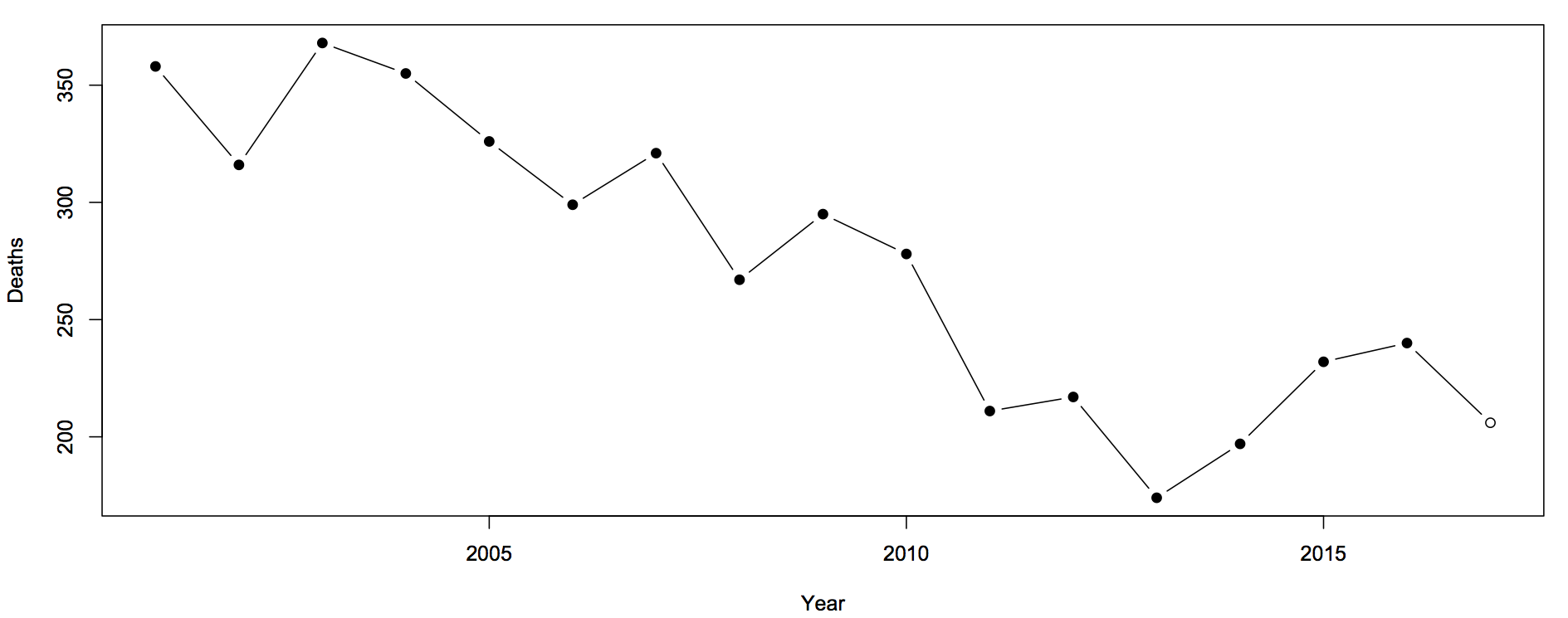
road-1

The first question you should ask is whether this is explained by population increases or by driving increases. That is, we want rates — deaths per unit of distance travelled
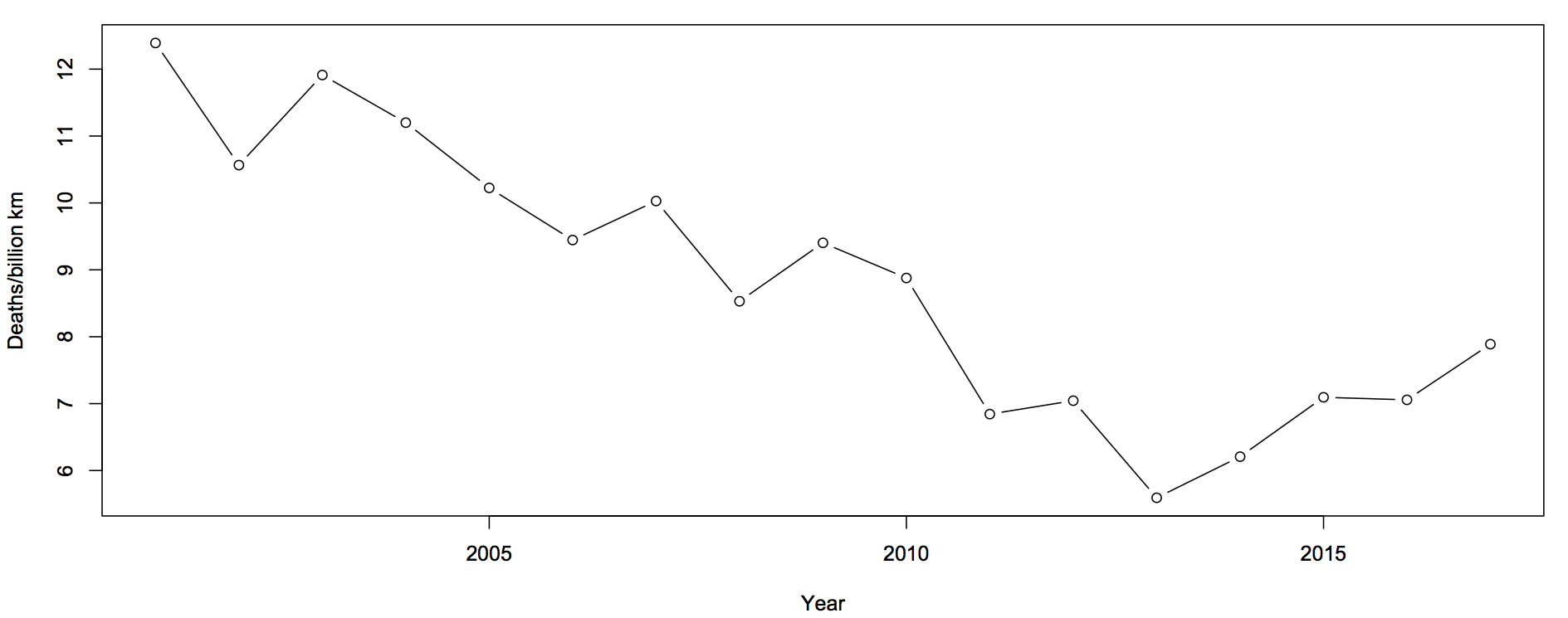
roads-2

There’s still an increase, but now the 2017 partial data are in line with the increase. The increase cannot be explained simply by more cars being on the roads.

The next question is about uncertainty.  Traditionally, news stories about the road toll were based on one month of data and random variation could explain it all. We still need a model for how much random variation to expect.  What I said before was

The simplest mathematical model for counts is the Poisson process.  If dying in a car crash is independent for any two people in NZ, and the chance is small for any person (but not necessarily the same for different people) then number of deaths over any specified time period will follow a Poisson distribution.    The model cannot be exactly right — multiple fatalities would be much rarer if it were — but it is a good approximation, and any more detailed model would lead to more random variation in the road toll than the Poisson process does.

In that case I was arguing that there wasn’t any real evidence of a change, so using an underestimate of the random variation made my case harder. In this case I’m arguing the change is larger than random variation, so I need to make sure I don’t underestimate random variation.

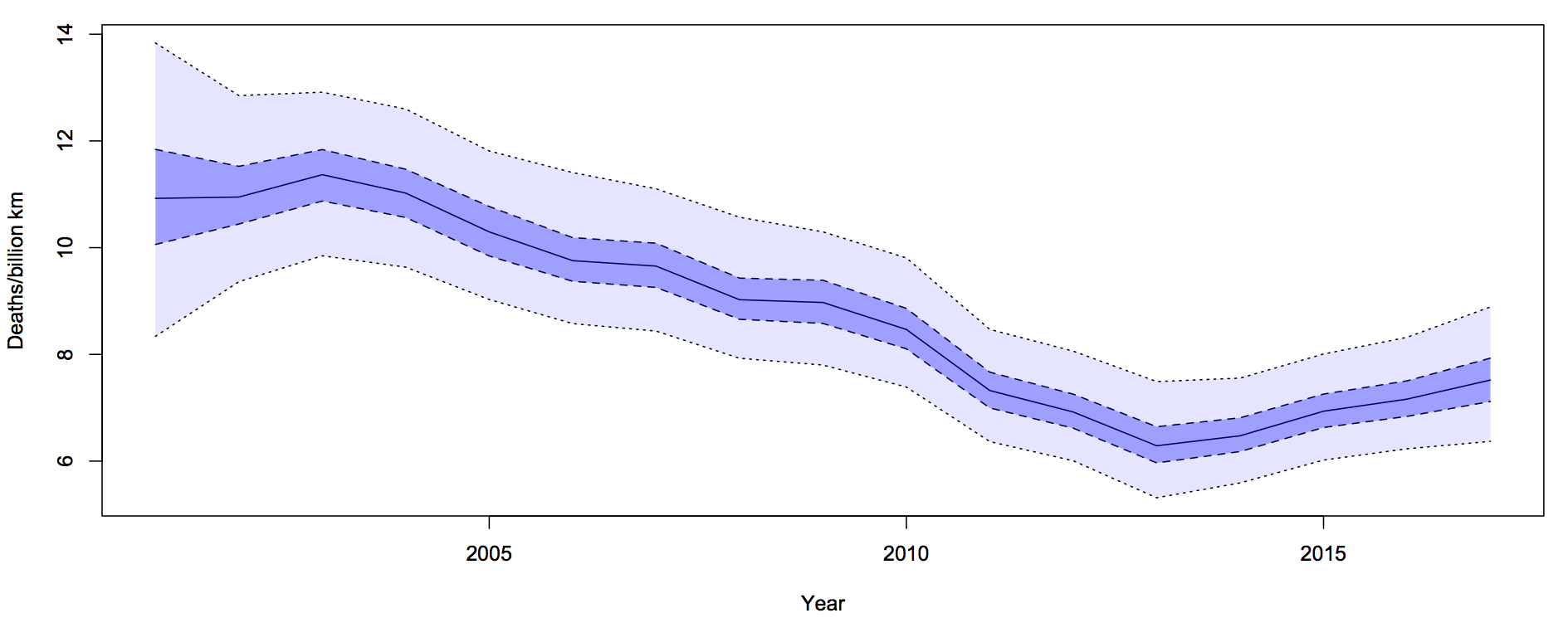
What I did was fit a Bayesian model with two extra random components.  The first was the trend over time. To avoid making assumptions about the shape of the trend I just assumed that the difference between adjacent years was relatively small and random. The second random component was a difference between the trend value for a year and the ‘true’ rate for that year. On top of all of that, there’s Poisson variation.  Since the size of the two additional random components is estimated from the data, they will capture all the variation.
roads-3

For each year, there is a 50% probability that the underlying rate is in the darker blue interval, and a 95% probability it’s in the light blue interval.  The trend is smoother than the data because the data has both the Poisson variation and the extra year-specific deviation. There’s more uncertainty in 2001 because we didn’t use pre-2001 data to tie it down at all, but that won’t affect the later half of the time period much.

It looks from the graph as though there was a minimum in 2013-14 and an increased rate since then.  One of the nice things about these Bayesian models is that you can easily and meaningfully ask for the probability that each year was the minimum. The probability is 54% for 2013 and 27% for 2014: there really was a minimum around then.

The probability that the rate is higher in 2017 than in 2013 is over 90%. This one isn’t just random variation, and it isn’t population increase.


Update: Peter Ellis, who has more experience with NZ official statistics and with Bayesian state-space time series models, gets qualitatively similar results