February 8, 2017

Hans Rosling, 1948-2017

Hans Rosling, the public health physician and inspiring statistics communicator, has died.

Coverage:

His TED talk.

Gapminder, the foundation he co-founded, with the aim of giving people accurate information about health and development around the world.

February 7, 2017

Official statistics and official truth

From a story in the Guardian about the US government and official statistics

In August, the then presidential candidate described the Bureau of Labor Statistics (BLS) unemployment numbers as “phoney”, claiming: “The 5% figure is one of the biggest hoaxes in American modern politics.” In the same speech, Trump suggested alternative data, adding: “The number’s probably 28, 29, as high as 35. In fact, I even heard recently 42%.”

As the story goes on to say, Trump is unlikely to tamper with the estimation of basic economic statistics — they’re too important to government and big business, and it would be a very messy fight.  It’s more likely that lower-level statistics on questions he doesn’t want answered will be lost.   On the other hand, there are a lot of unemployment statistics it’s possible that the government could start advertising a different one.

The number that’s “probably 28, 29, as high as 35. In fact, I even heard recently 42%” exists. It’s reported by the Bureau of Labor Statistics in the same report that gives the 5% number, and estimated from the same basic data.  It’s just that there are a lot of ways to summarise changes and differences in unemployment and the whole world has decided the 5% number is a good one to standardise on.

It’s relatively easy to count the number of people with jobs: either by a survey or by the fact that they (mostly) pay taxes.  What’s harder is to decide who to compare them to.   The simplest choice, dividing by the total population, gives the ’employment:population ratio’.  You still need to decide which total population to use; the standard choice is everyone 16-64 who isn’t in the military, in prison, or in some other sort of institution such as a nursing home.  The employment:population ratio in the US is currently a little under 60% in the US, still down a lot in the Great Recession.  In New Zealand, it’s about 67%.  Subtracting from 100% gives about 40% in the US and about 33% in NZ.

The problem with using the employment:population ratio to measure unemployment is the fact that it counts a lot of people who aren’t even potentially employed. In particular, a lot of the variation between countries and over time in the employment:population ratio comes from women entering the workforce, which isn’t a change in unemployment in the sense that we usually mean.

‘Unemployment’ in the sense we usually care about means that people are trying to get jobs, and can’t. The difficulty here is measuring who is trying to get a job, which has to be done by surveys and has to be approximated with a questionnaire.  The ‘headline’ measure of unemployment is people looking for jobs as a fraction of those who have jobs or are looking — the denominator is called the ‘labour force’.

However, when jobs get hard to find, some people will temporarily stop looking and do something more productive instead.  These aren’t the same as people who currently don’t want a job. So, in addition to the employment:population ratio and the unemployment rate, statistics agencies publish a range of other summaries.  Stats NZ reports ‘underutilised’ people, defined as ‘underemployed’ (wants more work), “unemployed”, “potential available jobseeker” (wants work but not actively looking), and ‘unavailable jobseeker’ (looking, but for a future start, not right now). The US Bureau of Labor Statistics reports ‘marginally attached’ (don’t have a job; were looking recently),  ‘part time for economic reasons’ (basically Stats NZ’s underemployed), and ‘discouraged’ (not looking because they say they don’t think there are jobs).

You can combine these numbers lots of ways, and there are good uses for many of them. But the headline unemployment rate isn’t a hoax, and anyone who wants to understand what it means and how it’s calculated can readily find out.

February 6, 2017

Stat of the Week Competition: February 4 – 10 2017

Each week, we would like to invite readers of Stats Chat to submit nominations for our Stat of the Week competition and be in with the chance to win an iTunes voucher.

Here’s how it works:

  • Anyone may add a comment on this post to nominate their Stat of the Week candidate before midday Friday February 10 2017.
  • Statistics can be bad, exemplary or fascinating.
  • The statistic must be in the NZ media during the period of February 4 – 10 2017 inclusive.
  • Quote the statistic, when and where it was published and tell us why it should be our Stat of the Week.

Next Monday at midday we’ll announce the winner of this week’s Stat of the Week competition, and start a new one.

(more…)

February 4, 2017

Tracing a science story

The Herald has a headline Two or more children? You’re at risk of heart disease. The story does have a link, but it’s to the Daily Mail, which (unsurprisingly) has no further information about sources.

Searching for key words (“china heart disease risk number of children“) leads to a story at Science DailyIt also doesn’t link or specify enough information to find the research. However, it does indicate that the origin is some sort of commentary from someone at the European Society of Cardiology, involved with their guidelines on “Management of CVD During Pregnancy.”

Searching for ‘“management of CVD During Pregnancy” esc‘ finds both the ESC press release and the EurekAlert version.  The EurekAlert one has had the reference trimmed off, but it’s in the original.  So now I can search on the title of the research paper or, more reliably in theory, on the DOI permanent identifier.  These lead to an error page at Oxford University Press saying

Sorry, the International Journal of Epidemiology content that you are trying to access has moved. Please search for the content using the DOI, Author or Title.

That advice does not get me any further. Neither does going in via the PubMed database. Looking further at the journal website, the paper is not in the ‘coming soon’ list, nor in any recent issue of the journal.

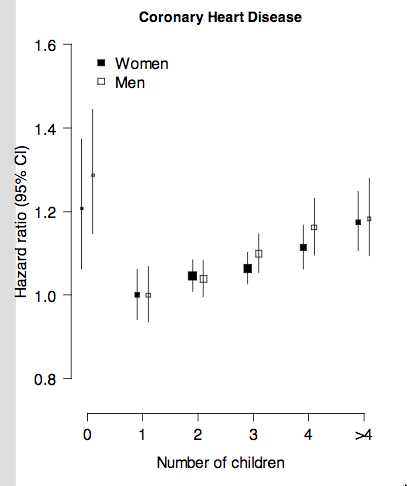
I have no idea what’s happened to the paper, but the Google does reveal a presentation about the research (PDF). I’m going to show you a graph from page 8.

kids-heart

They’re estimating a lower risk for people with children than those without. Among those with kids, the risk was higher with more, but by less than 5% per extra child.

As the researchers say, this probably isn’t biochemical, it’s probably socioeconomic. In which case, a cohort from China during both their economic boom and the One Child policy might not generalise all that well to New Zealand.  And while I wouldn’t expect a busy journalist to go to the lengths I did to find a source, they should at least notice they don’t have one.

February 2, 2017

Defining on-time arrival

Bernard Orsman, in the Herald, has written about Auckland bus punctuality, this time with data from Auckland Transport broken down by bus route.  The numbers look good overall, with, apparently, 96.36% of buses on time in January. If you caught a bus in January, you might find this surprising. The problem is that defining and then measuring the percentage of on-time buses is harder than it sounds.

The Auckland Transport number is the percentage of buses that depart their first stop within 5 minutes of schedule. That’s probably a good number for measuring whether the bus companies are delivering the service they’re being paid for. It’s not a good description of the lived experience of passengers.

At the other extreme, you could argue for a measurement averaged over all bus stops. That punctuality number would inevitably be lower, because of variation in traffic and traffic lights from trip to trip.  This isn’t the ideal measure in many ways, because the way to optimise it would be to have lots of slack in the bus timetable and force the bus to wait at every stop. But people do care about it. I bet Aaron Schiff that 80% of buses were within 5 minutes of schedule averaged over all stops and all trips using the bus GPS data. I’ve conceded: I think the true figure is probably more like 70%.

Another approach would be to  look at on-time performance at the timepoints on the official timetable for the route. For example, the 324, singled out in the Herald story, has Mangere Town Centre, Ōtāhuhu station, Ōtāhuhu Town Centre, and Seaside Park.  If you wanted an official benchmark statistic, that would be a reasonable choice. You’d expect to get a higher number than the all-trips/all-stops figure, but lower than the first-stop-only figure.

There are other possibilities, though. For a frequent service what matters isn’t the timetable but the waiting time between buses. You’d prefer to have all the buses 10 minutes late rather than alternate ones 10 minutes late and on time. “Maintenance of Headway” is the the technical term (and the title of a humorous novel about bus timetables. No, I’m not making this up).

Also, there can be more important things than adherence to a schedule.  On a rainy Friday evening the punctuality is going to be pretty bad, but your ability to get from point A to point B by bus is going to be better than on a typical Sunday morning.

The right choice of summary depends on what you’re trying to do: contractual audit, benchmarking for trends or against similar cities, describing what it typically feels like to passengers, or detecting that the system is having a bad time right now.  Personally, I’m most interested in the last of these: describing how performance varies over time with weather, school holidays, and other challenges, and how it varies over Auckland.

Whatever your aim, it’s important to have realistic expectations based on what summary you’re using: 90% punctuality would likely be unattainable taken over all stops, but it’s a bit average for just the first stop.

Eat more kale?

From the Mail, via the Herald

Eating nuts, kale and avocado could help protect women from suffering a miscarriage, new research suggests.

Being deficient in vitamin E starves an embryo of vital energy and nutrients it needs to grow, scientists have found.

There’s a sense in which this is true. But only a weak one.  Here’s the first sentence of the research paper (via Mark Hanna)

Vitamin E (α-tocopherol, VitE) was discovered in 1922 because it prevented embryonic mortality in rats, but the involved mechanisms remain unknown 

That is, it’s been known since vitamin E was discovered 95 years ago that severe deficiency causes miscarriage in rats. In fact, the chemical name ‘tocopherol’ comes from Greek words meaning, basically, “to carry a pregnancy.” This isn’t new.  The new research was a study of severe deficiency in little tropical fish, so it wouldn’t be an improvement over rats from the point of view of a public health message.  And the research paper doesn’t try to say anything about avocados and kale for preventing miscarriage; it’s about clarifying what goes wrong with the embryos at a biochemical level.

The dietary-advice question would be whether it’s common for women to have low enough levels of vitamin E to increase miscarriage risk, and if so whether nuts, kale, and avocado would help or whether supplements make sense as they do with folate and perhaps iodine.  Somewhat surprisingly, the first published research on this question seems to be from 2014 (story, paper).  In a study in rural Bangladesh, where nearly 75% of women had vitamin E deficiency, those with low vitamin E were twice as likely to miscarry.  I don’t have data for New Zealand, but in the US less than 1% of people have vitamin E deficiency of that severity.  It doesn’t look to be a big problem. And, from the authors of the 2014 study:

Schulze says that the study may not be generalizable to higher-income nations where women of childbearing age tend to have better nutritional status.

It’s possible that slight deficiency increases miscarriage risk slightly, but there isn’t any direct evidence. And the new research doesn’t even try to address this issue.

Finally, if someone wanted to get more vitamin E, would the recommendations help? Well, according to this site, it would take 14 cups of kale a day to get up to the recommended daily intake. And we know there are problems with avocado in younger adults. So perhaps try the nuts instead.

CensusAt School kicks off next Tuesday

As many of you may already know, the Department of Statistics runs the magnificent, biennial CensusAtSchool TataurangaKiTeKura, a national statistics literacy programme in schools supported by the Ministry of Education and Statistics New Zealand. Students aged 9 to 18 (Year 5 to Year 13) use digital devices to answer 35 online questions in English or te reo Māori about their lives and opinions. The aim is to turn them into data detectives – and turn them on to the value of statistics in everyday life.

Pakuranga College visit by Minister of Statistics and local MP Maurice Williamson, to see Census At School 2013 in action with teacher Priscilla Allan's Year 9 digital maths class, along with co-directors of the programme from The University of Auckland, on Monday 6 May 2013, Auckland, New Zealand.  Photo: Stephen Barker/Barker Photography. ©The University of Auckland.

Photo: Stephen Barker.  © The University of Auckland.

The latest edition of CAS starts next Tuesday, February 7, after the Waitangi Day holiday, and we’re hoping to get more than 50,000 Kiwi students taking part, which would be a record since CAS started in Aotearoa in 2003. Registrations have been open for a few weeks and are piling in, and I can see that so far we have 780 teachers from 507 Māori-language and English-medium schools registered – and there’s also a school from the Cook Islands, Tereora College. Check out if your local school is involved here.

CAS started as a pilot programme here, in 1990, run by Sharleen Forbes. As an international educational project, it started in the UK in 2000, and now runs in the UK, New Zealand, Ireland, Australia, Canada, South Africa, Japan, and the US. Good ole NZ, still punching above its weight in stats education.

There are questions common to all the censuses so comparisons can be made, but there are locally-specific questions as well – you can see the list of questions here. This year, we’re asking students about topics such as whether they get pocket money, and how much; whether there is there a limit on their screen time after school; and if anything in their lunchbox that day had been grown at home. In each census, students also carry out practical activities such as weighing the laptops and tablets they take to school and measuring each other’s heights, as in the picture of these Pakuranga College students. From mid-June, the data will be released for teachers to use in the classroom.

As this census is the only national picture of how kids are feeling, what they’re thinking and what they’re doing, journalists love the stories that flow from the results. The publicity isn’t only fascinating – it helps raise awareness of the value of statistics to everyday life. With any luck, some of the kids who do this year’s census will end up being our statisticians of tomorrow.

February 1, 2017

Safe, but not effective

Pharmaceutical giant Eli Lilly has basically given up on its candidate Alzheimer’s treatment, solanezumab (they’re still trying for one special genetically-driven subtype).

In a Herald story in 2015, the lead was

The first drug that slows down Alzheimer’s disease could be available within three years after trials showed it prevented mental decline by a third.

That was clearly overstating the case. Previous trials has failed to find the benefits they were looking for; this report was based on hints of benefit in a new trial earlier in the disease — a reasonable hope, but nothing like good evidence.

Last year, the company changed the ‘primary endpoint’ of the trial — the definition of what they were hoping to find. That’s usually not a good sign. And it wasn’t.  The company now says

there was no scientific basis to believe they would find a “meaningful benefit to patients with prodomal Alzheimer’s disease.”

Alzheimer’s is an especially difficult condition to research, in part because scientists don’t have a good handle on exactly what’s going wrong. Solanezumab binds to the amyloid protein that causes plaques, enabling it to be removed. That makes a lot of sense as an approach — it wasn’t successful this time. Finding that out was very time-consuming and expensive, because the only way is to run large, long-term randomised trials in people with early-stage disease.

For some drugs and some conditions, you can find out about effectiveness easily: we know Sudafed works for nasal congestion, because it’s obvious. We knew penicillin worked in septicaemia and pneumococcal pneumonia , because of all the people who didn’t die. It took a lot more effort to learn than penicillin works for preventing rheumatic fever. And studies in chronic, slow-moving diseases are far harder than that.

Solanezumab is safe, unlike some previous drugs with similar mechanisms.  It’s an example of a treatment for a serious disease that would have been available years ago if it weren’t for FDA regulation. Millions of people with early dementia could have bought it and used it. It still wouldn’t work.


Briefly

  • Maps as a research communication tool: a research project into the relationship between rateable value and sales value for homes in Milwaukee, and who ends up overpaying their rates.
  • What happens when you make a major change to the definition of an important official statistic.
  • One of the minor aspects of Donald Trump’s awful executive order is collection and reporting of crimes committed by immigrants. Whether this was a mistake for him depends on how good people are at denominators: immigrants commit less crime on average than people born in the US, and there are fewer immigrants than people think there are, so the number will be smaller than people should expect. But that takes maths. Or in the US, math.
January 30, 2017

Stat of the Week Competition: January 28 – February 3 2017

Each week, we would like to invite readers of Stats Chat to submit nominations for our Stat of the Week competition and be in with the chance to win an iTunes voucher.

Here’s how it works:

  • Anyone may add a comment on this post to nominate their Stat of the Week candidate before midday Friday February 3 2017.
  • Statistics can be bad, exemplary or fascinating.
  • The statistic must be in the NZ media during the period of January 28 – February 3 2017 inclusive.
  • Quote the statistic, when and where it was published and tell us why it should be our Stat of the Week.

Next Monday at midday we’ll announce the winner of this week’s Stat of the Week competition, and start a new one.

(more…)