Posts filed under General (3152)

December 20, 2016

Precision medicine?

  • Nicky Pellegrino, at Noted, “Genetic testing now offers personalised medicine, but just who should be tested?”
  • Nathaniel Comfort, in The Atlantic, “The Overhyping of Precision Medicine”
  • And again at Aeon, “Why the hype around medical genetics is a public enemy”

Lead and hope

The Flint water crisis is winding down: the city has been back on Detroit water for over a year, and in early December this year tests showed that nearly all the water supply was back within Federal standards for lead.  Criminal charges have been filed against some officials for their roles in creating or covering up the problems.

Flint residents were exposed to levels of lead in their drinking water that were well above the Federal safety threshold, and this translated, predictably, into higher levels of blood lead in children (and presumably in adults, too).  The proportion of kids under 5 with ‘elevated blood lead’, (>5μg/dL) increased from about 2% (close to the national average)  before the water crisis to about 4%.  Obviously, a national average of 2% means there are other places affected, but Flint was distinctive because the water-supply change was simple and deliberate.

On the other hand, lead is still one of the great victories over pollution. In the 2011-12 round of the US health survey NHANES, 95% of children had blood lead levels below 2.9 μg/dL.  In the 1976-1980 round(PDF), nearly 90% of  children had blood levels above 10 μg/dL, and 10% had levels above 30 μg/dL.  Abolishing lead in petrol has been a huge success and other restrictions have helped.  This year we’ve also seen signs that restricting CFCs has worked: the ozone hole may be slowly starting to heal.  Restricting CFCs was harder, and the improvement is slower, but we’re making progress.  It can work.


December 19, 2016

Sauna and dementia

Q: Did you see that saunas prevent dementia?

A: Well, even the Herald headline only says “could cut risk

Q: You don’t sound convinced.

A: No.

Q: Is this mice again?

A: No, I don’t think there are good animal models for saunas.

Q: Would it be inappropriate to attempt some sort of double entendre here?

A: Yes. The Finns would be offended.

Q: Ok. Back to business. You’re going to tell me that the research paper doesn’t make these claims and it’s all the fault of the British media, right?

A: No, the research paper has as one of its Key Points “Sauna bathing, an activity that promotes relaxation and well-being, may be a recommendable intervention to prevent or delay the development of memory diseases in healthy adults.”

Q: That’s pretty positive.

A: And the university press release is titled “Frequent sauna bathing protects men against dementia

Q: Is this one of those things that’s statistically significant but too small to care about?

A: No, they’re claiming a 2/3 reduction in dementia risk.

Q: Wow. That’s…umm…?

A: Larger than one would reasonably expect?

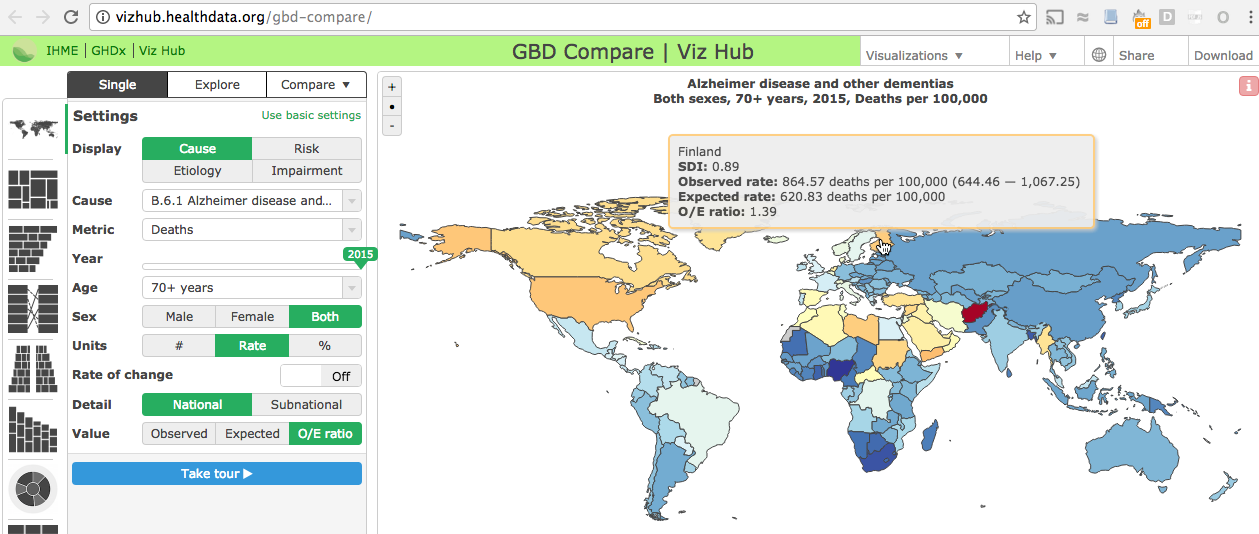
Q: Very diplomatically put.  Wait, so if that was true, you’d be able to see it in the national figures. Does Finland have a much lower dementia rate than you’d otherwise expect?

A: An excellent question.  No.

Q: [citation needed]

A: Well, ok, diagnosis bias makes it tricky, but the Institute for Health Metrics and Evaluation is making serious attempts to do international comparisons on all sorts of disease, and they think Finland has higher rates than expected, in contrast to the rest of Scandinaviasauna-alz
Q: So sauna isn’t protective?

A: Well, it’s not hugely, implausibly protective unless there’s some other Finland-specific risk factor that cancels it out


December 18, 2016

Magic Water?

Update: new reporting at the Herald, who got the stuff tested. It contains quite a lot of bleach (hypochlorite/hypochlorous acid). And it’s expensive.  When I wrote this, based on the Stuff article, I was willing to assume the assertions quoted in the article about the trial conduct and standards of research were true in the absence of evidence to the contrary. Not so much now.  Good work by the Herald. 


(more…)

Incriminating Claus-marks on her back

I was reminded by One News last night that I’d missed the annual ritual of the ACC Christmas Sermon.

ACC is supposed to be in the business of paying for accidents  and would prefer there to be fewer to pay for.  Every year, they issue warnings about Christmas risks, quoting large numbers of accidents and consequent medical costs. Often, the resulting stories omit the inconvenient fact that there are many fewer accidents over Christmas than at other times.  What actually happens at Christmas is a relatively small number of serious injuries, but often (as in the song) of distinctive  types, and often fairly easily preventable.

This year, the Manawatu Standard talks about specific Christmas risks, and mostly quotes numbers for those risks. They also quote local medics, who talk about types of risk rather than imply a high absolute level.

The Stuff Life & Style story fails at numbers. It leads with the total medical costs and number of injuries, not compared to a typical day and so giving a misleading impression.  It also has the regional-total comparisons that are a thing of the past for serious topics

Auckland had the highest rate of accidents anywhere in the country with 2866 claims over the three days, Christchurch had 945, Tauranga 469, Hamilton 451 and Wellington 399.

Auckland, of course, has more people — even at this time of year. Accounting for population, that’s a notably high rate for  Hamilton and Tauranga and a notably low rate for Wellington. Maybe Tauranga’s effective population is up because of tourists?

One News has a cost total, but $200,000,  singling out specifically Christmas-attributable injuries. In some ways that’s a problem in the other direction, since it misses out a lot of the ‘ordinary household tasks while stressed, tired, and/or drunk’ component. But they do give some good examples and advice.

December 17, 2016

Genetic determinism: beer edition

From the Sun, via the Herald “A brewery is promising the best beer of your life thanks to a personalised test using your DNA.”

The main detail mentioned (or alluded to) is testing for sensitivity to bitter tastes, where there’s a common single genetic variant with a big effect.  Sensitivity to bitter tastes has some relationship to whether you like bitter tastes or not, and that presumably has some effect on what sort of beer you like. If you had to make beer recommendations for someone using only a saliva sample, you’d probably do better than chance if you used the genetic information.

But, actually, if you want to know whether someone likes a particular flavour of beer it’s a lot easier and more reliable to give them a taste and see what they say. After all, many of us find our tastes in beer change over time, although our genome stays just the same.  And it sounds as though that’s really what is going on, with “customers are invited in for a one-to-one session with Meantime Brewery’s MasterBrewer, who will work to create the tastiest brew around.”

The first person to get a uniquely personalised genetic beer was the brewer himself:

And his pale ale has been a hit.

Following the successful test brew, his recipe will soon be available as a seasonal brew from The Meantime Tasting Rooms in Greenwich.

Where he’s not expecting anyone else to appreciate it?

December 15, 2016

Beginning to look a lot like Christmas

In particular, the BMJ Christmas Edition is out, with genuine but not completely serious research papers.

Two to highlight this year:

First, a study of Pokémon GO and young adult physical activity: the news is bad.

Results 560 (47.4%) of the survey participants reported playing Pokémon GO and walked on average 4256 steps (SD 2697) each day in the four weeks before installation of the game. The difference in difference analysis showed that the daily average steps for Pokémon GO players during the first week of installation increased by 955 additional steps (95% confidence interval 697 to 1213), and then this increase gradually attenuated over the subsequent five weeks. By the sixth week after installation, the number of daily steps had gone back to pre-installation levels. No significant effect modification of Pokémon GO was found by sex, age, race group, bodyweight status, urbanity, or walkability of the area of residence.

Second, and especially relevant to a country where Christmas occurs in early summer, a modern genetic study

Conclusion A large proportion of people have asparagus anosmia. Genetic variation near multiple olfactory receptor genes is associated with the ability of an individual to smell the metabolites of asparagus in urine. Future replication studies are necessary before considering targeted therapies to help anosmic people discover what they are missing.

Future criminals revealed?

I was going to write about the Herald’s headlineFuture criminals revealed at 3, says study“, but Toby Manhire has a good interview with someone from the study, explaining that no, it doesn’t.

Richie Poulton: No. It’s a headline that doesn’t reflect what’s in the paper accurately. There were unfortunate headlines.

What then are the major findings of this study?

The idea, which is intuitively appealing, is that there is a small group that account for a lot of service use…

December 12, 2016

Why no chicken enquiry?

There’s an inquiry into the water contamination in Havelock North. However,  Otago’s Michael Baker points out there are about that many cases of disease caused by Campylobacter in chicken every two months. He asks “So why aren’t we having a national enquiry about that problem?”

Prof Baker was presumably intending this as a rhetorical question, but thinking of it as a serious question is a good illustration of risk perception.  It’s pretty clear that we do (as a society) care more about Havelock North’s water supply than about chicken contamination. Why?

  • Control.  Most people would think (largely correctly, not that it matters for the perception) that they could protect themselves from Campylobacter in chicken by taking reasonable care in preparing it. There aren’t any simple, everyday measures to protect yourself from your water supply.
  • Purity. We’re trained to think of raw chicken as dirty, but to think of NZ aquifer water as clean and uncontaminated — to the extent that people aren’t willing to even consider chlorination of some of these water supplies.  The Havelock North incident was a desecration.
  • Salience (reporting): The Havelock North cases happened all in one place, over about the ideal length of time for a news story — long enough for reporters to get there and interview people, and have news every day, but not long enough for it to get boring. It was all over the news. The media don’t report the sporadic cases. Stuff has a story today about Consumer NZ testing raw chicken, but the last reports I could find there of individual cases were smaller outbreaks due to raw milk contamination in 2014 and liver contamination in 2012. The most recent individually-described case report I could find from food that wasn’t a specific contamination incident was in 2009.
  • Salience (topic): Water pollution is becoming an increasingly important environmental issue in New Zealand, and even though nitrate and phosphate in streams is a different problem from Campylobacter in tap water, they feel connected through intensive agriculture (the inquiry should tell us something about this, not that it matters for the perception).

A more difficult question is whether the higher concern about Havelock North is evidence that we’re not thinking about this right, or evidence that comparing the case numbers isn’t the right way to think about it.

December 9, 2016

Briefly

  • Has serious crime in the UK increased sharply? Some UK papers think so; David Spiegelhalter is less convinced.
  • The Guardian explains the five most common dreams. In addition to the unconvincing explanations, there’s a problem with the most common dream type “Being attacked or pursued”, which they say has been experienced by 83% of people, but only 77% of men and 78% of women.
  • New Zealand has launched its component of the “Choosing Wisely” medical campaign, trying to get patients as well as health professionals asking whether tests or treatments are actually useful.
  • According to Pew Research, the majority of US people aren’t actually confused by all the poorly-substantiated and divergent diet news they see.  I think Pew are being too optimistic here: what their data say is that people don’t think they are confused by it, just as they don’t think they are influenced much by advertising.
  • A long story with good use of maps and visualisation, about Houston’s flooding problem. From Pro Publica.
  • Why the amazing new cancer immunotherapies might not fix everything: the immune system is terrifyingly powerful and we’re starting to get close to where it gets dangerous. (New York Times)
  • Visualisations of bird songs, by Google and the Cornell Ornithology Lab (via Susan Holmes)
  • The basic skill of mathematical modelling, in any applied field, is to decide what you don’t need to include in the model — “assume a spherical cow of uniform density”.  But sometimes, as in this simple chemistry example, you may need to include EVERYTHING.
  • Sometimes, on the other hand, it’s easy to see the important features: