Posts filed under General (3160)

January 19, 2012

This is your media on “drugs”

You may believe, Gentle Reader, that this blog is entirely negative towards stories about drugs.  That’s because the relationship between numbers and conclusions is often seriously overstated, if not completely made up.    An illustrative example is today’s story in the Herald.  Apart from the statistics, this is a reasonable story.  It has information based on actual measurements, and comments from two people who know what they are talking about, one of whom is independent of the data source. Unfortunately, the story is let down by the statistics.

Police and ESR actually grew some cannabis from high-quality seized material, and measured the THC concentration, comparing the results to when they did the same exercise in 1996.  This is potentially a fair comparison, although the sample size is small.  Unfortunately, they reported the mean (6%) from 1996 and the range (4.35%-25.3%) from the recent study, so the conclusion in the headline “Dope quadruples in THC strength” is not actually supported by the article. The growing study wasn’t even that recent — it ran from 2004 to 2006 — making the support for the headline even more dubious.   It’s not that the headline is intrinsically improbable, if growing has largely moved indoors and changed to modern strains, but we aren’t given any evidence.

The comment by Detective Sergeant Miller that “We are not seeing poor quality cannabis. It’s all good quality” is interesting.  In the US, according to Stanford expert Keith Humphreys, that isn’t the case: there is a lot of cheap, low-grade cannabis, and a smaller amount of boutique high-grade stuff.

Robin Ross Bell, from the Drug Foundation, makes the important point that we don’t actually know if higher concentrations of THC are more dangerous  — people may just use less when it’s strong.  This is especially true since smoking gives immediate feedback on dose, and we do know that tobacco smokers get about the same nicotine dose from varying nicotine concentrations in cigarettes.  It’s encouraging that there is actual research being done on this topic.

[Updated: Sorry about the name error].
January 18, 2012

Journalism warning labels

Tom Scott has warning labels for newspaper articles (via Luis Apiolaza)

January 16, 2012

Dragon Baby Boom?

Local media have been discussing the Chinese year of the dragon which starts on January 23rd and comes around every twelve years:

“Many Chinese consider the Year of the Dragon to be the most auspicious year to have a child. Those born under the sign of the dragon – the fifth, and the mightiest of the 12 Chinese zodiac signs – are said to be outstanding, driven, independent and destined for success.

[Feng shui practitioner] Mrs Chan said there would definitely be a spike in the number of Chinese mothers in New Zealand giving birth, but did not believe the numbers were large enough to affect hospitals or the health system.”

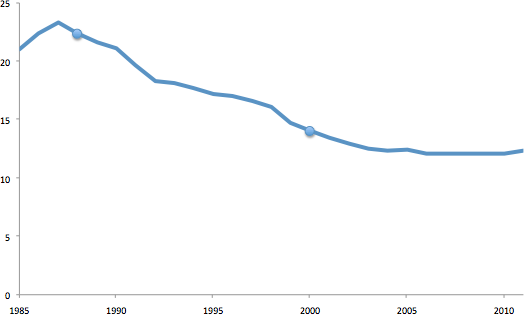
Out of curiosity, I had a look at the birth rate statistics (births per 1,000 population) for China:

The two dots indicate the year of the Dragon – no a year of the dragon spike at all.

I couldn’t get detailed enough statistics on birth rates for women of Asian descent in New Zealand – they were grouped together over a period of years.

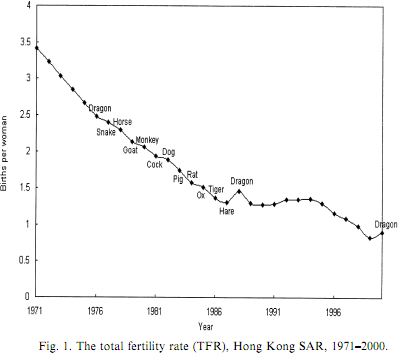
However, researchers have found a (small) year of the Dragon effect on birth rates in other Asian countries – their paper on the subject and its history is fascinating.

Here’s an example in Hong Kong:

They conclude:

“birth rate rise in the Dragon Year is due to changes in timing of births that will have little effect on cumulative fertility.”

I would have liked to have seen some numbers about the “spikes” mentioned in the news stories to give context to how big this effect is (or isn’t).

January 14, 2012

Truth vigilantes?

The New York Times public editor (a position previously called ‘ombudsman’) has asked whether the paper should be a `truth vigilante’

I’m looking for reader input on whether and when New York Times news reporters should challenge “facts” that are asserted by newsmakers they write about.

I don’t know whether it’s encouraging that they are considering this, or discouraging that they need to.


January 8, 2012

Where do the numbers come from?

“What someone doesn’t want you to publish is journalism; all else is publicity.” Paul Fussell

Duncan Hedderley, in a comment on the ‘Overgeneralising again’ post, suggested that the problem with those articles was really advertising masquerading as research, rather than imprecise statistical reporting.

In fact, most of the stories we comment on are like that. It can be interesting to see if you can find any statistics in the typical news broadcast or newspaper that aren’t just publicity or commentary.  That is, the story contains a number which is an estimate or summary for a well-defined population, and either

  • if the story is based on a press release, at least one of the numbers does not come from the press release or from interviewing the people who produced the press release; or,
  • the story contains an informed comment on the number, where the comment comes from someone independent of the source of the number.
January 5, 2012

Polling terminology

We’ve commented before on the annoying tendency of newspapers to claim that self-selected website polls actually mean something.  The media usually refers to the results as coming from “an unscientific poll”, but a better term would be “a bogus poll”.  In the interests of openness, democracy, and giving you something to do over summer, we are conducting a bogus poll ourselves, to find out which terminology is better.


December 23, 2011

Are rock stars more likely to die at 27?

After British singer Amy Winehouse died in July aged 27, out popped various lists of those music stars who had died at the same age, among them Jim Morrison, Jimi Hendrix and Kurt Cobain.

An enterprising Aussie stat-man has now looked at the numbers and has found that rock stars are three times more likely to die in their 20s and 30s than everyone else – but age 27 is not particularly doom-laden.

The full story is originally from the Telegraph, and was reprinted in today’s New Zealand Herald.


All I want for Christmas …

… is for the media to stop making hackneyed stories out of self-selecting and meaningless ‘polls’ hawked by companies seeking free profile.  Yes, vast expanses of white space between the ads need to be filled, but really … This is in today’s Herald:

Auckland most hostile city – by a country mile

It’s the city many past the Bombay Hills love to hate and now Auckland has topped a poll to find the least friendly places in New Zealand. The city led the online poll by Yahoo NZ Travel with 50 per cent of the 4231 votes.

Thankfully Mayor Brown pointed out (and the paper reported) that  a “scientific survey” found the opposite.

The full story is here.


December 22, 2011

Stats Chat on Media7 tonight

This week we’ve been talking with Sam Mulgrew, a statistical reporter for Media7, about some of the statistics in the media highlights from this year.

If you’re interested, tune in to see what’s covered tonight at 9:05pm on TVNZ7 or watch it when it’s available on YouTube.

December 21, 2011

Airbourne cocaine levels cause cancer

That got your attention didn’t it? The article Are You Inhaling Secondhand Coke? certainly got my attention when I read it on Slashdot but more in the kind of “correlation being misinterpreted as causation” way.

To be fair to the scientists in the study, they do actually say this, but the journalist who wrote it up did not find it necessary to include that information until the reader is about three quarters of the way through the article.

Somebody should nominate this for Stat of the Week.