February 27, 2015

CensusAtSchool 2015 launches soon!

It’s nearly CensusAtSchool time again!  CAS is a biennial educational project in te reo Māori and English that turns school students into data detectives, using real-world, anonymised data about them, their peers, and their world.123_UoAStats_6May13 -low res

This is how it works: In the classroom, using any sort of internet-enabled digital device, and under the supervision of teachers, students fill in a confidential questionnaire in English or te reo Māori.

Some questions involve practical skills, such as weighing their schoolbags and measuring their arm span. Some questions ask about their day-to-day lives: How do they get to school? Where did they eat their dinners the night before? Do they think bullying is a problem in their school? And, given that this is a major sporting year: Which two teams will contest the Rugby World Cup final?

The database is then made available for students and their teachers to undertake statistical investigations, which is an important part of the statistics strand of the curriculum.

Teachers, this year’s Census starts on March 16, and can be completed any time this year. It’s free and you can register at www.censusatschool.org.nz. For everyone else, CAS always attracts great mainstream media interest – we’ll post the best stories here as they crop up.081_UoAStats_6May13low res

CensusAtSchool is an international educational project that began in the UK in 2000, based on a 1990 trial project by Dr Sharleen Forbes, then of Statistics New Zealand. It is now run in the UK, Ireland, Australia, Canada, South Africa, Japan and the US, as well as  New Zealand.

What are you trying to do?


There’s a new ‘perspectives’ piece (paywall) in the journal Science, by Jeff Leek and Roger Peng (of Simply Statistics), arguing that the most common mistake in data analysis is misunderstanding the type of question. Here’s their flowchart

F1.large

The reason this is relevant to StatsChat is that you can use the flowchart on stories in the media. If there’s enough information in the story to follow the flowchart you can see how the claims match up to the type of analysis. If there isn’t enough information in the story, well, you know that.


February 25, 2015

Super 15 Predictions for Round 3

Team Ratings for Round 3

The basic method is described on my Department home page.

Here are the team ratings prior to this week’s games, along with the ratings at the start of the season.

Current Rating Rating at Season Start Difference
Crusaders 8.49 10.42 -1.90
Waratahs 8.16 10.00 -1.80
Hurricanes 4.10 2.89 1.20
Brumbies 4.07 2.20 1.90
Sharks 3.21 3.91 -0.70
Stormers 3.03 1.68 1.30
Chiefs 2.65 2.23 0.40
Bulls 1.41 2.88 -1.50
Blues 0.56 1.44 -0.90
Highlanders -2.43 -2.54 0.10
Force -3.75 -4.67 0.90
Cheetahs -4.42 -5.55 1.10
Lions -4.56 -3.39 -1.20
Reds -6.00 -4.98 -1.00
Rebels -7.52 -9.53 2.00


Performance So Far

So far there have been 14 matches played, 8 of which were correctly predicted, a success rate of 57.1%.

Here are the predictions for last week’s games.

Game Date Score Prediction Correct
1 Chiefs vs. Brumbies Feb 20 19 – 17 3.30 TRUE
2 Rebels vs. Waratahs Feb 20 28 – 38 -12.10 TRUE
3 Bulls vs. Hurricanes Feb 20 13 – 17 2.70 FALSE
4 Highlanders vs. Crusaders Feb 21 20 – 26 -7.10 TRUE
5 Reds vs. Force Feb 21 18 – 6 0.30 TRUE
6 Stormers vs. Blues Feb 21 27 – 16 6.30 TRUE
7 Sharks vs. Lions Feb 21 29 – 12 10.90 TRUE


Predictions for Round 3

Here are the predictions for Round 3. The prediction is my estimated expected points difference with a positive margin being a win to the home team, and a negative margin a win to the away team.

Game Date Winner Prediction
1 Highlanders vs. Reds Feb 27 Highlanders 8.10
2 Force vs. Hurricanes Feb 27 Hurricanes -3.40
3 Cheetahs vs. Blues Feb 27 Blues -0.50
4 Chiefs vs. Crusaders Feb 28 Crusaders -1.80
5 Rebels vs. Brumbies Feb 28 Brumbies -7.60
6 Bulls vs. Sharks Feb 28 Bulls 2.20
7 Lions vs. Stormers Feb 28 Stormers -3.60


Measuring what you care about

If cannabis is safer than thought (as the Washington Post says), that might explain why the reporting is careful to stay away from thought.

thought


The problem with this new research is that it’s looking at the acute toxicity of drugs — how does the dose people usually take compare to the dose needed to kill you right away.  It’s hard to overstate how unimportant this is in debates over regulation of alcohol, tobacco, and cannabis.  There’s some concern about alcohol poisoning (in kids, mostly), but as far as I can remember I have literally never seen anti-tobacco campaigns mentioning acute nicotine poisoning as a risk, and even the looniest drug warriors don’t push fatal THC overdoses as the rationale for banning marijuana.

Alcohol is dangerous not primarily because of acute poisoning, but because of car crashes, violence, cancer, liver failure, and heart damage. Tobacco is dangerous not primarily because of acute poisoning, but because of lung cancer, COPD, heart disease, stroke, and other chronic diseases.

It’s hard to tell how dangerous marijuana is. It certainly causes dependence in some users, and there are reasons to think it might have psychological and neurological effects. If smoked, it probably damages the lungs. In all these cases, though, the data on frequency and severity of long-term effects are limited.  We really don’t know, and the researchers didn’t even try to estimate.

The conclusions of the researchers — that cannabis is over-regulated and over-panicked-about relative to other drugs — are reasonable, but the data provide very little support for them.  If the researchers had used the same methodology on caffeine, it would have looked much more dangerous than cannabis, and probably more dangerous than methamphetamine. That would have been a bit harder to sell, even with a pretty graph.


[story now in Herald, too]

Briefly

  • NZ papers have sensible coverage of the new peanuts/kids research (Herald, Stuff). NHS Behind The Headlines has a summary and takes some UK papers to task.
  • “Rich Data, Poor Data”: Nate Silver writes about why sports statistics works. Unfair summary: it’s an artificial problem in a controlled environment that people care about more than they should.
  • “the vast majority of health sites, from the for-profit WebMD.com to the government-run CDC.gov, are loaded with tracking elements that are sending records of your health inquiries to the likes of web giants like Google, Facebook, and Pinterest, and data brokers like Experian and Acxiom.” Story at vice.com, video summary from the researcher:
  • “A memo to the American people from US Chief Data Scientist Dr DJ Patil”.  More informative than you might expect given the source.
  • “the biggest problem facing the world of public opinion research isn’t that online opt-in polls, but rather the temptation to troll twitter to “see what people are thinkingand other thoughts from Cathy O’Neil, based on the new report on Big Data from the American Association for Public Opinion Research.
  • Openweathermap.org: another part of the increasing supply of open data
    weathermap

Wiki New Zealand site revamped

We’ve written before about Wiki New Zealand, which aims to ‘democractise data’. WNZ has revamped its website to make things clearer and cleaner, and you can browse here.

As I’m a postgraduate scarfie this year, the table on domestic students in tertiary education interested me – it shows that women (grey) are enrolled in greater numbers than men at every single level. Click the graph to embiggen.

Founder Lillian Grace talks about the genesis of Wiki New Zealand here, and for those who love the techy  side, here’s a video about the backend.


png


February 21, 2015

Another interesting thing about petrol prices

or What I Did At Open Data Day.

The government monitoring data on petrol prices go back to 2004, and while they show their data as time series, there are other ways to look at it.

petroltrend

The horizontal axis is the estimated cost of imported petrol plus all the taxes and levies. The vertical axis is the rest of the petrol price: it covers the cost hauling the stuff around the country, the cost of running petrol stations, and profit for both petrol stations and companies.

There’s an obvious change in 2012. From 2005 to 2012, the importer margin varied around 15c/litre, more or less independent of the costs. From 2012, the importer margin started rising, without any big changes in costs.

Very recently, things changed again: the price of crude oil fell, with the importer margin staying roughly constant and the savings being passed on to consumers. Then the New Zealand dollar fell, and the importer margin has fallen — either the increased costs from the lower dollar are being absorbed by the vendors, or they have been hedged somehow.


If it seems too good to be true

The Herald (from the Daily Telegraph) has a story about a new high-antioxidant chocolate

Its makers claim it can change the underlying skin of a 50 to 60-year-old into that of someone in their 20s or 30s.

Actually, in an uncontrolled short-term trial in 400 people they say

“We used people in their 50s and 60s and in terms of skin biomarkers we found it had brought skin back to the levels of a 20 or 30-year-old

The target market is

“elegant, educated and affluent” city-dwelling women in their 30s and businessmen “to support their appearance in a stressful environment and on their business travels”.

or, in other words, people who would be willing to bore on about how young and beautiful their skin biomarkers are, in case you can’t tell by looking.

To be fair, there is independent expert comment (which is not entirely convinced). If you read right to the last sentence you get the real highlight:

Nutrition experts at UCL also warned that previous trials showed that astaxanthin worked better when applied directly to the face rather than ingested.


Updated to add: the story was also on Prime News, where they made explicit the point that this really has nothing to do with the chocolate. They could have put the astaxanthin in a pill, but they thought it would be more attractive if they put it in chocolate. A spoonful of sugar makes the medicine go down, etc,

February 20, 2015

Why we have controlled trials


joc80747f2

The graph is from a study — a randomised, placebo-controlled trial published in a top medical journal — of a plant-based weight loss treatment, an extract from Garcinia cambogia, as seen on Dr Oz. People taking the real Garcinia cambogia lost weight, an average of 3kg over 12 weeks. That would be at least a little impressive, except that people getting pretend Garcinia cambogia lost an average of more than 4kg over the same time period.  It’s a larger-than-usual placebo response, but it does happen. If just being in a study where there’s 50:50 chance of getting a herbal treatment can lead to 4kg weight loss, being in a study where you know you’re getting it could produce even greater ‘placebo’ benefits.

If you had some other, new, potentially-wonderful natural plant extract that was going to help with weight loss, you might start off with a small safety study. Then you’d go to a short-term, perhaps uncontrolled, study in maybe 100 people over a few weeks to see if there was any sign of weight loss and to see what the common side effects were. Finally, you’d want to do a randomised controlled trial over at least six months to see if people really lost weight and kept it off.

If, after an uncontrolled eight-week study, you report results for only 52 of 100 people enrolled and announce you’ve found “an exciting answer to one of the world’s greatest and fastest growing problems” you perhaps shouldn’t undermine it by also saying “The world is clearly looking for weight-loss products which are proven to work.”


[Update: see comments]

February 19, 2015

London card clash sensitivity analysis

The data blog of the Daily Mirror reports a problem with ‘card clash’ on the London Underground.  You can now pay directly with a debit card instead of buying a ticket — so if you have both a transport card and a debit card in your wallet, you have the opportunity to enter with one and leave with the other and get overcharged. Alternatively, you can take the card out of your wallet and drop it.  Auckland Transport has a milder version of the same problem: no-touch credit cards can confuse the AT HOP reader and make it not recognise your card, but you won’t get overcharged unless you don’t notice the red light.

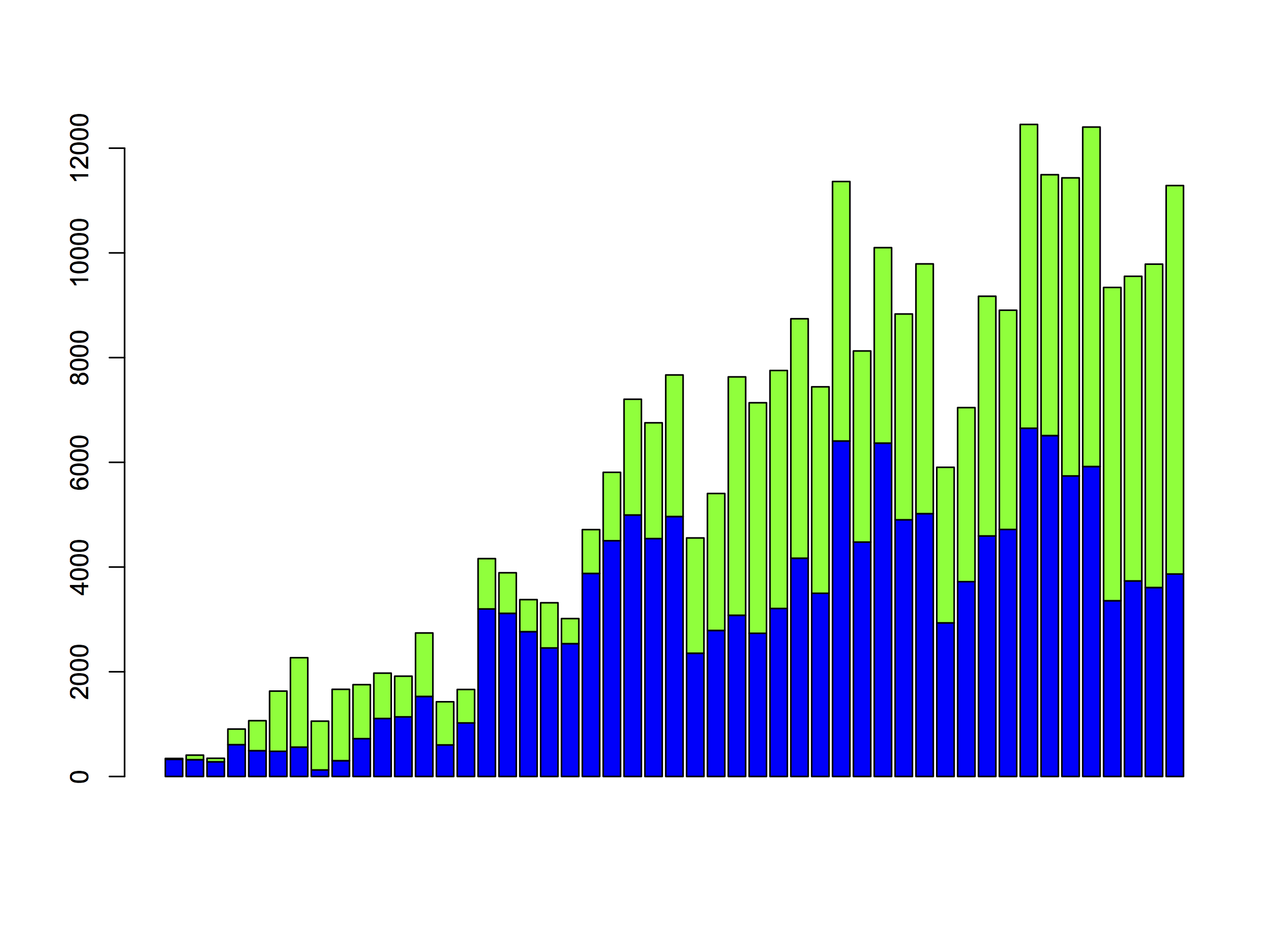
They looked at numbers of cards handed in at lost-and-found across the London Underground over the past two years (based on FOI request)

card-clash

If we’re going to spend time on this, we might also consider what the right comparison is. The data include cards on their own and cards with other stuff, such as a wallet. We shouldn’t combine them: the ‘card clash’ hypothesis would suggest a bigger increase in cards on their own.

Here’s a comparison using all the data: the pale points are the observations, the heavy lines are means.

allcards

Or, we might worry about trends over time and use just the most recent four months of comparison data:

recentcards

Or, use the same four months of the previous year:

matchedcards


In this case all the comparisons give basically the same conclusion: more cards are being handed in, but the increase is pretty similar for cards alone and for cards with other stuff, which weakens the support for the ‘card clash’ explanation.

Also, in the usual StatsChat spirit of considering absolute risks: there are 3.5 million trips per day, and about 55 cards handed in per day: one card for about 64000 trips. With two trips per day, 320 days per year, that would average once per person per century.