May 12, 2014

Big savings in super?

Via Stuff and the DimPost

Tens of thousands of well-off pensioners are claiming up to half a billion dollars in superannuation every year.

With government debt at more than $60 billion, critics say the wealthy are asking their children and grandchildren to fund their so-called retirement.

Ministry of Social Development figures revealed more than 26,000 people with total income of more than $70,000 a year claimed superannuation last year. At current rates, this could add up to $570m a year before tax..

From last year in the Herald via me

Imagine the public outrage if it were discovered that more than 80,000 New Zealanders were receiving wages, salaries and investment incomes of more than $6 billion a year, but were also receiving a benefit from the Government.

Income figures this week from Statistics NZ show more than 80,000 New Zealanders over the age of 65 receive wages, salaries and investment returns of more than $6.5 billion a year while claiming NZ Super.

The benefits to those 80,000-plus seniors are costing poorer taxpayers at least $1.3 billion a year. Many of these beneficiaries will be retired judges, politicians, chief executives, doctors, diplomats and lawyers who are well able to look after themselves.

It seems the problem is only half as bad now, without any policy changes.  Either that, or people really don’t know where they would like to draw the line.
Stat of the Week Competition: May 10 – 16 2014

Each week, we would like to invite readers of Stats Chat to submit nominations for our Stat of the Week competition and be in with the chance to win an iTunes voucher.

Here’s how it works:

  • Anyone may add a comment on this post to nominate their Stat of the Week candidate before midday Friday May 16 2014.
  • Statistics can be bad, exemplary or fascinating.
  • The statistic must be in the NZ media during the period of May 10 – 16 2014 inclusive.
  • Quote the statistic, when and where it was published and tell us why it should be our Stat of the Week.

Next Monday at midday we’ll announce the winner of this week’s Stat of the Week competition, and start a new one.

(more…)

May 11, 2014

Briefly

  • New York Times: In addition, however, “we are able to identify gay bars in Tehran. Moscow too,” said Pete Warden, a co-founder of Jetpac. The company does not want to do that, he added, but he does think it’s important that “we make people aware, get people talking about this.”
  • US spending on science, space, and technology correlates with Suicides by hanging, strangulation and suffocation (correlation 0.992)
  • Can you stop the Internet knowing you’re pregnant. Maybe?
  •  “I’m still a little embarrassed and feel it should be up to the scientists themselves to present the arguments for science.” Bill Bryson


Change you can’t believe in

From One News and  a Colmar Brunton poll about Judith Collins and the Oravida affair

Which of these statements best describes how the issues will influence your vote in the upcoming election?

23% These issues will be a factor in your decision about who to vote for 
75% These issues will not have much influence on your vote 
1% Don’t know/won’t vote

Graeme Edgeler pointed out on Twitter that it matters what starting position people are being influenced from.  That information wasn’t in the Colmar Brunton summary, because reporting it would also involve reporting the split of party affiliations in the sample, and the poll wasn’t designed for that split to be a reliable estimate.

I’m not going to report the split, either, but you can get it from the detailed poll report.  I do think it’s reasonable to note that among people who identified as Labour/Green voters, about 1/3 said it would influence their vote, and among those who identified as National voters, less than 10% said it would influence their vote. The difference is more than twice the margin of error estimated from those proportions and numbers. Looked at the other way, three-quarters of respondents said the issue would not make much difference to their vote, and three-quarters of the rest were Labour or Green voters.

It’s not impossible for Labour or Green supporters to have their votes influenced by the Oravida affair. You could imagine someone with a long-term philosophical or emotional attachment to Labour, who had been thinking of voting National at this election, but who decided against it because of the scandal. But if there are enough people like that to show up in a poll, the left-wing parties are in real trouble. It’s more likely that most respondents said whatever they thought would make their side look good.

May 10, 2014

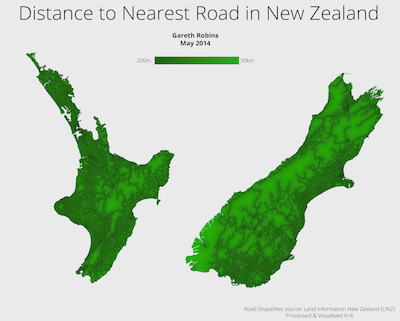
How close is the nearest road in New Zealand?

Gareth Robins has answered this question with a very beautiful visualization generated with a surprisingly compact piece of R code.

Distance to the nearest road in New Zealand

Distance to the nearest road in New Zealand

Check out the full size image and the coded here.

May 9, 2014

Terrible, horrible, no good, very bad month

From Stuff

The road toll has moved into triple figures for 2014 following the deadliest April in four years.

Police are alarmed by the rising number of deaths, that are a setback after the progress in 2013 when 254 people died in crashes in the whole year – the lowest annual total since 1950.

So far this year 102 people have died on the roads, 15 more than at the same point in 2013, Assistant Commissioner Road Policing Dave Cliff said today.

The problem with this sort of story is how it omits the role of random variation — bad luck.  The Police are well aware that driving mistakes usually do not lead to crashes, and that the ones which do are substantially a matter of luck, because that’s key to their distracted driver campaign. As I wrote recently, their figures on the risks from distracted driving are taken from a large US study which grouped together a small number of actual crashes with a lot of incidents of risky driving that had no real consequence.

The importance of bad luck in turning bad driving into disaster means that the road toll will vary a lot. The margin of error around a count of 102 is about +/- 20, so it’s not clear we’re seeing more than misfortune in the change.  This is especially true because last year was the best on record, ever. We almost certainly had good luck last year, so the fact that it’s wearing off a bit doesn’t mean there has been a real change in driver behaviour.

It was a terrible, horrible, no good, very bad month on the roads, but some months are like that. Even in New Zealand.

Seeking case-study material for journo unit standard

As many of you will know, I’m on the working group developing the content of a unit standard in statistical concepts for the National Diploma in Applied Journalism, which journalists with basic qualifications pursue while on the job to extend their skills.

It’s now time for me to ask you to send New Zealand examples of well-written statistically-based stories and poorly-written statistically-based stories that we can use. BUT you need to be able to send me the source data and an explanation (however rough) of what’s wrong with the story and how it could be improved.

I think that teachers may have existing examples that might do, and I would love to see them. You can email me your juicy contributions to statschat@gmail.com.

May 8, 2014

Where to see NZ data

Today, Wiki New Zealand came to our department to talk about their work.  I mentioned them in late 2012 when they first went live, but they’ve developed a lot since then.

The aim of Wiki New Zealand is to have ALL THE DATAS about New Zealand in graphical form, so that people who aren’t necessarily happy with spreadsheets and SQL queries can browse the information. Their front page at the moment has data on cannabis use, greenhouse gas emissions,  wine grape and olive plantings, autism, and smoking.

 Check them out. 

Where would they get that impression?

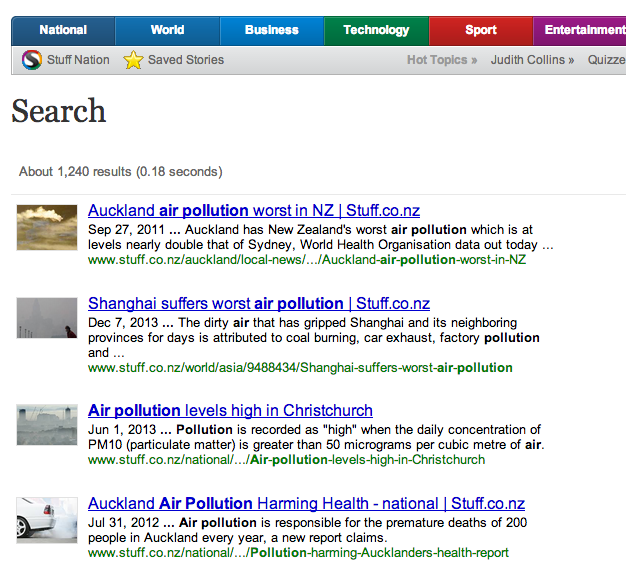
From Stuff: “New Zealand’s worst air is not where you think“.  That’s not actually true. New Zealand’s worst air, according to the story, is pretty much where I thought it would be, in coastal Canterbury and Otago.  However, if you search the Stuff website for the term “air pollution”, you get:

airpollution-search


So if you expected Auckland to be the worst, you know who to blame.

Briefly