November 7, 2013
Just wrong enough to sound convincing
From Saturday Morning Breakfast Cereal: The top six reasons your infographic is just wrong enough to sound convincing
. 
From Saturday Morning Breakfast Cereal: The top six reasons your infographic is just wrong enough to sound convincing
.
From the Genetic Literacy Project:
“Up till now, newborn screening has not been done by looking directly at an infant’s genes. Instead researchers check a tiny drop of blood taken from a baby’s heel for certain biochemical markers. These markers indirectly reveal the presence of abnormalities that can be treated effectively early in life.
“That indirect approach could change, depending on the results of four new pilot projects funded by the US National Institutes of Health. The projects are studying whether extending newborn screening to studying the genes themselves makes medical—and ethical—sense.”
Read the whole post here.
While some traditional herbal medicines (foxglove, opium, willow, qinghaosu) turn out to actually work when studied carefully, others don’t. The most likely explanation for the reported benefits in some ineffective herbal products is some sort of placebo effect. That’s become more likely following recent research that tested 44 herbal products on sale in the USA and found that a third of them were completely missing the active ingredient, with some of the others containing inactive fillers such as oats or potentially active (or allergenic) plants other than those on the label.
The researchers used DNA barcodes: measurements of short DNA regions that are variable enough to distinguish most plant species, they didn’t measure the putatively active compounds in the herbs. The DNA approach is much more efficient, but it can give an unrealistically favorable view of the situation: it’s possible that even where the right plant was present, it didn’t have a meaningful concentration of the right compounds.
There was a bit of publicity over this when it came out a few weeks ago (I wrote about it on my blog), but now the New York Times has picked the story up and has a lot more detail.
The website datadrivenjournalism.net says
The website is part of an European Journalism Centre initiative dedicated to accelerating the diffusion and improving the quality of data journalism around the world. We also run the online course Doing Journalism with Data as well as the School of Data Journalism, and are behind the acclaimed Data Journalism Handbook.
A couple of interesting links in particular
So, the decision has been made and the blood alcohol limit will be lowered. Perhaps now we can start using realistic numbers for the impact. The story in the Herald today shows the problem, although it’s actually much better than anything I’ve seen in the mainstream media previously:
The changes come after a two-year review of the impact of lowering the legal blood alcohol limit by 30mg suggested 3.4 lives would be saved a year and 64 injury-causing crashes avoided.
It would also save $200 million in social costs over 10 years.
“Alcohol impairment is a major cause of road accidents in New Zealand, with an average of 61 fatalities, 244 serious injuries, and 761 minor injuries every year caused by at-fault drivers who have been drinking,” said Transport Minister Gerry Brownlee.
“The social cost of these injuries and fatalities is $446 million – a huge sum in a country of our size.”
In the first paragraph the estimated benefit based on actual research is quoted. That’s a big step forward. The second paragraph is just wrong: the social costs aren’t in addition to the lives saved and injuries prevented; that’s where the social cost numbers come from. And it’s multiplied by ten years.
In the third and fourth paragraphs Mr Brownlee is quoted as justifying the change by quoting total costs of drink driving. The social cost number in the fourth paragraph is 22 times larger than the actual estimated benefit. You’d think that sort of discrepancy would draw some journalistic comment.
And later in the story we are told about a victim of a drunk driver. A driver whose blood alcohol concentration was 190mg/100ml, more than twice the existing legal limit, and who was duly convicted and sent to prison under the old laws. Not the sort of person whose behaviour is likely to be affected by this change.
From Andrew Gelman, who is passing along research by some Columbia political scientists, the estimated support, by state, for the Employment Nondiscrimination Act, a gay rights bill that the US Senate will be voting on this Monday.
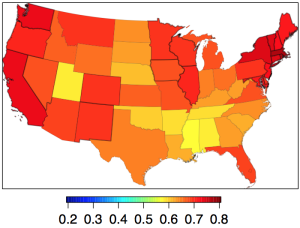
US Senators are elected by, and theoretically represent, their state as a whole. The bill has majority support in every state, well over 60% in most states. It’s not clear whether it will pass.
Part of the problem is multilevel democracy: to be a Senator, you have to be selected as a candidate as well as winning the election. And the people who vote at the preselection stage (primary elections, in the US) average more extreme than those who vote in the election. The more levels of selection you need, the worse the problem gets: Tim Gowers (prompted by the US government shutdown) does the mathematician thing and derives the extreme case. And the problem is exacerbated by the fact that politicians aren’t as knowledgeable about the views of their electorates as they think are.
Each week, we would like to invite readers of Stats Chat to submit nominations for our Stat of the Week competition and be in with the chance to win an iTunes voucher.
Here’s how it works:
Next Monday at midday we’ll announce the winner of this week’s Stat of the Week competition, and start a new one.
Syria has a million child refugees, a million adult refugees, and about 5 million ‘internally displaced persons’. What does that look like?
Al Jazeera News has an interactive map of the USA to demonstrate: click on a location and see an area around that point whose population is equal to the number of refugees. For example, Albuquerque, New Mexico, location of Breaking Bad, gives
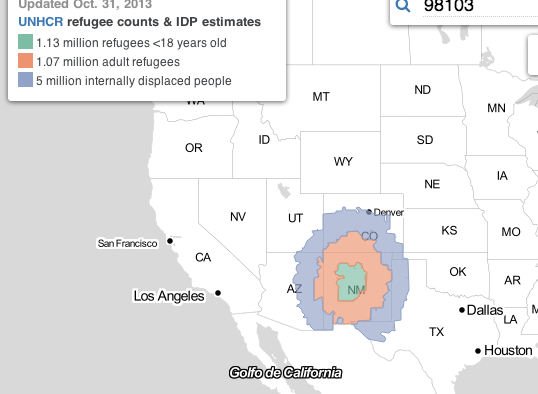
In New Zealand, the 1 million child refugees corresponds to most of the population of urban Auckland. Adding the million adult refugees would expand to cover Northland and Waikato, and the total of seven million people corresponds to all of New Zealand, plus Samoa, Tonga, Fiji, the Solomon Islands, and more.
The Herald has a story about a global wine shortage and its potential benefits for NZ producers. The story links to the Morgan Stanley report that it’s based on, and presents it well.
However (and you knew something like this was coming), Felix Salmon at Reuters has also written about the report, using more than just this one report as a source. Find out how the Organisation Internationale de la Vigne et du Vin numbers that show a modest and increasing surplus

turn into the Morgan Stanley numbers that show an increasing wine deficit

He also cites wine industry experts pointing out that the shortage story just doesn’t add up, and concludes
But never mind all that: the Morgan Stanley report has numbers and charts, and journalists are very bad at being skeptical when faced with such things. Even Finz’s Chronicle article, which sensibly poured cold water on the report, ends with a “Wine by the numbers” box which simply reproduces all of Morgan Stanley’s flawed figures. And besides, the debunkings are never going to go viral in the way that the original “wine shortage!” articles did.
Recent comments