Posts filed under General (3152)

February 23, 2018

Briefly

  • Data visibility as a political act: Ben Goldacre and co-conspirators have set up a webpage tracking clinical trials that are violating the FDA Amendment Act (2007) by not having reported any results.  It only became possible to violate the Act this Monday, so the compliance is fairly high so far, nearly 90%.
  • Politician Sam is an expert system from Victoria University Wellington that’s trying to learn NZ political views.  That’s not an unreasonable thing to try, but reading “Unlike a human politician, I consider everyone’s position, without bias, when making decisions” doesn’t make me more optimistic about the project.
  • Which NZ songs get streamed the most here and overseas? Gareth Shute at the Spinoff
  • “Count on Stats” is an effort by the American Statistical Association to rebuild public confidence in US official statistics.
  • Alice Zhao analysed text messages with her (now) husband from the year they married and the year they started dating — a nice illustration of what you can miss by looking at just one source of information.

February 20, 2018

Super 15 Predictions for Round 2

Team Ratings for Round 2

The basic method is described on my Department home page.

Here are the team ratings prior to this week’s games, along with the ratings at the start of the season.


Current Rating Rating at Season Start Difference
Hurricanes 16.18 16.18 0.00
Crusaders 15.23 15.23 0.00
Lions 13.25 13.81 -0.60
Highlanders 10.29 10.29 -0.00
Chiefs 9.29 9.29 0.00
Brumbies 1.75 1.75 0.00
Sharks 1.57 1.02 0.60
Stormers 1.36 1.48 -0.10
Blues -0.24 -0.24 -0.00
Waratahs -3.92 -3.92 -0.00
Jaguares -4.51 -4.64 0.10
Bulls -4.79 -4.79 0.00
Reds -9.47 -9.47 0.00
Rebels -14.96 -14.96 0.00
Sunwolves -18.42 -18.42 0.00


Performance So Far

So far there have been 2 matches played, 2 of which were correctly predicted, a success rate of 100%.
Here are the predictions for last week’s games.

Game Date Score Prediction Correct
1 Stormers vs. Jaguares Feb 17 28 – 20 10.10 TRUE
2 Lions vs. Sharks Feb 17 26 – 19 16.30 TRUE


Predictions for Round 2

Here are the predictions for Round 2. The prediction is my estimated expected points difference with a positive margin being a win to the home team, and a negative margin a win to the away team.

Game Date Winner Prediction
1 Highlanders vs. Blues Feb 23 Highlanders 14.00
2 Rebels vs. Reds Feb 23 Reds -2.00
3 Sunwolves vs. Brumbies Feb 24 Brumbies -16.20
4 Crusaders vs. Chiefs Feb 24 Crusaders 9.40
5 Waratahs vs. Stormers Feb 24 Stormers -1.30
6 Lions vs. Jaguares Feb 24 Lions 21.80
7 Bulls vs. Hurricanes Feb 24 Hurricanes -17.00


February 19, 2018

Ihaka Lecture Series – live and live-streamed in March

The theme of this year’s Ihaka Lecture Series is “A thousand words: Visualising statistical data”. The distillation of data into an honest and compelling graphic is essential component of modern (data) science, and this year, we have three experts exploring different facets of data visualisation.

Each event begins at 6pm in the Large Chemistry Lecture Theatre, Building 301, 23 Symonds Street, Central Auckland, with drinks, nibbles and chat – just turn up – and the talks get underway at 6.30pm. Each one will be live-streamed – details will be on the info pages, the links to which are given below.

On March 7, Professor Dianne Cook from Monash University (right) looks at simple tools for helping to decide if the patterns you think you see in the data are really there. Details. Statschat interviewed Di last year about the woman behind the data work, and it was a very popular read. It’s here. Di’s website is here.

On March 14, Associate Professor Paul Murrell from the Department of Statistics, The University of Auckland (left) will embark on a daring statistical graphics journey featuring the BrailleR package for visually-impaired users, high-performance computing, te reo, and XKCD. Details. Paul was a student when R was being developed by Ross Ihaka and Robert Gentleman, and has been part of the R Core Development team since 1999.

On March 21, Alberto Cairo, the Knight Chair in Visual Journalism at the University of Miami (below right) teaches principles so we all become more critical and better informed readers of charts. This lecture is non-technical – if you have any journalist friends, let them know. Details. His website is here.

The series is named after Ross Ihaka, Associate Professor in the Department of Statistics at the  University of Auckland. Ross, along with Robert Gentleman, co-created R – a statistical programming language now used by the majority of the world’s practicing statisticians. It is hard to over-emphasise the importance of Ross’s contribution to our field, so we named this lecture series in his honour to recognise his work and contributions to our field in perpetuity.


February 14, 2018

Most inaccurate media number ever?

In 2012, the Telegraph and other UK papers were off by five orders of magnitude when they said there were only 100 adult cod in the North Sea. The Washington Post beats that easily.

Quantum computers are straight out of science fiction. Take the “traveling salesman problem,” where a salesperson has to visit a specific set of cities, each only once, and return to the first city by the most efficient route possible. As the number of cities increases, the problem becomes exponentially complex. It would take a laptop computer 1,000 years to compute the most efficient route between 22 cities, for example. A quantum computer could do this within minutes, possibly seconds.

As mathematician Bill Cook pointed out on Twitter, his iMac can solve a 22-city problem in 0.005 seconds, roughly six trillion times faster than the Washington Post claims.  It looks as though the writer has assumed there is no more efficient algorithm than just trying all the possible routes, one at a time.  At one billion attempts per second, that would take on the order of a thousand years.  In fact, there are more efficient algorithms, it’s just that these algorithms also get very slow as the number of points increases. Prof Cook estimates in the twitter thread that 1000 CPU-years might allow a 100,000-point problem to be solved: six trillion times more computing gets you only a 5000-fold increase in the number of points.

For the cryptographic problems that are the actual point of the story, fast quantum algorithms are known. If large enough quantum computers can be built, these security protections are toast. And as the story says, there’s research going on now to find replacements if/when they’re needed (though what the story says about those algorithms is almost completely unhelpful).  But the travelling salesman problem is not one of the ones for which fast quantum algorithms are known. On the contrary, there are reasons to suspect fast quantum algorithms don’t even exist for “NP-complete” problems such as the travelling salesman.


Update: Scott Aaronson, who knows from quantum, is Not Impressed.

February 13, 2018

Super 15 Predictions for Round 1

Team Ratings for Round 1

The basic method is described on my Department home page.

Here are the team ratings prior to this week’s games, along with the ratings at the start of the season.

Current Rating Rating at Season Start Difference
Hurricanes 16.18 16.18 0.00
Crusaders 15.23 15.23 0.00
Lions 13.81 13.81 0.00
Highlanders 10.29 10.29 -0.00
Chiefs 9.29 9.29 0.00
Brumbies 1.75 1.75 0.00
Stormers 1.48 1.48 -0.00
Sharks 1.02 1.02 0.00
Blues -0.24 -0.24 -0.00
Waratahs -3.92 -3.92 -0.00
Jaguares -4.64 -4.64 0.00
Bulls -4.79 -4.79 0.00
Reds -9.47 -9.47 0.00
Rebels -14.96 -14.96 0.00
Sunwolves -18.42 -18.42 0.00


Predictions for Round 1

Here are the predictions for Round 1. The prediction is my estimated expected points difference with a positive margin being a win to the home team, and a negative margin a win to the away team.

Game Date Winner Prediction
1 Stormers vs. Jaguares Feb 17 Stormers 10.10
2 Lions vs. Sharks Feb 17 Lions 16.30


February 6, 2018

Briefly

February 2, 2018

Map whining

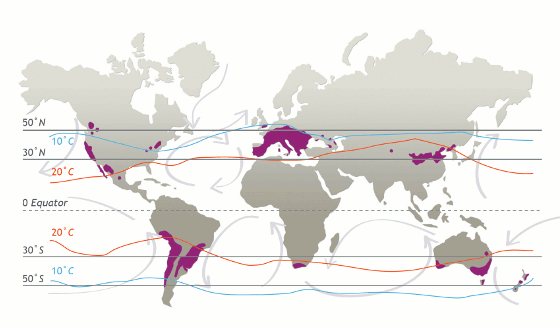
I’ve seen this map several times on Twitter. It’s originally from a British company, ThirtyFifty. It gives a really nice idea of where the world’s wine regions are, and why, in terms of temperature.

There’s one problem, which is probably more obvious to New Zealanders than northern-hemisphere people. The latitude lines are wrong.

The 50N line and the equator are right, but the 30N line is a little too far north; the 30S line is a little too far north; and the 50S line is way too far north — it’s at about 45S, measured by the southern tip of Tasmania and the middle of NZ’s South Island.

February 1, 2018

Another test for Alzheimers

As StatsChat readers will know, there are lots of candidate tests for Alzheimer’s Disease, all of which are much better than just flipping a coin. These tests may be useful in selecting people for clinical trials, and if we ever get effective disease-modifying treatments, for deciding who to treat. At the moment, though, these tests aren’t much use.

BBC News has another one

Scientists in Japan and Australia have developed a blood test that can detect the build-up of toxic proteins linked to Alzheimer’s disease.

The work, published in the journal Nature, is an important step towards a blood test for dementia.

The test was 90% accurate when trialled on healthy people, those with memory loss and Alzheimer’s patients.

If you’re not paying careful attention, 90% accuracy sounds pretty good. But that’s the accuracy in a group of people where about half of them have Alzheimer’s.  In the population, where most people are ok, the false positive rate will still be scarily high.

Also, in contrast to some tests I’ve written about, the main focus of this paper is differentiating Alzheimer’s Disease from other sorts of dementia

The research paper says

The plasma composite biomarker showed 96.7% sensitivity, 81.0% specificity, and 90.2% accuracy in the overall data (n = 51) when predicting individual Aβ status (Aβ+ or Aβ) using the common cut-off value (0.376) (Extended Data Fig. 8e–g). The results suggest that the plasma biomarker could be helpful for the differential diagnosis of AD and aid in determining therapeutic strategies, by providing additional information on the brain Aβ deposition status of individuals.

That’s going to be useful when we get treatments, since the treatments for Alzheimer’s probably won’t work on unrelated kinds of dementia, but it doesn’t really fit with the framing in the story

Alzheimer’s disease starts years before patients have any symptoms of memory loss.

The key to treating the dementia will be getting in early before the permanent loss of brain cells.


January 26, 2018

Briefly

  • “Are bigoted, irrational robots hurting humans?” (Herald, from the Daily Mail).
  • From 538: ” If I had a magic wand, I’d develop an algorithm that: a) draws the shortest possible line(s) necessary to split a state into equally populous districts and b) requires that only as many pre-existing jurisdictions be split as necessary to achieve equally populous districts.” That’s the easy part. Getting a fair voting system isn’t primarily difficult because math is hard, but because power corrupts.
  • Sharon Begley at STAT on the hype around exercise and dementia “But we thought it was a reasonable thing to say, especially since [exercise] doesn’t have a lot of risk. To be honest, we’re looking for something positive to tell people.”
  • Peter Ellis writes on how to recruit data scientists in the public sector
  • There’s a famous medical paper reviewing all the randomised trials of parachute use when jumping from a plane (the point being, of course, that there aren’t any, and shouldn’t be). There’s a new medical paper looking at people using this analogy. Of 35 interventions where the parachute analogy was used explicitly to argue that randomised trials were impossible and there was no room for doubt about effectiveness , 22 had been examined in randomised trials. Six had been shown effective.
January 23, 2018

Low-flying rocks

From Stuff The Herald‘Potentially hazardous’ asteroid heading towards Earth at 108,800km/h, and in the story

It is the largest space rock to brush past our planet this year and previous research has found a rock of this size could plunge Earth into a mini-ice age if it hit.

The impact would cause average temperatures around the world to fall by as much as 8°C, according to a 2016 study on the effects of a collision with a 0.6-mile-wide (1km) asteroid.

“These would not be pleasant times,” Charles Bardeen, of the National Center for Atmospheric Research, said during a presentation at the American Geophysical Union (AGU).

In the “worst case scenario”, soot would remain in the atmosphere for around 10 years, while dust take six years to settle back on Earth.

Fortunately Nasa does not think this asteroid will collide with Earth.

NASA would put that more strongly. From NASA/JPL Asteroid WatchAsteroid 2002 AJ129 to Fly Safely Past Earth February 4,

At the time of closest approach, the asteroid will be no closer than 10 times the distance between Earth and the Moon (about 2.6 million miles, or 4.2 million kilometers).

“We have been tracking this asteroid for over 14 years and know its orbit very accurately,” said Paul Chodas, manager of NASA’s Center for Near-Earth Object Studies at the Jet Propulsion Laboratory, Pasadena, California. “Our calculations indicate that asteroid 2002 AJ129 has no chance – zero – of colliding with Earth on Feb. 4 or any time over the next 100 years.”

The @asteroidwatch twitterwallah is off because of the government shutdown, but was relatively patiently answering Twitter questions in both English and Spanish until Friday.

Part of the problem is that NASA uses “potentially hazardous” for any asteroid approaching within 1/20th of the distance to the sun, because these are the ones they want to track to be sure that they aren’t actually hazardous.  It’s an unfortunate term because it sounds dangerous when it isn’t.