Posts filed under General (3156)

December 31, 2015

Superbooze?

Q: Did you see there’s a designer Kiwi cider that makers claim could combat ageing?

A: <sigh> Yes.

Q: And do the makers claim that?

A: Pretty much: “I never feel guilty about the drinks I consume, but I know that’s not the case for everyone. Knowing I’ve played a part in unlocking the secret to eternal youth is a career highlight.”

Q: Wow.

A: I know, right?

Q: What is his secret to eternal youth?

A: Cascara

Q: I think I’ve heard of ….  wait,  isn’t that a laxative?

A: They’re probably hoping their customers are too young to think of that. This is a completely different plant, just the same Spanish word.

Q: Ah. I see. Coffee berry husks. They used to just throw it away?

A: Well, in Yemen it’s a traditional beverage, and they drink it in Bolivia, too. And everywhere it at least gets recycled as compost. But from the viewpoint of the superfood industry they threw it away.

Q: Are they more specific about the whole eternal youth thing?

A: The Herald didn’t quote them, but yes, the company blog says “brewers added the berry’s purported health benefits that include preventing premature aging, heart disease, high cholesterol, asthma and Alzheimer’s to the cider profile.

Q: What research do they cite supporting this?

A: Very droll.

Q: No, seriously, don’t they say anything?

A: No.

Q: Is there research?

A: Well, it’s got antioxidants.

Q: Doesn’t everything?

A: And it seems to stimulate the release of brain-derived neurotrophic factor.

Q: In mice?

A: No, in people. Five of them.

Q: And is this brain-derived neuro-factor thing good?

A: With a name like that, how can it not be? Having some of it is important for lots of things.

Q: Some of it?

A: Doesn’t seem to be any real evidence that releasing more is good.

Q: But releasing it is unusual?

A: Caffeine does.

Q: Oh. Doesn’t sound like much support for the claims.

A: That’s what Dr Paul Jarrett, said — the expert the Herald asked.

Q: How about Yemen? Does this coffee berry stuff make them healthier there?

A: You couldn’t really tell, given what a mess the social and healthcare systems are in, not to mention the occasional drone bombings.

Q: Well, that was depressing

A: Ok. Back to the cider, then.

Q: Right. So, you’re not going drink it?

A: Well, not for the eternal youth. The flavour combination sounds attractive if I can hold my nose over the marketing.

Q: And maybe find a charity that does useful things in places like Yemen and Bolivia

A: Yeah.
December 29, 2015

Briefly

  • The Herald (and to a lesser extent Stuff) has started reporting number of crashes as well as number of fatalities on the roads. Probably a good thing.
  • Health News Review writes about spin in medical news reporting.
  • “But now scientists may finally have the answer. They have found that if a food is labelled as a healthy option we tend to eat more of it” From the Mail via the Herald. In fact, the research did not compare the consumption of food with healthy labels to food without.
  • The frequency of `positive’ words such as “favorable”, “encouraging”, “supportive” has been increasing in medical research abstracts. In less favourable reporting, Language Log points out that abstracts have gotten longer, and is not entirely supportive about deducing attitude from single words.
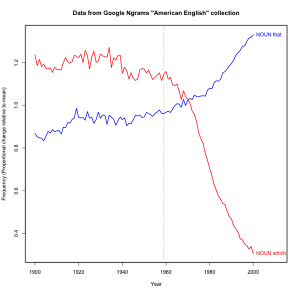
  • Also from Language Log: the `traditional’ `grammar rule’ that “which” doesn’t occur in restrictive relative clauses first became popular roughly when The Beatles did.
    CXIqYQnUsAAht_0

Recycling

For when stories we’ve commented on get recycled as ‘best of’

December 26, 2015

For the day after Christmas

  • Violin plots are a useful way to show the whole distribution of a large set of data, or dot plots for a small set
  • There’s a new movie out about at the effect of repeated minor brain injuries in US football; the same problem occurs in other sports.
  • “The shipping container is one of those rare devices, like the light bulb or the telephone, that can be traced to a single inventor”  — from a review, now ten years old, of an fascinating book about container shipping. Yes, I do know how that sentence sounds.
  • Will the new Stars Wars movie beat the original one in (real) ticket income? Will it go further and beat Gone With The Wind?
December 25, 2015

O Christmas Tree

tree

(from Wikipedia)

December 23, 2015

Above average

From the person most likely to be the next President of those United States:

“Now, I wouldn’t keep any school open that wasn’t doing a better than average job. If a school’s not doing a good job, then you know it may not be good for the kids.”

This, as you’d expect, has occasioned some discussion on the internets.

There’s nothing mathematically impossible about the idea of nearly all schools being above average.  Nearly everyone has more than the average number of legs.  Darwin, Australia, has had better than average Christmas weather on 49 of the last 50 years — in 1974, Cyclone Tracy destroyed 80% of houses in the city, which tends to pull the average down.

In other settings, it’s not even an unreasonable idea that you’d routinely close a large fraction of establishments.  It’s roughly what happens to restaurants, for example: lots of them are started, most fail, the remaining ones tend to be pretty close to the optimal price:quality tradeoff line.

In this quote, though, neither explanation really flies: it’s not that nearly all schools are the same except for a few really bad ones, and it doesn’t really make sense to close half the schools in the country, because even if you’re in favour of free competition between schools, most schools are too far apart to compete effectively.

What we’re seeing here is the broadening of ‘average’ to mean ‘ok’, which is one of the reasons it’s less useful as a technical term than it used to be.  If you want to be precise, ‘mean’ is better.

December 22, 2015

Briefly

  • From a Press Council decision (via Matt Nippert)
    Press releases are a useful way for newspapers to receive information and comment from interested parties. However, as the senior editor concedes, using a release almost verbatim falls well below best practice. Newspapers risk losing the trust of their readership if they print material that is not independent and objective (or otherwise clearly labelled as comment).
  • Siouxsie Wiles and Kate Hannah have a crowdfunding appeal to send copies of Nicola Gaston’s book on sexism in science to people who need to read it.
December 20, 2015

Return of the cheese addiction beatup

Remember cheese addiction? It’s back (in the Independent)

Using the Yale Food Addiction Scale, designed to measure a person’s dependence on, scientists found that cheese is particularly potent because it contains casein. 

The substance, which is present in all dairy products, can trigger the brain’s opioid receptors which are linked to addiction.

This time there’s enough circumstantial evidence to track down the open-access research paper. It does not contain the word “casein” (or “casomorphin”).

The research paper does not make any assertions about cheese or dairy products and opioid receptors. In fact, it doesn’t single out cheese at all. It says

…we observed that highly processed foods with added levels of fat and/or refined carbohydrates (like white flour and sugar), were most likely to be associated with addictive-like eating behaviors

The cheese obsession in the media coverage is a complete fabrication. It would be interesting to know who’s behind it.


Update: the lead author, Erica Schulte is Not Happy with the cheese claim in this radio interview (at 17:30).

December 18, 2015

Cutting down on the supply. Not.

XKCD today:

cold_medicine

There’s another story today about seizing large quantities of methamphetamine, this time hidden in a coffee table.  The border people also catch at lot of imports of ephedrine or pseudoephedrine. From January 1 to October 31, the authorities seized 293kg of meth and the equivalent of 3 million tablets of pseudoephedrine. And, of course, these are  not available legally in New Zealand. We have phenylephrine instead, which is on the Nice List because it can’t be turned into methamphetamine

Recently, a study in the US compared phenylephrine to placebo for hay fever. That’s not quite the same as looking at effectiveness for colds, but it’s still notable that there was no detectable difference. There were also no detectable side effects, which the researchers attribute to the drug all being zapped by the liver before it gets into general circulation.

At least the ban on pseudoephedrine is making us safe, though? Well, the government is tracking the effectiveness of its strategies. Here’s the summary from the October 2015 report, which is robustly disappointing.
meth

There has been a decrease in use of methamphetamine, but it doesn’t look like the war on cold medicine can explain it.


Update: Before anyone else posts it, the famous joke synthesis

Because the hours of availability of such pharmacies are often limited, it would be of great interest to have a simple synthesis of pseudoephedrine from reagents which can be more readily procured.

A quick search of several neighborhoods of the United States revealed that while pseudoephedrine is difficult to obtain, N-methylamphetamine can be procured at almost any time on short notice and in quantities sufficient for synthesis of useful amounts of the desired material.

December 17, 2015

Lettuce and global warming

Sometimes things are more complicated than they seem.

From the Herald

It might seem like a virtuous choice – but munching lettuce is worse for the planet than eating bacon, a study claims.

Researchers say the amount of energy and water used – and the level of greenhouse gases produced – is far greater per calorie for lettuce than pork.

The second sentence doesn’t look as if it can carry the weight of the first sentence. I mean, yes, maybe per calorie, but who gets most of their calories from lettuce? Not even rabbits.

Later on, the story points this out:

Richard Bennett, dean of food research at Reading University, said: “The calorie is not the most sensible functional unit of comparison.”

and ends

But the study conceded that eating fewer calories would lead to better public health, benefiting the environment and cutting energy use.

That seems to settle it: Study 0, lettuce 1. Until you go and look at the research.

The research isn’t actually about working out the relative impacts of bacon and lettuce, it’s about a much less trivial question. It would probably be a good thing for the US population, on average, to lose weight. It would probably also be a good thing for the US population to eat more fruit and vegetables. What does that imply about food production and resource use?

In the research, they considered three scenarios:  keep eating unhealthy stuff, just less of it to reduce obesity; eat healthier food without reducing calorie intake; and eat healthier food at a lower total calorie intake to reduce obesity. The per-calorie resource demands for various foods are an input to this calculation; they aren’t conclusions in themselves.

The second scenario is the worst environmentally, but that’s not really surprising.  What’s interesting, and basically missed in the reporting is that the third scenario is worse than the first.  If people in the US changed their diets to eat less and to follow dietary recommendations, the result would be an increase in greenhouse-gas emissions, in water use, and in energy use.  Reducing meat consumption, especially beef, would help the environment, but reducing use of cheap fats, sugars, and starches wouldn’t, and increasing consumption of the current mix of fruit and vegetables definitely wouldn’t

To some extent, the conclusions are US-specific. NZ fruit and vegetable production uses less irrigation, and the produce is shipped shorter distances, in milder climates, than in the US. The conclusions also assume business as usual in food production. With cheap petrol and cheap water, it made sense to grow everything in the Imperial Valley and truck it or fly it across the country; in the future, that may not be efficient and the mix of fruits and vegetables consumed may change.

Carbon pricing and water shortages are going to increase the cost of food. The interesting part of this analysis is that they will increase the cost of healthier diets (at least in the US) even more, at least until the industry works out ways to adapt.