Posts filed under General (3156)

November 19, 2015

False positives

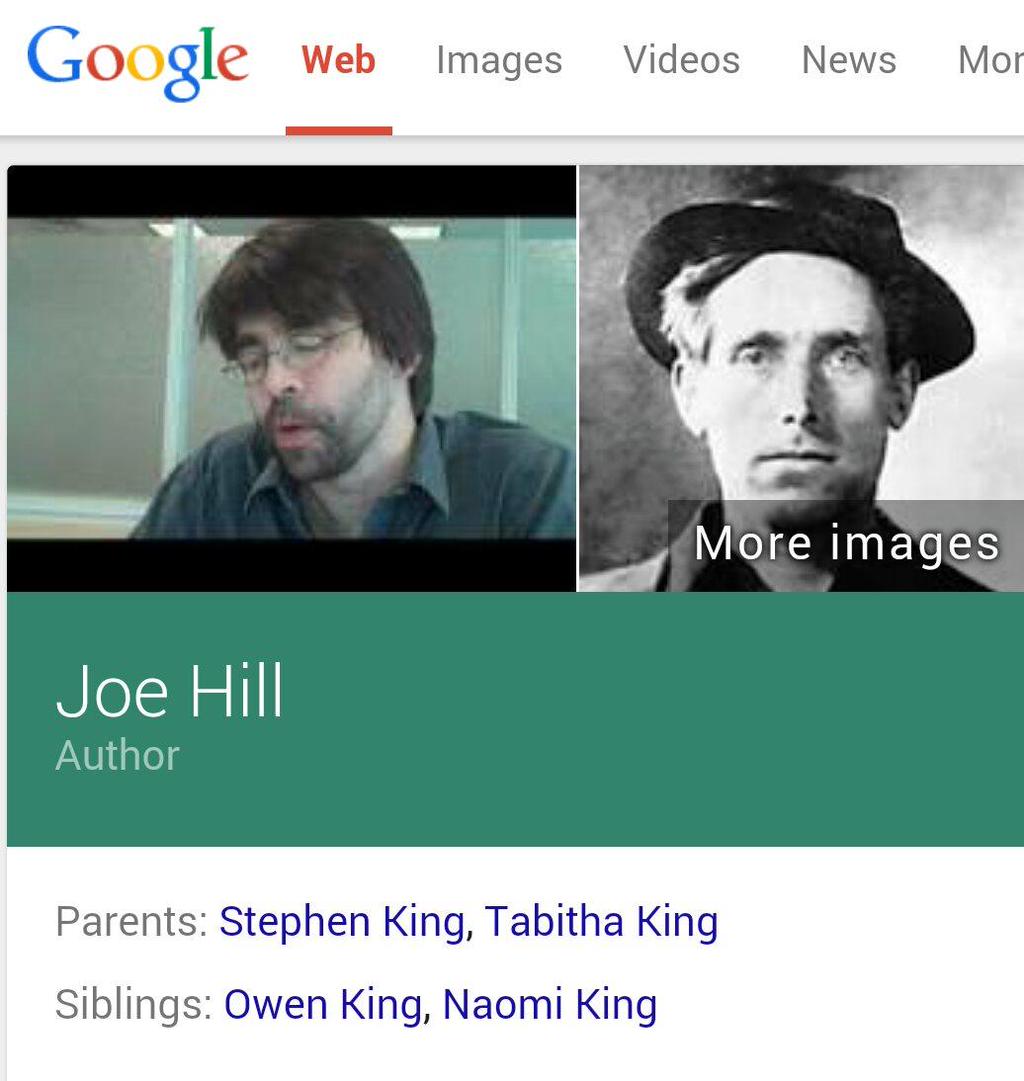
I searched for “Joe Hill” on Google a few months ago, and the “aren’t we clever” box popped up with:
CCvDKyaUMAEGqVg

The statistics and  computation behind these searches is impressive: in addition to all the usual Google stuff, the system realises that the – fairly common – words “joe” and “hill” occur together sufficiently often that they are probably a thing. Then it takes advantage of Wikipedia to realise that “joe hill” is the name of a person, not a geographical feature or a coffee shop (or, I suppose, profanity), and finds pictures and information. And it almost works — even with people who aren’t especially well known.

The gentleman on the left really is Joe Hill (author), aka Joseph Hillstrom King. One of his books has been made into a movie starring Daniel Radcliffe, so he’s definitely successful but not in any sense a mainstream celebrity. The gentleman on the right is someone else. People with an interest in labour history or folk music will recognise Joe Hill (activist), aka Joseph Hillstrom ,aka Joel Emmanuel Hägglund: I dreamed I saw Joe Hill last night, alive as you and me”. It’s an understandable mistake for the Google: the modern Joe Hill was named after the historical one, and there will be a lot of cross-referencing of the two. And it doesn’t really matter.

Joe Hill (activist) was involved in a rather more important false positive. The song says “they framed you on a murder charge”, and it’s only exaggerating a bit. There was strong circumstantial evidence and Hill refused to give any explanations, but it also appears the eyewitness testimony was manufactured. He was executed 100 years ago today.
November 13, 2015

Drug subsidy arithmetic

There are new, very promising treatments for some cancers, which work by disabling one of the safety mechanisms in the immune system so that it can attack the tumour. These treatments have been approved in the US for melanoma and the most common type of lung cancer, and they look better than anything we’ve seen before.  The problem is the price, more than NZ$200,000.

In New Zealand, roughly 2000 people die of melanoma or lung cancer each year. At the current market prices, a course of treatment for each of them would absorb more than half of Pharmac’s budget.

It’s not even as if the $200,000 guarantees a cure. The results of the KEYNOTE trial in melanoma were impressively good by the standard of melanoma treatment, but:

The overall response rate was 34% and the complete response rate was 6%. Eighty percent of responses were still ongoing at the time of analysis, and the median duration of response has not yet been reached.

There really are people whose disease completely vanished, but only about one in sixteen. Two thirds didn’t see any response. Even for the people who have no detectable disease we can’t yet know if the benefits will last a few years or a lifetime.

Pharmac is not going to fund these treatments at anything like the current price in the current budget. That’s not a matter of debate or public pressure. It’s just not happening. It won’t add up. Conceivably, the government could decide to come up with the money to fund the treatments outside the current Pharmac budget. I don’t think that would be the best way to spend the money, but I’m glad to say this is the sort of decision I don’t get to make.

Over the next few years, other companies will introduce treatments that attack the same or related immune checkpoint targets, and competition will make the price fall. At some point, it will be worthwhile for drug companies to make Pharmac an offer it can accept, as happened recently with Humira, Pharmac’s current top spend (which turns off the immune response in a somewhat similar way to how the new cancer treatments turn it on).

Five years ago, you couldn’t get these treatments if you were a billionaire. In ten years or so, I expect these or similar treatments will be effectively free to New Zealanders. At the moment, we’re in the painful transition period, where the manufacturers can afford to target only the wealthiest individuals and insurance companies.

November 10, 2015

Briefly

  • One of the problems with reducing things to hypothesis testing is that you often don’t want to make a one-off decision. A comic from Saturday Morning Breakfast Cereal makes this point, but in a case where you really do want to make a one-off decision.
  • From StuffMost women are either lesbian or bisexual’ but never straight, study claims”. From the Daily Beast: “Um, yes, straight women are real”
  • Digit preference in US football “The only explanation that has stuck with me is that when a official thinks ‘oh damn this is a mess, there are seven separate six foot tall millionaires all piled up on top of the ball and I have 100 rules to try and remember, where did that ball stop?’  their subconscious makes them grab for the safety blanket of a line drawn and place it down on there.”
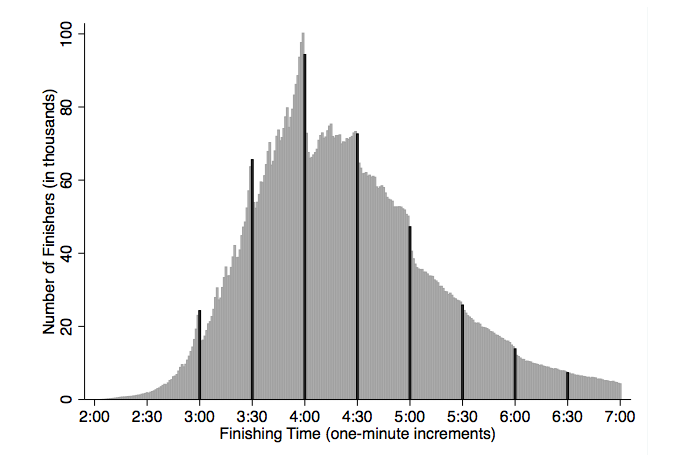
  • Digit preference in marathons: People really prefer to run 3:59 rather than 4:00 (early last year, from some economists at Chicago(PDF), but you probably saw the New York Times version)
    marathon
  • A useful bit of arithmetic for “Why isn’t this medication free?” stories. Pharmac’s budget is a little under $800 million per year.  There are about 4.5 million people in New Zealand, so that’s under $200 per person per year, or under $16,000 per person per expected lifetime. Based on more accurate inputs, it’s about $14,000 per person per lifetime.
  • In the US, mortality isn’t falling for 45-54 year olds identifying as white the way it is for basically everyone else in the West. If you read lots of statistics blogs, you will have seen discussion about whether mortality in this group is really rising or not: the peak of the baby boom just swept through the 45-54 band, so the average age of people in this group has increased. That’s worth looking at, but doesn’t change the basic message.
November 9, 2015

NZ Herald promotes data

Today (assuming nothing went wrong overnight) the Herald is giving data journalism a much higher profile: Insights

Harkanwal Singh and Caleb Tutty have been working frantically to assemble and format the past data visualisations and do new stuff for the launch. You should check it out: the way to convince the Herald management that good local data journalism is more valuable than bogus UK health stories is for it to get pageviews.

November 3, 2015

Briefly

  • Cancer cure hype: In a five-day period in June, 36 cancer drugs were described in the news as “breakthrough”, “game-changer”, “miracle” or similar words. Five of them had not yet been tested in humans.
  • Similarly , from Vox, on a 2003 study: “They looked at 101 studies published in top scientific journals between 1979 and 1983 that claimed a new therapy or medical technology was very promising. Only five, they found out, made it to market within a decade.” Most promising treatments don’t work: that’s not cynicism, it’s empirical fact. Of course, it’s only with new pharmaceuticals that we find out they don’t work.
  • An XKCD comic on Bill Gates’ blog, talking about the importance of being boring and non-innovative to finally finish off polio
  • London has a smaller proportion of residents born overseas (37%) than Auckland (39%). So does New York (37%). No real conclusion, just that it’s interesting. (via Hayden Glass)
  • “Cartography — what maps reveal about ourselves” from the BBC
  • Typically beautiful use of interactive graphics and maps in a New York Times story about ice melting in Greenland.
November 2, 2015

Have you ever tasted tofu?

Q: Did you see that an Asian diet helps ward off the effect of menopause?

A: An “Asian diet?” Do they mean Afghan, Punjabi, Bengali, Goan, Kirghiz, Uighur, Malaysian, Thai, Vietnamese, Lao, Korean, Beijing, Sichuan, Shanghai, …

Q: Ok, yes, I get the point.  Did you see that a diet with lots of soy, similar to Japanese and some Chinese diets, helps prevent fractures and heart attacks?

A: The story about phytoestrogens? Yes.

Q: And do they?

A: Hard to tell.

Q: Was it mice again?

A: No, this was a proper randomised trial in women. It’s just they didn’t measure fractures or even bone density.

Q: What did they measure?

A: The concentration of two proteins that are involved in bone formation

Q: How reliable is that?

A: By the standards of purely biochemical laboratory markers, not bad. An article in the newsletter of the American Association for Clinical Chemistry said “Commercially available immunoassays for all the markers are reasonably bone-specific and reflect bone turnover in postmenopausal osteoporosis and following anti-resorptive therapy.

Q: I can sense a ‘but’ coming on here

A: The story doesn’t say how big the changes were, and since this is only a forthcoming conference presentation, it’s hard to find out much detail. The abstract is here.

Q: How does it work?

A: Soy beans contain chemicals that weakly stimulate oestrogen receptors and so have some of the effects of oestrogen.

Q: Oh, like the dangerous endocrine disrupting pollutants I keep hearing about?

A: No, those are synthetic chemicals, not natural dietary components.

Q: That’s a remarkably good poker face you have

A: Can we move on?

Q: Ok, so what about the cardiovascular risk factors? The story says “They were also less at risk of heart disease, which oestrogen is also thought to protect against.” Did they measure heart disease?

A: No, they measured “cardiovascular risk markers”

Q: Does oestrogen improve these “risk markers”?

A: Yes, it does.

Q: Wait, wasn’t there a big trial of oestrogen and heart disease risk?

A: You mean the Women’s Health Initiative? Yes, there was.

Q: Did they see these improved risk markers?

A: Yes

Q: And a reduction in fractures?

A: Yes.

Q: But they didn’t see a reduction in heart disease, did they?

A: No, an increase. Over all, serious chronic disease was very slightly worse with oestrogen supplements.

Q: So why do we expect soy to be different?

A: An excellent question

October 28, 2015

Rugby World Cup Predictions for the Rugby World Cup Final

Team Ratings for the Rugby World Cup Final

The basic method is described on my Department home page.

Here are the team ratings prior to this week’s games, along with the ratings at the start of the Rugby World Cup.

Current Rating Rating at RWC Start Difference
New Zealand 28.10 29.01 -0.90
South Africa 23.16 22.73 0.40
Australia 21.25 20.36 0.90
England 16.43 18.51 -2.10
Ireland 15.97 17.48 -1.50
Wales 13.85 13.93 -0.10
Argentina 10.87 7.38 3.50
France 8.96 11.70 -2.70
Scotland 5.94 4.84 1.10
Fiji -2.19 -4.23 2.00
Samoa -4.15 -2.28 -1.90
Italy -6.37 -5.86 -0.50
Tonga -8.84 -6.31 -2.50
Japan -9.10 -11.18 2.10
USA -17.13 -15.97 -1.20
Georgia -17.74 -17.48 -0.30
Canada -17.89 -18.06 0.20
Romania -19.44 -21.20 1.80
Uruguay -31.67 -31.04 -0.60
Namibia -33.29 -35.62 2.30


Performance So Far

So far there have been 46 matches played, 39 of which were correctly predicted, a success rate of 84.8%.
Here are the predictions for last week’s games.

Game Date Score Prediction Correct
1 South Africa vs. New Zealand Oct 24 18 – 20 -5.60 TRUE
2 Argentina vs. Australia Oct 25 15 – 29 -9.60 TRUE


Predictions for the Rugby World Cup Final

Here are the predictions for the Rugby World Cup Final. The prediction is my estimated expected points difference with a positive margin being a win to the first-named team, and a negative margin a win to the second-named team

Game Date Winner Prediction
1 South Africa vs. Argentina Oct 30 South Africa 12.30
2 New Zealand vs. Australia Oct 31 New Zealand 6.80


October 27, 2015

The computer is watching

When I was doing an MSc in statistics, back last century, the state of the art in image analysis was recognising handwritten numbers. There was a lot of money in number recognition, for automated sorting of letters by postal code. Australia Post made it easier by having little squares printed on the envelope, showing you where to write the numbers.

In 1997, Terry Pratchett referred to the then state of the art in one of his Discworld novels. A pocket organiser powered by a small demon could do handwriting recognition: you show it a sample, and it says “Yes, that’s handwriting”.

At the time, neural networks weren’t regarded as terribly interesting in statistics. They weren’t good models for the brain, and they were a bit disappointing as black-box classifiers, even discounting how much more black-box they were than the alternatives. The people who taught me were of the opinion that neural networks probably wouldn’t amount to all that much.

It turns out that all they needed was twenty more years development and tens of thousands of times more computing power and training data. Now, neural-network image recognition actually works. I have two posts by Andrej Karpathy to illustrate.

In the first, “What I learned from competing against a ConvNet on ImageNet,” Karpathy tries to do better than a neural network on classifying objects present in photos. He manages. Just.  The neural network was particularly good at fine-grained classifications such as breeds of dogs.

The second, “What a Deep Neural Network thinks about your #selfie” indicates some of the problems. The neural network was trained to recognise “good” selfies. Actually, it was trained to recognise selfies that got lots of likes.  If you think about what might make a photo get more or fewer likes, you could easily come up with some ideas that aren’t just about photo quality.


Bacon cancer roundup

So now it’s official: processed meat is a IARC Group 1 carcinogen, red meat (including pork) is Group 2A. Their website is a bit slow at the moment, but they have a press release (PDF) and a Q&A (also PDF)

Over the past 24 hours there has been a lot of activity in science communication, trying to offset the early headlines that likened eating processed meat to smoking.

Obviously, the meat industries are also trying to play this down: the difference is we’re saying “look at the actual estimates” and they are saying things like “no published evidence that any single food, including processed meat, caused cancer.”

The International Agency of Research into Cancer (IARC), an arm of the World Health Organization, is notable for two things. First, they’re meant to carefully assess whether things cause cancer, from pesticides to sunlight, and to provide the definitive word on those possible risks.

Second, they are terrible at communicating their findings.

  • Bloomberg has explanations and some nice graphics that move around.
  • The story at Stuff and the new one at the Herald are pretty good, though they both kind of miss the point that people already aren’t eating bacon for the health benefits.
  • 3News is very sensible. One News less so, leading with “putting processed meats in the same danger category as smoking or asbestos, though that doesn’t mean, say, salami is as bad as cigarettes.”
  • Radio NZ is fairly unhelpful in interpreting the IARC ratings, surprisingly so given the high quality of their usual science coverage.
    • Yesterday they had “Meat producers say a report expected to be released today that will suggest bacon, ham and sausages are as big a threat as cigarettes and arsenic will not look at the full picture.
    • Today: “The International Agency for Research on Cancer (IARC), which is part of the WHO and based in Paris, put processed meat like hot dogs and ham in its group 1 list, which already includes tobacco, asbestos and diesel fumes, for which there is “sufficient evidence” of cancer links.”
  • Overseas:
    • The Sydney Morning Herald is good
    • New York Times is excellent; thorough and careful
    • The Guardian is still running the headline “Processed meats rank alongside smoking as cancer causes – WHO” on the front of its site.
    • The Daily Mail“Bacon, burgers and sausages DO cause cancer, says World Health Organsiation as it classifies processed meat as as big a threat as cigarettes
  • Here’s what I said for the Science Media Centre

    The International Agency for Research on Cancer (IARC) has declared processed meat a Group 1 carcinogen and red meat (their definition includes pork) as a Group 2A carcinogen. These are not based on new evidence and are not surprising findings; scientists have believed for a long time that some smoked, salted, or cured meats increase the risk of colorectal cancer and that higher meat consumption probably increases risk to some extent. 

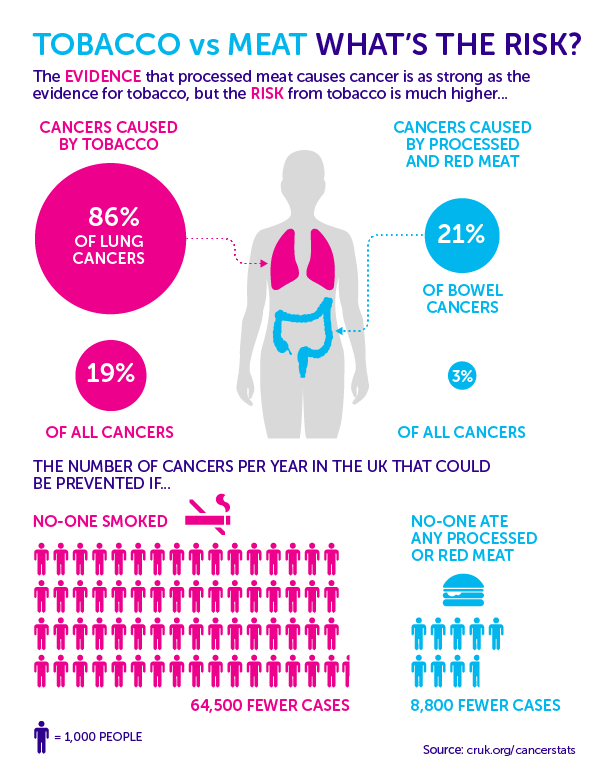
    IARC’s press release confirms that the risk increase (about 1.2 times higher for one daily portion of processed meat) is small from an individual point of view, but that the large number of people who eat meat means that it has a noticeable public health impact. Cancer Research UK estimates that 21% of bowel cancers and 3% of all cancers could be prevented if no-one ate any red meat or processed meat 

    Some of the publicity for the new classification has tried to link the risk of cancer from processed meat to the risk of cancer from other Group 1 carcinogens.  There is no justification for this. IARC classifications are based only on the strength of evidence for an effect at some (not necessarily realistic) dose; they do not consider the size of effect. 

    Group 1 carcinogens are those where IARC believes the cancer hazard is well-established, regardless of its strength. Group 1 includes asbestos, tobacco, and plutonium, but it also includes sunlight, oral contraceptives, and alcohol. 

    The only mention of other Group 1 carcinogens in the new IARC announcement is an explicit disclaimer in their Q&A, saying the classification does NOT mean that they are all equally dangerous. Bringing up other Group 1 carcinogens when explaining the cancer risks of meat consumption does not seem helpful for public understanding.


October 26, 2015

Cheese addiction follow-up

On Friday the Herald published a “cheese addiction” story and I handed out a reading assignment. Now you’ve had the long weekend to look things up, Stuff has come out with the story, so we can look at the warning signs in more detail.

The first hint is in the second sentence

A new study from the US National Library of Medicine..

The US National Library of Medicine is a library, like it says on the tin. It doesn’t conduct or publish research on food addiction any  more than the Auckland City Library wrote or published Into The River.  Unfortunately, the combination of no publisher and no author makes it hard to find the study.

Next we hear about the Yale Food Addiction Scale and foods that rated high

While pizza topped the food list, cheese was also ranked high because of an ingredient called casein, a protein found in all milk products. When it is digested, casein releases opiates called casomorphins. 

If you look up the Yale Food Addiction Scale, you find

Foods most notably identified by YFAS to cause food addiction were those high in fat and high in sugar.

That seems plausible, and it would explain pizza and cheese being on the list.  If the high rating was because of casein, you’d expect high ratings to be given to low-fat cheeses, but not to high-sugar foods, and that isn’t what has been found in the past with this scale.

You probably haven’t heard of casomorphins. I hadn’t. It turns out that quite a lot of small protein fragments stimulate opioid receptors to some extent (in a lab-bench setting). The ones from milk protein are called casomorphins. There are also some from gluten, some from soy protein, and some even from spinach.

So far there isn’t good evidence that any relevant quantity of these fragments would get into the human brain, or that they would have much effect there, but if they did, tofu would be as much a risk as cheese.

While we know the National Library of Medicine didn’t do the research, they do have an excellent search facility for research stored on their virtual shelves.  It doesn’t list any papers about both “Yale Food Addiction Scale” and either “casomorphin” or “casein”.

In any case the story changes right at the end

If a food item is more processed, it’s more likely to be associated with addictive eating behaviours.

If that’s true it would argue against casomorphins being the problem.

Although the full picture does take some work and some knowledge of biochemistry, you can tell in a few minutes with just Wikipedia that the attribution of the research is wrong and that the claims contradict previous uses of the Food Addiction Scale. In Friday’s Herald version you could also tell the story was being pushed by a lobby group rather than by the researchers.