Posts filed under General (3156)

October 29, 2013

Significant bacon

Q: The Herald says  Bacon makes everything better – research“. What research is this?

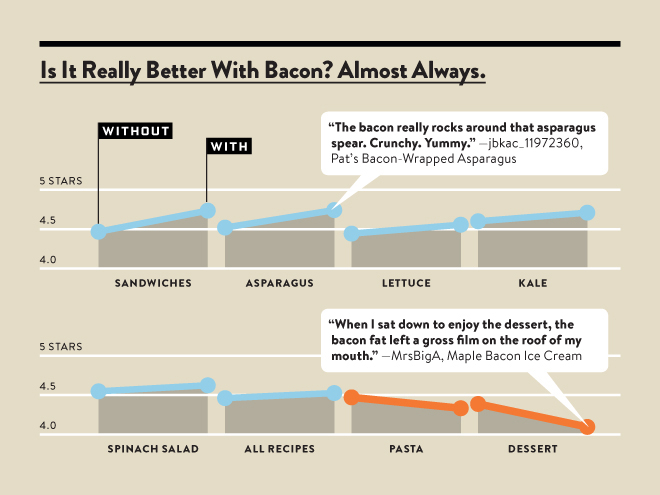
A: Wired magazine and the Food Network did a simple analysis of recipe ratings, comparing recipes for roughly the same thing with and without bacon (and a similar analysis for some other ingredients). For example, they compared sandwiches with bacon to sandwiches without bacon.

Q: And did bacon make everything better, like the headline says?

A: No.

Q: Ok, did it make nearly everything better?

A: No.

Q: Lots of things?

A: Yes. Though not necessarily by very much. Here’s the results. The biggest improvement is about 0.2 points on a 5-point scale.
bacon


Q: Are there actual numbers given somewhere, or results of other comparisons of ingredients?

A: No.

Q: These eight groups look a bit strange: kale vs all pasta dishes, for example. Did they look at other groups?

A: They might well have, but they aren’t telling.

Q: Do they explain why bacon is so good?

A: The Herald has an explanation (in fact, they have it twice, so it must be good). It’s the Maillard reaction

Q: Is that something that’s unique about bacon, which would explain why it’s different from other ingredients.

A: No. It’s in a huge range of foods.

Q: Is this sort of thing the future of data journalism?

A: Well, Wired says “Food is so personal and subjective that we’re always talking about it in vague and imprecise ways. But one of the many amazing things you can do with big-ish data is give precise questions to answers that always seemed so subjective.

Q: Is that as bogus as it sounds?

A: Yes. For example, this is a sample where the average kale dish is rated  more highly than the average dessert. Generalisable and objective food preference ratings are not what we’re looking at.

Q: Does this story, perhaps, come from the Daily Mail?

A: Why, yes. Complete with the misspelling of sriracha.
October 28, 2013

Some long reads

October 25, 2013

Briefly

October 23, 2013

ITM Cup Predictions for the ITM Cup Finals

Team Ratings for the ITM Cup Finals

Here are the team ratings prior to the ITM Cup Finals, along with the ratings at the start of the season. I have created a brief description of the method I use for predicting rugby games. Go to my Department home page to see this.

Here are the team ratings prior to this week’s games, along with the ratings at the start of the season.

Current Rating Rating at Season Start Difference
Canterbury 22.49 23.14 -0.70
Wellington 13.07 6.93 6.10
Auckland 7.57 9.02 -1.50
Tasman 5.25 -6.29 11.50
Counties Manukau 3.08 4.36 -1.30
Hawke’s Bay 0.85 -6.72 7.60
Waikato -0.32 5.25 -5.60
Otago -2.67 -4.44 1.80
Taranaki -3.53 3.92 -7.50
Bay of Plenty -5.56 -1.96 -3.60
Southland -8.61 -11.86 3.20
Northland -10.45 -8.26 -2.20
North Harbour -11.70 -7.43 -4.30
Manawatu -12.74 -8.97 -3.80


Performance So Far

There is a problem with the code I have been using for assessing performance, due to the unusual schedule in the ITM Cup, where some teams play more than one game in a week. I haven’t had time to alter the code so am omitting this section for the time being. Look at last week’s post to see how the predictions went. For the record, there were 3 games correct, out of 4 games played last week

Predictions for the ITM Cup Finals

Here are the predictions for the ITM Cup Finals. The prediction is my estimated expected points difference with a positive margin being a win to the home team, and a negative margin a win to the away team.

Game Date Winner Prediction
1 Tasman vs. Hawke’s Bay Oct 25 Tasman 8.90
2 Wellington vs. Canterbury Oct 26 Canterbury -4.90


Currie Cup Predictions for the Currie Cup Final

Team Ratings for the Currie Cup Final

Here are the team ratings prior to the Currie Cup Final, along with the ratings at the start of the season. I have created a brief description of the method I use for predicting rugby games. Go to my Department home page to see this.

Here are the team ratings prior to this week’s games, along with the ratings at the start of the season.

Current Rating Rating at Season Start Difference
Western Province 5.29 4.47 0.80
Sharks 4.03 3.24 0.80
Cheetahs 0.51 -2.74 3.30
Blue Bulls -0.35 0.59 -0.90
Lions -0.67 -1.22 0.50
Griquas -10.97 -6.48 -4.50


Performance So Far

So far there have been 32 matches played, 17 of which were correctly predicted, a success rate of 53.1%.

Here are the predictions for last week’s games.

Game Date Score Prediction Correct
1 Western Province vs. Lions Oct 19 33 – 16 12.70 TRUE
2 Sharks vs. Cheetahs Oct 19 33 – 22 11.00 TRUE


Predictions for the Currie Cup Final

Here are the predictions for the Currie Cup Final. The prediction is my estimated expected points difference with a positive margin being a win to the home team, and a negative margin a win to the away team.

Game Date Winner Prediction
1 Western Province vs. Sharks Oct 26 Western Province 8.80


October 22, 2013

Surprises in data

What’s wrong with this sentence? (source)

The people we meet on the other star system are humans who were collected from Earth a hundred thousand years ago, and hence are virtually identical with us.

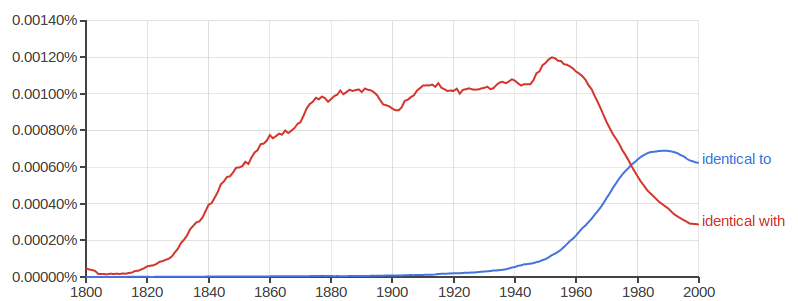
Many people would correct ‘identical with us’ to ‘identical to us’. Some people would argue that ‘identical with’ is not merely unconventional, but wrong for good reasons.

From Language Log, this is an example of linguistic change in process

identicalto_with


Until relatively recently, “identical with” was overwhelmingly the standard way to write. Now it isn’t. That’s not surprising. What’s surprising is that we mostly don’t notice the change, and often don’t notice how arbitrary these standards are.


October 20, 2013

Medical Research Ethics

There’s a new edition of the Declaration of Helsinki, the research ethics declaration of the World Medical Association (diffs from the previous version)

Some of the main changes

  • Clarification of the principles for research on vulnerable populations, such as developing countries: the question should be relevant to them so that the answer provides benefits to them, and there should be a fair level of other benefits.
  • Explicit recognition that risks need to be monitored during the research
  • Requiring some way for the treatment identified as best to be available to research participants after a trial
  • Adding research sponsors (eg, drug companies) to the list of those with explicit obligations to ensure publication of all results.

(via Alice Dreger and Janet Stemwedel)

October 19, 2013

Briefly

  • Nature, the well-known science journal, has a new ‘Nature Graphics‘ tumblr with art, infographics, and some actual graphics with information.
  • The Herald reports the WHO has listed outdoor air pollution as a leading cause of cancer. They don’t point out that air pollution is going down in most of New Zealand.
  • The Herald also has an interesting report of someone getting a deep-vein thrombosis after a long gaming session. Sitting still for long periods has been known to have this risk since WWII, when cases turned up in Britain in air-raid shelters, but the risk is small.  For long plane flights, the risk of death from a blood clot is about one in a million, but more than ten times that many will need hospital treatment.
October 17, 2013

Truly, madly, deeply

The Herald has a story on extra-marital affairs (no, not that one), headlined “Men with deep voices sexier, but more likely to cheat – study

Scientists found that men with masculine, low-pitched voices are better at attracting women – at least those looking for short-term flings.

But the baritone bad boys were also seen as more likely to cheat and not viewed as marriage material.

When you track down the actual research and look at the paper

Women selected lower-pitched men’s voices as more attractive for a short-term relationship (t86 = 6.74, p < .001; M = .70, SD = .279), as more attractive for a long-term relationship (t86 = 5.66, p < .001, M = .67, SD = .277), and as more likely to cheat on their romantic partner (t86 = 5.64, p < .001, M = .68, SD = .298), on a proportion of trials that was significantly greater than chance.

So, firstly, the headline is completely unsupported by the research: there is no information about actual propensity to cheat, just about what women thought about the men based solely on voice recordings.  Second, men with lower-pitched voices were also seen as more attractive, not less attractive, for a long term relationship.

What the research found that’s at least somewhat related to the story is that the advantage of deep voices was smaller in the context of long-term than short-term relationships. The problem is that this sort of difference of differences is quite sensitive to how you summarise your data — a switch from differences to ratios, for example, can easily cause it to reverse.

The story was originally from the Daily Mail. Sex, like cancer, is one of the topics where the Mail is especially untrustworthy

October 16, 2013

Briefly