August 16, 2013
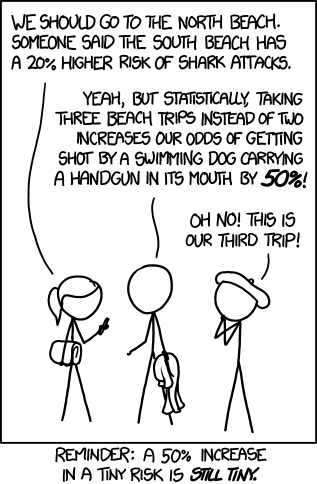
Absolute and relative risks
XKCD, reminding us of the difference
Dr Mark Apperley, from Uni of Waikato, with Phil O’Brien
“Big Data” isn’t just big, it’s unstructured.
(via Kate Hannah)
An NZ wine maker has produced wines with high levels of the chemical resveratrol. In Stuff’s story
“We can’t say that alcohol is healthy, but we can say resveratrol is,” co-director Kathleen Corsbie said.
Actually, the evidence for health benefits of lowish levels of alcohol consumption compared to none is much, much stronger than the evidence for any benefit of resveratrol, because resveratrol is almost unstudied in human disease.
Stuff’s story is well done, with useful background and expert commentary, eg,
The French, who eat fatty foods such as cheese and pate and also drink a lot of red wine, are the most commonly used example, Holt said.
“They have one of the lower rates of heart disease.”
But saying the wine will protect drinkers against cancer and other diseases is an exaggeration, Holt said.
It’s a respectable, though far from proven, hypothesis that resveratrol has some part in lower French rates of heart disease, but as he points out, that’s not true for cancer (the French actually don’t have low cancer rates compared to the rest of Europe, for example).
If you go to the Southern Wines website, you find more detail about their claim
The human body uses many complex biochemical pathways and reactions to function; but these reactions result in waste products such as free radicals (molecular compounds that contain an extra unpaired electron). These free radicals are the body’s terrorists and cause biological havoc which helps contribute to our degenerative ongoing diseases such as cancer, dementia, diabetes, vascular disease (heart attack and stroke), macular degeneration (most common cause of blindness in people over 65) and arthritis.
So, they are claiming a reduction in a large collection of aging-related diseases, based on anti-oxidant effects. In this context it’s useful to note that while there have been no large studies of resveratrol in humans, there have been large randomised trials of anti-oxidant vitamins (beta-carotene, vitamin C, vitamin E) that have, by and large, not found benefits. For cancer, they have sometimes even found harm, perhaps because free radicals are an important part of the immune system’s armory.
This is the sort of case that makes setting advertising standards tricky. There’s no question that resveratrol is an antioxidant. Presumably the manufacturer knows how much resveratrol is in their wine, though saying it’s “40 times higher” as they do is harder to defend given the more-than-20-fold range in resveratrol concentrations in regular red wines (PDF). There’s moderate evidence that resveratrol is good for lab animals. In humans, almost nothing is known directly — there’s slight evidence for reductions in some heart disease risk factors — but there’s strong evidence that some other antioxidants don’t have large benefits.
Southern Wines co-director is quoted as saying
“One glass of our Balancing Act wine is equivalent to consuming the resveratrol contained in around 40 glasses of normal wine, so why would you drink anything else?”
As with chocolate, the StatsChat advice would be that if you are drinking wine primarily for the health benefit, you’re doing it wrong.
Some South African readers have asked for Currie Cup predictions and since the methodology should work, I have decided to provide them. Interestingly, the home ground advantage in past games appears to be large, and the predictability of games has varied enormously. Last year’s competition was very hard to predict it seems.
Here are the team ratings prior to Round 1, along with the ratings at the start of the season. I have created a brief description of the method I use for predicting rugby games. Go to my Department home page to see this.
Here are the team ratings prior to this week’s games, along with the ratings at the start of the season.
| Current Rating | Rating at Season Start | Difference | |
|---|---|---|---|
| Western Province | 4.68 | 4.68 | -0.00 |
| Sharks | 3.30 | 3.30 | 0.00 |
| Blue Bulls | 0.87 | 0.87 | -0.00 |
| Lions | -1.52 | -1.52 | 0.00 |
| Cheetahs | -3.10 | -3.10 | 0.00 |
| Griquas | -6.38 | -6.38 | -0.00 |
Here are the predictions for Round 1. The prediction is my estimated expected points difference with a positive margin being a win to the home team, and a negative margin a win to the away team.
| Game | Date | Winner | Prediction | |
|---|---|---|---|---|
| 1 | Sharks vs. Griquas | Aug 09 | Sharks | 17.20 |
| 2 | Lions vs. Cheetahs | Aug 10 | Lions | 9.10 |
| 3 | Western Province vs. Blue Bulls | Aug 10 | Western Province | 11.30 |
Here are the team ratings prior to Round 22, along with the ratings at the start of the season. I have created a brief description of the method I use for predicting rugby games. Go to my Department home page to see this.
| Current Rating | Rating at Season Start | Difference | |
|---|---|---|---|
| Roosters | 14.34 | -5.68 | 20.00 |
| Sea Eagles | 9.83 | 4.78 | 5.10 |
| Storm | 8.37 | 9.73 | -1.40 |
| Rabbitohs | 7.50 | 5.23 | 2.30 |
| Bulldogs | 6.76 | 7.33 | -0.60 |
| Knights | 3.68 | 0.44 | 3.20 |
| Cowboys | -0.22 | 7.05 | -7.30 |
| Sharks | -0.62 | -1.78 | 1.20 |
| Warriors | -1.24 | -10.01 | 8.80 |
| Broncos | -3.26 | -1.55 | -1.70 |
| Titans | -3.35 | -1.85 | -1.50 |
| Panthers | -5.19 | -6.58 | 1.40 |
| Dragons | -6.06 | -0.33 | -5.70 |
| Raiders | -6.96 | 2.03 | -9.00 |
| Wests Tigers | -10.63 | -3.71 | -6.90 |
| Eels | -16.69 | -8.82 | -7.90 |
So far there have been 152 matches played, 92 of which were correctly predicted, a success rate of 60.53%.
Here are the predictions for last week’s games.
| Game | Date | Score | Prediction | Correct | |
|---|---|---|---|---|---|
| 1 | Panthers vs. Roosters | Aug 02 | 6 – 42 | -9.79 | TRUE |
| 2 | Knights vs. Broncos | Aug 02 | 18 – 18 | 14.30 | FALSE |
| 3 | Warriors vs. Sharks | Aug 03 | 14 – 18 | 5.85 | FALSE |
| 4 | Eels vs. Sea Eagles | Aug 03 | 6 – 40 | -19.03 | TRUE |
| 5 | Cowboys vs. Rabbitohs | Aug 03 | 30 – 12 | -8.52 | FALSE |
| 6 | Raiders vs. Storm | Aug 04 | 4 – 68 | 2.46 | FALSE |
| 7 | Titans vs. Wests Tigers | Aug 04 | 36 – 6 | 7.22 | TRUE |
| 8 | Dragons vs. Bulldogs | Aug 05 | 20 – 39 | -5.65 | TRUE |
Here are the predictions for Round 22. The prediction is my estimated expected points difference with a positive margin being a win to the home team, and a negative margin a win to the away team.
| Game | Date | Winner | Prediction | |
|---|---|---|---|---|
| 1 | Storm vs. Rabbitohs | Aug 09 | Storm | 5.40 |
| 2 | Eels vs. Wests Tigers | Aug 09 | Wests Tigers | -1.60 |
| 3 | Roosters vs. Raiders | Aug 10 | Roosters | 25.80 |
| 4 | Sharks vs. Knights | Aug 10 | Sharks | 0.20 |
| 5 | Sea Eagles vs. Warriors | Aug 11 | Sea Eagles | 15.60 |
| 6 | Broncos vs. Dragons | Aug 11 | Broncos | 7.30 |
| 7 | Panthers vs. Cowboys | Aug 11 | Cowboys | -0.50 |
| 8 | Bulldogs vs. Titans | Aug 12 | Bulldogs | 14.60 |
What are randomised trials and why are they important: one of a set of videos made for the 100th anniversary of the UK Medical Research Council
Also, a post about public randomisation ceremonies as a way of making the process transparent and obviously fair in trials where whole communities rather than individuals are randomised. In this case it was in Cameroon, but the PRISM trial of improved support for new mothers in Victoria, Australia used the same approach.
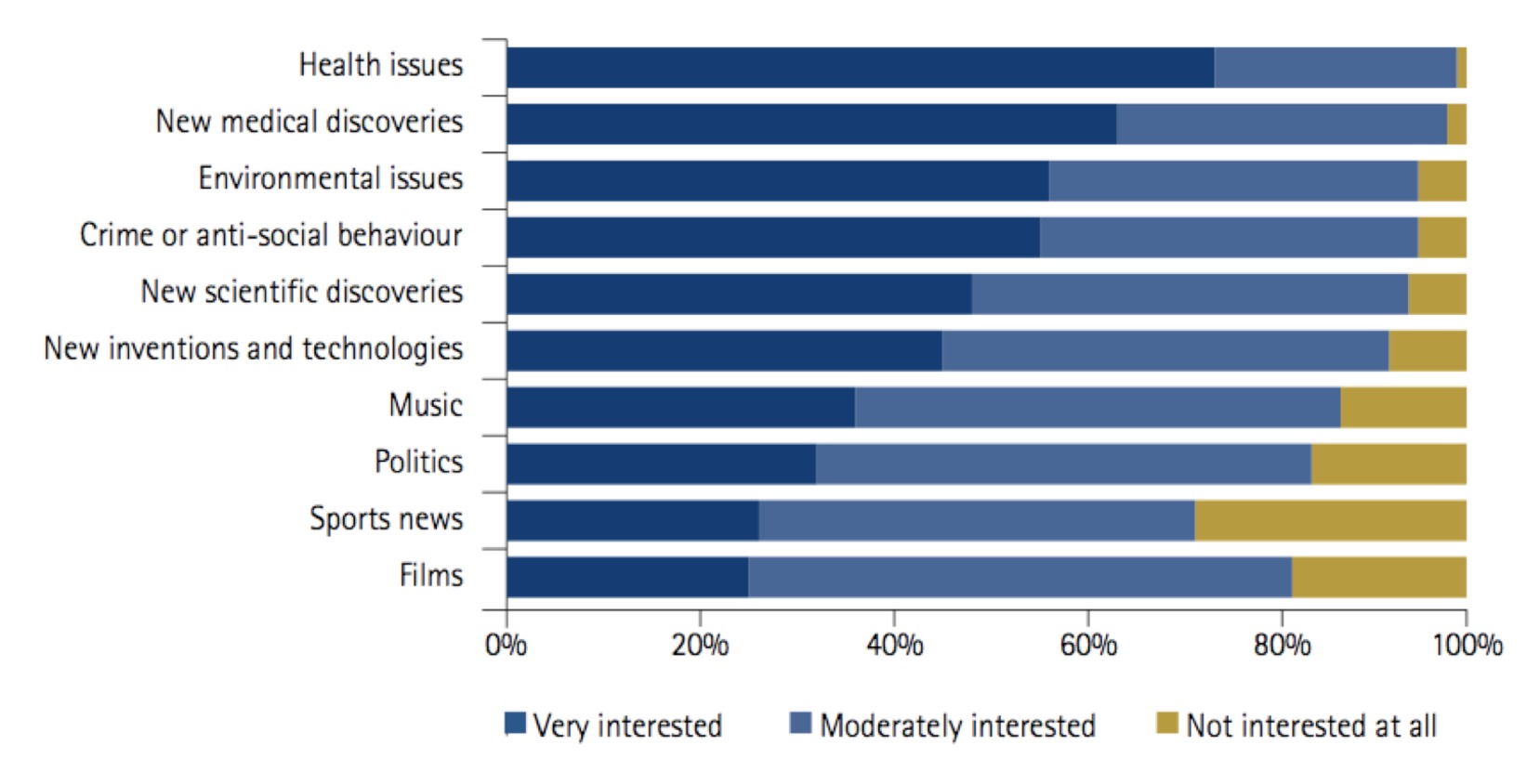
According to The Conversation, that’s the name of a group petitioning Queensland radio station Triple J to include at least 20 seconds of science news in their news updates. They’ve got support from one of the great science journalists, Robyn Williams, and from an ANU survey that found science news was regarded as more interesting than politics or sports news