Posts filed under General (3156)

July 22, 2013

CensusAtSchool on Radio New Zealand National this afternoon

A story about one of our Department’s projects, Census at School will air during Afternoons with Jim Mora on Radio New Zealand National (101FM) today, Monday 22 July at 3.30pm, and a slightly longer version again during Our Changing World on Thursday 25 July. Professor Chris Wild and Rachel Cunliffe are among those talked to.

July 20, 2013

Briefly

July 16, 2013

Briefly

July 5, 2013

How recommendation systems work: beer

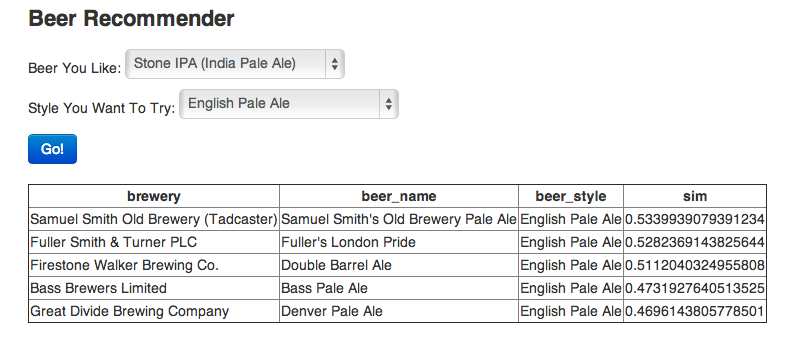
It’s nearly that time of the week, so here’s a post describing a simple beer recommendation system using 1.5 million ratings from BeerAdvocate.com and analysis in R

I don’t need a statistical model to tell me that someone who likes Fat Tire is probably going to like Dale’s Pale Ale more than Michelob Ultra. But what about picking between Dale’s Pale Ale and Sierra Nevada Pale Ale? Things get a little more complicated. For this reason (and because we don’t want to manually select between each beer pair), we’re going to write a distance function that will quantify similarity.

For our similarity metric we’re going to use a weighted average of the correlation of each metric. In other words, for each two-beer-pair we calculate the corelation of review_overallreview_aromareview_palate, and review_taste seperately. Then we take a weighted average each result to consolidate them into one number.

The resulting tool lets you put in a specific beer you like and then ask for recommendations in a category, eg,

beer

July 3, 2013

Briefly

On sports journalism

I’ve commented on several occasions that it would be great if science journalism was as good as sports journalism.  Here’s a more-detailed quote from Noam Chomsky on the same issue


When I’m driving, I sometimes turn on the radio and I find very often that what I’m listening to is a discussion of sports. These are telephone conversations. People call in and have long and intricate discussions, and it’s plain that quite a high degree of thought and analysis is going into that. People know a tremendous amount. They know all sorts of complicated details and enter into far-reaching discussion about whether the coach made the right decision yesterday and so on. These are ordinary people, not professionals, who are applying their intelligence and analytic skills in these areas and accumulating quite a lot of knowledge and, for all I know, understanding. On the other hand, when I hear people talk about, say, international affairs or domestic problems, it’s at a level of superficiality that’s beyond belief.

(via Chad Orzel, who thinks there’s a snappier version of this out there, but can’t find it)

June 27, 2013

Hand-washing study awash in misunderstanding …


The New York Times has reported on a study in which observers sat discreetly in bathrooms and observed whether people “properly” washed their hands (I reckon it would be quite hard to sit discreetly in a bathroom unless you’re in a cubicle). Anyway, the description of the study gave careful attention to the stats: 10.3% of women and over 15 percent of men didn’t wash at all. Of those who did wash, 22.8% did not use soap. And only 5.8% washed for more than 15 seconds.

The lead author said, “Forty-eight million people a year get sick from contaminated food, and the (American) Centre for Communicable Diseases says 50% would not have gotten sick if people had washed their hands properly. Do as your mum said: Wash your hands.”

Surely there’s some basic confusion over percentages here: 50% of those who got sick wouldn’t have if everyone had washed their hands properly, but we have no idea what percentage of those who don’t wash actually get sick.

As a matter of fact, there is no indication that these particular non-handwashers have anything to do at all with the fact that people eat contaminated food. Does it matter what bathroom activity was being carried out? Whether you use toilet paper or your foot to flush? Whether you work in food services? Whether you subsequently wash your hands before eating dinner?

Though mum may have had good advice, this sort of scare-mongering about food-borne illnesses resulting from not washing one’s hands may actually distract us from the real concerns over germs.

  • Read the full analysis by Rebecca Goldin, here. She is Director of Research for STATS, an American non-profit, non-partisan service that  helps journalists think quantitatively through providing education, workshops and direct assistance with data analysis.
June 26, 2013

Stem cell bait-and-switch

From Stuff

“I’ll never forget the woman whose knee was injected with stem cells to repair it, and came back two months later saying her skin on her face was smoother and more elastic. We hadn’t touched her face,” he says.

What makes the quote interesting is that it’s being advanced as evidence for, not against, the benefits of stem cells.

Injected stem-cells at least have the potential to work, though the story doesn’t mention any actual controlled trials or anything.  What’s less plausible is the idea that rubbing messenger proteins (cytokines) from stem cells on your skin will have any effect. Despite the best efforts of small children, rubbing stuff on your skin doesn’t usually have the same effects as eating it or injecting it. Skin is there for a reason, and it’s quite good at keeping stuff out of your body, especially huge, fragile molecules like cytokines.

If new skin-care technologies really provided a benefit over ordinary moisturisers, it wouldn’t be hard to collect convincing evidence, as has been done for retinoid creams to treat acne, and chemical skin peels for various skin problems. Unfortunately, the new NZ law on unsupported health claims is just for foods and doesn’t apply to things you rub on your skin.

June 24, 2013

Small irk of the day

While watching Discovery Channel’s coverage of Nik Wallenda’s nerve-wracking high-wire walk across the Little Colorado Gorge Grand Canyon*, it was somewhat bothersome to hear the commentators repeatedly say that there was “no room for margin of error”.

I wonder if there’s any other statistical phrase that is used in other contexts so often?

June 20, 2013

Does success in education rely on having certain genes?

If you have read media stories recently that say ‘yes’, you’d better read this article from the Genetic Literacy Project …