Posts filed under General (3156)

June 2, 2013

Making data meaningful

A guide from the UN Economic Commission for Europe

  1. A guide to writing stories about numbers
  2. A guide to presenting statistics
  3. A guide to communicating with the media

And for local examples, check the @StatisticsNZ Twitter feed


[update: link fixed]

June 1, 2013

Briefly

Science communication fightback edition

  • “Archaeologists Officially Declare Collective Sigh over Paleo Diet” –FRANKFURT- In a rare display of professional consensus, an international consortium of anthropologists, archaeologists, and molecular biologists have formally released an exasperated sigh over the popularity of the so-called “Paleo Diet” during a two-day conference dedicated to the topic.
  •  Technocrats and Big Data:  It was especially interesting to see how this second guy reacted when the single somewhat thoughtful and informed Congressman, whose name I didn’t catch because he came in and left quickly and his name tag was miniscule, asked him about whether or not he taught his students to be skeptical. The guy was like, I teach my students to be ready to deal with big data just like their employers want. The congressman was like, no that’s not what I asked, I asked whether they can be skeptical of perceived signals versus noise, whether they can avoid making huge costly mistakes with big data. The guy was like, I teach my students to deal with big data.
  • Artist Creates Portraits from DNA. Scientists say “That’s Impossible”. But though our genetic privacy may not be safe, our faces probably are.  Dewey-Hagborg’s portraits may rarely resemble the people whose DNA she’s using to generate them. The whole thing — most disturbingly the fact that she’s been contacted by law enforcement officials — shows how ill-prepared we are for dealing not only with what biotech may do in the future, but for what biotech can do now. She needs to work at making her message clearer. 
May 29, 2013

More on communicating with journalists

Two physicists (and long-time bloggers) responding to Ed Yong’s post on how to talk to journalists:

Chad Orzel

As a physicist, I’m fond of simple universal principles from which all other results are derived. When a journalist is interviewing a scientist for a story, I think the important underlying idea is that each is doing the other a favor. A quote from a prominent scientist will make a story better, but it’s not an absolute requirement, and there’s certainly no obligation to deal with any particular scientist. Being quoted in a media report about some new discovery incrementally raises a scientist’s profile, but the only concrete benefit is providing a clipping that your parents might read.

..

The temptation for each party in this situation is to try to push as much of the work to the other as possible, and that’s where most advice from journalists to scientists (or vice versa) fails. Each side treats the conventions of their particular profession as immutable laws of nature that the other must adjust to accommodate. Even when offered with the best of intentions, as with Ed Yong’s post last week, the advice ends up sounding one-sided: “Here’s what you need to do to work with me.”

Tim Swanson:

There’s a reason you should take some of the advice in Ed Yong’s post with a grain of salt (as I’ve come to realize over several years of hearing or reading advice from Ed): because it comes from Ed Yong. Now, let me explain — this isn’t a dig at Ed. Quite the opposite. He’s an excellent science journalist, and the tips he gives other science journalists about journalism is quite good. But this is a different subject, and given that there are a lot of journalists out there, you probably aren’t going to be asked for commentary from Ed Yong.


May 21, 2013

Legal highs: testing and voting

The SPCA and similar groups have put together a petition asking for a ban on testing `legal highs’ on animals. The petition shows that at least 2% of New Zealand voters support the ban, which doesn’t sound terribly impressive.  The problem is that petition-gathering is hard, so it’s not really useful unless either you get to the referendum threshold or it’s an issue that the Government wasn’t really aware had significant public feeling.  The petition opposing marriage equality (signed by nearly 2.5% of voters) had the same problem.

We’re going to get more basically uninformative numbers purporting to show public opinion from The Vote tomorrow.  Judging from the first episode and the line-up, it will be worth watching for the arguments presented, and to see whether they affect the studio audience.   The actual `vote’, on the other hand, really isn’t helpful — there’s no way that it can be interpreted even approximately as a summary of public opinion.

Even though the petition isn’t going anywhere, the issue of animal testing is worth thinking about.  The official position that a ban on animal testing is outside the scope of the bill is actually more reasonable than it sounds.  All the bill says about testing is in Section 35

35 Grounds for approving product
The Authority may approve a psychoactive product as an approved product only if the Authority is satisfied that—
(a)the application relating to the product—
     (i)complies with the requirements of section 31; and

     (ii)does not contain any materially false or misleading information; and

(b)the degree of harm that the product poses to individuals using the product is no more than a low risk of harm.

The Authority is largely on its own when it comes to policies and guidelines on how to establish the “low risk of harm”, and even on what that term means (to the extent that it isn’t implied by other law).  Presumably the government will have input, and that would be a better place to get testing standards set.

If there happens to be pre-existing data from animal tests I can’t see any real justification for excluding it, but whether new testing on animals should be required, permitted, or forbidden is more complicated.  It is absolutely necessary to test on whole mammals of some sort — I can’t imagine any regulatory committee, especially one with pharmacology and toxicology expertise, approving as ‘low risk’ a compound that had only been tested in test-tubes.  If that worked, there’d be a whole lot less failed clinical trials.  The question basically comes down to this: dogs or people?

There is actually a respectable ethical argument that testing in humans, who can volunteer, is better than testing in animals, who can’t.  Most people don’t actually behave as if they believe this argument, but some do. Even in that case, the disadvantage of testing in people is that you have to use more of them, because you aim to leave them in better condition afterwards and so have to use lower doses and cruder measurements of effect.  You might have to use, say, 20 backpackers to replace six dogs.

Personally, I think a better approach would be to decriminalize cannabis and MDMA, to cut out the market for the new smokes and party pills.  The traditional soft drugs aren’t harmless by any means, but they seem to be a whole lot less dangerous than the new substitutes.  If that option is ruled out, the proposed legal highs legislation is safer than the current policy of requiring dealers to churn through new formulations every few months, exposing people to more and more untested biologically-active chemicals. It does need some form of testing. Pick your species.
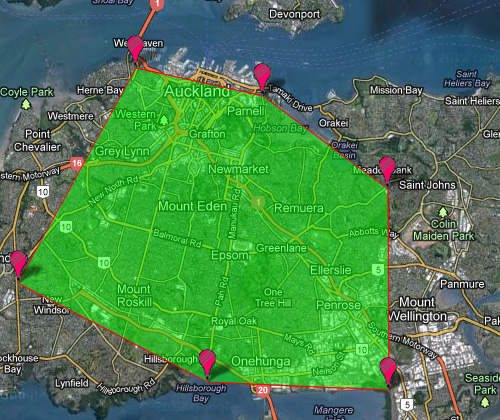

How big an area was damaged by the Oklahoma tornado?

One of the first things I want to understand when there’s a natural disaster is the scale of it. Since I don’t deal with square miles or square kilometres each day, I find it hard to comprehend what an estimate of 60 square miles of damage means.

So, I used this tool to overlay 60 square miles on a map of Auckland:

tornado-size

Of course, the accuracy of such an estimate remains to be seen, or indeed what the level of damage is within that area, but this helps me grasp a sense of the scale of this tornado’s damage.

May 16, 2013

Whichever way you look it – “Is that an Android, I mean Samsung you’re holding there?”

A report by research firm Strategy Analytics has estimated that Korean electronics giant Samsung took a whopping 94.7% share of the $US5.3 billion first quarter operating profits for Android handset sales. Whichever way you look at it, currently Samsung is the Android platform of choice.
Samsung Market Share
The Register notes that the same report notes that Android has 43% of the smartphone market share.

Briefly


  • Via @felixsalmon, bad graphics moving into baseball

baseball

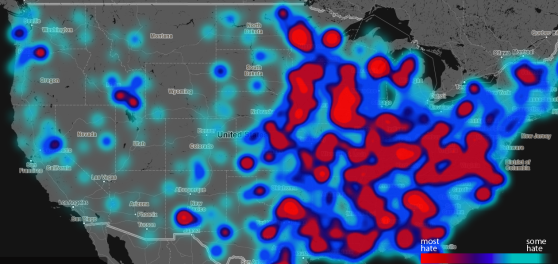
  • Twitter Hate Map aims to show where racist or homophobic tweets occur.  It tries to correct for the usual denominator problem, but there just aren’t enough tweets from some parts of the country

hatemap

  • Early this morning, the moderately accurate pageview counter on WordPress ticked over to quarter of a million page views on StatsChat.  It’s only a small milestone — someone like Ben Goldacre gets more hits than that every time he tweets — but at least we’re world famous in New Zealand. Web metrics site Alexa.com estimates that 0.000066% of internet users have seen StatsChat!
May 12, 2013

Briefly

A simple exercise with numbers

Stuff has a headline Shoplifters cost $1b as staff theft soars“.  Let’s think about what we would need to know to interpret this number, and what we actually get told.

First, we note that nowhere in the story is there any evidence or informed opinion presented that staff theft has increased, just that it is high.  Also,  the $1 billion figure is fairly weak — the Retailers Association of New Zealand estimates $2 million per day, which is rounded up to $750 million per year, and then to ‘up to $1 billion’.

We don’t get told how this number is estimated: is it actual reports of theft, or imbalances between stock bought and stock sold, or just a impression from the retailers? Is it based on a representative survey, on informed opinion, or on some sort of bogus poll?  Is the cost based on actual wholesale costs paid by the retailer or is it inflated to include the anticipated retail price if the stuff had been sold? Does it include all retailers, or just members of the Retailers Association of New Zealand? Don’t wholesalers also have this problem?  We might hope that the Retailers Association website had some more details, but its press release and media log pages only go up to May 1.

If we were to stipulate the number for the purposes of analysis, does it sound plausible?  Unfortunately, as part of Statistics New Zealand’s ongoing endeavour to deliver a better web experience they are doing maintenance on their servers today, so the quality of my sources may not be up to standard. Still, the University of Auckland career planning site says that retail employs about 265 000 people in NZ.  If half the theft is by staff, that’s about $1900 average per year — and if, say, as many as 75% of them are honest, that would be about $7500 for the others, which seems a bit high.

The other half of the billion dollars, attributed to shoplifting rather than staff theft, would be an average of  $2000/year if spread over  5% of the population, which also seems a bit high.  Maybe I’m just naive and innocent about this, but the worst incident quoted in the story was $20000 by four people; $5000 each, and the next worst was $1100 dollars —  you’d think there would be better examples.

The same University of Auckland page says gross revenue in retail is $65 billion/year, so $1billion would be 1.5% of that. The Retail Association has a report (p15) saying that net margins are about 2-3% averaged over the industry, so if the $1 billion were real costs, it would mean the industry is losing more than a third of its profits to theft. You’d think that would be the headline, if it were true.

May 10, 2013

The Art of Data Visualisation

The information content in this video (7m38s) from PBS’ Off Book series is on the low side but its still an interesting watch, if only for a large collection of graphic designers’ appealing but appalling infographics.