February 12, 2013

Sneak peek at questions for CensusAtSchool 2013

Registrations have now opened for primary and high school teachers to sign up to have their classes take part in this year’s CensusAtSchool which runs from May 6 – June 15.

Tens of thousands of school children will be taking part once again, and here’s a sneak peek of some of the new questions they’ll be answering:

Which of the following food allergies* do you have? (You may tick more than one.)

  • cow’s milk (dairy)
  • eggs
  • peanuts
  • tree nuts (e.g. cashews, almonds, Brazil nuts)
  • fish or shellfish
  • soy
  • wheat
  • Other. Please state:
  • none

About how long did you spend on your homework last night? (If you did not do any last night, type 0.)

Who is your favorite singer or band? (If you do not have one, type “Don’t have one”)

This year on 5 March, we all filled in a Census of Population and Dwellings form. Have a guess at what New Zealand’s population was on that date:

Preliminary results will be available from May 9.

Learn more about the educational project CensusAtSchool »

* Interestingly, New Zealand has no prevalence data on food allergies.

February 11, 2013

Petrol-price data

Stuff reports on rising petrol prices:

All three retailers said refined fuel costs had been steadily rising since the beginning of the year and those costs were now being passed onto customers.

Wouldn’t it be nice if you could get data on this, rather than just believing the petrol companies? Well, you can

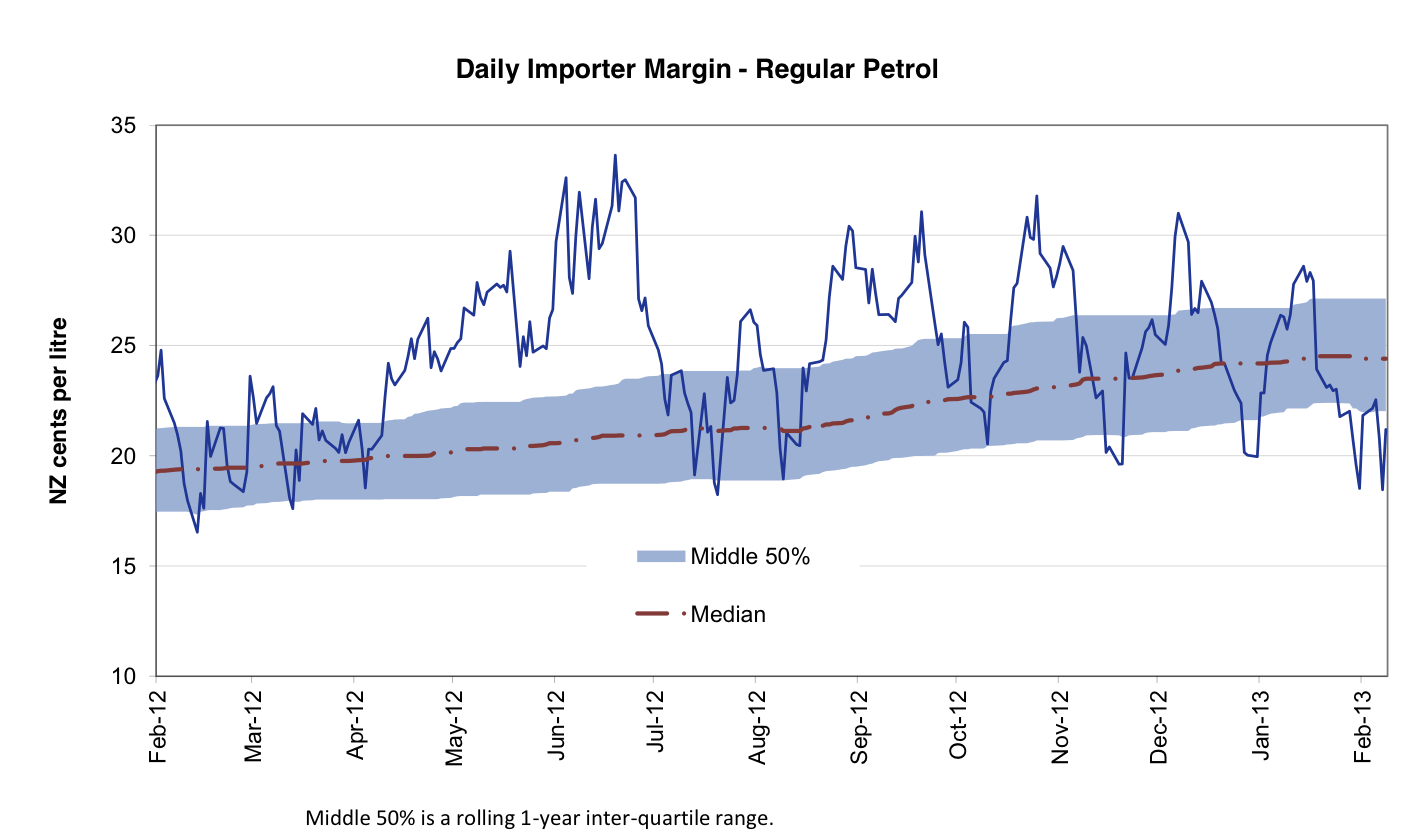
The Ministry of Economic Development carries out weekly monitoring of “importer margins” for regular petrol and automotive diesel.  The weekly oil prices monitoring report is reissued every Tuesday with the previous week’s data.

The purpose of this monitoring is to promote transparency in retail petrol and diesel pricing and is a key recommendation from the New Zealand Petrol Review

And if you look at the current graphs, the ‘importer margin’ has been declining since the start of the year, implying increasing pressure on retailers.  On the other hand, the importer margin is about the same as it was this time last year, and as the median from the year before that, so the ‘increasing’ pressure on retailers is partly just business returning to normal.


They also have the underlying data to download.

Real-estate stories: a comparison

Both the Herald and Stuff have stories based on the latest release from Quotable Value. The stories are pretty similar, though the Herald has speculation about the impact on the Reserve Bank rate setting.

Good points:

  • The Herald links to the original media release
  • Stuff points out that prices are still not above the 2007 peak when inflation is taken into account. This isn’t in the media release, but it’s not rocket science and it’s good to see reporters doing it.


February 10, 2013

Two of these things belong together

From an op-ed column in the New York Times, describing three countries

But there is one thing all three have in common: gigantic youth bulges under the age of 30, increasingly connected by technology but very unevenly educated.

If I tell you two of these countries are Egypt and India, can you guess the third?  Anyone? Anyone? Bueller?

It might take a while: in the real world, the third country Friedman includes is better known for instituting draconian (but successful) population-growth controls thirty years ago.

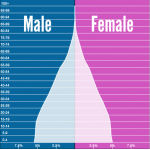
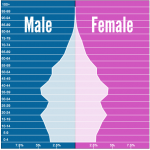
Here are the population age distributions for Egypt, India, and somewhere else, from populationpyramid.net.

egyptindiachina


(via)

Is cherry-picking season finally over?

Ben Goldacre writes in the New York Times about the need for all clinical trials to be published

The Food and Drug Administration Amendments Act of 2007 is the most widely cited fix. It required that new clinical trials conducted in the United States post summaries of their results at clinicaltrials.gov within a year of completion, or face a fine of $10,000 a day. But in 2012, the British Medical Journal published the first open audit of the process, which found that four out of five trials covered by the legislation had ignored the reporting requirements. Amazingly, no fine has yet been levied.

An earlier fake fix dates from 2005, when the International Committee of Medical Journal Editors made an announcement: their members would never again publish any clinical trial unless its existence had been declared on a publicly accessible registry before the trial began. The reasoning was simple: if everyone registered their trials at the beginning, we could easily spot which results were withheld; and since everyone wants to publish in prominent academic journals, these editors had the perfect carrot. Once again, everyone assumed the problem had been fixed.

But four years later we discovered, in a paper from The Journal of the American Medical Association, that the editors had broken their promise: more than half of all trials published in leading journals still weren’t properly registered, and a quarter weren’t registered at all.

There’s a new campaign and petition at Alltrials.net, and if you’re in Auckland, you can hear Ben Goldacre in May at the Auckland Readers and Writers Festival

Netflix owns your brains

Netflix has commissioned an American remake of the brilliant UK television series House of Cards. That’s not especially relevant to StatsChat, but apparently they did it with Big Data and Data Science, so it must be right.

Andrew Leonard at Salon bemoans how this is turning us into puppets

Netflix’s data indicated that the same subscribers who loved the original BBC production also gobbled down movies starring Kevin Spacey or directed by David Fincher. Therefore, concluded Netflix executives, a remake of the BBC drama with Spacey and Fincher attached was a no-brainer, to the point that the company committed $100 million for two 13-episode seasons.

“We know what people watch on Netflix and we’re able with a high degree of confidence to understand how big a likely audience is for a given show based on people’s viewing habits,” Netflix communications director Jonathan Friedland told Wired in November. “We want to continue to have something for everybody. But as time goes on, we get better at selecting what that something for everybody is that gets high engagement.”

The strategy has advantages that go beyond the assumption of built-in popularity. Netflix also believes it can save big on marketing costs because Netflix’s recommendation engine will do all the heavy lifting. Already, Netflix claims that 75 percent of its subscribers are influenced by what Netflix suggests to subscribers that they will like.

Felix Salmon (who is generally a believer in data) is not impressed


It should go without saying, of course, that dropping $100 million on a 26-episode remake of a great TV show is never a no-brainer. For one thing, for all that the original series is extremely good, it was also very timely, coming as it did at the end of Margaret Thatcher’s transformation of the Prime Minister’s office into something much more powerful and Presidential than the UK had ever seen. The BBC series tapped into Britain’s fear of the possible implications of that power, as well as the fact that Richard III and Macbeth are deeply rooted in the national psyche.

More generally, remakes are inherently dangerous things: what producers think of as a “proven formula” more often turns out to have been a unique and inimitable confluence of creative electricity. And it goes without saying that the better the original was, the less likely it is that the remake will surpass it.

Note that $100 million for 26 episodes is about 30% more than ‘Glee‘ costs, which in turn is about 50% more than the average prime-time drama.  Will this be an investment no-brainer in the same sense as Florida real-estate? You might very well think so. I couldn’t possibly comment.
February 6, 2013

The checklist: a worked example

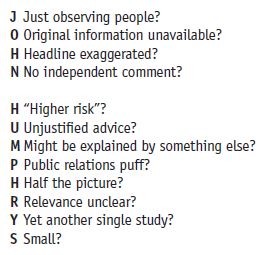
The Herald has a story about increased stroke risk in young adults using cannabis.  Let’s run it past the JOHN HUMPHRYS checklist:

  • Just observing people:  X
  • Original information unavailable:  ?. The abstract should be available, but I can’t find it on the conference website — it will probably be out soon.  It looks as if this story may have leaked early.
  • Headline exaggerated:  The headline is fine.
  • No independent comment: X.
  • Higher risk: X.  Absolute risks are not given, and are extremely low in “young adults”
  • Unjustified advice:? The advice that cannabis smoking is probably bad for your health is justified, but not by this study.
  • Might be explained by something else: X.  Tobacco, for example, which is mentioned in the story but dismissed without justification.
  • Public relations puff: no real problem here.
  • Half the picture: this one’s ok, though the publication bias issue could have been mentioned — this is the first study to find a link, but was it the first to look for one?
  • Relevance unclear: this isn’t a problem
  • Yet another single study: X
  • Small: X only 160 strokes, only 12 or 13 in cannabis users.

It’s not that all stories should pass all checks on the list — sometimes small observational studies can be important or at least interesting.  The problem (as with the Bechdel test) is that such a small fraction of stories pass the checks.


[Update: forgot the link originally]

February 5, 2013

A quick tongue-in-cheek checklist for assessing usefulness of media stories on risk

Do you shout at the morning radio when a story about a medical “risk” is distorted, exaggerated, mangled out of all recognition? You are not alone. Kevin McConway and David Spiegelhalter, writing in Significance, a quarterly magazine published by the Royal Statistical Society, have come up with a checklist for scoring media stories about medical risks. Their mnemonic checklist comprises 12 items and is called the ‘John Humphrys’ scale, said Mr Humphrys being a well-known UK radio and television presenter.

Capture

They assign one point for every ‘yes’ and do a test on a story about magnetic fields and asthma, and another about TV and length of life. The article, called Score and Ignore: A radio listener’s guide to ignoring health stories, is here.

Could form the basis of a useful classroom resource.

February 3, 2013

What do Kiwis die of?

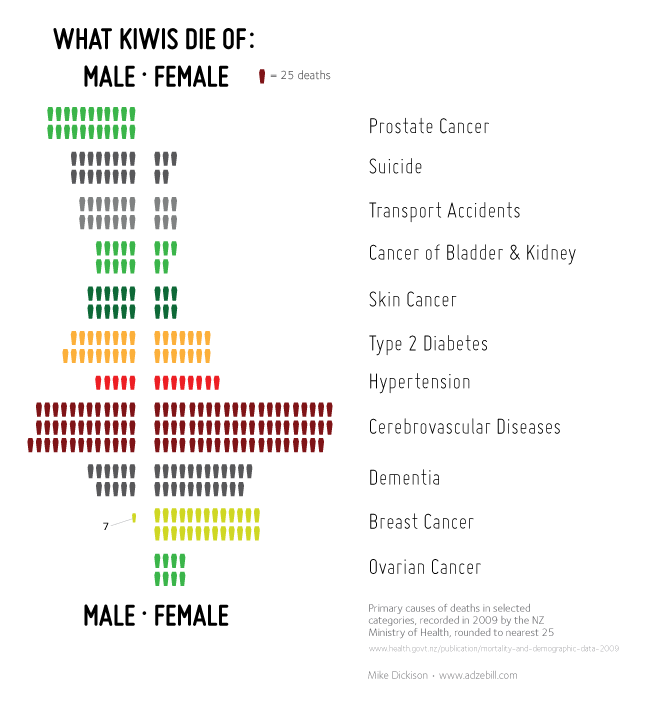
University of Auckland research scientist Dr Siouxsie Wiles (she’s the one who makes bacteria glow in the dark) has teamed up with data visualisation expert Mike Dickison to create a series of infographics looking at the morbidly fascinating topic of what New Zealanders die from.

Here’s one (click to enlarge). See the whole post on Siouxsie’s blog Infectious Thoughts  here.

battle-of-the-sexes-infographic1

January 30, 2013

How stats made Auckland City Hospital’s heart unit more efficient: Radio New Zealand

When Auckland City Hospital was experiencing a cardiac-surgery cancellation rate approaching 30%,  staff decided to ask a statistician for help.  The University of Auckland’s Ilze Ziedins is an expert in queuing theory and probability who often works in areas such as telecommunications and traffic; she jumped at the chance to collaborate on a problem that involved people.

Ilze and two of her graduate students, William Chen and Kim Frew, set out to develop a mathematical model of the Cardiavascular Intensive Care Unit using R, a statistical environment and programming language initially developed at The University of Auckland by Ross Ihaka and Robert Gentleman.

The model used real-life data to investigate different staffing and resourcing scenarios, and as a result was able to confirm what hospital staff had suspected – that the Cardiac Intensive Care Unit was the bottleneck creating problems. The model was also able to suggest an optimal staffing regime that took into account the irregular arrival of people in the unit, either from the operating theatre or as the result of an emergency. As a result, ICU director Andrew Kee and other team members were able to allocate more staff and reduce the cancellation rate to about 10%.

Alison Ballance, of Radio New Zealand show Our Changing World,  went to Auckland City Hospital to meet Ilze Ziedins and Cardiovascular Services Manager Pam Freeman. Listen to the 13-minute interview here.