Posts filed under General (3156)

March 5, 2013

NZ language maps

There’s a new information paper from the Royal Society of New Zealand, on languages. We have 160 of them, which is a lot, but the paper says we could do with more coherent policy about them.

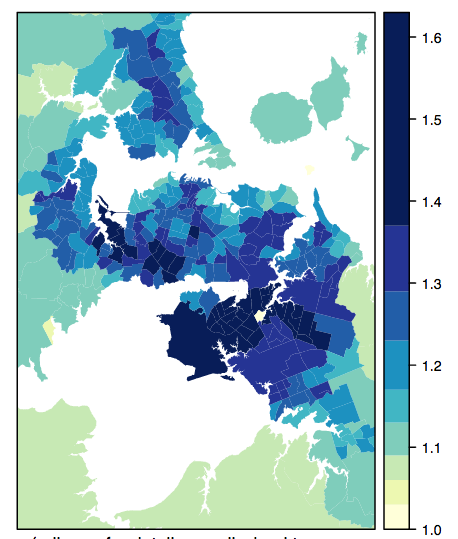
It’s accompanied by some neat interactive maps, produced by Paul Behrens and Jason Gush from the Royal Society and Paul Murrell from our department. The map of average number of languages per person across the country is visually dominated by the largely-rural areas where te reo Maori is widely spoken

Multilingualism1


but if you zoom in to Auckland, the detail gets dramatically more complicated.  I speak 0.286 fewer languages than average for my neighbourhood.

aucklang


There are also national maps for  NZ Sign, Samoan, and all other languages combined.


Statistics used for decoration

The story on Stuff starts

Wellingtonians are an inventive bunch, with many in the capital applying to patent ideas they could create income from.

You might expect this would be backed up by data on high or increasing patent submissions from Wellington, but no:

In the year to July 2012, the Intellectual Property Office of New Zealand received 6253 patent applications, compared with 6163 a year earlier.

Last year, 124 were filed from the Wellington region and only 27 were accepted.

That is, the number of patent applications is roughly constant, and Wellington is under-represented in terms of population (and I would have though in terms of number of head offices as well).

The numbers don’t actually add anything to the story, they’re like the little paper umbrellas in a cocktail, intended for decoration rather than consumption.

March 4, 2013

Briefly

March 3, 2013

Shooting yourself in the foot

The US has just imposed a set of spending cuts that was deliberately designed to be so stupid and destructive that even getting the wrong side of a compromise would be more attractive to both parties.

Among the major victims are scientists and their technical staff. Here’s some of what they have written about it

[update: the #sciquestertips tag on Twitter has black humour about the situation]

Statistics and journalists

The (US) National Institute for Computer-Assisted Reporting is having its annual conference.  This is a project of Investigative Reporters & Editors, whose statistics interventions for journalists range from a set of statistical tipsheets to having Hadley Wickham teach R to the nerdier ones. Unfortunately, it’s harder to fund this sort of thing in a small country.

Liz Lucas, one of the participants in a recent ‘statistics boot camp’ wrote about why journalists should learn statistics

When confronted with this statistical reality, what did the state officials say? In effect, “leave the statistical analysis to the government, OK?”

Now, if that doesn’t make you want to run for the nearest copy of “Statistics for Dummies”, I don’t know what will.


Homeopathy: there’s nothing to it

From yesterday’s Herald:

Government agencies are assessing the legality of a diet that promises people they will lose up to half a kilogram a day by using a homeopathic fertility hormone banned in the United States.

The diet, which is gaining popularity in New Zealand, involves taking a substance known as hCG and restricting food to 500 calories a day for up to 40 days.

If it’s homeopathic, it doesn’t involve taking hCG. That’s kind of the point of homeopathy.  Either way, if the diet involves losing half a kilogram a day, that’s water, not fat.  Losing half a kilogram of fat means cutting cumulative energy intake by 4500 Calories, and you’re not doing that in a day.

If it’s homeopathic, then the product itself is presumably safe, but the diet probably isn’t, and the quoted statements by the distributor seem to pretty clearly violate NZ Advertising Standards, as does the web site.

Update: if the drops are homeopathic, they won’t be doing anything, but would real hCG help with weight loss?  The place to look for evidence is the Cochrane Library (which is free-access in NZ). There is a systematic review of 14 randomised trials of hCG.  In summary

Twelve of the RCTs reported that weight‐loss with the use of hCG was no greater than with the use of a placebo or with the use of diet alone.

All of the 8 trials reporting fat distribution as an outcome had negative results.

Ten trials reported on hunger and 8 on a feeling of well‐being, only one trial in each case having a positive result.

So, this is a homeopathic version of a treatment that has been demonstrated ineffective, coupled with a dangerous diet.

March 1, 2013

It’s all happening…

Next Tuesday, March 5, is Nerdnite Auckland again, at Nectar, above the Kingslander pub on New North Rd

  • Tim McNamara, who coordinates digital volunteer response in emergencies talking about privacy. “Privacy: It’s worse than you think”.
  • Biomedical engineer Michelle Dickinson, on nanotechnology
  • Richard Easther, a cosmologist from the physics department at Auckland University will be giving us a biographical talk about Beatrice Tinsley

and when you get home, you can fill out your Census form.

February 25, 2013

Economic data mining needs theory

Via the new Observational Epidemiology blog, it is possible to talk about stochastic complexity in reasonably plain English


February 23, 2013

Buy low, sell high?

From the Herald

Expectations of house price inflation continue to climb in ASB’s latest quarterly survey and are close to their all-time high 10 years ago.

The same seller’s market is reflected in a drop in the net balance of people who consider it a good time to buy a house

That doesn’t make sense to me.  If people expect house prices to keep rising, ie, that houses now are cheaper than in the future, they should want to buy.  Is the market confused, or is it the Herald (or, of course, me)?

February 19, 2013

International cooperation

Ben Goldacre mentions the current UK discussion over whether Members of Parliament go to prison at a higher rate than people in general.  He points out that age, gender, and social class distributions are different for MPs, and suggests someone does an adjustment.

Here’s a preliminary attempt. Firstly, note that the data (and the claims) have been about prevalence rather than incidence — MPs as a fraction of the UK prison population, not as a fraction of sentences.  I got prison population data from a Parliament briefing paper, and MPs in prison data from Channel 4’s Factcheck

  • I don’t have detailed age data for MPs, though it could certainly be determined, but at least we can restrict from the whole British population to adults (51 million)
  • The UK adult population is very close to 50:50 on gender, 502/648 MPs are male, 63318 out of 66818 (adult) prisoners

So, 0.79% of male MPs were in prison, compared to 0.24% of adult males in the UK. No female MPs, compared to 0.01% for the female population. Gender-standardised, that’s a relative rate of 3.0

The other important variable is social class.  The briefing paper on the prison population says that `almost three-quarters’ of prisoners were on benefits immediately before entry, and Factcheck says 5.5 million people in Britain are on benefits (and presumably MPs aren’t). I don’t have data on how this varies by gender, either for prisoners or for the population, so I’ll do it separately from the gender standardisation

We have 0.61% of MPs (not on benefits) in prison, and one-quarter of 68818 prisoners out of (51 million – 5.5 million) people not on benefits in prison, which comes to 0.037%, for a relative rate of 16.

So, among adults not on benefits, (people who would otherwise be) MPs are 16 times more likely to be in prison.